
Custom Blockchain Development Services: Building Scalable Web3 Solutions for Businesses
The global business landscape is undergoing a significant digital transformation, driven by the need for greater transparency, security, and efficiency. Among the emerging technologies shaping this transformation, blockchain stands out as one of the most impactful innovations. From financial services to supply chain management, healthcare, and beyond, blockchain is redefining how organizations manage data and transactions.
However, while blockchain adoption is growing, many businesses quickly realize that off-the-shelf solutions often fail to meet their specific operational needs. Generic platforms may lack the flexibility, scalability, or integration capabilities required for real-world business environments. This is where custom blockchain development becomes essential.
Customized services enable organizations to design and build solutions tailored to their exact requirements. Whether it’s creating a secure decentralized platform, automating workflows through smart contracts, or enabling real-time data sharing across stakeholders, custom solutions offer unmatched adaptability.
For startups, this approach allows innovation without limitations, enabling them to build unique Web3 products from the ground up. For enterprises, it offers a pathway to modernize legacy systems and create scalable, future-ready digital infrastructure.
In this comprehensive guide, we explore everything businesses and startups need to know about tailored blockchain services, including solution types, technologies, methodologies, and the long-term benefits of adopting enterprise-grade blockchain solutions.
What Are Custom Blockchain Development Services?
Custom blockchain development services refer to the end-to-end process of designing, developing, and deploying blockchain-based solutions that are specifically tailored to a business’s unique requirements. Unlike pre-built platforms, these solutions are created with a deep understanding of business workflows, compliance requirements, and scalability goals.
These services go beyond basic implementation. They involve strategic planning, architecture design, development, testing, and continuous optimization. The focus is not just on using, but on how blockchain technology is solving real business challenges efficiently.
Core Components of Custom Blockchain Development Services
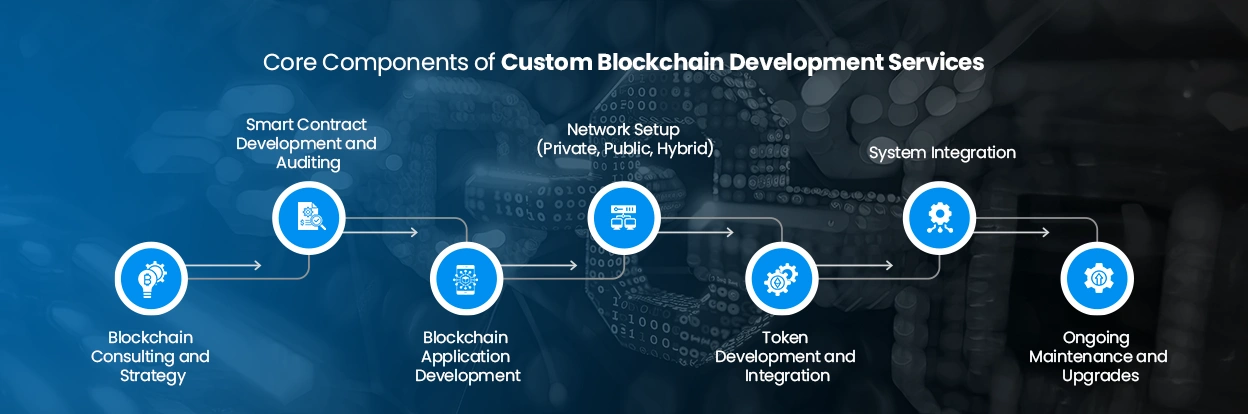
- Blockchain Consulting and Strategy: Identifying the right use case, defining objectives, and selecting the appropriate blockchain framework.
- Smart Contract Development and Auditing: Writing secure, efficient, and tamper-proof smart contracts, followed by thorough auditing to eliminate vulnerabilities.
- Blockchain Application Development: Building scalable decentralized applications (dApps) with intuitive user interfaces and robust backend systems.
- Network Setup (Private, Public, Hybrid): Creating blockchain networks based on business needs, whether permissioned or open.
- Token Development and Integration: Designing digital assets for payments, governance, or asset representation.
- System Integration: Seamlessly integrating blockchain solutions with existing enterprise systems such as CRM, ERP, or payment gateways.
- Ongoing Maintenance and Upgrades: Ensuring long-term performance, security updates, and scalability enhancements.
Why Customization Matters
Every business operates differently. A logistics company may need real-time tracking and verification, while a fintech platform may prioritize transaction speed and compliance. Custom solutions ensure that blockchain is aligned with these specific needs, rather than forcing businesses to adapt to rigid systems.
Ultimately, enterprise digital solutions built through customization deliver better ROI, improved efficiency, and long-term scalability.
Types of Blockchain Solutions We Build
Blockchain technology is highly versatile, allowing businesses to develop a wide range of applications. Here are the most impactful solutions we have built under blockchain:
1. Decentralized Applications (dApps)
Decentralized blockchain application development operates on blockchain networks rather than centralized servers, ensuring higher transparency, reliability, and security. These applications eliminate single points of failure and provide users with greater control over their data.
Common use cases include:
- Decentralized finance (DeFi) platforms
- Identity verification systems
- NFT marketplaces and gaming platforms
- Voting and governance systems
dApps are particularly beneficial for businesses looking to create trustless environments where transactions and interactions are verifiable and transparent.
2. Smart Contract Development
Smart contracts are self-executing programs that run on blockchain networks. They automatically enforce agreements when predefined conditions are met, eliminating the need for intermediaries.
Business applications include:
- Automated payment systems
- Escrow and settlement services
- Insurance claim processing
- Contract lifecycle management
With proper auditing and testing, smart contracts significantly reduce operational costs and human error while improving efficiency.
3. Private and Enterprise Blockchain Solutions
Private or permissioned blockchains are designed for organizations that require controlled access, high performance, and data confidentiality. These are ideal for enterprises handling sensitive information.
Industries leveraging enterprise blockchain solutions:
- Banking and financial services
- Supply chain and logistics
- Healthcare and pharmaceuticals
- Manufacturing and retail
These solutions provide enhanced control, faster transaction speeds, and better compliance with regulatory standards.
4. Blockchain-Based Supply Chain Solutions
Supply chain management is one of the most impactful use cases of blockchain technology. By creating an immutable record of transactions, blockchain improves traceability and accountability across the supply chain.
Key benefits include:
- Real-time tracking of goods
- Reduced fraud and counterfeiting
- Improved collaboration among stakeholders
- Enhanced operational efficiency
Businesses can gain complete visibility into their supply chain, ensuring trust and transparency at every stage.
- Tokenization Platforms
Tokenization allows businesses to convert real-world or digital assets into blockchain-based tokens. This enables fractional ownership, increased liquidity, and easier asset transfer.
Examples of tokenized assets:
- Real estate properties
- Intellectual property rights
- Fine art and collectibles
- Equity shares
Tokenization opens new revenue streams and investment opportunities for businesses.
6. Cryptocurrency Wallets and Exchanges
As businesses enter the digital asset ecosystem, secure wallet and exchange solutions become critical.
Key features include:
- Multi-currency support
- Secure private key management.
- Real-time trading capabilities
- Compliance with regulations
These platforms are essential for businesses operating in fintech and digital asset management.
Technologies Used in Blockchain Development
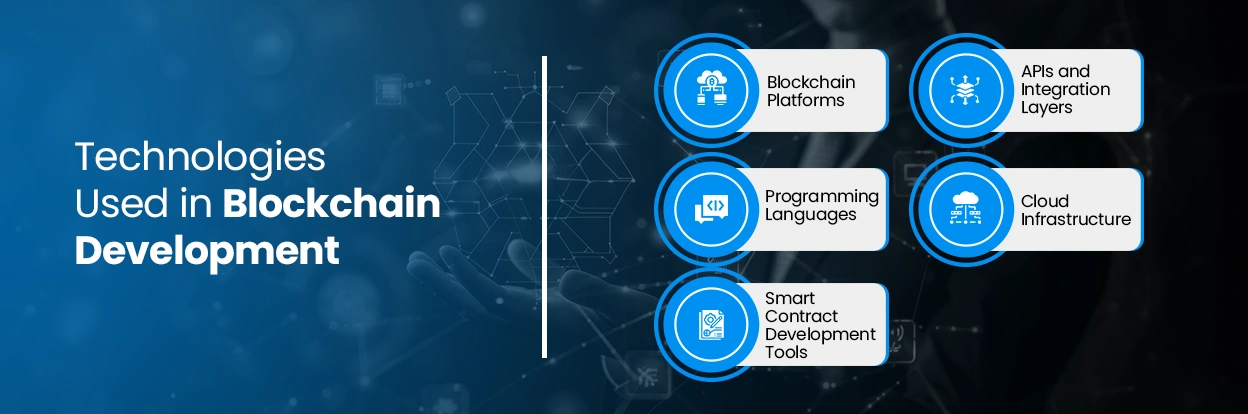
The success of any custom blockchain development project depends on selecting the right technology stack. Each component plays a crucial role in ensuring performance, scalability, and security.
- Blockchain Platforms
- Ethereum – Ideal for smart contracts and dApps with a large developer ecosystem
- Hyperledger – Designed for enterprise-grade solutions with high security
- Binance Smart Chain – Cost-effective with faster transaction speeds
- Solana – Known for high throughput and scalability
Choosing the right platform depends on the use case, transaction volume, and required level of decentralization.
- Programming Languages
- Solidity – Primary language for smart contract development
- Rust – High-performance blockchain applications
- Go – Backend development and infrastructure.
- JavaScript – Frontend and dApp interfaces
A combination of these languages ensures a robust and scalable system.
3. Smart Contract Development Tools
Tools such as Truffle, Hardhat, and Remix streamline the development, testing, and deployment of smart contracts. They help ensure code quality and reduce development time.
4. APIs and Integration Layers
APIs act as a bridge between blockchain systems and traditional enterprise applications. They enable seamless data exchange and ensure interoperability across platforms.
5. Cloud Infrastructure
Cloud platforms like AWS and Azure are commonly used to host blockchain nodes and services. They provide scalability, reliability, and cost efficiency for enterprise deployments.
Our Development Methodology
A structured and strategic approach is essential for successful blockchain application development. Our methodology ensures that every solution is secure, scalable, and aligned with business objectives.
- Requirement Analysis: We begin by understanding your business goals, challenges, and technical requirements. This phase includes stakeholder discussions, market research, and feasibility analysis.
- Solution Design: Based on insights gathered, we design a blockchain architecture that defines network type, consensus mechanisms, and integration strategies.
- Prototyping (PoC Development): A proof-of-concept is developed to validate the idea and identify potential challenges before full-scale development.
- Development
This phase involves:
- Smart contract coding
- Backend infrastructure development
- Frontend UI/UX design
- API integrations
- Testing and Quality Assurance
Comprehensive testing ensures:
- Security of smart contracts
- Performance under different conditions
- Bug-free deployment
- Deployment: The solution is deployed on the chosen blockchain network, followed by configuration and optimization for performance.
- Maintenance and Support: Continuous monitoring, updates, and performance optimization ensure long-term success and scalability.
Benefits of Working with Our Agency
Choosing the right partner for custom blockchain development services can significantly impact your project’s success.
- Tailored Business Solutions: We design solutions that align perfectly with your business needs, ensuring maximum efficiency and ROI.
- Scalable Architecture: Our systems are built to handle growth, allowing your platform to scale seamlessly with increasing demand.
- Strong Security Framework: We implement advanced security protocols and conduct rigorous smart contract audits to ensure reliability.
- End-to-End Development: From strategy to deployment and maintenance, we provide comprehensive services under one roof.
- Industry Expertise: Our experience across industries enables us to deliver solutions that meet real-world business challenges.
- Faster Time-to-Market: Agile methodologies and efficient workflows help us deliver projects quickly without compromising quality.
From strategy to deployment, we help you build powerful blockchain solutions that drive real business results.
FAQs
What services are included in blockchain development?
Custom blockchain development services include consulting, architecture design, smart contract development, dApp creation, system integration, testing, deployment, and ongoing maintenance.
Do blockchain solutions require ongoing maintenance?
Yes, regular updates, monitoring, and optimization are essential to ensure performance, security, and scalability.
Can blockchain apps scale with business growth?
Yes, with the right architecture and infrastructure, blockchain applications can scale efficiently as your business grows.
How secure are smart contracts?
Smart contracts are secure when developed and audited properly. Regular testing and audits are crucial to prevent vulnerabilities.
Conclusion
Custom blockchain development is no longer optional; it is a strategic investment for businesses aiming to stay competitive in a rapidly evolving digital economy. From improving transparency to automating complex processes, blockchain offers a wide range of benefits.
By leveraging customized services, businesses can build scalable, secure, and efficient solutions tailored to their needs. Whether it’s developing decentralized applications or implementing enterprise blockchain solutions, the opportunities are vast.
Organizations that adopt blockchain strategically today will be better positioned to lead in the Web3-driven future.
Author's Perspective
Blockchain is steadily evolving from an emerging technology into a core component of modern digital infrastructure. From a business standpoint, the real value of custom blockchain development lies in its ability to solve specific challenges rather than simply adopting a trending technology.
One of the most common mistakes organizations make is adopting blockchain without a clearly defined use case. This often results in complex systems that fail to deliver measurable value. A focused approach, where blockchain is implemented to address a clear business problem, yields far better outcomes.
For startups, the opportunity lies in building innovative and scalable products that prioritize usability. For enterprises, success depends on integrating blockchain seamlessly into existing systems while maintaining operational continuity.
Looking ahead, blockchain will play a crucial role in building trust-driven ecosystems where transparency and security are standard expectations. Businesses that invest in well-planned, scalable solutions today will gain a significant competitive advantage in the future.
Discuss Your Project NowGaurav Goyal
Global Sales- VP
Related Posts
Crypto Trading Bot Development: Architecture, Features & Cost...

Cost to Develop a Cryptocurrency Exchange App Like...

How to Build a Secure Crypto Payment Gateway...
Insights Are Valuable & Execution is Priceless
You’ve read about the digital future. Now, let’s build the infrastructure to take you there. Move your strategy from the page to the product.
Design Your Solution Now
Contact Us
Schedule The Appointment At Your Convenience Date And Time.
30 Min
Web Conference
Time Zone
Indian standard time (08:30pm)

Thanks For Getting In Touch!
You’ve Taken The First Step Toward Transforming Your Digital Presence. Our Experts Will Reach Out Shortly To Take It Forward.
Launch Your Dream Project
Provide a brief overview of your project, and our specialists will evaluate your requirements. We will connect with you to explore how the right digital solutions can help you launch faster.