
eCommerce App Development : Cost, Features, and Complete Strategy [2026]
Let’s be honest, eCommerce app development isn’t just online shopping anymore; it’s a full-blown gold rush. People aren’t browsing websites; they’re tapping through apps, making split-second purchases between scrolling sessions. From trending fashion drops to last-minute gifts, it all happens in frictionless mobile experiences. And here’s the reality check: most of the online sales now come from mobile devices. If your business isn’t in the app game yet, you’re not just behind-you’re handing over your customers to your competitors.
This guide walks you through everything you need to know to join the eCommerce app gold rush, from strategy and technology to cost and design that keeps users coming back for more.
Understanding eCommerce platform development
Think of an eCommerce app as your digital store that lives in your customer’s pocket. Instead of waiting for them to visit your website, your brand is always just one tap away, helping them buy products/services from the comfort of their mobile. They function as an extension of websites but provide a more user-friendly and tailored experience.
By outlining a plan for an eCommerce app, companies can determine the market, the best platform, the MVP features to build, and provide an exceptional user experience. A successful application for e-commerce is not only useful for facilitating a purchase but also for enhancing customer engagement, loyalty, and sales.
What Is The Timeline For Developing An eCommerce App From Scratch?
The time taken depends on several factors crucial for the development process. These factors include the complexity of the app, the number of features, and the customizations. On average, mobile app development can take between three and six months for essential apps and six months to a year or more for more complex projects.
Pick the Platform That Powers Your eCommerce Success
The selection of the right platform is not only a technical decision; it is your entry ticket to the e-commerce app gold rush. To successfully build eCommerce platform solutions that can carve their niche in the market, you need to look beyond the basic requirements and think about the long-term growth prospects.
First and foremost, you need to consider the various factors involved. Are you looking for a quick go-to-market strategy, or do you need a fully customized experience for your users? This decision will define your entire eCommerce platform development strategy.
There are various options for selecting the right eCommerce platforms for your business. While one option may offer a quick go-to-market strategy, the other may offer a high level of customizability and require a high investment. The selection should be done according to the requirements.
In the world of eCommerce, where the competition is high and the attention span is short, the right selection of the right eCommerce platforms can either take your business to the next level or hold you back.
Breaking Down the eCommerce App Success
Planning on joining the eCommerce app gold rush? One of the first things you need to figure out is the eCommerce app development cost, but, surprisingly, it’s not a straightforward question. Moreover, the cost factor for creating an application varies based on several factors, including the features included in the application, the technologies used for the creation of the application, and even the geographical location of the developers. You must understand the variables involved, whether you prefer to work with individual developers or a team of experienced eCommerce app developers.
Let’s take a look at a brief but detailed list of what actually affects eCommerce app development cost:
App Complexity
The more complex your app, the higher it will cost. A simple app with all the required eCommerce app features is much more affordable, but adding features like AI-based suggestions, live tracking, AR, and more will increase both time and cost.
Tech Stack & Platform Choice
The choice of whether to build a native or hybrid app is another factor that plays a major role in cost. Native apps are better in terms of performance and user experience, but require more resources. On the other hand, hybrid apps are less powerful in terms of performance, but are faster and more cost-effective because they use a single codebase.
Development Team Location
Where your development team is based can have an impact on pricing. For example, development teams in North America and Western Europe can charge a higher price for development, though they can also provide excellent communication skills and high-quality expertise. In Eastern Europe and Asian countries, you can get high-quality development at a lower price.
Maintenance & Ongoing Updates
Your app launch is merely the beginning and not the end. Continuous maintenance, fixes, updates, and app enhancements are a must for your app to remain competitive in a dynamic environment. Be prepared for the fact that the cost of maintaining your app can run anywhere from 15% to 20% of the original cost each year.
Knowing these factors will enable you to make informed decisions and spend wisely, as in this ever-evolving world, the key to staying ahead of the competition may be the way you spend.
Now that you know the costs involved, let’s move on to the factors that make an app successful.
Must-Have Features for a Winning eCommerce App
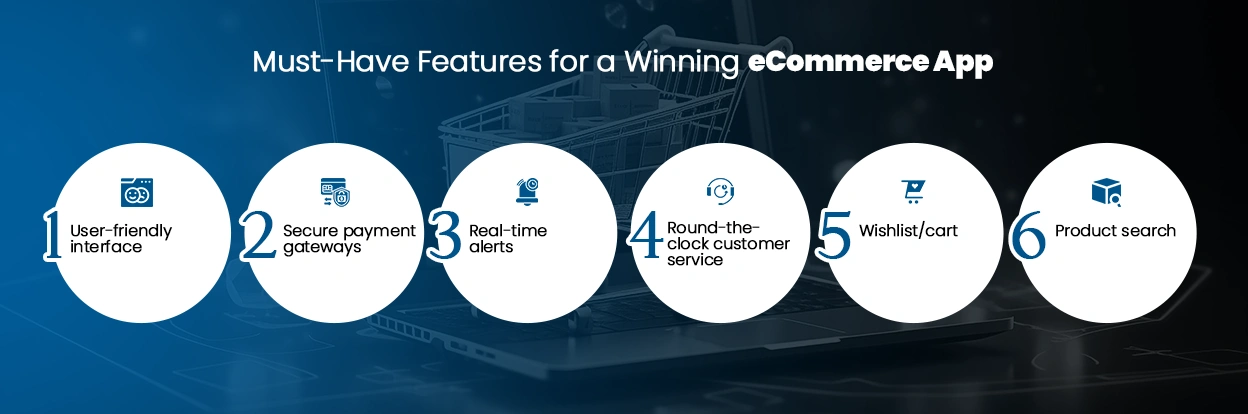
An ideal eCommerce app does not only provide the basic functionality of a shopping cart; rather, it should provide an automated solution for the entire Ecommerce business workflow. To set yourself apart from the rest of the competition, you should consider implementing a few key features:
- User-friendly interface: Design a simple, clean, and intuitive interface for your application so that the user can use the application with ease and have a great experience as well.
- Secure payment gateways: Secure payment gateways should be implemented so that the user can shop safely and securely.
- Real-time alerts: Real-time alerts should be provided so that the user can be kept engaged continuously.
- Round-the-clock customer service: A live chat option should be provided so that the user can reach the customer service anytime.
- Wishlist/cart: A wishlist/cart option should be provided so that the user can save products for future use.
- Product search: An efficient system for categorizing products according to their prices, popularity, ratings, etc., should be implemented so that the user can easily locate their favorite products.
eCommerce App Development Cost Breakdown
Understanding the eCommerce app development cost becomes much easier when you break it down into specific components. Instead of looking at a single number, it’s more practical to see where your investment actually goes during the development process.
| Component | Description | Estimated Cost (USD) |
| UI/UX Design | Wireframes, user journey mapping, and visual design | $3,000 – $10,000 |
| Frontend Development | User-facing side of the app (mobile interface) | $8,000 – $25,000 |
| Backend Development | Server, database, APIs, and business logic | $10,000 – $30,000 |
| Admin Panel | Dashboard for managing products, users, and orders | $5,000 – $15,000 |
| Core eCommerce Features | Product listings, cart, checkout, payments | $8,000 – $20,000 |
| Advanced Features | AI recommendations, AR/VR, analytics, chatbots | $10,000 – $40,000+ |
| Third-Party Integrations | Payment gateways, shipping APIs, CRM tools | $2,000 – $10,000 |
| Testing & Quality Assurance | Functional, usability, and performance testing | $3,000 – $8,000 |
| Deployment & Launch | App store submission, configuration, and release | $1,000 – $3,000 |
| Maintenance (Annual) | Updates, bug fixes, performance optimization (15–20% of total cost) | $5,000 – $20,000/year |
Advanced Features That Set Your Application Apart
Besides the basic eCommerce app features, some of the advanced features that can be incorporated are as follows:
- AI Recommendations: Provide recommendations to the user for the products they need to purchase based on their activities. This will allow the user to purchase more products.
- AR/VR Integration: Provide a platform to try the product before they purchase it. This will allow the user to feel comfortable while purchasing, especially clothes and furniture.
- IoT Integration for Shopping: Allow the user to buy products easily through smart home devices.
- Role-based Dashboard: A user-friendly interface for sellers and users provides a personal shopping experience.
- Gamification: Gamification will motivate users to use the app for a longer period.
These features will improve the overall experience for the users and retain them as customers.
Steps in the eCommerce app development process
Developing an eCommerce app may seem like a complicated task, as it involves juggling between various aspects. However, if you have a proper plan in your hands, it’s absolutely helpful. Here’s a step-wise eCommerce app development process that you should follow for the development of your eCommerce app:
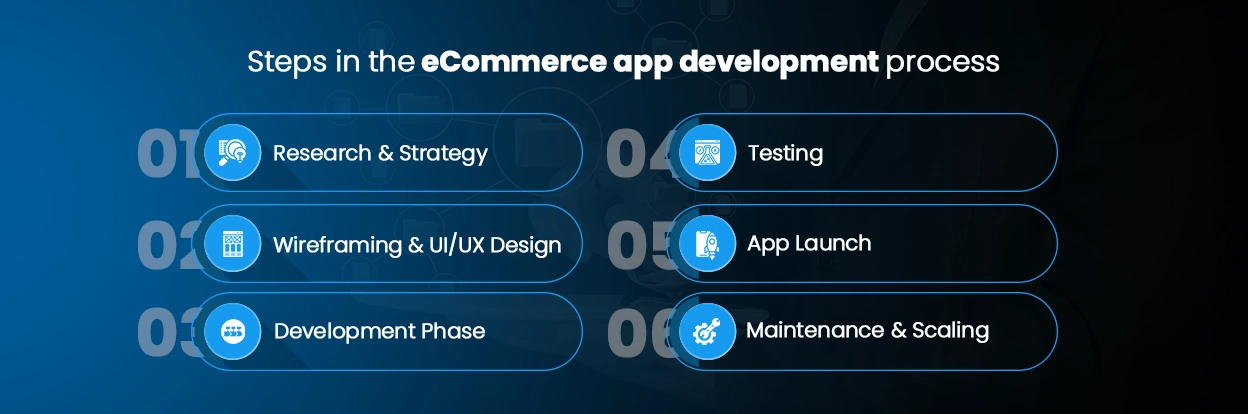
- Research & Strategy: Identify your target audience, unique selling points, and gaps in the competition.
- Wireframing & UI/UX Design: Design a wireframe and UI/UX design for your eCommerce app.
- Development Phase: Start with the development phase, where you will develop the frontend and backend for your eCommerce app.
- Testing: You need to perform the necessary tests for your eCommerce app.
- App Launch: You need to launch your eCommerce app on the App Store/Play Store or through a PWA.
- Maintenance & Scaling: After the launch, the focus should be on maintaining your eCommerce app.
With the help of a professional eCommerce app development company, the development process can be smooth, and the turnaround time can be quick.
What Makes Building an eCommerce App Necessary?
Mobile shopping statistics indicate that the use of smartphones for online shopping is more preferred than desktop devices by people aged 70+. This is a great opportunity for businesses to expand their consumer base. The creation of eCommerce mobile apps is a key growth strategy for businesses. This strategy has been effective for businesses as it has enabled them to expand their consumer base and increase consumer engagement.
- Faster and Smoother: The use of mobile apps for online shopping makes the payment system smoother compared to the use of other websites.
- Tailored Just for Them: The personal shopping experience and the use of a drag-and-drop checkout system for making payments enable businesses to use the mobile app for a special connection with their customers.
- Push Notifications: This strategy enables businesses to notify their customers about app updates and other offers.
- Better Conversion Rates: The use of a mobile app for online shopping enables businesses to achieve high conversion rates compared to the use of other websites.
- Unique Benefits of a Mobile eCommerce App: A mobile app for online shopping enables businesses to offer their customers seamless shopping and analytics. Similarly, the use of a mobile app for online shopping enables customers to enjoy the benefits of a personal connection.
Types of eCommerce Applications
Different specialized apps in the eCommerce market are designed for the needs of businesses and for what customers want. Here are the main categories of apps and how they differ from one another:
B2C eCommerce Apps
These are apps designed for businesses that sell directly to customers. In this category, you will find large businesses like Amazon, as well as small businesses that sell through apps. The main aim of these apps is to provide a smooth shopping experience for customers. An online store app, for example, focuses on a smooth shopping experience, with emphasis on product display, customer reviews, and checkout.
B2B eCommerce Apps
These are apps designed for businesses that sell large quantities of products to other businesses. In this case, the business sells in large quantities, also known as bulk, to retailers. These apps are designed with features that help speed up the order-making process of orders.
Marketplace Apps
Apps like Amazon, eBay, and Etsy are marketplace apps, which allow several vendors to display their items on a single platform. This way, a consumer is able to access different vendors within a single app.
Niche-Specific eCommerce Apps
This type of app is designed for the sale of a particular type of item, e.g., clothes, electronics, or food items. This is a specialized app for the consumer, designed for a particular type of purchase. For instance, a fashion app is designed for a consumer looking for clothing items.
Different types of eCommerce apps serve different markets by catering to the different needs of those markets. However, the right type of app for your business depends on your business needs, i.e., what you are selling and to whom you are selling. The right platform is also necessary, as this will help your app reach a larger audience and gather feedback.
Common Challenges in eCommerce App Development
eCommerce app development often leads developers to perfect their user interface while seeking out modern technologies that can distract them from essential app functions. Every business faces critical challenges that demand proactive preparation from app development companies.
- Scalability: The application should remain scalable so that as the number of users increases, the application does not consume more system resources.
- Data Security: The application should protect user information, including their payment information. The application should comply with the latest privacy regulations.
- Integration with Third-Party Systems: Integration with third-party APIs, for example, payment gateways and inventory management systems, is a challenge for the application developers.
- User Retention: After the application is deployed, user retention is a challenge for the developers.
These challenges can be tackled during the beginning stages of the app development so that the barriers to the eCommerce app development can be cleared.
Final Thoughts
eCommerce apps are no longer an alternative for businesses; they are a necessity for business success in the mobile-first world. A well-developed app with current trends, essential features, and a better strategy will help attract visitors and increase revenue while maintaining your position in the market. Working with experienced developers will turn your eCommerce app idea into reality and ensure it meets user and business needs.
Let’s implement your vision for eCommerce app development. The opportunity is massive-but only for those who act fast.’
Author's Perspective
From a strategic standpoint, eCommerce app development is no longer just about building an app, it’s about creating a scalable digital ecosystem that evolves with your customers. Many businesses focus too heavily on adding features, but long-term success comes from prioritizing user experience, starting with a lean MVP, and using real data to guide decisions.
It is equally important to choose the right technology foundation and partner with an experienced app development company that understands both business and technical goals. The eCommerce gold rush is real, but success isn’t just about entering the market; it’s about doing it right. When you approach the app development process with a clear strategy, you’re not just launching an app, you’re building a sustainable revenue engine for long-term growth.
Discuss Your Project NowAjit Kumar Jha
VP - Business Operations
Related Posts

Oil & Gas Software Development: Digital Transformation in...
Complete Fitness App Development Solution: Features, Cost and...

Manufacturing Software Development: Automating Modern Factories
Insights Are Valuable & Execution is Priceless
You’ve read about the digital future. Now, let’s build the infrastructure to take you there. Move your strategy from the page to the product.
Design Your Solution Now
Contact Us
Schedule The Appointment At Your Convenience Date And Time.
30 Min
Web Conference
Time Zone
Indian standard time (08:30pm)

Thanks For Getting In Touch!
You’ve Taken The First Step Toward Transforming Your Digital Presence. Our Experts Will Reach Out Shortly To Take It Forward.
Launch Your Dream Project
Provide a brief overview of your project, and our specialists will evaluate your requirements. We will connect with you to explore how the right digital solutions can help you launch faster.