
In Brief
- AI is transforming stock trading through faster market analysis, predictive modelling, automated execution, and advanced risk assessment.
- Enterprise applications extend beyond automated trading to portfolio intelligence, compliance monitoring, fraud detection, and investor advisory services.
- Reliable AI trading depends on high-quality market data, robust model governance, and well-defined risk controls.
- AI adoption also introduces challenges such as model bias, overfitting, cybersecurity threats, market manipulation, and regulatory complexity.
- Financial institutions need to balance automation with explainability, human oversight, and continuous model monitoring to ensure responsible deployment.
Stock trading is becoming increasingly data-driven, and AI is changing how financial institutions process that information and respond to market movements. Instead of relying primarily on manual analysis and predefined trading rules, modern AI systems can process large volumes of market data in real time, identify complex patterns, analyse sentiment, generate predictive insights, and support or automate trading decisions. This enables enterprises to respond faster to changing market conditions while reducing the manual effort involved in research and analysis.
For enterprises, however, the opportunity goes far beyond automated buying and selling. AI can strengthen portfolio management, investment research, market surveillance, risk assessment, compliance, fraud detection, and investor services. At the same time, financial institutions must address model reliability, data quality, cybersecurity, regulatory requirements, and the risks associated with automated decisions. Understanding both the practical applications and limitations of AI is therefore critical for enterprises looking to capture new opportunities in AI-powered stock trading.
Understanding AI in Stock Trading
What Is AI-Powered Stock Trading?
AI-powered stock trading uses machine learning and other AI technologies to analyse market information, identify patterns, generate trading insights, and support or automate investment decisions. It can process far more data and variables than manual analysis, making it valuable for both institutional traders and financial enterprises.
How AI Analyses Financial Market Data
AI systems can process historical and real-time price data, trading volumes, financial reports, news, market sentiment, and alternative data. By identifying relationships and recurring patterns across these sources, models can generate insights that support trading and investment decisions.
Key Technologies Behind AI Trading Systems
AI trading platforms commonly combine machine learning, deep learning, natural language processing, predictive analytics, and real-time data processing. These technologies work alongside APIs, cloud infrastructure, databases, and trading systems to support the complete trading workflow.
AI Stock Trading vs Traditional Algorithmic Trading
Traditional algorithmic trading generally follows predefined rules and conditions. AI-powered systems can identify more complex patterns from data and adapt their predictions as new information becomes available. However, AI does not eliminate the need for predefined trading rules and risk controls; enterprise systems often combine both approaches.
How AI Stock Trading Systems Work
An AI trading system follows a continuous process that moves from data collection to analysis, prediction, execution, and monitoring.
Market Data Collection and Processing
The system collects market prices, trading volumes, financial information, news, and other relevant datasets. Data is cleaned and structured before being used by AI models.
Pattern Recognition and Feature Engineering
Models identify useful patterns and relationships within market data. Feature engineering helps transform raw information into variables that can improve prediction and decision-making.
Model Training and Market Prediction
Machine learning models are trained using historical data to identify patterns associated with different market conditions. Their performance is then tested against unseen data before being considered for live use.
Trade Signal Generation
Based on model predictions and trading strategies, the system generates signals indicating potential buy, sell, or hold actions. Risk parameters can be applied before any decision reaches execution.
Automated Trade Execution
Approved signals can be sent through broker APIs or trading platforms for automated execution. Enterprises can also introduce human approval for high-value or high-risk transactions.
Continuous Monitoring and Model Adaptation
Market behaviour changes over time, so AI trading systems require continuous monitoring. Performance, prediction accuracy, execution outcomes, and model drift should be reviewed regularly and used to improve the system.
Enterprise Applications of AI in Stock Trading
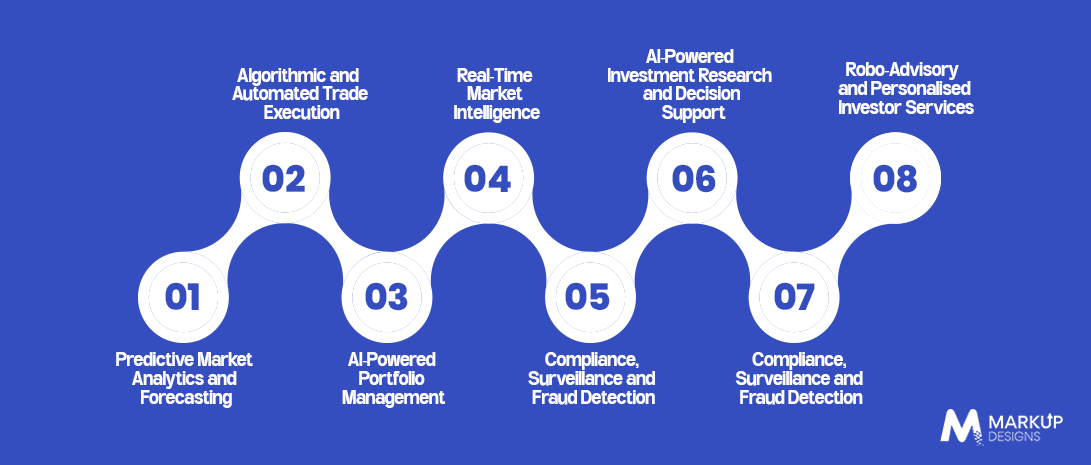
AI is being applied across the broader investment and trading ecosystem, not just for automated transactions. Financial enterprises can use it to improve market intelligence, portfolio decisions, risk management, compliance, and investor experiences.
Predictive Market Analytics and Forecasting
AI models can analyse historical and real-time data to identify trends, estimate market movements, and generate predictive insights. These forecasts can support traders and investment teams without being treated as guaranteed predictions.
Algorithmic and Automated Trade Execution
AI can help determine when and how trades should be executed based on market conditions and predefined strategies. Automated execution can reduce manual intervention and improve the speed and consistency of transactions.
AI-Powered Portfolio Management
AI can evaluate portfolio performance and market conditions to support more informed investment decisions.
- Portfolio Optimisation
Models can analyse risk and return factors to identify portfolio combinations that align with defined investment objectives.
- Asset Allocation
AI can assess market conditions and portfolio requirements to support allocation decisions across different asset classes.
- Rebalancing Strategies
AI systems can monitor portfolio changes and identify when allocations move beyond predefined thresholds, helping investment teams determine when rebalancing may be required.
Real-Time Market Intelligence
AI enables enterprises to process market information continuously and identify developments that could influence trading or investment decisions.
- News and Sentiment Analysis
Natural language processing can analyse financial news, company announcements, analyst commentary, and social sentiment to identify market signals.
- Alternative Data Analysis
AI can process non-traditional datasets such as web activity, consumer trends, satellite data, or other commercially available sources to uncover additional market insights.
- Event Detection
AI can identify significant events such as earnings announcements, regulatory changes, or unusual market activity and flag them for further analysis.
Risk Modelling and Management
AI can help financial institutions identify and assess potential risks across portfolios and trading strategies.
- Market Risk Assessment
Models can analyse volatility, price movements, exposure, and other indicators to help estimate potential market risk.
- Stress Testing
AI can simulate adverse market conditions to evaluate how portfolios or strategies may perform under different levels of stress.
- Scenario Analysis
Enterprises can model potential market scenarios and assess their possible impact on investments, helping teams prepare for changing conditions.
Compliance, Surveillance and Fraud Detection
AI can monitor transactions and trading behaviour for unusual patterns that may indicate fraud, market abuse, or policy violations. It can also support compliance teams by flagging activity that requires further investigation.
AI-Powered Investment Research and Decision Support
AI can accelerate investment research by analysing financial documents, company data, market trends, and news. It can summarise findings and surface relevant information, allowing analysts to spend more time on higher-level evaluation.
Robo-Advisory and Personalised Investor Services
AI can support digital investment services by analysing investor objectives, risk preferences, and portfolio information. This enables more personalised recommendations and automated portfolio assistance while keeping appropriate controls around financial decisions.
Read Also: AI in Fintech: Use Cases, Adoption, and Growth Strategies
How Enterprises Can Build AI-Powered Stock Trading Systems
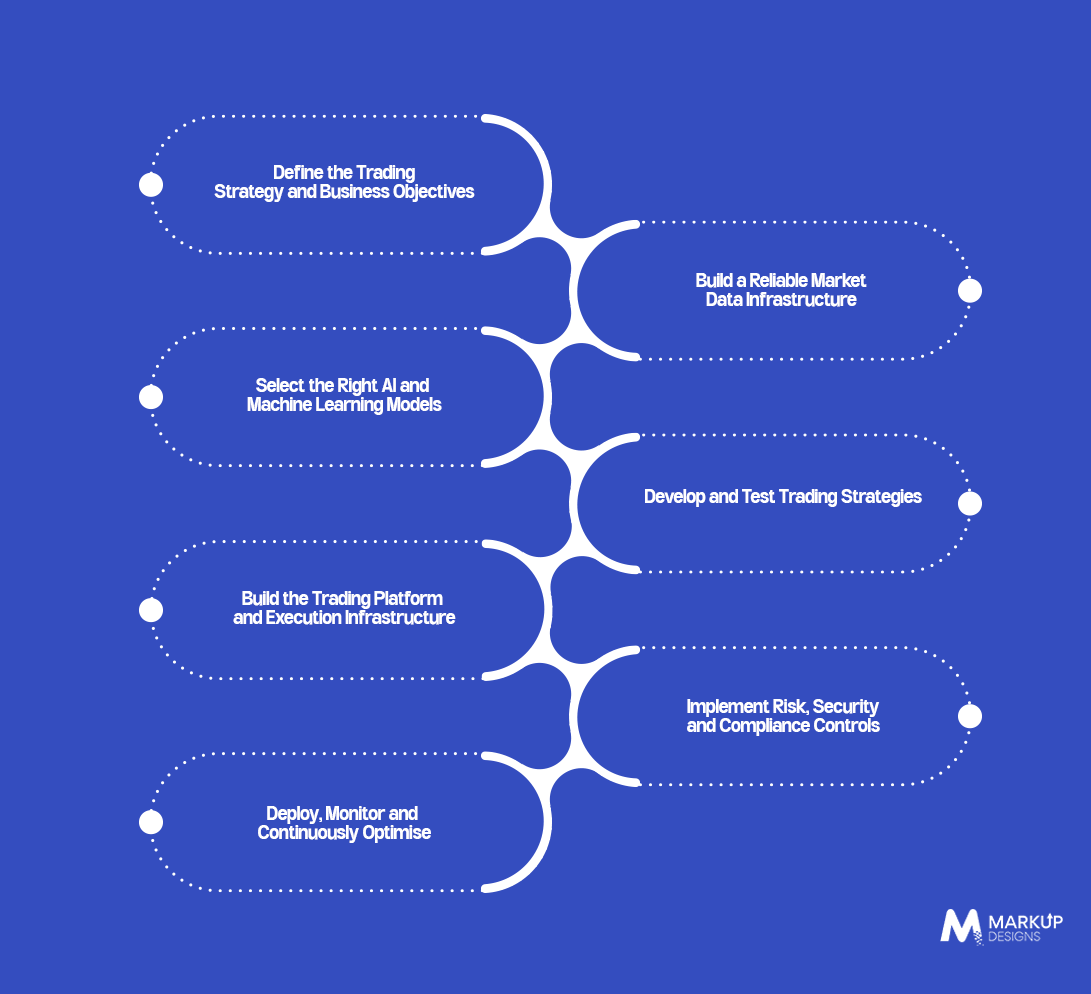
Building an AI-powered stock trading system requires more than selecting a machine learning model. Enterprises need a reliable data foundation, clearly defined trading objectives, robust testing, secure execution infrastructure, and continuous oversight to ensure the system performs within acceptable risk limits.
Step 1: Define the Trading Strategy and Business Objectives
Start by identifying what the AI system is expected to achieve and where it will be used. Clear objectives prevent unnecessary automation and provide measurable criteria for evaluating performance.
Identify the Target Market and Asset Classes
Determine whether the system will focus on equities, ETFs, derivatives, or other asset classes. Each market has different data, liquidity, volatility, and execution requirements.
Define AI Use Cases and Automation Levels
Decide whether AI will support research and decision-making or execute trades autonomously. High-risk actions can retain human approval while lower-risk activities may be automated.
Establish Performance and Risk Metrics
Set measurable targets for factors such as returns, accuracy, latency, drawdown, volatility, and risk exposure. These metrics provide a basis for evaluating the system beyond raw profitability.
Step 2: Build a Reliable Market Data Infrastructure
AI trading models are only as reliable as the data they receive. Enterprises need infrastructure capable of collecting, processing, validating, and delivering market information efficiently.
Integrating Real-Time and Historical Data
Combine historical datasets for model training with real-time feeds for live analysis and decision-making. Consistent data pipelines help maintain accuracy across both environments.
Managing Data Quality and Latency
Incomplete, duplicated, delayed, or inaccurate data can produce unreliable signals. Data validation and low-latency processing are particularly important for time-sensitive strategies.
Using Alternative Data Sources
Alternative sources such as financial news, company filings, consumer trends, and market sentiment can provide additional signals. These sources should be validated for reliability and relevance before being incorporated into models.
Step 3: Select the Right AI and Machine Learning Models
The model should match the trading objective rather than being selected simply because it is technically advanced.
Choosing Models for Prediction and Classification
Traditional machine learning models can support tasks such as market classification, price movement prediction, and signal generation. Model selection should consider accuracy, interpretability, computational requirements, and data availability.
Using Deep Learning for Complex Market Patterns
Deep learning can identify complex relationships across large datasets and may be useful for time-series analysis, sentiment processing, and other demanding applications. However, greater complexity does not automatically mean better trading performance.
Combining AI with Quantitative Trading Models
AI can complement established quantitative techniques by adding pattern recognition and adaptive analysis. Combining approaches can provide stronger controls than relying on a single model.
Step 4: Develop and Test Trading Strategies
A promising model should not move directly into live trading. Strategies need to be tested under different market conditions before real capital is exposed.
Backtesting Against Historical Data
Backtesting evaluates how a strategy would have performed using historical market data. Testing should account for realistic transaction costs, liquidity, slippage, and other trading conditions.
Paper Trading and Simulation
Paper trading allows enterprises to evaluate strategies using live or simulated market conditions without risking actual capital. It provides an additional validation stage before deployment.
Measuring Strategy Performance
Evaluate the strategy using multiple metrics, including returns, volatility, drawdown, Sharpe ratio, execution quality, and consistency across market conditions.
Step 5: Build the Trading Platform and Execution Infrastructure
The trading platform must connect AI models with market data, decision engines, broker systems, and monitoring tools while maintaining reliability and speed.
Integrating Broker APIs and Trading Systems
Secure API integrations allow the platform to retrieve market information and submit approved orders. API failures and duplicate requests should be handled through appropriate safeguards.
Designing Low-Latency Architecture
For strategies that depend on rapid execution, infrastructure should minimise delays between data processing, signal generation, and order execution.
Building Monitoring and Control Dashboards
Dashboards can provide visibility into model performance, active positions, trading activity, system health, and risk exposure, allowing teams to intervene when necessary.
Step 6: Implement Risk, Security and Compliance Controls
Enterprise trading systems must treat risk and governance as core architectural requirements rather than additions after deployment.
Position and Exposure Limits
Set limits on position sizes, portfolio exposure, losses, and trading frequency to prevent the system from exceeding predefined risk thresholds.
Explainable AI and Model Governance
Where AI influences significant financial decisions, enterprises should maintain documentation, validation processes, audit trails, and appropriate explainability around model behaviour.
Data Security and Access Controls
Protect market and customer data through encryption, authentication, role-based access, and restricted system permissions. Trading credentials and API keys should receive particularly strong protection.
Regulatory Compliance
Trading systems must operate within applicable financial regulations and market rules. Compliance requirements should be incorporated into system design, monitoring, and reporting processes.
Step 7: Deploy, Monitor and Continuously Optimise
AI trading systems require ongoing oversight because market behaviour, data patterns, and model performance can change over time.
Real-Time Model Monitoring
Track prediction quality, trading outcomes, latency, errors, and risk exposure during live operation. Alerts can help teams respond to abnormal behaviour quickly.
Detecting Model Drift
Monitor whether the data and market conditions the model encounters have changed significantly from its training environment. Early detection can prevent deteriorating performance from going unnoticed.
Updating Models and Trading Strategies
Models and strategies should be reviewed and retrained when performance declines or market conditions change. Updates should pass through controlled testing before being introduced into live trading.
Market Opportunities for AI in Stock Trading
AI is creating opportunities across the broader financial trading ecosystem, from institutional investment platforms to market intelligence and infrastructure. The strongest opportunities are emerging where AI can process complex information faster, improve decision support, or automate repetitive processes without removing necessary controls.
Growing Demand for Intelligent Trading Platforms
Financial institutions are investing in platforms that combine real-time data, predictive analytics, automated execution, and risk management. This creates opportunities for AI-powered trading infrastructure that can support increasingly complex strategies.
AI-Powered Institutional Investment Solutions
Banks, hedge funds, asset managers, and other institutions can use AI for portfolio analysis, investment research, market forecasting, and execution. Enterprise solutions can also be integrated into existing investment workflows rather than replacing them entirely.
Democratization of Advanced Trading Capabilities
AI can make sophisticated analytical capabilities more accessible through digital investment platforms and robo-advisory services. This allows a wider range of investors to access data-driven insights that previously required specialised financial expertise.
Expansion of Alternative Data and Market Intelligence
The growing availability of alternative data is creating new opportunities for AI-driven market analysis. Enterprises can analyse sources such as news, company filings, consumer behaviour, and sentiment to identify signals that may complement traditional market data.
AI Infrastructure for Financial Markets
The opportunity extends beyond trading applications themselves. Financial institutions increasingly need specialised infrastructure for data processing, model deployment, monitoring, security, and integration with trading systems.
Multi-Asset and Cross-Market Trading Opportunities
AI can analyse relationships across equities, commodities, currencies, and other asset classes. This creates opportunities for systems capable of identifying signals and managing strategies across multiple markets while accounting for different risk and execution requirements.
Benefits of AI in Enterprise Stock Trading
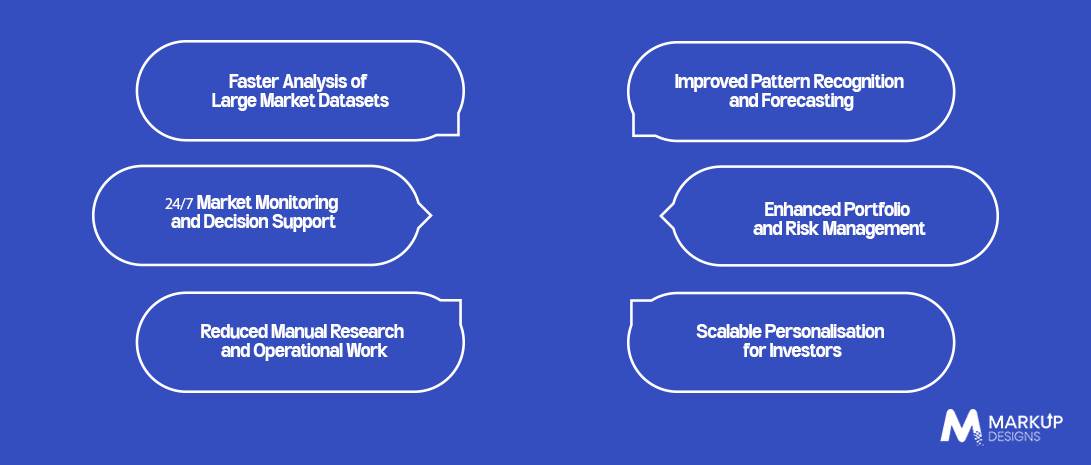
Faster Analysis of Large Market Datasets
AI can process large volumes of structured and unstructured information far faster than manual analysis. This allows trading and investment teams to identify relevant signals without reviewing every data source individually.
Improved Pattern Recognition and Forecasting
Machine learning models can identify complex relationships and recurring patterns within market data. While AI cannot guarantee accurate predictions, it can strengthen analytical capabilities when models are properly trained and validated.
24/7 Market Monitoring and Decision Support
Automated systems can continuously monitor relevant markets, news, portfolio conditions, and trading activity. This helps enterprises identify significant events and potential risks without relying entirely on manual monitoring.
Enhanced Portfolio and Risk Management
AI can support portfolio optimisation, exposure analysis, scenario modelling, and risk assessment. These capabilities can help investment teams make more informed decisions while maintaining defined risk limits.
Reduced Manual Research and Operational Work
AI can automate repetitive tasks such as data collection, document analysis, reporting, and routine monitoring. This allows financial professionals to focus on higher-value analysis and strategic decisions.
Scalable Personalisation for Investors
AI can analyse investor preferences, objectives, and risk profiles to support more personalised digital investment experiences. This can help financial platforms deliver recommendations and services at scale.
Risks and Challenges of AI in Stock Trading
Inaccurate Predictions and Model Risk
AI models can produce incorrect predictions, particularly when market conditions differ from the data used during training. Model outputs should therefore be treated as probabilistic signals rather than guaranteed outcomes.
Overfitting and Poor Generalisation
A model may perform exceptionally well on historical data while failing in live markets. Robust validation and testing across different market conditions are essential to identify this problem.
Biased or Low-Quality Market Data
Incomplete, outdated, or biased datasets can negatively affect model performance. Data quality controls are necessary throughout collection, processing, training, and deployment.
Data Security and Cybersecurity Risks
Trading platforms handle sensitive financial information and can provide access to systems capable of executing transactions. Weak security could therefore lead to data breaches, unauthorised access, or financial losses.
Explainability and Black Box Decision-Making
Complex models can make it difficult to understand why a particular prediction or recommendation was generated. Enterprises need appropriate explainability and documentation, particularly for high-impact decisions.
Regulatory and Compliance Challenges
AI trading systems must operate within applicable financial regulations, market rules, and internal governance policies. Regulatory expectations may also evolve as AI becomes more deeply integrated into financial markets.
Market Manipulation and Adversarial Attacks
AI systems can potentially be exploited through manipulated data, adversarial inputs, or coordinated market activity. Strong monitoring and security controls are required to detect suspicious behaviour.
System Failures and Uncontrolled Automated Execution
Technical failures or incorrect signals can result in unintended trades if automated execution lacks appropriate safeguards. Position limits, validation rules, circuit breakers, and emergency controls can help limit potential damage.
Best Practices for Enterprise AI Trading Adoption
Start with Controlled, High-Value Use Cases
Begin with specific workflows where AI can provide measurable value, such as research, market monitoring, or risk analysis. Expand automation only after reliability has been demonstrated.
Combine AI Predictions with Quantitative Risk Controls
AI-generated signals should operate alongside predefined risk rules. This creates a layer of protection against unexpected model behaviour or extreme market conditions.
Use High-Quality and Diverse Data Sources
Use reliable datasets and validate their accuracy, completeness, and relevance. Combining different data sources can also reduce dependence on a single signal.
Prioritise Explainability and Model Governance
Maintain clear documentation around model development, validation, inputs, outputs, and changes. Governance processes should define who can approve, modify, and deploy models.
Maintain Human Oversight for High-Risk Decisions
Keep human review where incorrect decisions could result in significant financial, regulatory, or operational consequences. The objective should be controlled automation, not maximum automation.
Test Strategies Beyond Historical Backtesting
Backtesting alone is insufficient because historical performance does not guarantee future results. Use simulation, paper trading, stress testing, and out-of-sample validation before exposing real capital.
Implement Real-Time Monitoring and Kill Switches
Monitor trading behaviour, model performance, exposure, and system health continuously. Emergency controls should allow authorised teams to stop automated trading when abnormal behaviour is detected.
Continuously Audit Models and Trading Outcomes
Review model performance and trading results regularly to identify drift, unexpected behaviour, and changing risk patterns. Auditing should continue throughout the model lifecycle rather than ending after deployment.
Future of AI in Stock Trading
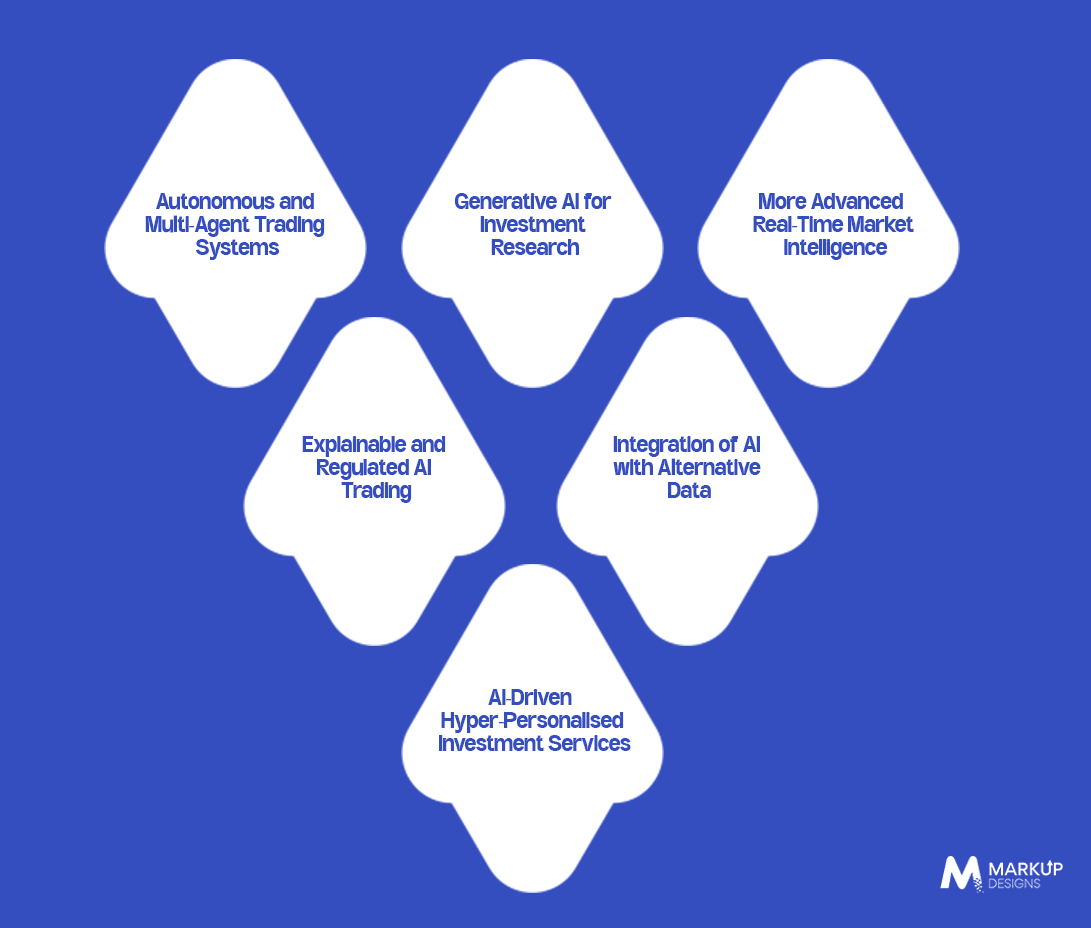
AI in stock trading is likely to move towards more autonomous, interconnected, and context-aware systems. However, increased autonomy will also make governance, monitoring, and human oversight more important.
Autonomous and Multi-Agent Trading Systems
Multiple specialised AI agents could collaborate across research, analysis, strategy selection, execution, and risk monitoring. Such systems will require strong orchestration to prevent conflicting actions.
Generative AI for Investment Research
Generative AI can accelerate research by summarising financial documents, analysing reports, comparing companies, and helping analysts explore large information sets. Its outputs will still require validation before influencing investment decisions.
More Advanced Real-Time Market Intelligence
AI systems will increasingly combine market data with news, sentiment, events, and alternative datasets to provide more comprehensive real-time intelligence.
Explainable and Regulated AI Trading
As AI adoption grows, financial institutions will face greater demand for transparent models, documented decision processes, auditability, and regulatory controls.
Integration of AI with Alternative Data
AI will continue expanding the use of non-traditional datasets to identify additional market signals. Better data infrastructure and validation will be essential as these sources become more widely used.
AI-Driven Hyper-Personalised Investment Services
Investment platforms can use AI to deliver more personalized portfolio insights and digital advisory experiences based on individual objectives and risk preferences, while maintaining appropriate financial and regulatory safeguards.
How Markup Designs Helps Build AI-Powered Stock Trading Solutions
Markup Designs helps financial businesses develop AI-powered stock trading solutions that combine machine learning, predictive analytics, and real-time market intelligence with robust trading infrastructure. Our expertise covers custom trading platform development, real-time market data and broker API integration, risk management and compliance-focused architecture, and secure, scalable deployment. We also support continuous monitoring and optimisation to help trading systems remain reliable as market conditions, data patterns, and business requirements evolve.
Build an AI Trading Platform Designed for Real-World Markets
Turn complex market data into intelligent trading and investment capabilities with secure AI, predictive analytics, real-time integrations, and enterprise-grade infrastructure.

Conclusion
AI is creating significant opportunities across stock trading, investment research, portfolio management, risk assessment, and market intelligence. However, adding AI to a trading platform does not automatically make it more profitable or reliable. Successful enterprise adoption depends on high-quality data, rigorous model testing, clearly defined risk controls, strong governance, and continuous monitoring. Financial institutions that combine AI capabilities with disciplined engineering and human oversight can use the technology to improve decision support and operational efficiency without treating automated predictions as guaranteed market outcomes.
FAQs
What is AI in stock trading?
AI in stock trading refers to using artificial intelligence and machine learning to analyse market data, identify patterns, generate trading signals, support investment decisions, and automate selected trading activities.
How is AI used by enterprises in stock trading?
Enterprises use AI for predictive market analysis, algorithmic execution, portfolio optimisation, investment research, risk modelling, market surveillance, fraud detection, compliance, and personalised investor services.
Can AI predict stock market movements accurately?
No AI model can predict stock market movements with guaranteed accuracy. Market behaviour is influenced by numerous changing factors, and models can fail when conditions differ from their training data. AI should therefore be used as a decision-support capability with appropriate validation and risk controls.
What are the biggest risks of AI-powered stock trading?
Major risks include inaccurate predictions, overfitting, poor-quality data, cybersecurity threats, model opacity, regulatory challenges, market manipulation, and unintended automated execution. Strong testing, governance, monitoring, and human oversight can help manage these risks.
How much does it cost to build an AI stock trading platform?
The cost depends on factors such as platform complexity, asset classes, AI models, data requirements, broker integrations, security controls, compliance requirements, and deployment infrastructure. A basic AI-assisted trading platform can cost significantly less than a sophisticated enterprise system with real-time execution and advanced risk management.
Author's Perspective
AI can make stock trading systems faster and more capable, but speed and automation are not the same as intelligence. The biggest mistake enterprises can make is treating an AI trading model as a standalone prediction engine and assuming better predictions automatically mean better returns. The real value comes from the system surrounding the model: reliable data, rigorous testing, controlled execution, risk management, governance, and continuous monitoring. AI should strengthen financial decision-making, not replace discipline with automation.
Discuss Your Project NowGaurav Goyal
Global Sales- VP
Insights Are Valuable & Execution is Priceless
You’ve read about the digital future. Now, let’s build the infrastructure to take you there. Move your strategy from the page to the product.
Design Your Solution Now
Contact Us
Schedule The Appointment At Your Convenience Date And Time.
30 Min
Web Conference
Time Zone
Indian standard time (08:30pm)

Thanks For Getting In Touch!
You’ve Taken The First Step Toward Transforming Your Digital Presence. Our Experts Will Reach Out Shortly To Take It Forward.
Launch Your Dream Project
Provide a brief overview of your project, and our specialists will evaluate your requirements. We will connect with you to explore how the right digital solutions can help you launch faster.