
In Brief
- The process of legacy modernization allows companies in Dubai to deal with their problems of tech debt, high expenses related to maintenance, and process obstacles.
- Depending on the complexity of the system, the priorities of the company, the integrations needed, and the ability to scale the system in the future, the approach to modernization may vary.
- The costs for modernization differ from one technique to another due to the architecture of the application, the process of moving data, and integrations.
- A good business case must calculate ROI by savings, efficiency enhancement, time reduction, or agility improvements.
Though legacy systems are still vital for conducting business operations in Dubai, the maintenance of such outdated technologies becomes an expensive task that limits various processes. Old systems are not able to integrate with modern solutions, cope with business expansion, or adjust to new safety and compliance requirements. The progress in the digital sphere leaves no option for Dubai business owners except modernization.
At the same time, the problem of legacy modernization is too serious to treat as a technology upgrade. Businesses need to determine which systems should be modernized, select the right modernization strategy, estimate the investment involved, and understand the expected return. A well-planned approach can reduce technical debt while improving operational efficiency, system performance, security, and flexibility.
This blog explores the key strategies, cost factors, and ROI considerations Dubai enterprises should evaluate before starting a legacy modernization initiative.
Why Dubai Enterprises Need to Modernize Legacy Systems
Legacy systems may offer a support system for core business activities for quite some time, yet as businesses grow and introduce new digital technologies, their constraints surface. For enterprises in Dubai occupying competitive and more connected environments, modernization serves as a solution to deal with these constraints while laying a strong ground for expansion in the future.
Rising Maintenance and Operational Costs
Older applications require expertise in maintenance and regular fixes, leading to a rise in IT costs over time. Updating the old parts can cut down on maintenance expenses, enabling companies to invest in more strategic initiatives.
Limited Scalability for Business Growth
Legacy systems may find it hard to accommodate growing users, transactions, volume of data, and other business requirements. Modern systems can offer greater flexibility and scalability in response to changes in enterprise needs.
Integration Challenges Across Digital Systems
A lot of legacy applications were not created with the idea of being established in the cloud or connected to other software through application programming interfaces and artificial intelligence solutions, leading to disconnection and difficulties in data sharing.
Growing Cybersecurity and Compliance Risks
Unsupported technologies can introduce security vulnerabilities and make it harder to meet evolving regulatory requirements. Modernization provides an opportunity to strengthen security controls and improve compliance readiness.
Slower Innovation and Time to Market
Rigid legacy environments can make it difficult to introduce new features or respond quickly to market changes. Modern architectures allow businesses to develop, test, and deploy new capabilities more efficiently.
Enterprise Legacy Modernization Strategy: Where to Start
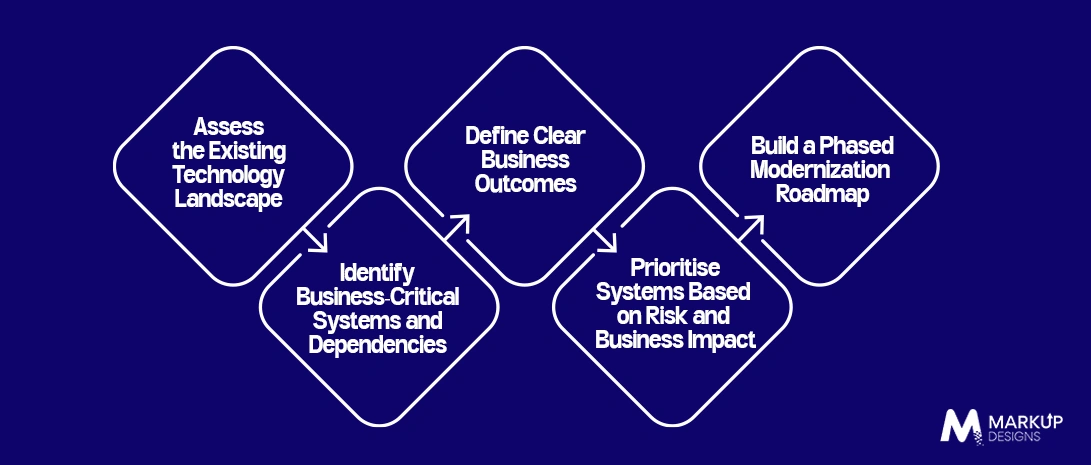
Modernization should begin with a clear assessment of the existing environment rather than immediately replacing systems. Enterprises need to understand what they have, what is holding the business back, and which systems should be addressed first.
Assess the Existing Technology Landscape
Review applications, infrastructure, databases, integrations, dependencies, technical debt, and performance issues to establish a clear baseline.
Identify Business-Critical Systems and Dependencies
Determine which applications directly support critical operations and understand how they interact with other systems before making modernization decisions.
Define Clear Business Outcomes
Set measurable objectives such as reducing maintenance costs, improving performance, strengthening security, enabling integrations, or accelerating product development.
Prioritise Systems Based on Risk and Business Impact
Not every legacy system needs immediate modernization. Prioritise applications based on business importance, technical risk, cost, and the potential value of modernization.
Build a Phased Modernization Roadmap
A phased roadmap allows enterprises to modernize strategically, test changes, manage business disruption, and gradually scale successful initiatives instead of attempting a high-risk transformation all at once.
Choosing the Right Legacy Modernization Approach
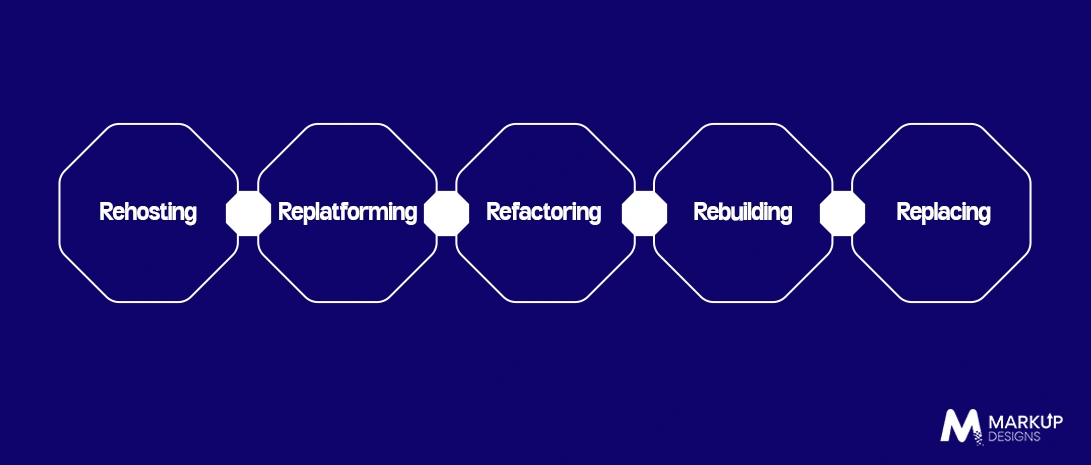
There is no single modernization strategy that works for every legacy environment. The right choice depends on the system’s condition, business criticality, available budget, integration requirements, and the organisation’s long-term technology goals.
Rehosting
Rehosting moves an existing application to a modern infrastructure environment with minimal changes. It can make financial sense when the system still works reliably, but the underlying infrastructure is expensive or difficult to maintain.
Replatforming
Replatforming introduces selected improvements, such as moving to a managed cloud service, without completely redesigning the application. It is useful when enterprises want better performance and scalability without the cost and disruption of a full rebuild.
Refactoring
Refactoring involves restructuring parts of the application to improve its architecture, maintainability, or scalability while retaining its core functionality. It suits systems that still provide business value but have become difficult to develop or integrate.
Rebuilding
Rebuilding means developing the system again using modern architecture and technologies while retaining the required business functionality. This can be justified when the existing codebase is too complex or restrictive to modernize incrementally.
Replacing
Replacement involves moving away from the legacy application modernization entirely, often by adopting a modern commercial or custom-built alternative. It may be the most practical option when the existing system is no longer viable, secure, scalable, or aligned with business requirements.
Legacy System Upgrade vs Replacement: How Should Dubai Enterprises Decide?
The decision should not be based simply on how old a system is. Enterprises need to weigh its current business value against its technical limitations, modernization cost, operational risk, and future requirements.
When Incremental Modernization Is the Better Choice
Incremental modernization is generally suitable when the system remains stable and business-critical, but specific components are creating performance, integration, or scalability issues. It allows enterprises to improve the system gradually while reducing disruption and spreading investment over time.
When Complete System Replacement Is Necessary
Replacement becomes more practical when the application is fundamentally difficult to maintain, lacks vendor or developer support, presents significant security risks, or cannot support essential business requirements. Continuing to invest in such a system may cost more than moving to a modern alternative.
Key Decision Factors: Cost, Risk, Integrations and Long-Term Growth
Dubai enterprises should evaluate the total cost of ownership, business disruption, data migration requirements, existing integrations, security, scalability, and expected future needs. The objective is not to choose the newest technology, but to select the approach that delivers the strongest long-term business value with manageable risk.
Legacy System Modernization Costs in Dubai
The cost of modernizing a legacy system in Dubai can vary significantly depending on the size and complexity of the application and the scope of transformation. A straightforward modernization may require a relatively focused investment, while large enterprise environments with multiple integrations and extensive data migration can require a much larger budget.
Key Factors That Influence Project Cost
Several factors can affect the overall investment:
- System complexity: Older, tightly coupled applications generally require more effort to modernize.
- Number of integrations: Connecting the modernized system with ERP, CRM, APIs, cloud platforms, and other applications increases development effort.
- Data migration: Large or poorly structured datasets require additional preparation, migration, and validation.
- Security and compliance: Regulated industries may require additional security controls, audits, and compliance measures.
- Cloud infrastructure: Cloud Infrastructure selection, configuration, and ongoing cloud costs contribute to the overall budget.
- Testing and quality assurance: Complex systems require extensive functional, security, performance, and integration testing.
- Ongoing support and optimisation: Post-launch monitoring, maintenance, and improvements should also be included in the overall cost calculation.
Typical Cost Ranges for Legacy Modernization
There is no fixed price for legacy modernization, but enterprises can use broad estimates for initial planning:
| Modernization Scope | Indicative Cost |
| Discovery and assessment | 5,000–25,000 |
| Incremental modernization | 30,000–150,000+ |
| Large-scale enterprise transformation | 150,000–500,000+ |
These figures are indicative rather than standard Dubai market rates. The actual cost depends on the application architecture, technology stack, integrations, data volume, security requirements, team structure, and modernization approach.
The Hidden Cost of Delaying Modernization
Deferring modernization does not eliminate the cost; it often shifts it into rising maintenance expenses, technical debt, downtime, security vulnerabilities, and slower development. Outdated systems can also prevent businesses from launching new digital transformation startgey or integrating emerging technologies quickly, creating opportunity costs that may be harder to quantify.
How to Build a Strong Business Case for Legacy Modernization
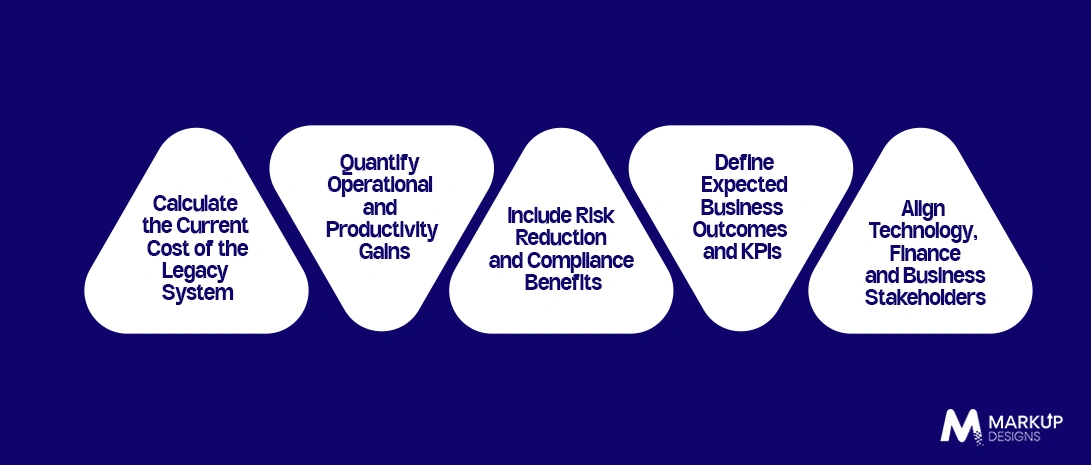
A modernization proposal needs to demonstrate more than technical improvements. Decision-makers should be able to see how the investment will affect operating costs, productivity, risk, revenue potential, and long-term business performance.
Calculate the Current Cost of the Legacy System
Account for maintenance, infrastructure, support staff, licensing, downtime, security remediation, and the cost of maintaining outdated technologies.
Quantify Operational and Productivity Gains
Estimate how modernization could reduce manual work, improve system performance, shorten development cycles, and help teams spend more time on higher-value activities.
Include Risk Reduction and Compliance Benefits
Improved security, stronger resilience, easier compliance management, and reduced dependency on unsupported technologies can form an important part of the business case.
Define Expected Business Outcomes and KPIs
Set measurable targets such as reduced downtime, lower maintenance costs, faster releases, improved system performance, or increased digital transaction capacity.
Align Technology, Finance and Business Stakeholders
Modernization should be evaluated as a business transformation initiative, not just an IT project. Technology teams, finance leaders, and business stakeholders should agree on priorities, investment, risks, expected outcomes, and success measures before implementation begins.
Measuring the ROI of Legacy System Modernization
Modernization ROI should be measured against both immediate cost savings and the long-term value created by a more capable technology environment.
How Legacy Modernization ROI Is Calculated
ROI can be assessed by comparing the modernization investment with savings from lower maintenance costs, reduced downtime, improved productivity, infrastructure efficiencies, and new revenue opportunities. Risk reduction and improved compliance can also contribute to the overall business value.
Key ROI Metrics Enterprises Should Track
Enterprises should monitor total cost of ownership, maintenance spending, downtime, incident frequency, release speed, operational efficiency, and infrastructure costs before and after modernization.
Expected ROI Timeline
Short-term: Reduced maintenance and infrastructure costs.
Mid-term: Improved productivity, system performance, and operational efficiency.
Long-term: Greater scalability, faster innovation, reduced technical debt, and stronger revenue opportunities.
Managing Risk During Legacy System Modernization
Modernization can affect critical business operations, so risk management needs to be built into the project from the beginning.
Preventing Business Disruption and Downtime
Use phased migration, parallel environments, and controlled releases to minimise disruption to ongoing operations.
Managing Complex Data Migration
Plan data mapping, cleansing, migration, validation, and backup processes carefully to prevent data loss or integrity issues.
Maintaining Security Throughout the Transition
Apply security controls across both legacy and modern environments during migration rather than waiting until the new system goes live.
Addressing UAE Data Protection and Industry Compliance
Ensure data handling, storage, access controls, and system architecture align with applicable UAE regulations and industry-specific requirements.
Reducing Scope Creep Through Phased Delivery
Define clear project boundaries and deliver modernization in manageable phases, making it easier to control costs, timelines, and changing requirements.
Enterprise Use Cases of Legacy Modernization in Dubai
Legacy modernization can deliver different business outcomes depending on the industry and the systems involved.
Banking and Financial Services
Modernizing core banking and financial platforms can improve transaction processing, security, API integration, and digital service delivery.
Healthcare
Modernized healthcare systems can improve interoperability, data accessibility, patient management, and integration with newer digital health platforms.
Retail and E-commerce
Modernization can connect legacy inventory, payment, and customer systems with modern commerce platforms to support faster transactions and personalised experiences.
Real Estate
Upgrading property management and transaction systems can improve data sharing, automation, customer portals, and integration with digital platforms.
Logistics and Supply Chain
Modern systems can connect legacy warehouse, fleet, and order management applications to improve visibility, planning, and operational efficiency.
A Practical Roadmap for Enterprise Legacy System Modernization
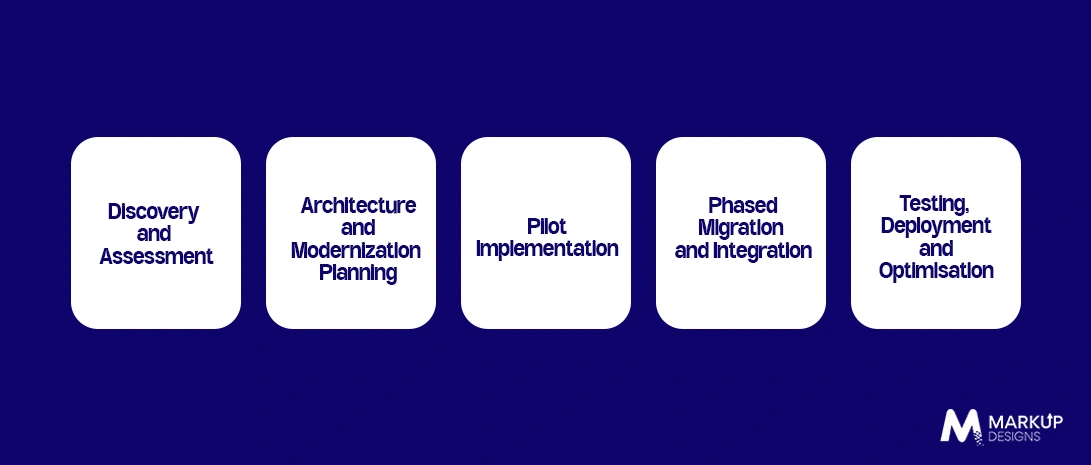
Discovery and Assessment
Evaluate existing applications, infrastructure, dependencies, technical debt, and business requirements.
Architecture and Modernization Planning
Select the appropriate modernization approach and define the target architecture, technology stack, migration strategy, and priorities.
Pilot Implementation
Modernize a controlled part of the environment to validate the approach, identify risks, and measure initial results.
Phased Migration and Integration
Gradually migrate applications and data while connecting modernized components with existing enterprise systems.
Testing, Deployment and Optimisation
Conduct functional, performance, security, and integration testing before deployment, followed by continuous monitoring and optimisation.
How Markup Designs Supports Legacy System Modernization in Dubai
Markup Designs helps Dubai-based enterprises modernize legacy environments with a structured approach that covers system assessment, modernization strategy, cloud migration, application development, API integration, data migration, security, and post-launch support. Our focus is on modernizing critical systems without losing the business functionality they already provide, while creating a more scalable and maintainable technology foundation for future growth.
Ready to Modernize Your Legacy Systems?
Move beyond outdated technology with a modernization strategy built around your business goals, budget, and long-term growth.

Conclusion
Legacy system modernization is not simply about replacing outdated technology. For Dubai enterprises, it is a strategic opportunity to reduce technical debt, improve operational efficiency, strengthen security, and create systems that can support future growth. The right approach depends on the condition of the existing environment, business priorities, integration requirements, available investment, and expected ROI.
A phased, business-focused modernization strategy can help enterprises manage risk while delivering measurable improvements over time. By evaluating the cost of maintaining legacy systems against the value of modernization, organisations can make more informed decisions about where to invest and which systems to transform first.
FAQs
1. What is legacy system modernization?
Legacy system modernization is the process of updating or transforming outdated applications, infrastructure, and technologies so they can meet current business, security, integration, and scalability requirements. Depending on the situation, this may involve rehosting, replatforming, refactoring, rebuilding, or replacing the existing system.
2. How much does legacy system modernization cost in Dubai?
There is no fixed cost because the investment depends on system complexity, integrations, data migration, security requirements, infrastructure, and the chosen modernization approach. A focused modernization project may cost tens of thousands of dollars, while large enterprise transformations can require several hundred thousand dollars or more.
3. How long does enterprise legacy modernization take?
The timeline depends on the number and complexity of applications, data migration requirements, integrations, testing, and the selected approach. Smaller modernization initiatives may take a few months, while large enterprise transformations can take a year or longer when delivered in phases.
4. How can businesses calculate the ROI of legacy modernization?
Businesses can compare the modernization investment against measurable benefits such as reduced maintenance costs, lower infrastructure spending, reduced downtime, productivity improvements, faster development, and new revenue opportunities. Risk reduction and improved compliance can also contribute to the overall return.
5. Is it better to modernize or completely replace a legacy system?
It depends on the system’s condition and business value. Incremental modernization is often more suitable when the existing system remains functional but has specific technical limitations. Replacement may be more practical when the system is difficult to maintain, presents significant security risks, lacks support, or cannot meet future business requirements.
Author's Perspective
Legacy modernization should not be treated as a technology refresh for the sake of replacing old systems. The real objective is to determine whether an existing system can continue supporting the business efficiently and, if not, identify the most practical path forward. A clear assessment of cost, risk, business impact, and future requirements allows enterprises to modernize where it matters most without creating unnecessary disruption. For Dubai businesses, a phased and outcome-focused approach can make modernization more manageable while delivering measurable long-term value.
Discuss Your Project NowJupinder Singh Arora
Founder and CEO
Related Posts
Why Businesses in Oman Need Digital Transformation Services
Digital Transformation in Financial Services: Trends, Benefits &...
IoT in Banking: Transforming Financial Services Through Connected...
Insights Are Valuable & Execution is Priceless
You’ve read about the digital future. Now, let’s build the infrastructure to take you there. Move your strategy from the page to the product.
Design Your Solution Now
Contact Us
Schedule The Appointment At Your Convenience Date And Time.
30 Min
Web Conference
Time Zone
Indian standard time (08:30pm)

Thanks For Getting In Touch!
You’ve Taken The First Step Toward Transforming Your Digital Presence. Our Experts Will Reach Out Shortly To Take It Forward.
Launch Your Dream Project
Provide a brief overview of your project, and our specialists will evaluate your requirements. We will connect with you to explore how the right digital solutions can help you launch faster.