
In Brief
- IoT is enabling banks to connect their physical infrastructure, such as ATMs, POS terminals, branches, security systems, and wearable payment systems, to their digital banking systems for better monitoring and enhanced operational efficiency.
- Through the combination of IoT with AI, cloud computing, and big data analytics, banks will be able to gain operational visibility, detect anomalies, minimize downtime, implement predictive maintenance, and make quick data-driven decisions.
- The key uses of IoT in the banking sector are smart ATMs, intelligent bank branches, connected POS terminals, wearable payments, cash and asset tracking, and IoT-enabled security and surveillance systems.
- The successful deployment of IoT solutions needs a well-defined business objective, a proper architectural approach, system integration, AI and analytics capability, robust cybersecurity measures, compliance management, testing, and ongoing monitoring and optimization.
- Even with difficulties like cybersecurity, data privacy, legacy system integration, compliance issues, and huge amounts of data, with the correct IoT strategy and technology partner, banks could establish more connected, secure, responsive, and efficient financial services.
Banking is no longer confined to mobile banking apps, banking websites, ATMs, and branch offices. With modern technological connections, financial institutions can know what is going on in their processes at any moment. This is where the Internet of Things comes to play.
The Internet of Things allows collecting and exchanging data from physical objects for analysis and transformation into useful information for banks. With the help of cloud computing, AI, and data analytics, IoT technologies will be able to provide banks with better security, less downtime, automated procedures, and improved customer experiences.
However, what is IoT application in banking? Where does it make the most sense? In this blog post, we will explore IoT in banking and discuss the following aspects: its advantages and applications, architecture and implementation process, possible difficulties, and factors that businesses should take into account while picking an IoT development company.
What is IoT in Banking?
The concept of IoT in banking involves the application of devices, sensors, and intelligent technology that transmit information to banking platforms through the network. Such devices may include ATMs, point-of-sale terminals, security cameras, branch sensors, smart kiosks, payment wearable devices, and other IoT infrastructure.
Unlike traditional stand-alone devices, such devices can provide constant data transmission to the banking systems in real-time. For instance, a smart ATM is able to transmit the amount of cash remaining in the device or an issue arising from technical difficulties before malfunctioning occurs. The same applies to the sensors in a bank branch.
The true potential of the IoT depends on how banks use this data. Integrating the Internet of Things with cloud technology, APIs, AI, and analysis allows financial institutions to keep track of their processes in real-time, detect any suspicious activity, and automate some procedures.
In simple terms, IoT helps integrate the physical aspects of the banking industry with its digital elements, thus making the banking industry smarter.
How Does IoT Work in Banking?
IoT technology in banking is about linking physical devices to banking applications in order to constantly get, transfer and analyze data. This process might seem quite complicated at first glance, but it is rather simple in essence.
Data collection from devices: Sensors and intelligent devices like ATMs, POS Terminals, cameras, branch devices collect data related to their state, use, location or actions.
Transfer of data: Data gets transferred through networks or IoT platforms.
Data processing: The received data gets sorted by cloud or local systems for further use in banking applications.
Analytics and AI detect insights: Analytics solutions and AI help detect any patterns, anomalies, issues with devices or changes in customers behavior.
Banking systems take action: Based on these insights, banks can trigger alerts, schedule maintenance, investigate suspicious activity, or improve customer service.
This interconnected process allows banks to evolve from data collection to monitoring and reacting to data insights.
Why is IoT Important for the Banking Industry?
There are millions of operations, devices, clients, and actions to be handled every day in the banking sector. In order to achieve success and effectiveness in such a business environment, it is not enough just to use conventional systems. IoT allows banks to integrate their physical operations with digital systems and thus have increased visibility in their work.
With connected devices, banks can control ATMs, branches, payment terminals, security systems, and other assets without completely depending on manual inspection.
In addition, the IoT has become vital as customers seek quicker, safer, and easier banking. IoT technology will allow for contactless payments, intelligent branches, customized services, and live security monitoring.
More importantly, IoT will produce an ongoing stream of real-world data. In connection with the use of AI and analytics, banks will be able to switch from reactive to predictive mode.
This way, IoT will allow for building more intelligent, predictive, secure, and customer-oriented banking processes.
Key Benefits of IoT in Banking
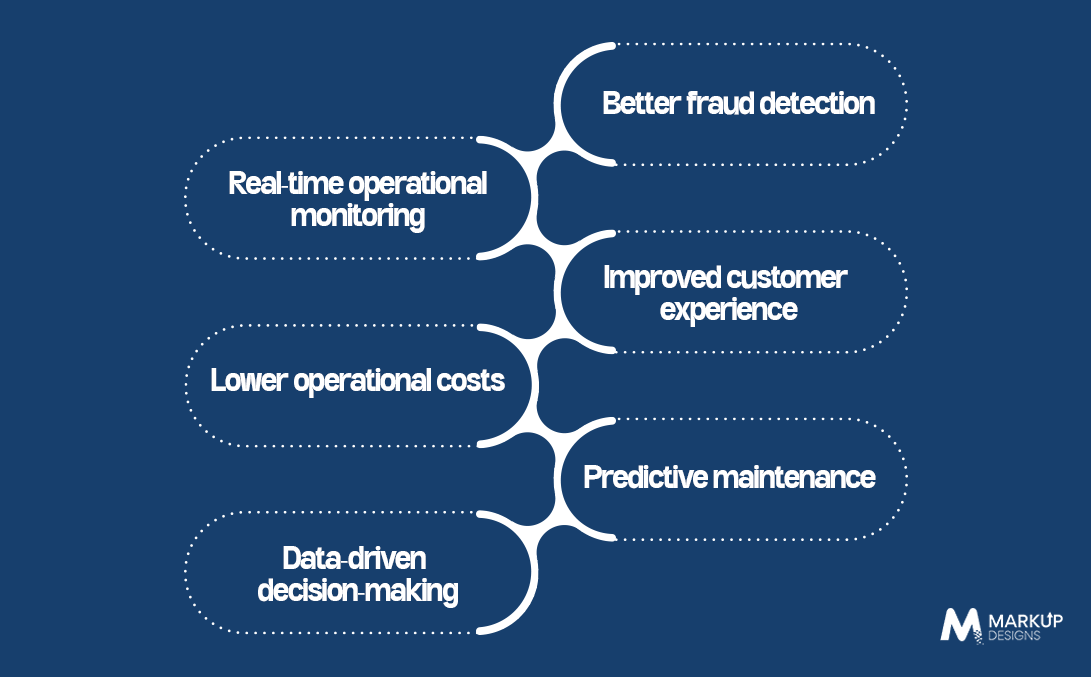
IoT is not only about connecting devices within the banking industry. It allows for better monitoring of operations as well as better understanding of customers’ behavior. The following are some of the main advantages of IoT:
1. Real-time operational monitoring
Banks are able to monitor their ATMs, POS terminals, branches, and other devices in real-time as well as spot any problems.
2. Better fraud detection
The IoT-enabled data can be merged with AI and analytics to pinpoint abnormal device behavior, suspicious transaction patterns, or security incidents.
3. Improved customer experience
Connected technologies allow for faster payments, smarter branches, personalized services, and an improved banking experience.
4. Lower operational costs
Automation helps to cut down on manual inspections, unnecessary maintenance, electricity consumption, and machine downtime.
5. Predictive maintenance
Early detection of the signs of machinery failure is possible, which enables timely maintenance before malfunction impacts customers.
6. Data-driven decision-making
The continuous stream of data coming from connected devices provides banks with valuable information.
Make Your Banking Operations Smarter With IoT
Connect your banking infrastructure with secure, scalable IoT solutions that improve monitoring, automation, security, and customer experiences. Partner with Markup Designs to turn connected technologies into measurable business value.

Top IoT Use Cases in Banking
IoT is being implemented in various banking areas, ranging from internal operational tasks to customer-oriented ones. The integration of physical and digital environments allows monitoring and automation of certain processes and handling of various problems more rapidly. Below are some of the use cases of IoT in banking:
1. Smart ATMs
ATMs that have connectivity will be able to send data on their cash reserves, physical health, and abnormal behavior. Banks will be able to perform remote monitoring and maintenance of the machines to avoid any failure.
2. Smart Bank Branches
Sensors can provide valuable information on customer traffic, queue length, energy consumption, room conditions, and equipment.
3. IoT-Enabled POS Terminals
Connectivity in payment devices will help send real-time information on their health, usage, and transactions.
4. Wearable Payments
Smartwatches and other connected devices can enable contactless payments that would allow customers to conduct transactions much quicker and easier.
5. Cash and Asset Monitoring
Through IoT sensors, banks could be able to track their cash, its movement, and also the other key assets in the branch in case there is anything suspicious.
6. Security and Surveillance
By incorporating connected cameras and sensors, the bank could enhance the safety of the branch through conducting real-time surveillance.
Read Also: AI Chatbots in Banking: Enhancing Customer Experience Through AI Automation
IoT Architecture for Banking
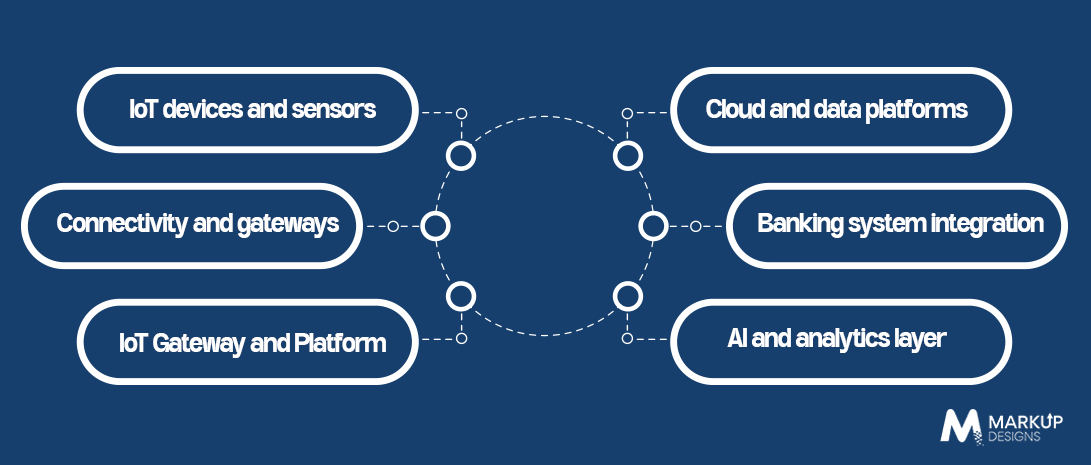
A strong IoT architecture forms the core of an effective IoT banking system. The architecture connects the physical components with banking apps, data systems, analytics software, and security systems. The architecture can change according to its purpose, but typically, the components of an IoT banking system are:
IoT devices and sensors
This is the hardware component where the data is gathered. This includes ATMs, point-of-sale devices, smart kiosks, surveillance cameras, wearables, and branch sensors.
Connectivity and gateways
The devices require a secure network to transfer the data. Banks will use various technologies depending on the application. These include cellular, WiFi, Bluetooth, and others.
IoT Gateway and Platform
The gateways gather the device data and forward it to the main platform. The platform enables the management of the devices, data, and communication.
Cloud and data platforms
Data collected by devices can be stored and processed using the cloud or on-premises solutions. This enables banks to manage the vast amount of data.
Banking system integration
Integration services and APIs allow for the connection of the IoT platform to core banking, customer relationship management, payment, and other enterprise systems.
AI and analytics layer
AI and analytics transform IoT data into actionable insights. The dashboard and banking applications help users track their operations and take necessary actions. Security, identity management, encryption, and governance need to be integrated at all layers.
How to Implement IoT in Banking
IoT implementation in the banking industry cannot be done using just a couple of intelligent devices. A bank should have an implementation strategy that takes into account the business objectives, the available technology, security issues, and other factors. The implementation process of IoT can be done in the following way:
1. Identify the Business Goal
It is important first to know what the issue is that will help to solve: whether it will be decreasing the downtime of ATMs, improving branch efficiency, or better security.
2. Select the Appropriate IoT Use Case
Select the use case that would yield quantifiable results. Piloting the project is one way for banks to test their concept first.
3. Design the IoT Architecture
Define the devices, connectivity, data infrastructure, APIs, cloud infrastructure, and applications that will be used as part of the solution.
4. Integrate With Existing Systems
Link the IoT system to the core banking, payment, CRM, security, and other systems within the enterprise for integration purposes.
5. Include Analytics and AI
Use analytics for the analysis of the data collected and use AI or machine learning for pattern detection, problem prediction, and automated decision-making.
6. Prioritize Security and Compliance
Ensure that encryption, device authentication, access control, monitoring, and compliance measures are implemented right from the start.
7. Test and Launch
Test for functionality, integration, connectivity, performance, and security before deploying the solution.
8. Scale Up and Optimize
Monitor performance and business outcomes, solve any problems that come up, and expand use cases where applicable.
Challenges of Implementing IoT in Banking
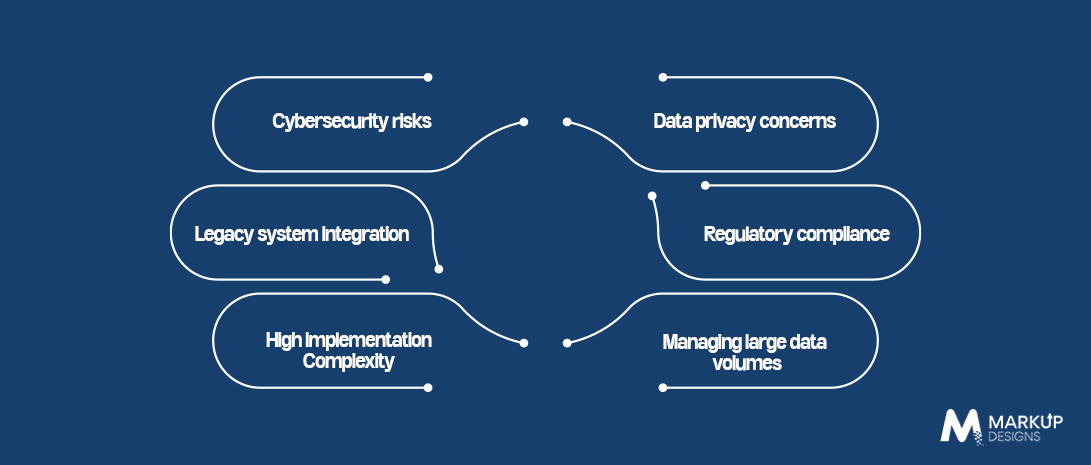
While IoT application is full of opportunities for banks, its implementation presents several challenges. Banking organizations have to tackle these issues to ensure that their IoT environment becomes both reliable and secure.
Cybersecurity risks
Any interconnected device could become a point of attack. Cybersecurity in banking is important to use robust mechanisms of authentication, encryption, monitoring, and updating security measures.
Data privacy concerns
The IoT devices are able to collect large volumes of operational and customer-related data. It is crucial to have clearly defined data collection, storage, and usage policies in banks.
Legacy system integration
There may be a number of legacy banking systems in use within financial institutions. They have to be linked to IoT infrastructure via certain API’s and middleware.
Regulatory compliance
IoT applications used by banks have to be aligned with certain regulations in the areas of finance, cybersecurity, data protection, and data management.
Managing large data volumes
The flow of data produced by IoT systems is constant and can cause problems in managing the data. It becomes necessary to establish an infrastructure for analyzing the data.
High implementation complexity
The management of thousands of devices and networking and application implementation can be a complex matter.
Why is Markup Designs the Right Partner for Banking IoT Solutions?
Selecting an appropriate technological partner is necessary for deploying an IoT system in the bank. It is important to choose a partner who is able to cooperate using connected technologies and who is skilled in terms of security, integration, scalability, and the specific requirements of banks.
Markup Designs offers to companies different services that allow them to deploy IoT systems that include devices, applications, data platforms, and enterprise systems into a single technology ecosystem. Our IoT development service focuses on IoT systems that are practical, secure, scalable, and business-related solutions.
It is also possible to provide us with a secure architecture for your solution design, which will incorporate things such as authentication, encryption, access control and others related to security. The services we provide can also include the possibility of integrating IoT data and analytics so that companies receive insights and make better decisions.
Markup Designs also has the ability to offer enterprise integration, which means that you are able to integrate your IoT solution with your banking systems, CRM, payment solutions, cloud and other business solutions. The solutions provided can also be designed in such a way that companies begin by using one use case and grow from there.
Apart from our enterprise software development services, we also have support services that will enable us to monitor the performance of the IoT solution once it is deployed.
Ready to Build a Smarter Connected Banking Ecosystem?
Partner with Markup Designs to develop secure and scalable IoT banking solutions that improve operational visibility, automate processes, and create better financial experiences.

Conclusion
Internet of Things (IoT) technology allows physical devices to be linked with digital platforms like smart ATMs, smart points of sale, smart branches, and payments via wearable technology. However, the true strength of IoT technology lies in the information that will be created by this networked technology. Using the technology of cloud computing and artificial intelligence (AI), the potential of IoT can be utilized for predicting maintenance, enhancing security, automation, and decision-making.
However, there will be a few issues that may arise in adopting IoT technology in the banking sector. These include security and privacy, compliance, integration with legacy systems, and scaling problems. It is very important for banks to begin with solving one business problem and then go forward.
FAQs
1. What is IoT in banking?
IoT in banking refers to using connected devices, sensors, and smart systems to collect, transmit, and exchange data with banking platforms. It can help banks monitor infrastructure, improve security, automate operations, and deliver better customer experiences.
2. What are the main use cases of IoT in banking?
Common use cases include smart ATMs, connected POS terminals, smart branches, wearable payments, cash and asset monitoring, predictive maintenance, and connected security systems.
3. How does IoT improve banking operations?
IoT provides real-time information from connected devices, allowing banks to monitor infrastructure, identify issues early, automate routine activities, reduce downtime, and make more informed operational decisions.
4. Is IoT secure for banks?
IoT can be secure when implemented with appropriate measures such as device authentication, encryption, access controls, network security, continuous monitoring, and regular security updates.
5. How are AI and IoT used together in banking?
IoT collects real-world data from connected devices, while AI and machine learning analyze that data to identify patterns, detect anomalies, predict equipment failures, and support smarter decisions.
Author's Perspective
IoT is more than connecting devices to banking networks. Its real value comes from linking physical banking operations with AI, cloud, automation, and analytics. From smart ATMs to connected payment systems, IoT can provide real-time insights and support faster decisions. However, banks should adopt IoT with clear business goals, strong security, and scalable architecture. The future lies in combining IoT with intelligent technologies to create more proactive and efficient financial services.
Discuss Your Project NowJupinder Singh Arora
Founder and CEO
Related Posts
Digital Transformation for Government Services in Kuwait: Key...

Why Businesses in Oman Need Digital Transformation Services

Digital Transformation in Financial Services: Trends, Benefits &...
Insights Are Valuable & Execution is Priceless
You’ve read about the digital future. Now, let’s build the infrastructure to take you there. Move your strategy from the page to the product.
Design Your Solution Now
Contact Us
Schedule The Appointment At Your Convenience Date And Time.
30 Min
Web Conference
Time Zone
Indian standard time (08:30pm)

Thanks For Getting In Touch!
You’ve Taken The First Step Toward Transforming Your Digital Presence. Our Experts Will Reach Out Shortly To Take It Forward.
Launch Your Dream Project
Provide a brief overview of your project, and our specialists will evaluate your requirements. We will connect with you to explore how the right digital solutions can help you launch faster.