
In Brief
- Enterprise AI outsourcing allows companies to benefit from specific AI expertise, speed up development, decrease hiring expenses, and create products without forming an entire in-house AI team.
- The selection of the correct partner for AI development depends on enterprise experience, AI and data expertise, system integration capabilities, security and compliance, MLOps services, communication, and post-launch support.
- There are various approaches to AI development outsourcing that enterprises can select depending on their needs and resources, such as dedicated teams, staff augmentation, project development, full-cycle outsourcing, offshore teams, and hybrid approaches.
- The price of enterprise AI outsourcing varies between $40,000 and more than $400,000 based on complexity, data needs, integrations, infrastructure, security, AI models, and maintenance.
- The correct approach to choosing a partner can minimize risks for enterprises. There is a list of steps that enterprises should follow in order to do this, which includes defining their AI objectives, assessing data and technology readiness, reviewing case studies, looking for red flags, assessing technical capabilities, and conducting a proof of concept.
AI is no longer an innovative technology used only by enterprises. Organizations leverage AI for process automation, decision-making, customer understanding, cost reduction, and digital experience creation. Yet, it can be hard to implement the technology in a secure, scalable, and production-ready way due to a lack of skills, a complex data environment, integration issues, security needs, and model monitoring requirements.
This is where enterprise AI outsourcing becomes relevant. With the help of a professional AI development partner, companies can get access to the needed talent and implement AI solutions without reinventing the wheel.
Still, it takes time to evaluate the right AI outsourcing partner. Every company claims to have relevant experience, but in reality, not everyone does. In this blog post, we’ll discuss the criteria you should use when evaluating AI development partners, types of outsourcing, cost estimates, signs to watch out for, and the steps to take to shortlist the most promising partner.
What is Enterprise AI Outsourcing?
Enterprise AI Outsourcing is when businesses partner with another company that specializes in technology to develop and implement AI into their business operations. Businesses do not need to hire and manage an entire AI team in-house but rather collaborate with experienced individuals who know how to implement AI solutions into businesses.
Depending on what kind of solution a business is seeking, the outsourcing partner might be involved in only one particular project or in the whole process of implementing AI into a business operation.
For example, banks can outsource AI fraud detection systems, and retailers can collaborate with external firms to create AI recommendation engines or customer assistants.
The greatest advantage lies in the increased flexibility of enterprises. They can rely on experts from the outside when needed without diverting their internal resources from core business processes. But at the same time, outsourcing will be effective only if the right partner is selected.
Read Also: How to Hire AI Consultants for Enterprise Digital Transformation
Why Are Enterprises Outsourcing AI Development?
AI can bring much business value to companies, although developing the AI skills within an organization may take a lot of time, effort, and special competencies. For this reason, more and more businesses prefer to outsource the process of AI development. Outsourcing will enable them to make use of all necessary resources to put AI into practice.
Some of the key reasons include:
- Access to specialized expertise: Companies have the option to collaborate with AI engineers, data scientists, ML experts, and MLOps experts without assembling a big team of their own.
- Faster time to market: The companies benefit from the experience of professional teams that will assist them in going from proof of concept to production more quickly.
- Lower costs of development: Outsourcing helps cut down the cost of hiring AI development teams.
- Flexible development: Businesses can scale their technical staff according to project needs.
- Modern technology access: Outsourced partners often have experience working with generative AI, AI agents, machine learning, computer vision, and automation.
- Focus on core activities: Teams within the company can focus on strategic planning while the outsourced team focuses on the technical aspects.
What to Look for in an Enterprise AI Development Partner
When selecting an AI development partner for enterprise AI, you need more than someone who will develop the AI model. You need a partner who is knowledgeable of your organizational goals, data environment, technology stack, security requirements, and future growth aspirations. It is important to have a partner who will assist you beyond the development phase of the AI project.
Here are the key factors to consider:
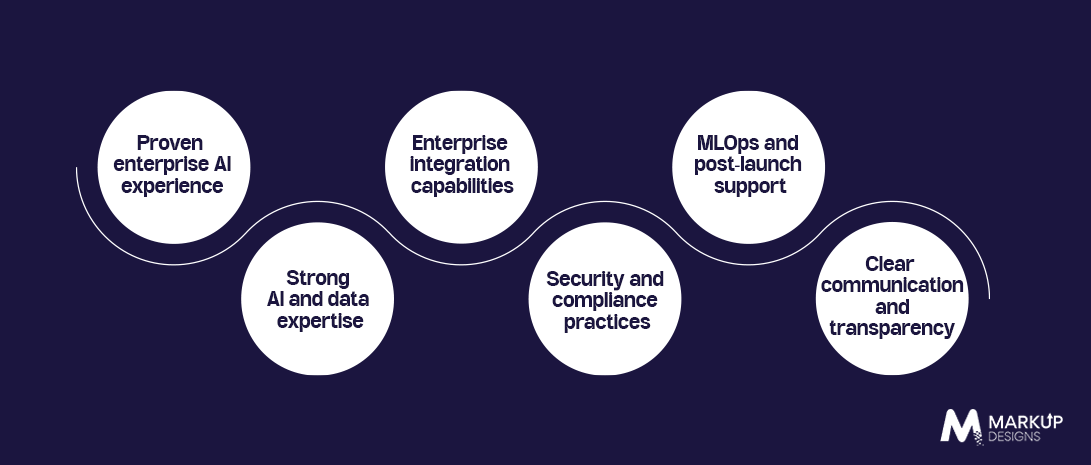
Proven enterprise AI experience
It is important to choose a partner who has experience in providing AI solutions in the context of enterprise settings rather than prototypes or demos.
Strong AI and data expertise
The team must have knowledge of machine learning, generative AI, data engineering, AI agents, and other similar technologies.
Enterprise integration capabilities
Integrations with CRM, ERP, cloud services, APIs, databases, and legacy systems are common in the case of AI solutions. Make sure that your partner has the experience of dealing with such integrations.
Security and compliance practices
Enterprise data is sensitive. See whether your partner is capable of handling data access, encryption, privacy, security, and compliance.
MLOps and post-launch support
The performance of AI may change over time. Ensure that your partner can monitor AI models, update them, detect problems, and optimize their performance.
Clear communication and transparency
Pricing, realistic deadlines, updates, documentation, and clear responsibilities can make the whole engagement more effective.
Key Questions to Ask Before Hiring an AI Outsourcing Partner
Choosing an outsourcing company for artificial intelligence solutions is one of the biggest decisions that can be made by any business organization. However, before coming to any conclusion, enterprises should pose some questions to find out certain facts about the partner.
Here are some important questions to ask:
1. How much experience do you have with enterprise AI initiatives?
Request relevant case studies, examples, and metrics.
2. Are you able to integrate with our current systems and infrastructure?
It is important that the partner is aware of your existing data, APIs, cloud, legacy systems, and more.
3. How do you secure enterprise data?
Explore issues of access control, encryption, privacy, security, and so more.
4. How do you monitor AI models?
The partner needs to have an answer on how they track performance, find problems, and improve AI models once deployed.
5. Who owns the AI solution and its associated assets?
It is important to clarify the issue of ownership in terms of source code, models, documentation, data, and other deliverables.
6. What kind of support do you offer post-deployment?
Be aware of maintenance, troubleshooting, updating, scaling, and optimizing options provided by the partner.
Asking these questions early can help enterprises avoid costly surprises and select a partner that can support their AI journey for the long term.
Ready to Turn Your AI Ideas Into Enterprise Solutions?
Partner with an experienced AI development team to build secure, scalable, and business-focused AI solutions. From AI strategy and development to integration and ongoing support, the right expertise can help you move from experimentation to real-world results.
Enterprise AI Outsourcing Models
Different companies have different requirements for their AI projects regarding budget, time frame, and technical capability. This is the reason why outsourcing of AI services is possible under a number of engagement models. Selection of the engagement model varies according to how much control and technical assistance one wants.
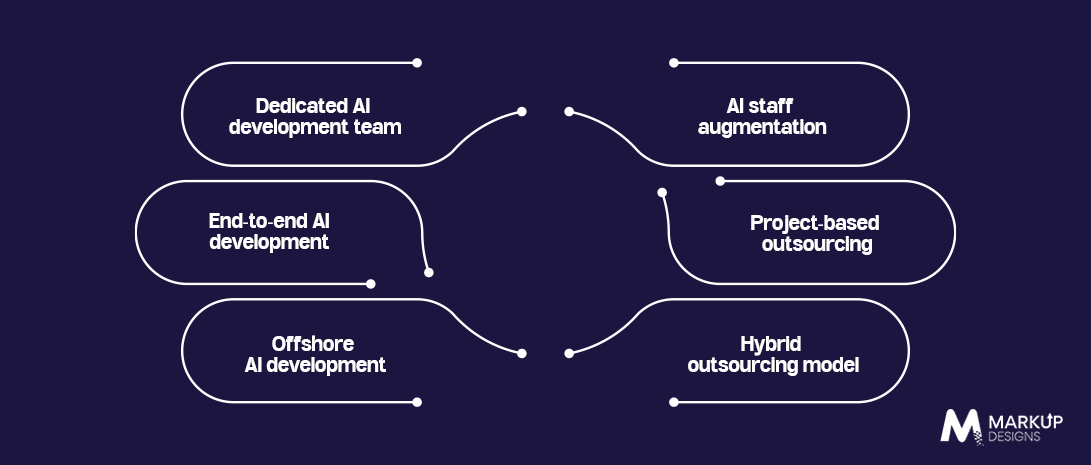
1. Dedicated AI Development Team
Having a dedicated team provides you with an AI professional team working only for your project. The approach is suitable for enterprises that are implementing AI solutions on a consistent basis.
2. AI Staff Augmentation
In case of staff augmentation, enterprises acquire external AI experts to join their existing team. It can be applied if you have an internal development team but require additional assistance.
3. End-to-End AI Development
The outsourcing partner controls the entire AI model development process, starting from planning and data preparation through to development, integration, deployment, and support.
4. Project-based Outsourcing
It is appropriate for enterprises that have a well-articulated project scope and timelines regarding AI technology. The partner oversees development according to the set deliverables.
5. Offshore AI Development
Enterprises collaborate with an offshore AI development team from other countries/regions, which could be an advantage due to expertise and reduced development costs.
6. Hybrid Outsourcing Model
The internal team works in collaboration with AI experts from outside. Enterprises retain their strategic control while outsourcing partners handle the rest of the development process.
How Much Does Enterprise AI Outsourcing Cost?
The cost of AI outsourcing for business purposes is going to be highly variable, as each AI project comes with its own unique demands. An easy AI automation process is going to need an entirely different development process than that of an extensive enterprise AI system.
As a general reference, enterprise AI outsourcing projects can fall into these ranges:
| Project Complexity | Estimated Cost |
| Small AI implementation | $40,000–$80,000 |
| Mid-level enterprise AI solution | $80,000–$200,000 |
| Complex enterprise AI platform | $200,000–$400,000+ |
These figures are only indicative. The actual cost depends on several factors, including:
- AI solution complexity: Complex models, AI agents, and multi-model approaches usually entail higher development costs.
- Data issues: Data preprocessing, annotation, engineering, and integration could influence your budget a lot.
- Integration needs: Integrating AI solutions into ERP, CRM, API-based services, cloud services, or legacy systems will take additional development time.
- Computing issues: Using cloud infrastructure, hosting models, data storage, and processing are all expenses.
- MLOps and maintenance: Monitoring, retraining, optimization, security updates, and post-launch support also need to be considered.
So, businesses should estimate the total cost of ownership, not only the initial development costs.
Red Flags to Watch for When Choosing an AI Outsourcing Company
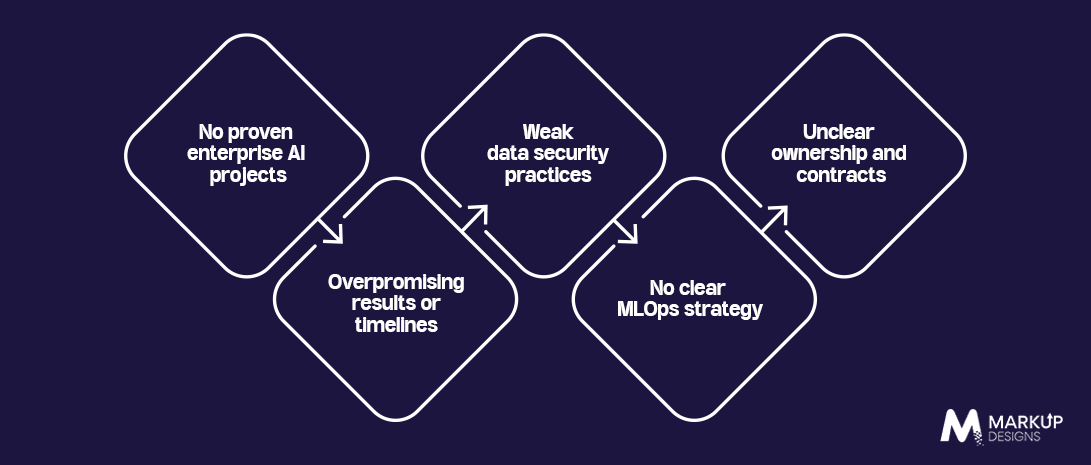
Choosing an AI outsourcing company based solely on their portfolio or price may cause some trouble down the line. Since enterprise-level AI solutions require working with highly confidential information, integration of different technologies, and long-term support, one must consider all possible red flags in advance.
Here are some red flags to watch for:
1. No proven enterprise AI projects
Watch out for organizations that only demonstrate basic demos or experimental AI applications that haven’t been implemented in practice.
2. Overpromising results or timelines
Don’t use partners that promise instant success, minimal prices, and short-term delivery without any understanding of your needs.
3. Weak data security practices
The organization you select should have a process in place for handling access, storage, encryption, privacy, and security of your data.
4. No clear MLOps strategy
Once an AI application is deployed, the work isn’t over. The absence of continuous monitoring, updating, and performance could cause problems in the future.
5. Unclear ownership and contracts
The contract must clearly state the ownership of the source code, models, documentation, and other elements of your project.
Identifying these warning signs early can help enterprises avoid unnecessary costs, delays, and operational risks.
How to Evaluate and Shortlist AI Development Partners
Finding potential AI development companies is only the first step. Enterprises also need a structured process to compare partners and identify the one that best fits their technical and business requirements. A clear evaluation process can reduce risks and make the selection more practical.
Define Your AI Business Goal
The first step is determining the business problem that AI is supposed to solve, the anticipated results, the audience, and the KPIs.
Evaluate Your Data and Technical Environment
Examine current data sources, applications, APIs, cloud technology, security considerations, and other relevant factors.
Create a List of Relevant Companies
Find companies that have experience working with enterprise AI solutions, companies in your industry, and similar solutions that you want to implement.
Assess Their Expertise
Assess their expertise in AI/ML, generative AI, data engineering, MLOps, cloud solutions, integration, and security.
Research Their Cases and References
Beware of only seeing logos; check out past work, business results, complexity of implementation, and customer reviews.
Start with Proof of Concept
In more complicated projects, implementing a well-formulated proof of concept might be an efficient initial step.
Finally, compare communication, pricing, timelines, ownership terms, support, and scalability before making the final decision.
What Makes Markup Designs a Trusted Enterprise AI Development Partner?
Choosing the appropriate partner for the development of AI is not only a matter of technical expertise. Companies need partners who can provide them with solutions in accordance with their objectives, can operate in the complicated environment of technologies, are proficient in data protection, and can ensure the proper operation of AI solutions after their implementation. Here comes the expertise of Markup Designs.
Markup Designs helps companies turn their AI solutions into reality using AI development, data engineering, automation, system integration, and constant support services. They are knowledgeable in providing solutions for various industries such as generative AI, AI agents, machine learning, intelligent automation, and enterprise AI applications.
In order to select a technology, we first have to understand the problem associated with the business so that we can make sure AI technologies are adopted not just because it is trending but rather because of their value addition. The whole process of designing and developing the AI solution can be done in accordance with the technological infrastructure of the enterprise.
Markup Designs has another area of focus on scalability and future compatibility. Since business requirements keep changing over time, there may be a need to optimize, train, and integrate AI solutions in the future. Having a partner to provide these services makes it easier to adopt scalable AI solutions for an enterprise.
Looking for the Right Enterprise AI Development Partner?
From AI strategy and development to integration and ongoing optimization, Markup Designs can help turn your AI vision into a production-ready solution.
Conclusion
Outsourcing enterprise AI enables companies to leverage specialized skills, speed up the process, and scale their AI efforts without developing everything internally. But this requires finding the right developer for a company’s needs. In addition to cost considerations, an enterprise must examine AI skills, industry experience, data capabilities, security, integration, MLOps, communication, and follow-up services.
Furthermore, the type of outsourcing must fit business needs. Enterprises may need dedicated teams, staff augmentation, project-based development, or any combination of these. It is vital that the correct developer can understand business problems, design robust solutions, integrate them into current business practices, and improve the process continually.
FAQs
1. What is enterprise AI outsourcing?
Enterprise AI outsourcing involves working with an external AI development company to plan, develop, deploy, integrate, and maintain AI solutions for business operations.
2. Why do enterprises outsource AI development?
Enterprises outsource AI development to access specialized talent, accelerate implementation, reduce hiring overhead, and gain expertise in technologies such as machine learning, generative AI, AI agents, and automation.
3. How do I choose the right enterprise AI development partner?
Evaluate the company’s enterprise AI experience, technical expertise, data capabilities, security practices, integration experience, MLOps capabilities, communication process, and post-launch support.
4. How much does enterprise AI outsourcing cost?
Enterprise AI outsourcing can range from around $40,000 to $400,000+, depending on project complexity, data requirements, integrations, infrastructure, AI models, security, and ongoing support.
5. What AI solutions can enterprises outsource?
Businesses can outsource generative AI applications, AI agents, predictive analytics, recommendation systems, computer vision, intelligent automation, chatbots, copilots, and other AI-powered enterprise solutions.
Author's Perspective
Enterprise AI outsourcing is not just about reducing development costs. Its real value lies in accessing specialized expertise and moving AI projects from experimentation to production. The right partner should understand business goals while considering data quality, integration, security, monitoring, scalability, and maintenance. A strong outsourcing relationship should be built on clear goals, transparent communication, measurable outcomes, and continuous improvement, helping enterprises adopt AI faster and create long-term business value.
Discuss Your Project NowJupinder Singh Arora
Founder and CEO
Related Posts
How AI is Revolutionising Industrial Automation in Australia
How UK Enterprises Can Build an Effective AI...
AI Voice Agent for Real Estate: Features, Benefits,...
Insights Are Valuable & Execution is Priceless
You’ve read about the digital future. Now, let’s build the infrastructure to take you there. Move your strategy from the page to the product.
Design Your Solution Now
Contact Us
Schedule The Appointment At Your Convenience Date And Time.
30 Min
Web Conference
Time Zone
Indian standard time (08:30pm)

Thanks For Getting In Touch!
You’ve Taken The First Step Toward Transforming Your Digital Presence. Our Experts Will Reach Out Shortly To Take It Forward.
Launch Your Dream Project
Provide a brief overview of your project, and our specialists will evaluate your requirements. We will connect with you to explore how the right digital solutions can help you launch faster.