
In Brief
- Learn how AI outsourcing helps businesses reduce implementation risks and accelerate AI adoption.
- Understand the key factors to evaluate when selecting an AI outsourcing partner.
- Explore the most common AI outsourcing models, including dedicated teams, staff augmentation, and full-service partnerships.
- Compare the benefits and challenges of outsourcing AI versus building an in-house AI team.
- Identify common warning signs that can lead to AI outsourcing project failures.
- Discover practical strategies for successful AI implementation, from data readiness and integration to MLOps and governance.
A company starts an AI pilot, and at first, it’s working nice in a controlled environment. However, once it needs to fit into existing systems and workflows, issues crop up, and its performance falters. Then, people start considering outsourcing the AI not only to save on costs but also to get specialized knowledge and keep projects moving forward.
The urgency isn’t slowing down either. Gartner thinks AI will impact every bit of enterprise IT by 2030, changing how businesses manage technology. As a result, companies must figure out early, which AI tasks to do in-house and when to bring in external pros.
So, switching to AI outsourcing is becoming sensible. Although dealing with private data demands an internal approach, handing other tasks to skillful AI providers speeds up development and lessens integration headaches.
In this blog, we’ll be reading about how to pick the right AI outsourcing task, how to find the best AI outsourcing partners, and how to dodge common errors that hold up your AI adoption process.
Key Factors to Consider When Selecting an AI Outsourcing Partner
A demo can seem amazing, and sales folks can sound very confident. But the real test happens when their solution has to work with your actual data, systems, and everyday tasks.
When choosing an AI outsourcing partner, don’t just evaluate how well they do in a perfect demo. It’s more important to see how they handle real-world issues. Can they fit into your existing setup? Are they prepared for the issues that are going to come after deployment? Most importantly, will they take responsibility for making the solution succeed and keep getting better?
1. Focus on Real-World Implementation, Not Just Model Performance
Even if a model does well during tests, it might still have problems when deployed. Things like heavier system loads, longer response times, and shifting data can really mess up. Plus, real-world issues frequently make it underperform, too.
- Talk to AI experts and quiz them on their projects that actually worked. Learn how they handle latency and failures, and ask about managing bigger workloads.
- See if they’ve done any real-time applications or dealt with large data sets previously.
- Also, probe into how they go about monitoring things after deployment and how they tackle declining performance.
If they only talk about accuracy scores and benchmarks, they might be ignoring key aspects needed for long-term success.
2. Evaluate Data Management Capabilities
AI projects depend heavily on both data and models. They often run into trouble not because of faulty algorithms, but due to issues like poor data quality, availability problems, or difficulties integrating it all. It’s really crucial then to understand an AI outsourcing partner’s approach to handling data throughout the entire process.
- Make sure to ask about their data pipeline setup and upkeep. ‘
- Find out how they deal with missing information, varying structures, and non-uniform inputs. Also, see if they can handle batch data along with real-time streams.
- Figure out their methods for ensuring smooth data flow between different systems and applications.
The best AI teams consider data to be a vital part of the overall solution. Data isn’t just something to clean before starting model development; it’s much more significant than that.
3. Good MLOps Framework
Building the AI model is only half the battle. Once the system is deployed, the outsourcing firm is responsible for ensuring that the developed system is effective.
- Ask about how they manage and monitor models, datasets, and feature versions.
- Do they constantly monitor the performance of the model and detect issues like data drift and accuracy degradation?
- See how they customise their models to handle any shifts in business requirements and/or data patterns.
- Check if they have processes to safely push out model updates and back out if needed.
If your chosen AI outsourcing firm cannot give you a clear answer on what to do post-deployment, then you can expect some issues down the road.
4. Evaluate the Integration Expertise
Unless the tech is simple to slot into what you’ve already got, it won’t help, right? So, pick an AI outsourcing partner who will give you a solid plan for smooth integration. This way, adding AI won’t turn into a headache.
- Before signing on the dotted line, ask about their track record with old systems and other complex setups.
- See how they plan to fit their AI into your current setup and daily workflow.
- Plus, quiz them on dealing with common problems like, sluggish responses, and syncing mishaps.
- Find out their tricks for keeping data accurate across all systems.
5. Check Security and Data Access
When collaborating with AI outsourcing partners, sharing your company’s and customers’ sensitive info might be necessary. So, it’s crucial to understand their methods for managing data protection, access, and compliance.
- First, ask about their history with handling sensitive and personally identifiable info.
- Make sure they use security solutions that let you keep control and visibility over data access.
- Plus, check if they meet different security requirements, such as GDPR or SOC 2.
- Also, find out their stance on data ownership, storage, and retention.
Verify if they can operate in secure settings, like private cloud infrastructure or VPCs. And don’t miss out onto look their AI governance policies. An AI outsourcing partner will have strong rules covering model usage, monitoring, and audits. This helps cut down security risks and boost governance and compliance overall.
6. Verify Experience
Tech skills matter, but industry smarts are key too. If you’re an expert in your field, you’ll do better on AI projects. Someone who truly understands your industry can actually make solutions that fit your business and customer needs.
- Make sure to check if the team has done work in exact field before. Also, check if, they know about the unique stuff in your specific area.
- Question them deeply about process risks and quirks. It’s important they can offer smart advice beyond just ticking off basic requirements.
- Companies that truly understand your industry often know the right questions to ask from the very beginning.
7. Evaluate Communication Practices
The way an AI partner communicates at the start might show how they’ll talk during the whole project. If done right, it can lower confusion and help the project succeed.
- Be cautious when discussing crucial stuff like data access, tech needs, and system integration hassles.
- Make sure your expectations are realistic and not overly optimistic.
- Make sure key decisions are easy to understand and that possible issues are anticipated before they arise.
Should You Outsource AI or Build an Internal Team?
Many organization wonder whether to develop AI in-house or team up with partners. The ideal choice hinges on their expertise, project complexity, timelines, and primary objectives. In the end, it’s about striking a balance between speed, cost, and control. So, you should go with what fits your needs best.
| Factor | Outsource AI | Build an Internal Team |
| Speed to Market | Faster implementation with access to experienced AI specialists and established processes. | Slower due to hiring, onboarding, and building internal capabilities. |
| Upfront Investment | Lower initial costs since infrastructure and expertise are already available. | Higher costs for recruitment, training, tools, and infrastructure. |
| Access to Expertise | Immediate access to AI engineers, data scientists, MLOps specialists, and domain experts. | Requires time and resources to build a skilled AI team. |
| Scalability | Easier to scale resources up or down based on project needs. | Scaling often requires additional hiring and operational investment. |
| Control Over Development | Less direct control over day-to-day execution and processes. | Full control over development priorities, workflows, and decision-making. |
| Knowledge Retention | Some knowledge may remain with the outsourcing partner. | Knowledge and expertise stay within the organization. |
| Long-Term Costs | Cost-effective for short-term projects or specific use cases. | Can become more cost-effective for continuous AI development and innovation. |
| Data Security & Compliance | Requires careful evaluation of security practices and compliance standards. | Greater control over sensitive data, governance, and compliance requirements. |
Common AI Outsourcing Models Used by Enterprises
When looking into outsourcing firms, the cost is usually zero in on similar details. While cost, team size, and deadlines are crucial, the actual method of outsourcing AI tasks also matters a lot. This shapes how efficiently and smoothly things go. So, following the approach and those usual factors into account really makes a difference.
There’s no one-size-fits-all way to outsource. Companies often rely on different models depending on what fits their project best. Knowing these options is important before you decide.
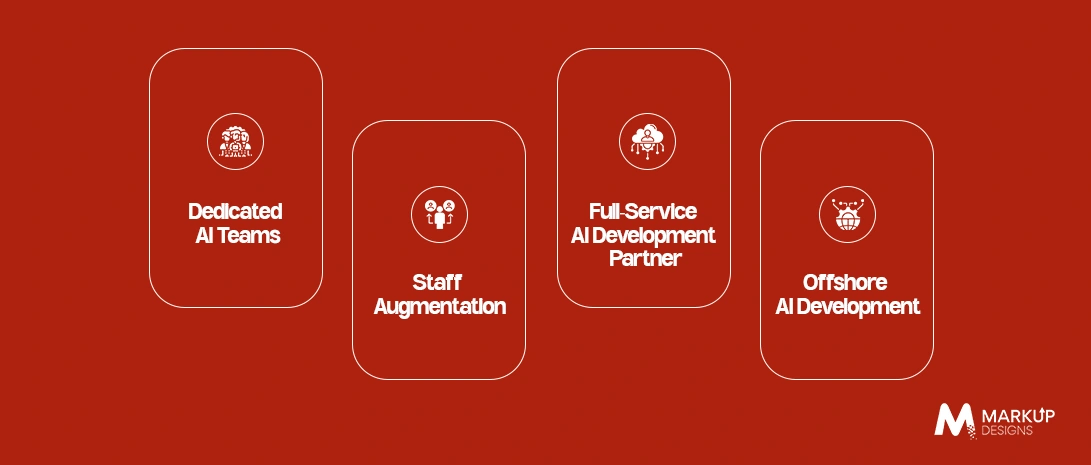
1. Dedicated AI Teams
This works for enterprises who already have an AI plan and strong internal leaders, but needs a skills boost for quicker action. It involves bringing in AI pros like machine learning engineers and data gurus to work with your team following your rules and using your tech.
This lets you amp up your AI efforts while keeping full control, which is super important.
Best suited for
- Long-term AI initiatives
- Enterprise AI platforms and products
- Organizations developing and maintaining multiple AI models over time
Key considerations
- Establish clear coding standards, development practices, and deployment processes from the start.
- Define responsibilities and ownership clearly between internal and external teams to reduce confusion and duplicated efforts.
- Ensure secure and efficient access to the data, tools, and systems required for collaboration.
When managed effectively, a dedicated AI team can function as a natural extension of your organization, helping you deliver projects faster without sacrificing quality or oversight.
2. Staff Augmentation
Staff augmentation can be perfect if you want to bring in specific AI experts without building a full team. Rather than filling up your crew with lots of new people, you add specialized roles such as ML engineers or NLP experts. These professionals can quickly integrate into your existing team and contribute their expertise where it is needed most, helping move your project forward and address complex challenges more effectively.
For optimizing models and boosting performance, setting up MLOps and deployment, scaling AI infrastructure, and standalone expert projects, here are key points:
First, avoid relying on just a few folks by documenting stuff across the organization. Secondly, plan how to transition knowledge so your team can keep things running after the engagement. Lastly, make sure everyone has clear roles for smooth teamwork.
Staff augmentation allows businesses to quickly access specialized AI expertise without the time and effort required for full-time hiring AI consultant. This flexibility helps organizations fill skill gaps, accelerate project timelines, and scale resources as needed
3. Full-Service AI Development Partner
This approach is ideal for companies that want an experienced partner to manage the entire AI development lifecycle. Instead of expanding their internal team, businesses can rely on a specialized AI development company to handle everything, from strategy and planning to development, deployment, and ongoing support. This allows organizations to focus on their core operations while ensuring the project is delivered efficiently by experienced professionals.
That covers prepping data and crafting solutions, setting up the needed infrastructure, blending systems, deploying it all, and giving constant support afterwards.
Recommended for
- New AI projects
- Projects implementing AI for the first time
- Complex projects involving various systems or technologies
- Firms with little AI experience in-house
Important things to keep in mind
- Ownership of data, models, and IP should be established up front.
- Make sure there is transparency in decision-making and the development process..
- Documentation and knowledge transfer should be requested.
4. Offshore AI Development
Offshore AI development involves partnering with an AI development company located in another country to design, build, and maintain AI solutions. This model is often chosen by enterprises looking to access specialized talent, scale development teams quickly, and optimize project costs without compromising on quality.
Best Suited for
- Massive amounts of data processing and annotation work
- Regularly scheduled model training and fine-tuning activities
- Back-end development and support
- Budget-oriented AI initiatives need extra development staff
Important factors
- Set up proper communication procedures to reduce the difficulties that may arise due to different time zones.
- Implement high standards of quality control and governance to achieve consistent outcomes.
- Formulate proper workflows and responsibilities to stay on track.
- Coordinate the actions of the in-house and outsourced teams effectively.
Know the Costing of AI Outsourcing
Organizations usually look at initial costs when thinking about outsourcing AI projects. This includes labor, time, and development expenses. Yet, the pricing for these apps can differ greatly, going from $40,000 to $400,000 or even more. These figures don’t cover everything though; there are extra costs to consider as well.
| Cost Factor | What It Covers | Cost Impact |
| Project Complexity | AI solution scope, custom features, integrations | High |
| Data Preparation | Data collection, cleaning, and labeling | Medium–High |
| Model Development | Training, testing, and optimization | High |
| System Integration | Connecting AI with existing systems and APIs | Medium–High |
| Infrastructure | Cloud services, storage, and computing resources | Medium |
| Security & Compliance | Data protection and regulatory requirements | Medium |
| Testing & Deployment | Quality assurance, deployment, and MLOps | Medium–High |
| Domain Expertise | Industry-specific knowledge and consulting | Medium |
Common Failure Signals in Outsourcing of AI
1. Shift Attention From Model Accuracy To Business Goals
When the talk is just about how well the model performs without mentioning business goals, it’s a major red flag. True success comes from thorough planning on data, integration, and deployment, along with setting tangible objectives. Without these, the project probably won’t do as well.
2. Overly Ambitious Timeframes And False Promises
Don’t fall for companies making unrealistic promises. Developing these solutions usually hits roadblocks with data prep, integration, and optimization. A reliable provider will be upfront about project hurdles, so always listen to their honest assessment.
3. Ineffective Communication Processes
Ineffective communication during development causes confusion and inefficiencies. Without clear requirements and regular status reports from the start, things fall apart fast. Misunderstandings about tech choices add to the mess.
4. Lack of Defined Roles and Responsibilities
Unclear roles and responsibilities cause problems in many cases. So, from the start, we need to figure out data ownership and model management. Deployment duties and post-deployment support should be settled too, plus this ensures everything runs smoothly later on.
5. Ignoring Data Integration Considerations
Most AI developments run into issues when data readiness is ignored. If an AI firm doesn’t question you about your infrastructure and data, expect trouble down the line. So, make sure they dig for that info early on; otherwise, it’s trouble ahead.
Key Strategies for Successful AI Outsourcing

After picking a partner, the real work begins. People often think everything will go smoothly from there. But that’s not always the case. This stage is just as crucial as choosing the right partner. Following certain practices can prevent future mishaps, though. So it’s worth doing things correctly from the start.
1. Set up the Scope of the Complete System from Day One
In many AI projects, the goal is clear – create a recommendation engine or automate document processing, for example. However, even when the idea seems simple at first glance, determining how the AI solution will fit in can be really tough.
During the early planning phase, you’ve got to set boundaries and understand how all the project pieces will link up. Figure out which processes and duties your AI system will handle. Also, list the data sources it needs and which systems will use its output data. And think ahead about any human intervention that might be necessary along the way.
2. Make Sure Data Is Properly Prepared Before Proceeding With Model Development
A common reason for AI project delays is poor data preparation. Often, folks assume the needed data is readily available when starting an AI project, but issues arise once they dive into the work.
To prevent problems, check data quality, accuracy, and consistency beforehand. That means coming up with plans for structuring and validating data, plus figuring out how to smoothly share it between systems. Deal with any data hassles from the get-go, before model development begins.
3. Integrate MLOps into Early Scope Planning
It is commonly delayed till later phases, leading to persistent instability.
- Create version control, monitoring, and alerting in advance
- Develop rollback plans before deployment
- Monitor data drift and performance degradation
- If not done, such problems will go undetected till they start impacting users.
4. Plan Integration as an Essential Workstream, Not a Last Resort
Most delays usually occur during integration, particularly in enterprise settings.
- Start by determining any API dependencies and system limitations
- Create your plan with asynchronous processing and error handling in mind
- Perform tests using live system inputs, not just pre-determined data sets
- Those systems that aren’t designed for live inputs will fail under pressure.
5. Determine Ownership Amongst Teams
Lack of clarity when everyone is responsible for something can be very problematic.
- Clarify who owns the data pipeline, models, and deployments
- Clarify what team owns incidents, updates, and monitoring
- Overlap among responsibilities can slow down processes and lead to misunderstandings.
How Does Markup Designs Help Companies to Scale AI?
Many firms hit roadblocks after initial AI model tests are successful. Though it starts strong, issues often surface with real-life data. At Makup Designs, while creating AI services, they focus on building a solid base first. Instead of only working on the model, they double-check that the required data is accurate too.
Smart planning at the beginning has a huge effect on the AI project’s success. Clear expectations about needed data, essential integrations, business goals, and team duties help avoid headaches and costly surprises later on. Even when outsourcing, companies keep control over the overall strategy and direction, benefiting from experts’ input on the technical aspects.
Scale AI with Confidence, Not Complexity
AI projects need more than just good models. Data readiness, system integration, deployment, and ongoing tweaks all matter for lasting success. Work with seasoned AI pros to create solutions that scale well, so you don’t miss out.
Conclusion
AI outsourcing was once mainly about cutting costs, but now it’s also a way to tap into specialized skills, speed up projects, and tackle growth hurdles.
Efficient outsourcing isn’t just about finding great engineers. You need a team that understands data readiness, systems integration, MLOps, and AI cybersecurity too. Delivering AI solutions properly requires lots of different skills.
Companies that really benefit from AI see outsourcing as more than a simple transaction. It’s about forming a lasting partnership. So, if you want to make the most of AI, team up with a company that gets all the complexities involved.
FAQ
1. What is AI outsourcing?
AI outsourcing is the practice of hiring external experts or specialized AI development companies to handle tasks such as data engineering, model development, deployment, MLOps, and ongoing AI maintenance.
2. When should a company outsource AI development?
Organizations typically outsource AI development when they need specialized expertise, faster implementation, additional development capacity, or support for complex AI initiatives that internal teams cannot manage alone.
3. Is it better to outsource AI or build an in-house team?
The answer depends on your business goals, budget, and available expertise. Outsourcing is often ideal for faster execution and access to specialized talent, while in-house teams provide greater control, knowledge retention, and long-term ownership.
4. What are the most common AI outsourcing models?
The most common models include dedicated AI teams, staff augmentation, full-service AI development partnerships, and offshore AI development teams. Many enterprises use a combination of these models depending on project requirements.
5. How much does AI outsourcing cost?
AI outsourcing costs can range from approximately $40,000 to $400,000 or more, depending on factors such as project complexity, data readiness, infrastructure requirements, integration needs, and ongoing maintenance.
6. What are the biggest risks in AI outsourcing?
Common risks include poor data quality, unclear ownership, weak integration planning, inadequate security controls, lack of MLOps practices, and insufficient communication between internal and external teams.
7. How can businesses choose the right AI outsourcing partner?
Look beyond model performance and evaluate real-world implementation experience, data management capabilities, integration expertise, security practices, industry knowledge, communication processes, and post-deployment support strategies.
8. Can outsourced AI projects remain secure and compliant?
Yes. With the right partner, organizations can maintain strong security and compliance standards through access controls, governance frameworks, secure infrastructure, audit processes, and adherence to regulations such as GDPR and SOC 2.
Author's Perspective
Lots of businesses assume that having a top-notch model means their AI project is guaranteed to succeed. While that’s partly true, it only scratches the surface. There are tons of other problems that appear once the model is made – like fitting the data into place, integrating it with current systems, and managing all the upkeep stuff afterwards. What seems to make the biggest difference is having a solid foundation from the start. That means clear job definitions and making sure everyone’s on the same wavelength. So while the quality of your models is important, it’s actually about how well you set everything up initially that tends to lead to the best results.
Discuss Your Project NowJupinder Singh Arora
Founder and CEO
Related Posts
How AI is Revolutionising Industrial Automation in Australia
How UK Enterprises Can Build an Effective AI...

AI Voice Agent for Real Estate: Features, Benefits,...
Insights Are Valuable & Execution is Priceless
You’ve read about the digital future. Now, let’s build the infrastructure to take you there. Move your strategy from the page to the product.
Design Your Solution Now
Contact Us
Schedule The Appointment At Your Convenience Date And Time.
30 Min
Web Conference
Time Zone
Indian standard time (08:30pm)

Thanks For Getting In Touch!
You’ve Taken The First Step Toward Transforming Your Digital Presence. Our Experts Will Reach Out Shortly To Take It Forward.
Launch Your Dream Project
Provide a brief overview of your project, and our specialists will evaluate your requirements. We will connect with you to explore how the right digital solutions can help you launch faster.