

In Brief
- Generative AI is involved in creation, coding, imaging, and obtaining valuable insights, whereas Agentic AI has the remarkable ability to take actions, finish operations, and meet business objectives with less human participation needed.
- Selecting the proper AI strategy is based on your business needs, operational complexity, budget flexibility, and regulatory norms, and not on the newest technology in the market.
- Australian businesses gradually introduce AI into operations in order to boost productivity, automate workflows, improve customer service, and support data-centered decision-making in various industries.
- In case Generative and Agentic AIs technologies are combined into one solution, it makes it possible for a company to reach maximum efficiency through intelligent content creation and automatic task execution.
- Working with a reputable AI vendor makes the process of implementation secure, compliant with regulations, well-integrated, and scalable.
Artificial Intelligence is changing the way that Australian businesses work, innovate, and compete in a digital economy. Because of this technological revolution, businesses are spending more on AI than ever before. There’s no argument about whether to use AI or not. Instead, focus on choosing the right type of AI technology, which will ensure your business success for many years to come.
Both Generative AI and Agentic AI are at the forefront of this revolution, with each of these technologies being designed for different purposes. By means of Generative AI, you can generate content, code, and business insights, whereas Agentic AI is responsible for autonomous planning and the realization of tasks. This blog will review the key differences between these two AI models, their applications, costs, and benefits.
Australia’s AI Landscape: Why Businesses Are Investing in Next Generation AI
In Australia, organizations embrace Artificial Intelligence because they want to increase productivity, improve customer service, and speed up digital transformation.
From finance and healthcare to retail and logistics, businesses are adopting AI to automate processes, improve decision-making, and gain a competitive advantage in an evolving market.
AI implementation across Australian industries
In Australia, companies are deploying artificial intelligence solutions in different sectors to identify new use cases, enhance customer experience, streamline business processes, and drive efficiency. The demand for new automation solutions is prompting enterprises to invest in artificial intelligence technologies.
Government initiatives in enterprise AI
Government schemes on responsible AI, digital innovations, and investments in digital technology are promoting the adoption of artificial intelligence among enterprises.
Significance of AI strategy
The integration of AI solutions without defining a proper business strategy can result in suboptimal returns for a business entity. Companies should ensure that their artificial intelligence initiative is in line with their business goals, needs, and long-term development strategy.
Generative AI
Generative AI refers to artificial intelligence systems that produce creative output based on data analysis and pattern extraction. The information generated by generative AI may include text, images, code, sounds, and videos, allowing organisations to enhance productivity or automate selected operations.
How does Generative AI operate?
Generative AI relies on certain advanced machine learning techniques and large language models to process textual information and develop adequate responses based on pre-established knowledge.
1. Core Capabilities of Generative AI
It can produce content, summarise, write code, provide answers, translate, create images, and assist with research and documentation tasks.
2. Commonly Used Generative AI Models and Platforms
Commonly used platforms are ChatGPT, Google Gemini, Claude, Microsoft Copilot, and Adobe Firefly, which work according to the different needs of businesses.
3. Generative AI Applications in Different Sectors in Australia
Australian businesses use Generative AI for customer support, marketing, software development, financial reporting, healthcare paperwork, and creating personalised learning.
4. Pros of Using Generative AI in Australia
Generative AI makes things easy, boosts productivity, and speeds up content creation while ensuring better decision-making and increasing customer satisfaction at a lower cost.
5. Disadvantages of Generative AI and Its Governance Issues
Though Generative AI offers many advantages, it may produce inaccurate results, cause data privacy issues, and require governance for better implementation.
What Is Agentic AI?
Agentic AI is an advanced form of artificial intelligence that is capable of independent planning, making decisions, and performing tasks without human interference. Whereas traditional AI is a reactive technology, Agentic AI can think for itself and can independently carry out complex workflows.
How Agentic AI Differs from Traditional AI Systems
In traditional AI systems, predetermined assignments are executed, but agentic AI systems reason, generate choices, and execute actions to realize particular aims.
Fundamental Parts of an Agentic AI System
Agentic AI systems consist of AI models, memory, planning abilities, decision-making logic, APIs, and other external tools.
How Autonomous AI Agents Make Choices
AI agents examine the available data, assess alternative courses of action, and modify their decisions depending on changing business objectives and new information.
Real World Uses of Agentic AI in Australian Business
Australian companies are implementing agentic AI for smart customer service delivery, automation of processes, supply chain improvement, financial activities, protection against cyber threats, and decision-making in business.
Advantages of Agentic AI for Business
Among the numerous benefits of agentic AI, are improved efficiency in operations, reduced need for manual interventions, increased decision-making speed, greater productivity, and the ability to automate complex processes.
Challenges, Governance, and Human Control
Implementation of agentic AI requires careful monitoring, data protection, compliance with regulations, and human supervision of the system for continuous reliability and transparency.
Agentic AI vs Generative AI: Complete Comparison
While both technologies are transforming businesses, they serve different purposes. Generative AI focuses on creating content and insights, whereas Agentic AI is designed to make decisions and execute tasks autonomously.
| Comparison Factor | Generative AI | Agentic AI |
| Purpose | Creates content, code, images, and text | Executes tasks and achieves business goals autonomously |
| Intelligence Model | Generates responses based on prompts | Plans, reasons, and takes actions independently |
| Level of Autonomy | Low to moderate | High |
| Human Intervention | Requires user prompts and guidance | Operates with minimal human involvement |
| Decision-Making Ability | Limited to content generation | Makes autonomous decisions based on objectives |
| Output Type | Text, images, code, audio, and reports | Completed tasks, workflows, and business outcomes |
| Learning Capability | Learns from training data and prompts | Continuously adapts using feedback and changing conditions |
| Workflow Automation | Assists with individual tasks | Automates end-to-end business processes |
| Integration Complexity | Moderate | High |
| Security Risks | Data privacy and content accuracy | Security, governance, and autonomous decision risks |
| Compliance Requirements | Data protection and responsible AI practices | Advanced governance, compliance, and audit controls |
| Infrastructure Requirements | AI models and cloud infrastructure | AI agents, orchestration frameworks, APIs, and enterprise systems |
| Scalability | Easily scales for content generation | Scales across enterprise workflows and operations |
| Development Complexity | Moderate | High |
| Business Value | Improves creativity and productivity | Drives automation, efficiency, and operational intelligence |
| Time to Market | Faster implementation | Longer implementation due to system integration |
| Implementation Cost | Lower | Higher |
| Best Fit Industries | Marketing, education, software development, customer support | Banking, healthcare, logistics, manufacturing, and enterprise operations |
When Should Australian Businesses Choose Generative AI?
Generative AI will provide the best solution for companies interested in increasing workplace efficiency, speed in content creation, and aiding their employees with smart systems. It suits organizations that would like to boost the workflow but cannot fully trust machines when making decisions.
Generative AI Use Cases
Generative AI can be efficiently used for purposes such as creating content, solving customers’ problems, developing software, conducting research, producing documents, and storing knowledge.
Generative AI Applications Across Different Industries
Generative AI technologies have already been used by such industries as marketing, education, healthcare, finance, retail, legal, and IT to increase efficiency and enhance client experience.
Business Functions Where Generative AI Is Most Valuable
Generative AI has proven its efficiency in many business processes, including content marketing, sales, customer service, human resource management, software development, data analysis, and reporting.
Signs That Your Company Is Prepared for Generative AI
The company is ready to benefit from Generative AI technologies if it aims to reduce the level of routine work, boost the productivity of employees, and create content faster.
When Does Your Business Need Agentic AI Instead?
Agentic AI is preferable for businesses that need intelligent systems to make decisions, control processes, and perform complicated tasks with less human involvement.
1. Possible Cases for Autonomous AI Implementation
Agentic AI is useful for automating logistics, finance processes, security systems, business processes, and process orchestration.
2. The Industries That Will Benefit from Agentic AI
Financial services, healthcare, manufacturing, transportation, insurance, telecommunications, and large enterprises will benefit most by implementing Agentic AI.
3. Operations That Will Get Fully Automated
Agentic AI can automate such operations as process management, fraud detection, inventory control, customer support, regulatory compliance, and predictive maintenance.
4. Signs That Your Company Is Ready for Agentic AI
Your company is ready for Agentic AI if you have complicated processes, process a lot of operational data, need to make decisions instantly, and want to automate business processes while managing them.
Hybrid AI Strategy: Why Australian Enterprises Are Combining Agentic AI and Generative AI
Numerous Australian companies are merging Generative AI with Agentic AI technologies to design the smart systems that produce insights and realize actions automatically. This approach lets companies increase their efficiency, streamline their operations, and make quicker, data-driven decisions.
1. Definition of Hybrid AI Ecosystem
A hybrid AI ecosystem is a combination of Generative AI, which is responsible for producing content and generating knowledge, and Agentic AI, which performs planning, making decisions, and executing actions.
2. Interaction of Agentic AI and Generative AI Technologies
The role of Generative AI consists of report- and answer-making processes, while Agentic AI performs analysis of the outputs, decision making, and execution of actions in the interconnected enterprise systems.
3. Hybrid AI Architecture
A hybrid AI architecture integrates AI models, enterprise application systems, and data-enabling technologies to provide seamless workflow processing.
4. Hybrid AI Applications in Various Australian Sectors
Australian companies use hybrid AI in intelligent customer service, automated financial operations, supply chain optimization, predictive maintenance, and personalized customer experience.
Industry-Wise Applications of Agentic AI and Generative AI in Australia
AI adoption is accelerating across Australian industries, with organisations using Generative AI and Agentic AI to improve productivity, automate operations, and enhance customer experiences.
Banking and Financial Services
AI supports fraud detection, risk assessment, personalised banking, automated compliance, and intelligent customer support.
Healthcare
Healthcare providers use AI for clinical documentation, medical research, patient engagement, diagnostics, and administrative automation.
Retail and E-commerce
AI enables personalised recommendations, inventory management, customer service automation, and demand forecasting.
Manufacturing
Manufacturers leverage AI for predictive maintenance, quality control, production planning, and operational efficiency.
Mining and Resources
AI improves equipment monitoring, safety management, resource optimisation, and predictive analytics for mining operations.
Logistics and Supply Chain
Businesses use AI to optimise route planning, warehouse operations, inventory management, and supply chain visibility.
Insurance
AI streamlines claims processing, fraud detection, underwriting, customer support, and risk analysis.
Government and Public Services
Government agencies use AI to automate citizen services, document processing, compliance management, and administrative workflows.
Education
Educational institutions apply AI for personalised learning, content generation, student support, and administrative efficiency.
Legal and Professional Services
Law firms and professional service providers use AI for legal research, contract analysis, document drafting, compliance, and knowledge management.
Quantifiable Business Benefits of Agentic AI and Generative AI
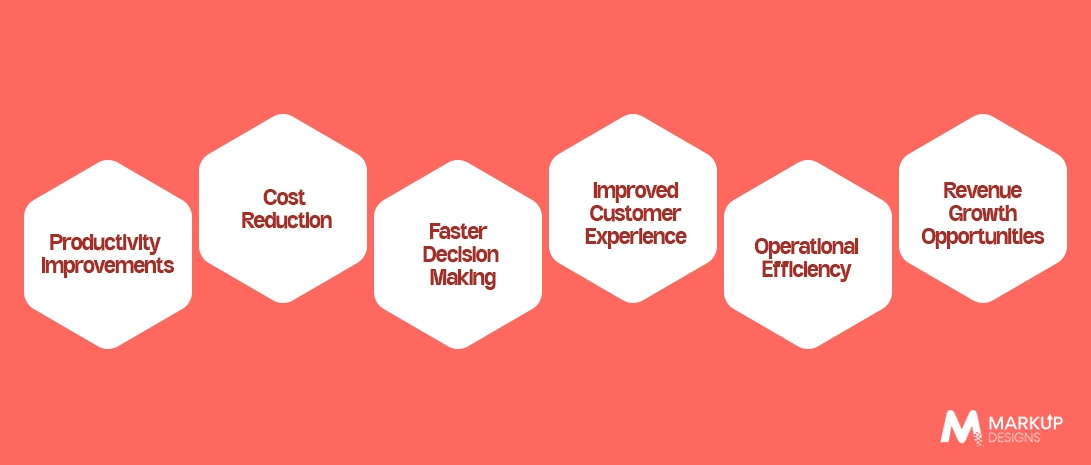
Both Agentic AI and Generative AI deliver measurable business value by improving productivity, reducing costs, and enabling smarter decision-making. The right AI strategy helps organisations increase efficiency while creating new growth opportunities.
Productivity Improvements
AI automates repetitive tasks, allowing employees to focus on higher-value work and strategic initiatives.
Cost Reduction
By streamlining workflows and reducing manual effort, AI helps lower operational and administrative costs.
Faster Decision Making
AI analyses large volumes of data quickly, enabling businesses to make informed decisions in real time.
Improved Customer Experience
AI enhances customer interactions through personalised recommendations, intelligent support, and faster response times.
Operational Efficiency
Businesses can optimise processes, reduce errors, and improve resource utilisation across departments.
Revenue Growth Opportunities
AI enables organisations to launch new services, improve customer retention, and identify additional revenue streams.
Cost of Implementing Agentic AI vs Generative AI in Australia
The cost involved in the deployment of AI depends on the complexity of the solution, the infrastructure, the integration, and the customization level. While Generative AI systems typically need less investment, Agentic AI requires more complex development and integration within businesses.
Understanding the Cost Structure of Development
Costs differ from one project to another depending on the project complexity, type of AI, and customization required.
Infrastructure and Cloud Computing Expenses
Cloud computing, data storage, and computing power usually contribute to significant AI implementation costs.
Costs Associated with AI Model Training and Fine-Tuning
To train AI models on data relevant only to the particular business, additional time, resources, and expertise are required.
Integration Cost
Linking AI with business systems causes additional complexity in the implementation process.
Maintenance Costs
After implementation, the system requires constant monitoring, updates, security enhancements, and general performance improvements.
Factors Affecting AI Implementation Cost
The final amount of money invested depends on the business goals, quality of the data, complexity of the system, compliance issues, integrations, and scalability.
Technology Stack Required for Agentic AI and Generative AI Development
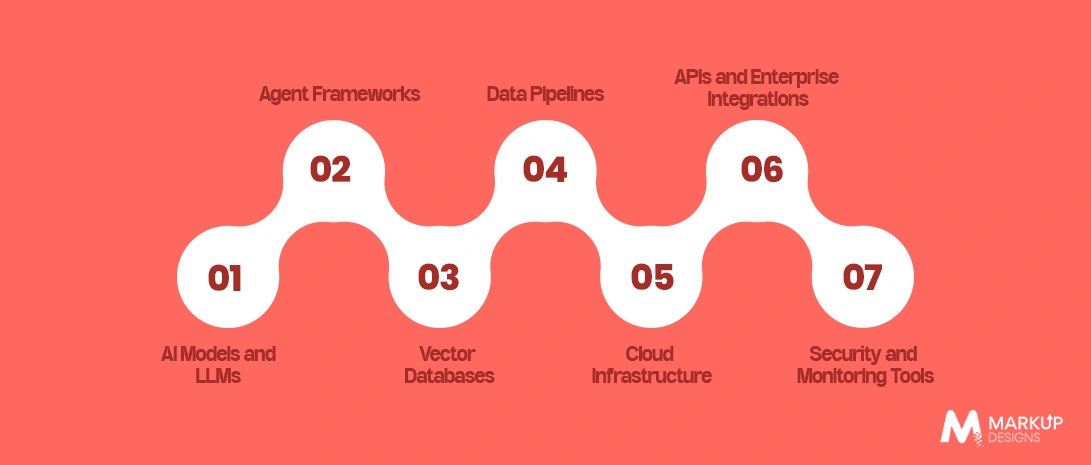
Selecting the right technology stack ensures AI solutions remain secure, scalable, and capable of supporting enterprise workloads.
AI Models and LLMs
Large Language Models (LLMs) and foundation models power content generation, reasoning, and intelligent decision-making.
Agent Frameworks
Agent frameworks enable autonomous planning, task execution, and orchestration across multiple business systems.
Vector Databases
Vector databases store and retrieve embeddings efficiently, improving semantic search and AI response accuracy.
Data Pipelines
Data pipelines collect, process, and prepare structured and unstructured data for AI models.
Cloud Infrastructure
Cloud platforms provide the computing power, storage, and scalability needed for AI development and deployment.
APIs and Enterprise Integrations
APIs connect AI solutions with CRM, ERP, business applications, and third-party services for seamless automation.
Security and Monitoring Tools
Security, governance, and monitoring solutions help protect AI systems, ensure compliance, and maintain reliable performance.
AI Governance, Security, and Regulatory Compliance in Australia
Just having advanced technology is not enough for organisations to successfully adopt AI. Businesses in Australia need to set up an effective governance framework, security, and compliance practices to ensure that they can implement AI in a responsible and trustworthy manner.
Requirements of the Australian Privacy Act
Businesses need to protect personal data and ensure that the AI system complies with the national privacy law.
APRA and ASIC Compliance
Those institutions that operate in industries that are regulated should ensure that their AI projects are in compliance with the regulations produced by APRA and ASIC, i.e., risk management, security, and operational resilience.
Principles of Responsible AI
Artificial intelligence systems should have transparency, fairness, accountability, and minimal bias while supporting ethical decision-making.
Data Residency Requirements
Businesses need to get to know where their AI data is stored and processed to comply with residency requirements.
AI Risk Management Framework
The adoption of the governance frameworks enables businesses to look for the AI risks and reduce them.
Human Oversight in AI
The role of people in supervising AI decisions is necessary for ensuring accountability and ethical use of AI.
Common Challenges in Implementing Agentic AI and Generative AI
Although AI delivers significant business benefits, organisations must overcome several technical and operational challenges to achieve successful implementation.
Data Quality Issues
Accurate, consistent, and well-managed data is essential for reliable AI performance.
Legacy System Integration
Integrating AI with existing enterprise systems can be complex and may require infrastructure upgrades.
Model Hallucinations
Generative AI may occasionally produce inaccurate or misleading outputs, making validation an important part of AI governance.
AI Security Risks
Protecting AI systems from cyber threats, data breaches, and unauthorised access is critical.
Workforce Adoption
Successful implementation depends on employee training, change management, and user acceptance.
Governance Challenges
Organisations need clear policies to ensure AI is used responsibly and complies with regulatory requirements.
Managing AI at Enterprise Scale
Scaling AI across multiple departments requires robust infrastructure, monitoring, and ongoing optimisation.
Step-by-Step AI Implementation Roadmap for Australian Businesses
A structured implementation strategy helps organisations maximise AI adoption while reducing risks and ensuring long-term success.
Assess Business Readiness
Evaluate business objectives, data availability, and technical capabilities before adopting AI.
Identify High Value AI Use Cases
Focus on business processes where AI can deliver measurable improvements and return on investment.
Select the Right AI Model
Choose Generative AI, Agentic AI, or a hybrid approach based on business requirements.
Build a Pilot Project
Develop and test a small-scale AI solution before expanding across the organisation.
Integrate with Enterprise Systems
Connect AI with existing applications, databases, and business workflows for seamless operation.
Test and Validate AI Performance
Evaluate AI accuracy, reliability, security, and compliance before full deployment.
Scale Across the Organisation
Expand successful AI solutions across departments while maintaining governance and performance.
Continuous Monitoring and Optimisation
Regularly monitor AI performance, update models, and optimise systems to support changing business needs.
How to Choose Between Agentic AI and Generative AI
Choosing the right AI approach depends on your business goals, operational needs, budget, and long-term digital transformation strategy. Evaluating these factors helps organisations invest in the solution that delivers the greatest business value.
Decision Matrix Based on Business Goals
Select Generative AI for content creation and productivity, Agentic AI for workflow automation, or a hybrid approach for end-to-end business transformation.
Budget Considerations
Generative AI typically requires a lower initial investment, while Agentic AI involves higher implementation costs due to advanced automation and integrations.
Operational Complexity
Businesses with simple workflows may benefit from Generative AI, whereas complex enterprise operations often require Agentic AI capabilities.
Compliance Requirements
Consider industry regulations, data privacy, governance, and security requirements before selecting an AI solution.
Long-Term AI Strategy
Choose an AI approach that aligns with future business growth, scalability, and evolving digital transformation goals.
Questions Every Business Should Ask Before Investing
Assess your business objectives, data readiness, expected ROI, technical capabilities, and integration requirements before implementing AI.
Future of Enterprise AI in Australia
Enterprise AI is evolving rapidly, with Australian organisations moving beyond basic automation towards intelligent, autonomous systems that drive innovation and operational excellence.
Rise of Autonomous AI Agents
Businesses are increasingly adopting AI agents capable of planning, reasoning, and executing tasks independently.
Multi-Agent Collaboration
Multiple AI agents will work together to manage complex workflows and improve enterprise productivity.
AI-Powered Decision Intelligence
AI will provide deeper insights and real-time recommendations to support faster, data-driven business decisions.
Industry Specific AI Models
Organisations will adopt AI models tailored to the unique needs of industries such as healthcare, finance, manufacturing, and retail.
The Next Phase of Enterprise AI Adoption
Future AI strategies will focus on responsible AI, seamless enterprise integration, and scalable automation across business functions.
Why Choose Markup Designs for Enterprise AI Development?
Markup Designs helps businesses transform operations with secure, scalable, and intelligent AI solutions tailored to their unique objectives. From strategy and development to deployment and optimisation, we deliver end-to-end AI services that drive measurable business outcomes.
Expertise in Generative AI Solutions
Develop intelligent AI applications for content generation, automation, analytics, and customer engagement.
Enterprise Grade Agentic AI Development
Build autonomous AI systems that streamline workflows, optimise operations, and support intelligent decision-making.
Secure, Scalable and Compliant AI Solutions
Design AI platforms with enterprise-grade security, regulatory compliance, and cloud scalability at their core.
End-to-End AI Consulting, Development and Support
Provide complete AI services, including strategy, solution design, development, integration, deployment, and ongoing optimisation.
Accelerate Your AI Transformation with Markup Designs
Whether you’re exploring Generative AI, Agentic AI, or a hybrid AI ecosystem, Markup Designs helps you design, develop, and deploy secure, scalable, and enterprise-ready AI solutions. From AI strategy and consulting to implementation and ongoing optimisation, our experts help businesses unlock measurable value from intelligent technologies.

Conclusion
Agentic AI and Generative AI are transforming the way Australian businesses innovate, automate, and compete. While Generative AI excels at creating content and enhancing productivity, Agentic AI enables autonomous decision-making and end-to-end workflow automation. The right choice depends on your business objectives, operational complexity, budget, and compliance requirements.
As AI adoption continues to accelerate across Australia, organisations that invest in a well-defined AI strategy will be better positioned to improve efficiency, deliver exceptional customer experiences, and achieve sustainable business growth. Partnering with an experienced AI development company ensures a secure, scalable, and future-ready implementation.
FAQs
1. What is the difference between Agentic AI and Generative AI?
Generative AI creates content such as text, images, code, and reports, whereas Agentic AI can analyse goals, make decisions, and execute tasks autonomously with less human intervention.
2. Is Agentic AI better than Generative AI?
Neither is universally better. Generative AI is ideal for content creation and productivity, while Agentic AI is better suited for automating complex workflows and enterprise operations.
3. Which industries in Australia benefit the most from Agentic AI?
Industries such as banking, healthcare, manufacturing, logistics, insurance, mining, and retail are increasingly using Agentic AI to improve efficiency and automate business processes.
4. How much does it cost to implement Agentic AI in Australia?
The cost varies depending on project complexity, integrations, and infrastructure. Enterprise implementations typically require a higher investment than Generative AI due to advanced automation and system integration.
5. Can Generative AI and Agentic AI work together?
Yes. Many organisations combine both technologies in a hybrid AI ecosystem where Generative AI creates insights or content, and Agentic AI executes tasks and automates workflows.
6. What compliance requirements should Australian businesses consider before implementing AI?
Businesses should consider the Australian Privacy Act, industry-specific regulations such as APRA and ASIC requirements, data security, governance, and responsible AI principles.
7. How do I decide whether my business needs Generative AI or Agentic AI?
Evaluate your business goals, operational complexity, budget, data readiness, and automation requirements. Businesses seeking content generation often benefit from Generative AI, while those requiring autonomous workflows should consider Agentic AI.
8. What is the future of Agentic AI in Australia?
Agentic AI is expected to play a significant role in Australia’s digital transformation by enabling autonomous enterprise operations, intelligent decision-making, and industry-specific AI solutions across multiple sectors.
Author's Perspective
Artificial Intelligence is no longer just a productivity tool. It has become a strategic business capability. While many organisations view Agentic AI and Generative AI as competing technologies, the greatest value often comes from combining both to solve real business challenges. Businesses that focus on clear objectives, responsible AI governance, and long-term scalability will be better equipped to maximise return on investment and stay competitive in an increasingly AI-driven economy.
Discuss Your Project NowGaurav Goyal
Global Sales- VP
Related Posts
How AI is Revolutionising Industrial Automation in Australia

How UK Enterprises Can Build an Effective AI...

AI Voice Agent for Real Estate: Features, Benefits,...
Insights Are Valuable & Execution is Priceless
You’ve read about the digital future. Now, let’s build the infrastructure to take you there. Move your strategy from the page to the product.
Design Your Solution Now
Contact Us
Schedule The Appointment At Your Convenience Date And Time.
30 Min
Web Conference
Time Zone
Indian standard time (08:30pm)

Thanks For Getting In Touch!
You’ve Taken The First Step Toward Transforming Your Digital Presence. Our Experts Will Reach Out Shortly To Take It Forward.
Launch Your Dream Project
Provide a brief overview of your project, and our specialists will evaluate your requirements. We will connect with you to explore how the right digital solutions can help you launch faster.