
In Brief
- Quick Digital Experiences: Progressive Web Apps can provide speedy and efficient experiences and help lessen waiting time and enhance usability.
- Lowering Barriers to Conversion: Clients can have the experience in a browser without having to install an app.
- Higher User Engagement: Customers are likely to return more frequently when there is the possibility of installing an app and receiving push notifications.
- Wider Reach: PWAs can provide a single experience across a mobile phone, tablet, or computer without the need for separate applications for each platform.
- Better Business Effectiveness: One easy-to-manage web application means easy updates and less effort needed towards the development and maintenance of two separate applications.
Consumers expect their digital experiences to be quick and smooth regardless of the type of device and network used. Traditional websites offer ample accessibility, while applications give an outstanding mobile experience, but companies usually need to pick between reach, performance, development effort, and convenience for users. PWAs combine the best aspects of the web with a lot of advantages of mobile applications and thus help eliminate this dilemma of performance versus accessibility.
The advantages of PWAs for companies are more than just offering an app-like experience in the browser. A well-crafted PWA should ensure speedy loading times, bring resolutions to users with poor internet connections, stimulate reuse, and eliminate all the difficulties that arise from downloading an app. As a result, PWAs allow businesses to increase their digital presence and deliver excellent customer experiences.
With businesses seeking to improve the effectiveness of their digital presence across all devices, the demand for PWAs is growing.
What is the meaning of Progressive Web App?

Progressive Web App (PWA) is a type of application specifically developed to provide users with an app experience in the browser. Utilizing a wide range of technologies, such as service workers, caching, and web app manifests, it offers faster loading times and high reliability.
What distinguishes PWAs from standard mobile websites is that they can perform app-like functions while still being available as web links. They can adjust their interface to different sizes, function on different devices, and ensure secure connections without requiring users to download other applications.
Why Are Businesses Moving Beyond Traditional Mobile Websites?
When customers are faced with a slow or complex mobile experience, they are likely to abandon a digital platform very quickly. Today’s consumers want their websites to be fast, smooth, and make their interactions as easy as possible, such as buying something, booking a service, and submitting inquiries.
While ordinary mobile websites may be accessible, they offer little incentive for users to keep coming back. Mobile applications development has better features for customers, but downloading an app is another obstacle for customers as well. Progressive Web Apps for businesses have become the best alternative, as they combine the benefits of web accessibility and application features together.
How Progressive Web Apps Drive Business Growth
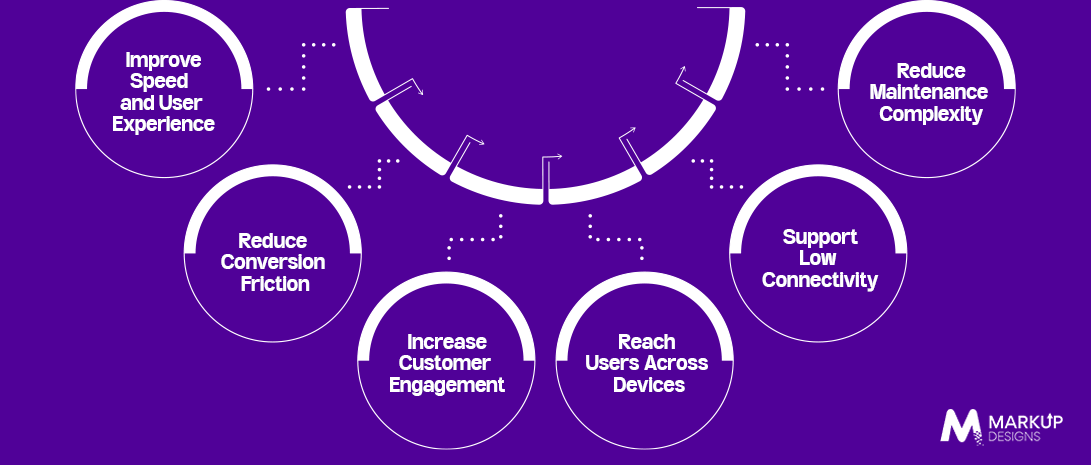
Improve Speed and User Experience
Performance directly affects how users interact with a digital platform. PWAs are built to deliver fast-loading and responsive experiences, helping reduce waiting time and unnecessary friction. A smoother experience can keep visitors engaged for longer and make important actions easier to complete, supporting stronger retention and conversions.
Reduce Conversion Friction
PWAs are accessible via the web, meaning that you do not have to go through the app stores before downloading the PWA. Hence, it makes marketing easier for businesses in that users can go through the entire process of knowing about the business and buying from it in the least amount of time.
Reducing the number of steps that customers need to take is pivotal for businesses in that sometimes the buyer may need to make a decision fairly quickly or would like to use the service through mobile devices.
Increase Customer Engagement
PWAs offer features such as push notifications and installation on the home screen, which allow businesses to stay in touch with customers. These features can be used to notify customers about new updates, promotions, and reminders.
Reach Users Across Devices
The PWA enables its users to use the same application regardless of the device that they are using. With PWAs, businesses do not need to create different applications for different types of devices.
Support Low Connectivity
Connectivity is not always reliable, particularly for users travelling or operating in areas with weaker networks. Service workers and caching allow PWAs to retain certain resources and previously loaded content, helping maintain usability even when the connection becomes unstable.
Reduce Maintenance Complexity
Maintaining separate applications for different platforms can increase development and maintenance requirements. A PWA uses a web-based architecture, allowing businesses to manage updates through a central application rather than depending entirely on separate Android and iOS releases.
PWA Business Growth Framework: Where Does the ROI Come From?
PWAs offer plenty of advantages to companies due to the reduced costs related to development. The speed of experience improves engagement, the ease of access helps overcome conversion barriers, and compatibility with many devices provides more opportunities for customer acquisition and retention.
Companies can calculate their ROI by comparing the costs of development and maintenance with the results that PWAs deliver. Such metrics as conversion rate, number of return visits, leads, engagement, and amount of revenue will present a more accurate picture of the business benefits than the technical results alone.
Real World Progressive Web App Examples and Results
Numerous famous companies have illustrated how PWAs can fulfill different digital goals. Starbucks has implemented PWA technology to improve its ordering process. Pinterest has aimed at enhancing its mobile web experience and engagement indexes, while Uber has taken advantage of the lightweight experience to offer users effortless ride booking. AliExpress has implemented PWA technology to achieve greater mobile engagement.
These Progressive Web App examples show that the value of a PWA depends on how effectively its capabilities are connected to a specific business objective, whether that means increasing purchases, improving accessibility, or encouraging users to return.
Industries That Benefit Most From PWAs
PWAs can be particularly useful for businesses where speed, accessibility, and repeat engagement influence customer decisions. Common use cases include:
- E-commerce and retail: Product discovery, shopping, and checkout experiences
- Media and publishing: Fast content delivery and repeat readership
- Travel and hospitality: Bookings, reservations, and travel information
- Financial services: Accessible account and service experiences
- Education and e-learning: Learning resources and course platforms
- Food delivery and marketplaces: Ordering and transaction-based services
- Healthcare: Appointments, information, and patient-facing services
PWA vs Native App vs Responsive Website

Choosing between these options depends on the business requirements rather than simply selecting the newest technology.
| Factor | PWA | Native App | Responsive Website |
| Development | Generally one web-based application | Separate platform development may be required | Web based |
| Performance | Fast when well optimised | Usually excellent | Varies by implementation |
| Installation | Optional and browser accessible | App store download required | No installation |
| Offline Support | Possible | Strong | Limited |
| Updates | Centralised web updates | App store releases | Centralised web updates |
| Engagement | Push notifications and installation support | Strong device integration | More limited |
| Device Access | Moderate | Extensive | Limited |
| Best For | Reach, engagement, and app like web experiences | Advanced mobile functionality | Content and standard web experiences |
Read Also: Mobile App Development vs Web Development: Key Differences for Business Owners
When Should Your Business Choose a PWA?
When your company requires access on both mobile and web versions promptly, PWA becomes a perfect fit. The use of PWAs is particularly important when it comes to users who interact with your brand online, and you would like to bypass the need for downloading resource-intensive native apps.
At the same time, PWAs can also be beneficial if users prefer high usability of apps while avoiding app maintenance.
When Is a PWA NOT the Right Choice?
In the following cases, PWAs should never take over native apps when you need advanced functions, such as interaction with hardware and back-end features. For instance, if you want to access sensors and hardware, business apps work better as native solutions.
Another situation when a native app is preferable is when your business relies on app store distribution as well as mobile application functionalities.
Thus, once again, it is preferable to look at the functionality of the app instead of considering the development convenience as the only criterion for the choice.
How to Build a Successful Progressive Web App
Any PWA that wants to be effective must provide benefits to a business and offer a quality user experience. The process needs to aim at both technical performance and results.
Define Business Goals and User Requirements
First, it is necessary to decide what the PWA should accomplish. Goals may vary from increasing sales and attracting customers to improving bookings and increasing customer activity. In any case, functionalities must be based on clear user and business needs.
Choose the Right PWA Technology Stack
Technology should be selected according to performance, scalability, integration, security, and maintenance issues. Technology must provide all functions needed by the company.
Design for Mobile-First Experiences
As many users will use smartphones, the design must focus on ease of navigation, readability, responsive layout, and ease of use.
Implement Service Workers and Caching
Service workers are able to cache and provide some capabilities in offline mode. Thus, they speed up resource processing.
Build Secure and Scalable Architecture
Security must be taken into account in advance, especially if the PWA is working with users’ personal data, money, accounts, and business information.
Test Performance Across Devices and Networks
A PWA should be tested across different browsers, devices, screen sizes, and network conditions. Testing helps identify slow-loading elements, compatibility issues, navigation problems, and unreliable offline behaviour before they affect users.
Monitor, Optimise, and Continuously Improve
Launching the PWA is not the end of development. Businesses should monitor user behaviour, performance, conversions, and technical issues to identify opportunities for ongoing improvement.
With custom Progressive Web App development, businesses can build experiences around their specific workflows instead of relying on generic functionality. Working with experienced teams offering PWA development services can also help align technical decisions with business objectives. The right Progressive Web App solutions should ultimately make the customer journey faster, simpler, and more effective.
How to Measure the Business Impact of a PWA
A PWA should be evaluated through business outcomes as well as technical performance. Key metrics can include:
- Performance: Loading time, responsiveness, and technical reliability
- Conversions: Purchases, bookings, enquiries, or completed actions
- Engagement: Session duration, interactions, and repeat visits
- Retention: Returning users and customer activity over time
- Installation: Number of users adding the PWA to their home screens
- Notifications: Open and interaction rates for push notifications
- Bounce Rate: Users leaving without meaningful interaction
- Revenue and Leads: Direct sales, enquiries, and generated opportunities
- Cost Efficiency: Development, acquisition, and maintenance costs compared with business returns
Tracking these metrics helps businesses determine whether the PWA is actually improving customer behaviour and generating measurable value.
Common PWA Mistakes That Limit Business Results
The technology itself does not guarantee better results. Poor implementation can undermine the advantages of a PWA. Common mistakes include:
- Treating a PWA as simply a faster version of a website
- Creating a complicated mobile user experience
- Sending excessive or irrelevant push notifications
- Implementing weak or unreliable offline functionality
- Ignoring accessibility requirements
- Failing to optimise images, scripts, and other resources
- Measuring technical metrics without connecting them to business KPIs
- Building features without understanding actual customer needs
A PWA should be designed around user behaviour and business objectives rather than adopting features simply because they are technically available.
The Future of Progressive Web Apps in Business
The demand for fast, accessible, and device-independent digital experiences is likely to keep growing. As businesses compete for attention across increasingly digital customer journeys, PWAs can provide a practical way to deliver app-like functionality without restricting access to users who are unwilling to install a native application.
The technology can also work alongside emerging capabilities such as AI-driven personalisation, intelligent recommendations, and more responsive web experiences. As modern browsers continue to expand their capabilities, PWAs can become increasingly useful within broader omnichannel strategies, allowing businesses to maintain a consistent experience across web and mobile touchpoints.
For businesses, the future of PWAs is less about replacing every native application and more about choosing the right technology for the right customer journey. Where accessibility, speed, engagement, and efficient development matter, PWAs can remain a valuable part of a modern digital strategy.
Is a Progressive Web App the Right Investment for Your Business?

A PWA can be a strong investment, but only when its capabilities match the way your customers interact with your business. Before starting development, evaluate a few practical factors:
- Business objectives: Define whether the goal is higher conversions, better engagement, improved accessibility, or reduced development complexity.
- Target users: Consider which devices your customers use, how they discover your business, and whether they are likely to install a native app.
- Required functionality: Identify whether your application needs advanced device features that may make native development more suitable.
- Budget and scalability: Compare the initial development and ongoing maintenance requirements with your expected growth and future feature needs.
- Expected ROI: Estimate potential gains in conversions, retention, engagement, and operational efficiency rather than focusing only on development costs.
Long-term maintenance should also be part of the decision. A Progressive Web App development company should not simply build the application and hand it over. The right partner should understand your business model, customer journey, technical requirements, scalability needs, and performance goals before recommending a solution.
Ready to Build a Faster, More Engaging Digital Experience?
Explore Progressive Web App development with a team that can align your PWA with your business goals, customer expectations, technical requirements, and long-term growth strategy.

Conclusion
Progressive Web Apps can help businesses create faster, more accessible, and engaging digital experiences while reducing some of the complexity associated with maintaining separate applications. Their ability to support smoother customer journeys can contribute to stronger engagement, improved conversions, and more efficient digital operations.
However, choosing a PWA simply because it is a growing technology is the wrong approach. The decision should be based on your business objectives, users, required functionality, budget, scalability, and expected return. When these factors align, a well-planned PWA can become a practical tool for sustainable digital growth.
FAQs
1. What are the main benefits of Progressive Web Apps for businesses?
PWAs can provide faster experiences, broader device accessibility, lower conversion friction, improved engagement, and simpler updates through a web-based application.
2. Are Progressive Web Apps better than native mobile apps?
Not necessarily. PWAs are better suited to businesses that prioritise web accessibility, cross-platform applications reach, and lower friction. Native apps can be preferable when advanced device capabilities or deep hardware integration are essential.
3. How much does Progressive Web App development cost?
The cost depends on factors such as application complexity, features, integrations, design requirements, security, scalability, and development resources. A simple PWA will require significantly less investment than a complex enterprise application.
4. How long does it take to develop a PWA?
Development time varies according to scope. A basic PWA may take considerably less time than a feature-rich application requiring custom integrations, authentication, payment systems, offline functionality, or complex backend architecture.
5. Can a PWA work offline?
Yes. PWAs can use service workers and caching to make selected content and functionality available during periods of limited or no connectivity. However, offline capabilities depend on how the application is designed and what functionality needs to remain accessible.
Author's Perspective
A PWA should not be viewed as a compromise between a website and a mobile app. Its real value lies in removing unnecessary barriers between businesses and their users. When speed, accessibility, engagement, and cross-platform reach are genuine priorities, a well executed PWA can deliver significant value.
The important question is not whether your business can build a PWA. It is whether a PWA solves a problem that matters to your customers and produces a measurable business outcome. That distinction should guide the technology decision from the beginning.
Discuss Your Project NowAjit Kumar Jha
VP - Business Operations
Related Posts

Flutter Web App Development: Process, Benefits, and Best...
Insights Are Valuable & Execution is Priceless
You’ve read about the digital future. Now, let’s build the infrastructure to take you there. Move your strategy from the page to the product.
Design Your Solution Now
Contact Us
Schedule The Appointment At Your Convenience Date And Time.
30 Min
Web Conference
Time Zone
Indian standard time (08:30pm)

Thanks For Getting In Touch!
You’ve Taken The First Step Toward Transforming Your Digital Presence. Our Experts Will Reach Out Shortly To Take It Forward.
Launch Your Dream Project
Provide a brief overview of your project, and our specialists will evaluate your requirements. We will connect with you to explore how the right digital solutions can help you launch faster.