
In Brief
- IoT application development involves integrating smart devices, sensors, cloud-based systems, and software to automate processes and gather real-time information that will assist companies in making decisions and increasing their efficiency.
- Development of an IoT solution is associated with various challenges, including security concerns, device compatibility, scalability, connectivity issues, data management problems, integration of legacy systems, power efficiency considerations, and system maintenance.
- The listed difficulties may be handled by utilizing proper security measures, adopting appropriate communication standards, using scalable cloud infrastructures, maximizing energy efficiency, achieving seamless integrations, and constantly monitoring system performance.
- Adoption of proven development practices like setting clear business objectives, picking the proper IoT platform, paying attention to security aspects, making the system scalable, testing the solution under real-life conditions, and meeting the relevant compliance requirements will result in reliable and forward-looking IoT applications.
- The costs of developing IoT applications include project complexity, number of devices integrated, application features, hardware, cloud-based infrastructure, integration, security, and development expertise among others.
The Internet of Things is transforming the way companies conduct their operations by linking various devices, systems, and even people via the Internet. By making use of IoT technology, companies can increase their efficiency, reduce costs, and help themselves make better decisions based on the information they receive in real time. The list of areas where IoT applications can be useful for various companies continues growing along with the adoption of IoT technology.
Development of a successful IoT application does not consist in connecting all devices together. An IoT solution comprises many elements, including hardware, software, cloud solutions, networks of communication, as well as cybersecurity. If any of these elements are poorly developed, businesses may experience operational issues, delays, and other challenges.
In this blog post, we will discuss the various challenges that one encounters while developing an IoT app, solutions for the same, best practices to be followed, and also the various factors that affect the cost of IoT application development.
Understanding IoT Application Development
IoT application development involves the creation of software systems that enable the connections between smart devices, sensors, machines, and cloud platforms for gathering and analyzing the data in real time. These applications enable organizations to optimize operations, automate business processes, and make data-driven decisions with real-time insights.
An IoT system usually includes various elements that work in collaboration with each other. The sensors and devices gather data from the physical world, while the communication network delivers the gathered data; the cloud platform processes it, and the application provides valuable insight through the dashboard or mobile application.
Unlike typical software development, where only the software has to be developed, IoT application development encompasses the development of software as well as hardware, making sure there is secure communication between the devices that are connected.
With the rise of IoT ecosystems, companies need to have applications that will be able to handle thousands of connected devices without impacting their performance or security. Having knowledge about the way in which the IoT applications operate is the first step towards overcoming the challenges of IoT application development.
Why Businesses Must Address IoT Development Challenges Early
IoT development obstacles that will be foreseen at the very start of the process will help to save a lot of time and resources for enterprises. The reason is that IoT applications are interconnected systems consisting of different devices, networks, clouds and software and any minor flaw in one aspect might have an impact on the system as a whole.
Thus, lack of attention to security measures might make the application vulnerable to various cyber attacks, exposing sensitive enterprise and customer data. The same is true about scalability as any problem with it will definitely become apparent when the number of connected devices increases.
Proactive measures would be easier when it comes to IoT application development since integrating such programs with business systems, complying with industry laws, and ensuring smooth interaction between devices would not be an issue. Thus, you would get an efficient and reliable IoT system that would contribute to future business growth.
Having recognized possible threats during the planning stage and applied effective development techniques, companies would be able to create secure, scalable, and performant IoT applications.
Key IoT Development Challenges Every Business Should Know
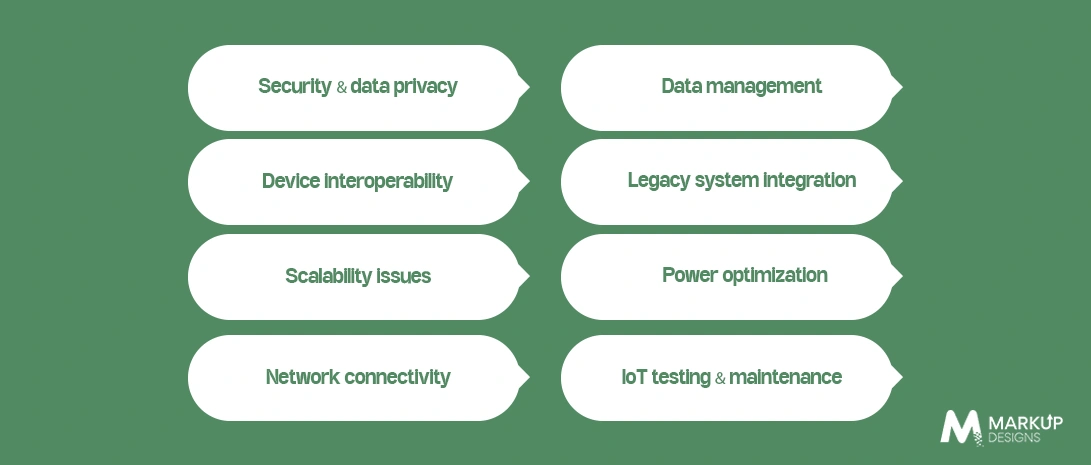
Developing an IoT application is more than connecting devices to the internet. Businesses need to manage hardware, software, cloud services, communication protocols, and data processing while ensuring everything works together smoothly. As IoT systems grow in complexity, developers frequently encounter some problems which may affect the performance of their system, its security and even usability.
Security & Data Privacy
Security has continued to be one of the major challenges faced by developers of IoT applications. The devices are prone to hacking due to constant transmission of private data. Lack of secure connections, weak encryption methods, and old firmware may expose business and customer private data to hackers.
Solution:
End-to-end encryption, multi-factor authentication, secure APIs, firmware updates, and consistent security monitoring could solve this problem. Adherence to industry standards also ensures security.
Device Interoperability
In most IoT solutions, the ecosystem involves devices from various manufacturers with varied operating systems and communication protocols. Ineffective communication between the devices may make the application not work properly.
Solution:
Employing standardized communication protocols like MQTT, CoAP, or HTTP and designing open APIs will ensure interoperability of devices.
Scalability Issues
Many IoT solutions start with a few devices but scale up quickly as the business requirements increase. Non-scalable applications may have lower performance, network congestion, or higher costs.
Solution:
Use cloud infrastructure, a microservices approach, and scalable databases to make sure your solution can handle an increasing number of connected devices without any performance issues.
Network Connectivity
IoT devices need stable internet connection to send the data. Bad network connectivity, disruptions, or lack of coverage may cause delays in the data sending process and impact performance of the application.
Solution:
Use the proper communication technology according to your use case, for example, Wi-Fi, Bluetooth, Zigbee, LoRaWAN, or 5G. You can also solve the problem using offline data synchronization or edge computing.
Data Management
With millions of data generated each second by IoT devices, the process of collecting, storing, processing, and analyzing such data can turn into a difficult task.
Solution:
Utilize cloud-based technologies that will help to analyze data instantly, filter data automatically, and provide storage services for big volumes of data. In addition, processing of valuable data on the edge level could also help to save bandwidth.
Legacy System Integration
Many companies have already implemented ERP, CRM, inventory management systems, or any other enterprise software system in their operations. The integration of IoT systems with legacy systems can be technically difficult because of the technology used in legacy systems.
Solution:
Develop secure APIs, middleware, and integration frameworks that allow IoT applications to communicate seamlessly with existing business systems while minimizing disruptions.
Power Optimization
Many IoT devices use batteries and are placed in locations where battery recharge or replacements are not easy to perform. Poor power usage practices may decrease device lifetime and increase maintenance expenses.
Solution:
Use power-saving hardware, optimize software performance, implement energy-saving communication protocols, and switch into sleep mode if the device is idle.
Iot Testing & Maintenance
IoT application testing is more complicated compared to regular software testing since in addition to the software testing developers need to check the performance of hardware, cloud services, network infrastructure, and all connected devices.
Solution:
Conduct a complete testing for functionality, security, connectivity, compatibility, and performance. After deployment, maintain continuous monitoring of devices, provide firmware updates, and perform maintenance activities.
Facing challenges in your IoT project?
At Markup Designs, we help businesses design, develop, and deploy secure, scalable, and high-performance IoT applications that connect devices seamlessly and deliver real business value.

Best Practices for Successful IoT Application Development
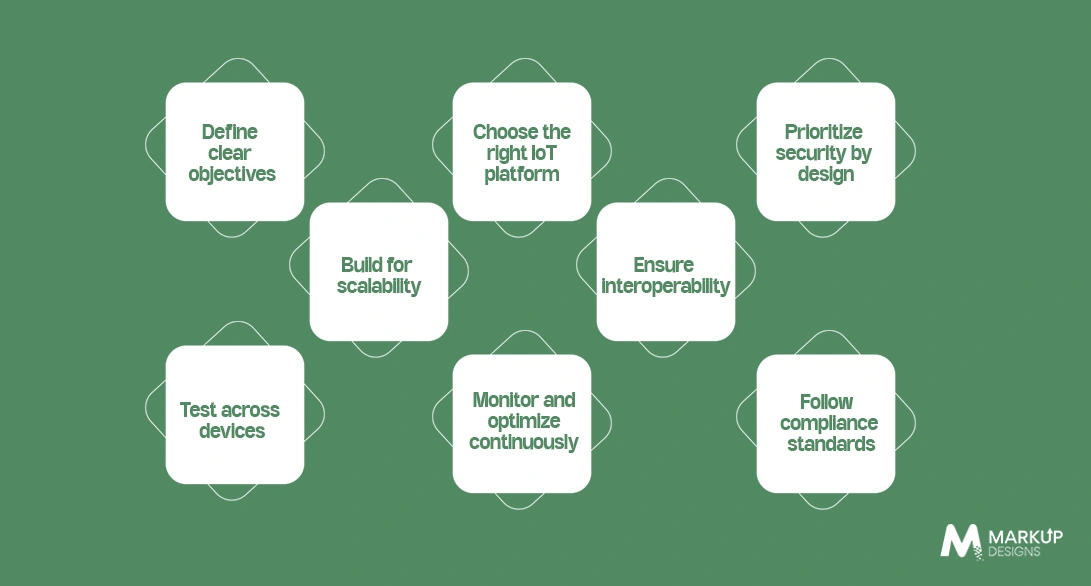
Right development practice not only helps organizations minimize risks, improve the performance of applications but also create IoT solutions that are scalable for future business needs. Following are the practices can be considered:
Define Clear Objectives
First of all, you should identify the particular problem your IoT app is going to solve. Clearly defined objectives can help to pick out proper features, technologies, and even the method of development.
Choose The Right IoT Platform
Choosing a platform which meets your needs, has scalable architecture and allows easy integration with your current systems.
Prioritize Security By Design
Don’t implement security at the end of the development cycle; make sure you integrate it into all stages of the process. Secure user authentication, encryption, and security updates will help keep your devices and data secure.
Build For Scalability
Design your app for scalability from the very beginning. This means you’ll be able to increase the number of devices, users, and functionalities without reducing performance of your system.
Ensure Interoperability
Utilize open communication standards and APIs to make sure that your IoT devices will be compatible with each other.
Test Across Devices
The application needs to be tested under various network conditions as well as operating conditions in order to find any problems before deploying.
Monitor And Optimize Continuously
Continuous monitoring using analytics will help you know about any problem that arises concerning the health of devices, their performance, and network activity.
Follow Compliance Standards
Depending on your industry, your IoT application may need to comply with data privacy and security standards. Following regulatory requirements helps build customer trust and reduces legal risks.
IoT Application Development Cost and Factors Affecting It
The cost of developing Internet of Things applications differs from project to project since each company has its unique needs. A simple IoT system that includes basic functionalities of monitoring will be much cheaper than an enterprise-level IoT application which connects thousands of devices and processes real-time data.
In addition to initial development costs, companies need to keep in mind expenses for cloud computing services, device management, security measures, maintenance, etc. If we invest in proper technology and development at the very start, it will become possible to decrease expenses in the future.
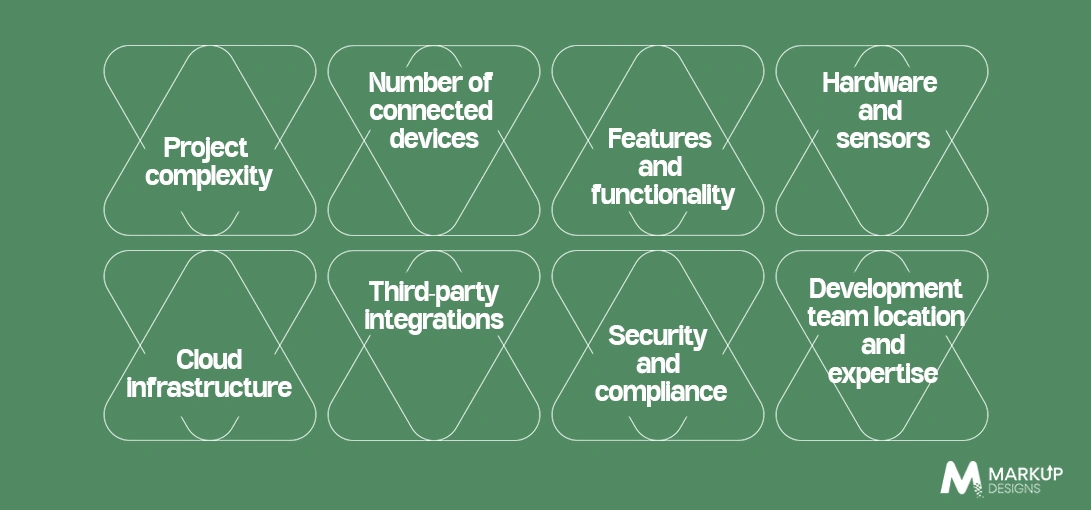
Several factors influence the overall cost of developing an IoT application, including:
Project Complexity
Apps that involve extensive automation, AI-driven analysis, or real-time monitoring take more time and skills to develop, making them more expensive.
Number Of Connected Devices
The greater the number of devices that you need to connect via your app, the more expensive it becomes to develop it.
Features And Functionality
The more features your app involves-remote monitoring, predictive maintenance, reporting, alerts, analytics, etc.-the higher the development cost will be.
Hardware And Sensors
The kind of sensors, gateways, and connecting devices employed in the IoT network has a direct bearing on the cost of the project.
Cloud Infrastructure
Cloud storage, cloud computing services, and cloud infrastructure affect the budget during the development process and further operation of the IoT application.
Third-Party Integrations
Integrating the application with ERP, CRM, payment system, or any other enterprise solution adds extra work.
Security And Compliance
Advanced security measures, encryption, and implementation of compliance standards impact the development budget.
Development Team Location And Expertise
Costs for IoT development are also dependent on the experience of the development team and its location. Working with experienced IoT developers ensures higher quality and cost-effectiveness of the whole development process.
Why Choose Markup Designs for IoT Application Development
Choosing the right application development partner is an important part of ensuring the success of any IoT project. At Markup Designs, we combine our domain experience with the latest technologies to create IoT apps for businesses looking to enhance their efficiency, automate processes, and make informed decisions.
We deliver safe and scalable IoT apps connecting devices, clouds, and enterprise systems. From the stage of strategy and architecture design to app development, deployment, and further maintenance, we offer end-to-end IoT app development services tailored to your needs.
Here’s what sets us apart:
- Experts in IoT app development from various industries.
- Designing applications with built-in security and efficient data protection.
- Scalable architecture capable of scaling up alongside the growth of your business.
- Easy integration into your current enterprise IT infrastructure.
- Solutions that provide real-time monitoring and analysis.
- Effective communication and support in managing the development process.
Whatever type of IoT application you’re building-whether it’s a smart manufacturing platform, a connected healthcare solution, a logistics monitoring system, or any other IoT-powered product-Markup Designs is the trusted technology partner to bring your vision to life.
Ready to Build Your Next IoT Solution?
Turn your IoT idea into a secure, scalable, and high-performing application with Markup Designs. Our experienced IoT developers help businesses create connected solutions that improve efficiency, enhance customer experiences, and support long-term growth.

Conclusion
IoT application development is assisting companies in improving efficiency, automating operations, and making smart decisions through devices that are interconnected and real-time data. However, in order to develop a good IoT application, it is important to be able to solve issues such as security, scalability, interoperability, connectivity, and data management in advance.
With proper approaches to IoT application development, using appropriate technologies, and working with the best IoT development company, companies can develop their applications that are both secure and scalable. As IoT becomes more popular, investing in a well-thought solution will provide them with advantages in the future.
FAQs
1. What are the biggest challenges in IoT application development?
Some of the most common challenges include data security, device interoperability, network connectivity, scalability, data management, legacy system integration, power optimization, and ongoing maintenance.
2. How can businesses improve IoT application security?
Businesses can strengthen IoT security by using end-to-end encryption, secure authentication, regular firmware updates, continuous monitoring, and following industry security standards throughout the development lifecycle.
3. What factors affect IoT application development costs?
The overall cost depends on several factors, including project complexity, number of connected devices, application features, hardware requirements, cloud infrastructure, third-party integrations, security measures, and the experience of the development team.
4. Why is scalability important in IoT applications?
A scalable IoT application can support an increasing number of connected devices, users, and data without affecting performance. This allows businesses to expand their IoT ecosystem as their operations grow.
5. How long does it take to develop an IoT application?
The development timeline varies depending on the project’s complexity, features, hardware integration, and testing requirements. Simple IoT applications may take a few months, while enterprise-level solutions often require a longer development cycle.
Author's Perspective
IoT is transforming the way businesses operate by enabling smarter decisions, automation, and greater operational efficiency. However, successful IoT applications require careful planning, strong security, and the ability to scale as business needs grow. Organizations that focus on building reliable and future-ready solutions are better prepared to adapt to new technologies and changing market demands. With the continued evolution of AI, edge computing, and 5G, IoT will play an even greater role in driving innovation and long-term business growth.
Discuss Your Project NowJupinder Singh Arora
Founder and CEO
Related Posts
Key Features Every IoT Solution Should Include in...

How to Choose the Right IoT Development Company...
Insights Are Valuable & Execution is Priceless
You’ve read about the digital future. Now, let’s build the infrastructure to take you there. Move your strategy from the page to the product.
Design Your Solution Now
Contact Us
Schedule The Appointment At Your Convenience Date And Time.
30 Min
Web Conference
Time Zone
Indian standard time (08:30pm)

Thanks For Getting In Touch!
You’ve Taken The First Step Toward Transforming Your Digital Presence. Our Experts Will Reach Out Shortly To Take It Forward.
Launch Your Dream Project
Provide a brief overview of your project, and our specialists will evaluate your requirements. We will connect with you to explore how the right digital solutions can help you launch faster.