
In Brief
- Digital transformation helps Omani businesses modernise operations, customer experiences, and decision-making.
- Cloud, AI, automation, analytics, and connected systems can improve efficiency and scalability.
- Digital transformation supports businesses in responding to changing customer and market expectations.
- Strong cybersecurity and data management are essential as businesses become more digitally connected.
- A structured digital transformation strategy helps Omani businesses align technology investments with long-term business goals.
Digital transformation is becoming an important part of how businesses in Oman modernise their operations, serve customers, and respond to changing market requirements. It involves more than adopting new software or moving existing processes online. Businesses can use technologies such as cloud computing, artificial intelligence, automation, data analytics, and connected systems to improve how different functions work together and support more informed business decisions.
For businesses operating in Oman, digital transformation can also support broader goals around operational efficiency, business growth, customer experience, and technology-led innovation. However, adopting technology without a clear strategy can result in disconnected systems, unnecessary costs, and difficult integration. Digital transformation services help businesses assess their existing environment, identify suitable opportunities, modernise systems, integrate technologies, and build a roadmap that connects digital investments with practical business objectives.
What Is Digital Transformation for Businesses in Oman?
Digital transformation refers to the use of modern digital technologies to improve how a business operates, serves customers, manages information, and makes decisions. For businesses in Oman, this can involve modernising legacy systems, automating routine processes, connecting different business functions, improving digital customer experiences, and creating more efficient ways for teams to collaborate. Technologies such as AI, cloud computing, IoT, automation, data analytics, and cybersecurity can support these changes based on the specific needs and objectives of a business.
However, digital transformation is not simply about introducing individual technologies or moving paper-based processes online. It involves reviewing existing workflows, infrastructure, applications, data, and customer touchpoints to identify where technology can create measurable improvements. A well-planned transformation connects business processes, IT infrastructure, data and analytics, workforce collaboration, customer experiences, and decision-making into a more integrated digital environment.
Why Businesses in Oman Need Digital Transformation Services
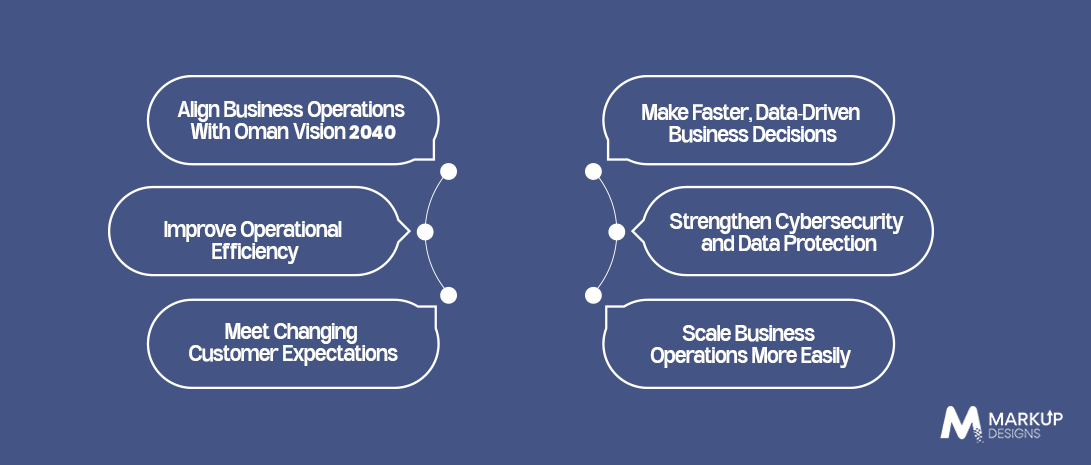
Align Business Operations With Oman Vision 2040
Oman Vision 2040 places emphasis on economic diversification, innovation, technology, and the development of a knowledge-based economy. Digital transformation can help businesses modernise their operations and adopt technologies that support productivity, innovation, and new business models. This is relevant across private-sector industries, from energy and manufacturing to banking, healthcare, logistics, retail, and tourism.
Improve Operational Efficiency
Manual and disconnected processes can create delays, duplicate work, and unnecessary operational costs. Digital transformation can automate repetitive activities, connect business systems, and streamline workflows across departments. Businesses can also use integrated digital platforms to improve resource utilisation and gain better visibility into day-to-day operations.
Meet Changing Customer Expectations
Customers increasingly expect businesses to provide convenient digital interactions, quick responses, and consistent service across online and mobile channels. Digital transformation enables businesses to modernise customer touchpoints, introduce self-service options, personalise interactions using customer data, and make services more accessible through digital platforms.
Make Faster, Data-Driven Business Decisions
Businesses often have valuable data spread across applications, departments, and databases. Digital transformation can bring this information together and make it easier to analyse through dashboards, reporting platforms, and business intelligence tools. Decision-makers can use these insights to identify operational trends, monitor performance, forecast demand, and make decisions based on current business information.
Strengthen Cybersecurity and Data Protection
As businesses become more dependent on connected applications, cloud platforms, and digital data, security needs to become part of the transformation strategy. Digital transformation services can incorporate access controls, data protection, monitoring, backup, and security management into modern technology environments. This helps businesses address security risks while protecting business and customer information.
Scale Business Operations More Easily
Traditional infrastructure and legacy applications can make it difficult to accommodate growing workloads, customers, employees, or locations. Cloud-based infrastructure, modern applications, and scalable digital platforms give businesses greater flexibility as their requirements change. This can also reduce dependence on rigid systems that are difficult or costly to expand.
Stay Competitive in a Digitally Evolving Market
Digital transformation can help Omani businesses modernise their operations and respond more efficiently to changing market conditions. Better-connected systems, digital customer experiences, automation, and data-driven processes can improve organisational agility and support new ways of delivering products and services. The focus should be on adopting technologies that solve specific business challenges rather than implementing technology simply for its own sake.
Key Digital Transformation Services for Businesses in Oman
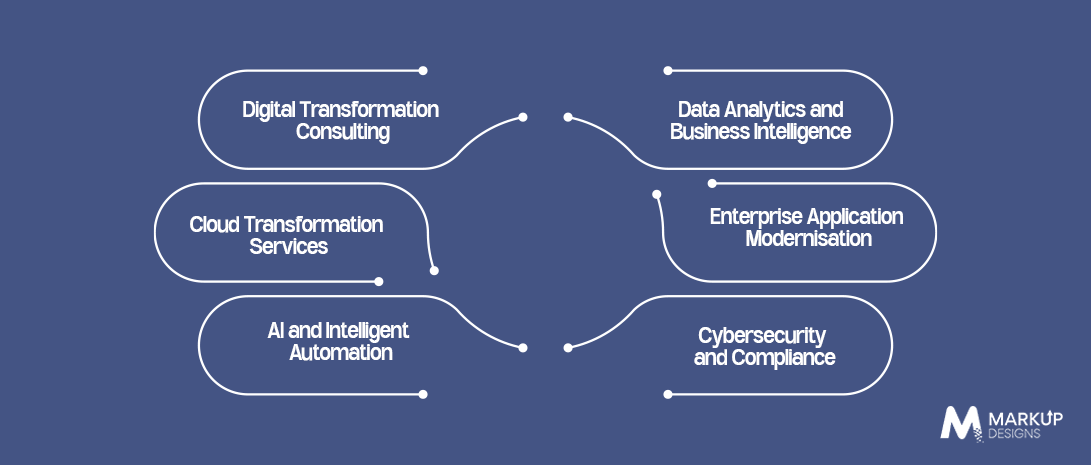
Businesses can adopt different digital transformation services depending on their existing technology environment, industry requirements, and transformation objectives.
Digital Transformation Consulting
Digital transformation consulting helps businesses assess their current systems, processes, and digital maturity before planning transformation initiatives. This can include technology assessments, gap analysis, digital roadmaps, solution planning, and prioritisation of technology investments.
Cloud Transformation Services
Cloud transformation can involve migrating applications and workloads to the cloud, modernising infrastructure, and implementing cloud-based business solutions. Businesses can also use cloud management and optimisation services to monitor performance, security, scalability, and resource usage.
AI and Intelligent Automation
AI and automation can be applied to repetitive processes, customer support, data analysis, forecasting, and business applications. Depending on the use case, businesses can implement AI-powered solutions, automated workflows, predictive models, and intelligent customer service tools.
Data Analytics and Business Intelligence
Data analytics services help businesses integrate information from different sources and turn it into actionable insights. Business intelligence platforms can provide dashboards, performance reports, trend analysis, and predictive insights to support operational and strategic decision-making.
Enterprise Application Modernisation
Modernising legacy applications can help businesses improve performance, integration, usability, and scalability. Services may include ERP and CRM integration, custom software development, API integration, application redevelopment, and migration from outdated systems.
Cybersecurity and Compliance
Cybersecurity services can be integrated into digital transformation initiatives to protect applications, infrastructure, identities, and business data. Depending on business requirements, this can include security assessments, identity and access management, data protection, monitoring, risk management, and compliance-focused controls.
Industries in Oman That Can Benefit From Digital Transformation
Digital transformation can support businesses across Oman’s major economic sectors by improving operational visibility, automating workflows, connecting systems, and creating more responsive customer experiences. The technologies and use cases will vary by industry, but the underlying objective remains the same: using digital capabilities to address specific operational and business requirements.
Oil & Gas and Energy
Oil and gas and energy businesses can use connected systems, IoT development, data analytics, and predictive maintenance to monitor assets and operations. Digital platforms can also help teams access operational data, identify potential issues, and improve maintenance planning.
Banking and Financial Services
Banks and financial institutions can use digital transformation to modernise banking services, automate internal processes, strengthen security, and improve customer interactions. Digital platforms, analytics, AI, and integrated systems can support faster and more personalised financial services.
Healthcare
Healthcare organisations can modernise patient and administrative processes through digital records, connected systems, appointment platforms, and patient-facing applications. Integrated data systems can also help authorised teams access relevant information and coordinate services more efficiently.
Manufacturing
Manufacturers can apply IoT, automation, analytics, and connected production systems to improve visibility across manufacturing operations. Predictive maintenance and real-time monitoring can help identify equipment issues and support more informed production planning.
Logistics and Transportation
Digital transformation can improve fleet visibility, route planning, shipment tracking, and supply-chain coordination. Integrated logistics platforms can connect operational data from vehicles, warehouses, suppliers, and other systems to support more efficient transportation management.
Retail and E-commerce
Retailers can use digital platforms to connect online and offline customer experiences, manage inventory, personalise interactions, and analyse purchasing behaviour. Automation and integrated commerce systems can also simplify order, payment, fulfilment, and customer service processes.
Tourism and Hospitality
Hotels, resorts, travel businesses, and other travel tourism development organisations can use digital booking platforms, customer relationship systems, automation, and analytics to improve guest interactions and operational management. Digital tools can support communication throughout the customer journey, from booking to post-stay engagement.
Government and Public Services
Government organisations can use digital transformation to modernise service delivery, digitise processes, connect information systems, and make public services more accessible. Integrated platforms can also reduce reliance on manual processes and improve coordination between departments.
Common Digital Transformation Challenges for Omani Businesses
Digital transformation can deliver significant operational changes, but businesses may face challenges when modernising established processes and technology environments. Common issues include legacy systems and technical debt, disconnected applications and data silos, shortages of specialised digital skills, cybersecurity risks, and resistance to organisational change. Businesses may also struggle to determine which initiatives should be prioritised, integrate new technologies with existing systems, and justify investments when expected costs and business outcomes have not been clearly defined.
Addressing these challenges requires more than selecting new technology. Businesses need a clear transformation roadmap, realistic implementation priorities, appropriate security controls, and a plan for managing organisational and technical changes throughout the process.
How to Build a Digital Transformation Strategy in Oman
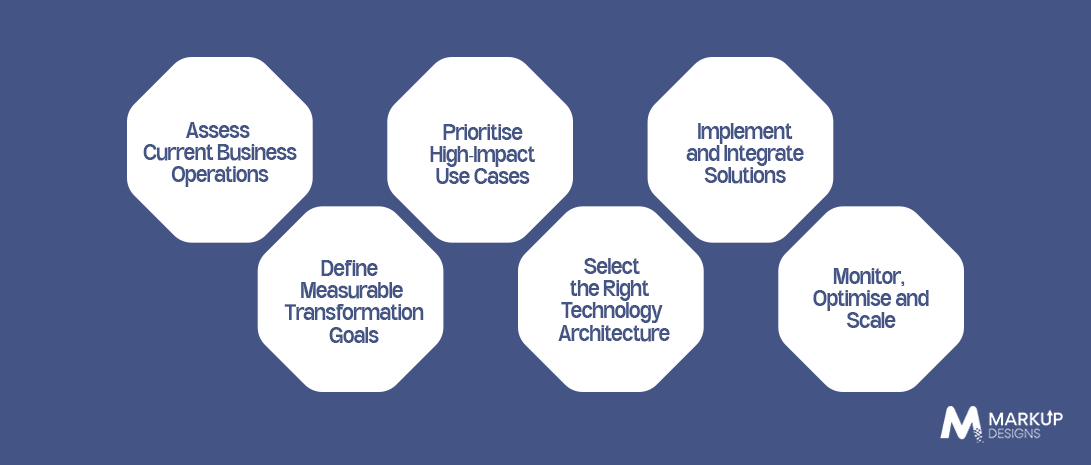
Step 1: Assess Current Business Operations
Review existing processes, applications, infrastructure, data, and workflows to identify inefficiencies, technology gaps, and areas that require modernisation.
Step 2: Define Measurable Transformation Goals
Connect technology investments with specific business outcomes, such as improving process efficiency, reducing operational delays, strengthening customer service, or improving data visibility.
Step 3: Prioritise High-Impact Use Cases
Identify the business problems that should be addressed first. Prioritising practical use cases helps businesses avoid investing in technologies that do not have a clear operational purpose.
Step 4: Select the Right Technology Architecture
Evaluate the technologies required to support the transformation, including cloud platforms, AI, analytics, automation, business applications, APIs, integration tools, and cybersecurity controls.
Step 5: Implement and Integrate Solutions
Develop or configure the required solutions, migrate data and applications where necessary, integrate systems, and conduct appropriate testing before deployment.
Step 6: Monitor, Optimise and Scale
Track performance after implementation and use operational data to identify areas for improvement. Successful initiatives can then be expanded as business requirements evolve.
Why Partner With a Digital Transformation Services Provider in Oman?
Working with a digital transformation services provider can give businesses access to specialised technology expertise and a structured approach to modernisation. A provider can assess the existing technology environment, develop a transformation roadmap, integrate new solutions with established systems, and incorporate security requirements into implementation.
External expertise can also support implementation, optimisation, and ongoing maintenance, allowing businesses to expand their digital capabilities as their operational requirements change.
Future of Digital Transformation in Oman
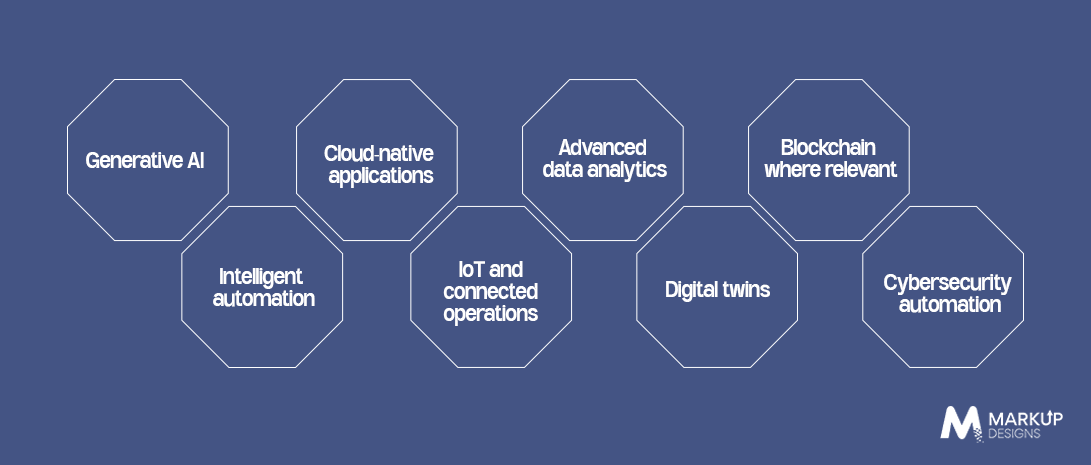
Digital transformation in Oman is likely to increasingly involve technologies that can connect business operations, automate decisions and workflows, and generate greater value from organisational data. Rather than adopting every emerging technology, businesses can evaluate these developments according to their specific industry requirements and practical use cases.
Generative AI
Generative AI can support applications such as content generation, knowledge assistance, customer service, software development, and internal productivity, depending on the organisation’s data, security, and governance requirements.
Intelligent Automation
Combining automation with AI can help businesses handle more complex workflows, reduce repetitive manual tasks, and support processes that require data analysis or rule-based decisions.
Cloud-Native Applications
Cloud-native architectures can provide businesses with flexible application environments designed for scalability, integration, and continuous development.
IoT and Connected Operations
Connected devices and sensors can provide real-time operational data across areas such as energy, manufacturing, logistics, facilities, and asset management.
Advanced Data Analytics
Businesses can increasingly use advanced analytics to identify patterns, forecast demand, monitor performance, and support operational and strategic planning.
Digital Twins
Digital twins can create virtual representations of physical assets, systems, or processes, allowing organisations to monitor conditions, simulate scenarios, and analyse operational performance.
Blockchain
Where there is a suitable business use case, blockchain can support applications involving shared records, transaction traceability, digital assets, and multi-party data exchange.
Cybersecurity Automation
As digital environments become more connected, cybersecurity automation can help organisations continuously monitor systems, identify potential threats, manage security events, and respond to risks more efficiently.
Transform Your Business With Digital Solutions Built for Oman
Build a digital environment around your business processes, technology requirements, security needs, and long-term growth objectives.

Conclusion
Digital transformation is not simply about adopting the latest technology. It involves rethinking how a business operates, connects its systems, serves customers, uses data, and responds to changing requirements. For businesses in Oman, the right approach is to identify specific operational challenges and then select digital technologies that address those challenges while supporting long-term business objectives.
From cloud transformation and AI to automation, analytics, application modernisation, and cybersecurity, businesses can build digital capabilities around their actual requirements rather than adopting technology without a clear purpose. A structured transformation strategy can also help organisations modernise existing environments while creating a foundation for future growth.
FAQ
1. What is digital transformation in Oman?
Digital transformation in Oman refers to the use of digital technologies to improve business processes, customer experiences, data management, infrastructure, and decision-making. It can involve technologies such as cloud computing, AI, automation, IoT, analytics, and modern business applications.
2. Why is digital transformation important for businesses in Oman?
Digital transformation can help businesses improve operational efficiency, reduce manual processes, strengthen data visibility, modernise customer experiences, and adapt to changing market requirements. It also provides a structured way to modernise legacy systems and build more scalable technology environments.
3. How does digital transformation support Oman Vision 2040?
Oman Vision 2040 includes priorities related to economic diversification, innovation, technology, and the development of a knowledge-based economy. Businesses can contribute to these broader objectives by adopting digital technologies that improve productivity, develop new capabilities, modernise services, and support technology-led business models.
4. What digital transformation services do businesses in Oman need?
The required services depend on each business’s existing infrastructure and objectives. Common services include digital transformation consulting, cloud transformation, AI and automation, data analytics, enterprise application modernisation, system integration, and cybersecurity.
5. Which industries in Oman benefit from digital transformation?
Digital transformation can benefit businesses across sectors including oil and gas, energy, banking and financial services, healthcare, manufacturing, logistics, transportation, retail, e-commerce, tourism, hospitality, and government services. The specific technologies and use cases will depend on the operational requirements of each sector.
Author's Perspective
From an implementation perspective, the value of digital transformation lies in how effectively technology solves a business problem. Businesses should not begin with a technology checklist; they should begin by understanding where processes are inefficient, where customers experience friction, where data is difficult to use, and where existing systems limit growth. This creates a more practical transformation roadmap and helps ensure that technology investments deliver measurable business value.
Discuss Your Project NowJupinder Singh Arora
Founder and CEO
Related Posts

Digital Transformation in Financial Services: Trends, Benefits &...
IoT in Banking: Transforming Financial Services Through Connected...
Digital Transformation for Australian Enterprises: Strategy, Technology &...
Insights Are Valuable & Execution is Priceless
You’ve read about the digital future. Now, let’s build the infrastructure to take you there. Move your strategy from the page to the product.
Design Your Solution Now
Contact Us
Schedule The Appointment At Your Convenience Date And Time.
30 Min
Web Conference
Time Zone
Indian standard time (08:30pm)

Thanks For Getting In Touch!
You’ve Taken The First Step Toward Transforming Your Digital Presence. Our Experts Will Reach Out Shortly To Take It Forward.
Launch Your Dream Project
Provide a brief overview of your project, and our specialists will evaluate your requirements. We will connect with you to explore how the right digital solutions can help you launch faster.