

In Brief
- Digital transformation is helping financial institutions modernise legacy systems, automate operations, and deliver more connected digital experiences.
- AI, cloud computing, data analytics, automation, APIs, and embedded finance are reshaping how financial services are developed and delivered.
- Financial institutions can improve operational efficiency, customer personalisation, fraud detection, scalability, and decision-making through digital transformation.
- A successful transformation strategy requires clear business objectives, modern technology architecture, integrated data, strong security, and regulatory compliance.
- Organisations need a phased approach to modernisation that aligns technology investments with customer needs, business priorities, and long-term growth.
Digital transformation in financial services is changing how banks, FinTech companies, insurers, lenders, payment providers, and other financial institutions operate and serve their customers. Instead of relying solely on traditional processes and legacy infrastructure, organisations are adopting cloud platforms, artificial intelligence, automation, data analytics, APIs, and other digital technologies to build faster, more connected, and scalable financial services. This shift is also changing customer expectations, with users increasingly looking for convenient, personalised, and real-time financial experiences across digital channels.
However, adopting new technology alone does not constitute digital transformation. Financial institutions need to modernise underlying systems, connect fragmented data, strengthen security, meet regulatory requirements, and align technology investments with measurable business objectives. In this blog, we explore the major digital transformation trends in financial services, their key benefits, the technologies driving the change, and the strategy organisations can follow to modernise their financial operations effectively.
What is Digital Transformation in Financial Services?
Digital transformation in financial services involves using modern technologies to improve how financial institutions operate, deliver services, and interact with customers. It can include modernising legacy systems, automating processes, moving infrastructure to the cloud, using data for better decisions, and creating connected digital financial experiences across banking, lending, insurance, payments, and wealth management.
Why is Digital Transformation Important for Financial Services?
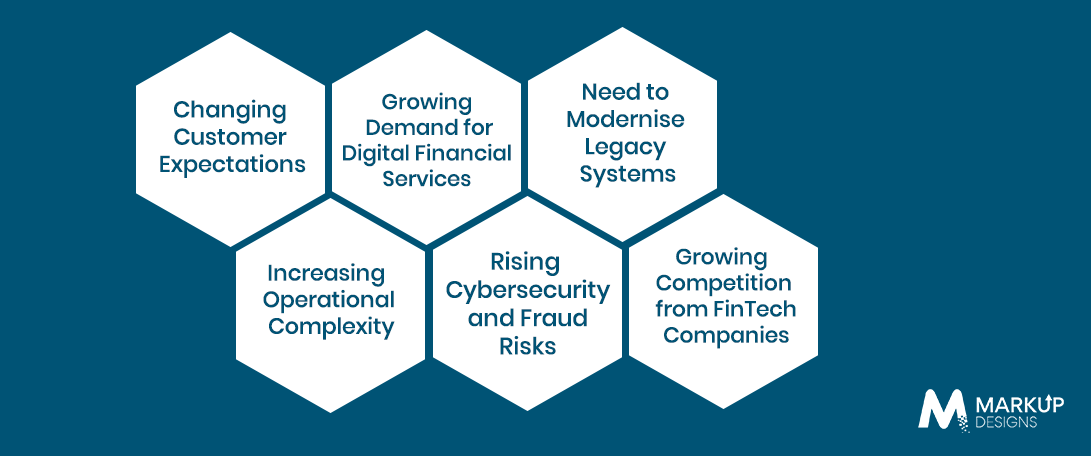
Changing Customer Expectations
Customers expect faster, convenient, personalised, and accessible financial services across digital channels. Digital transformation helps institutions respond to these expectations with better connected experiences.
Growing Demand for Digital Financial Services
The growing use of mobile banking, digital payments, online lending, and other financial platforms is pushing institutions to expand and improve their digital services.
Need to Modernise Legacy Systems
Older systems can make it difficult to integrate new technologies, manage data, and scale services. Modernisation helps financial institutions create more flexible and connected technology environments.
Increasing Operational Complexity
Financial institutions manage large volumes of transactions, customer data, and internal processes. Automation and integrated digital systems can simplify repetitive workflows and improve operational visibility.
Rising Cybersecurity and Fraud Risks
As financial services become increasingly digital, institutions need stronger security, identity management, fraud monitoring, and data protection capabilities to protect customers and financial operations.
Growing Competition from FinTech Companies
FinTech companies are introducing faster and more specialised digital financial experiences. Traditional institutions are adopting digital technologies to improve their services and respond to changing market expectations.
Key Benefits of Digital Transformation in Financial Services
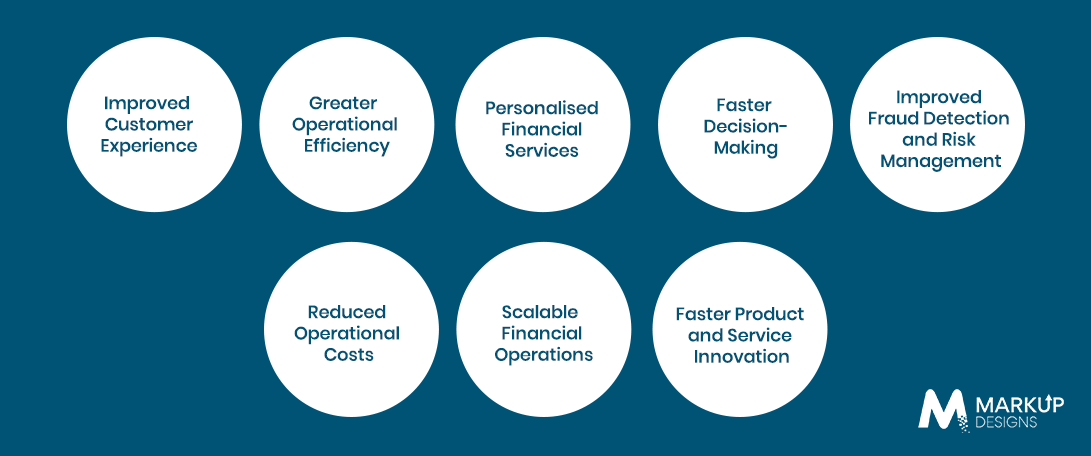
Improved Customer Experience
Digital platforms can make financial services more accessible, convenient, and responsive across different customer touchpoints.
Greater Operational Efficiency
Automation and connected systems can reduce manual work, streamline workflows, and improve the efficiency of everyday operations.
Personalised Financial Services
Data analytics and AI can help institutions understand customer behaviour and deliver more relevant products, recommendations, and services.
Faster Decision-Making
Real-time data and analytics give financial teams faster access to insights, supporting quicker and more informed business decisions.
Improved Fraud Detection and Risk Management
AI, machine learning, and data analytics can help identify unusual patterns, monitor transactions, and support more effective risk management.
Reduced Operational Costs
Automating repetitive processes and modernising infrastructure can reduce manual effort and improve resource utilisation.
Scalable Financial Operations
Cloud-based infrastructure and modern architectures make it easier to expand digital services as transaction volumes and customer requirements grow.
Faster Product and Service Innovation
Modern technology environments allow financial institutions to develop, test, integrate, and launch new digital products and services more efficiently.
Key Digital Transformation Trends in Financial Services
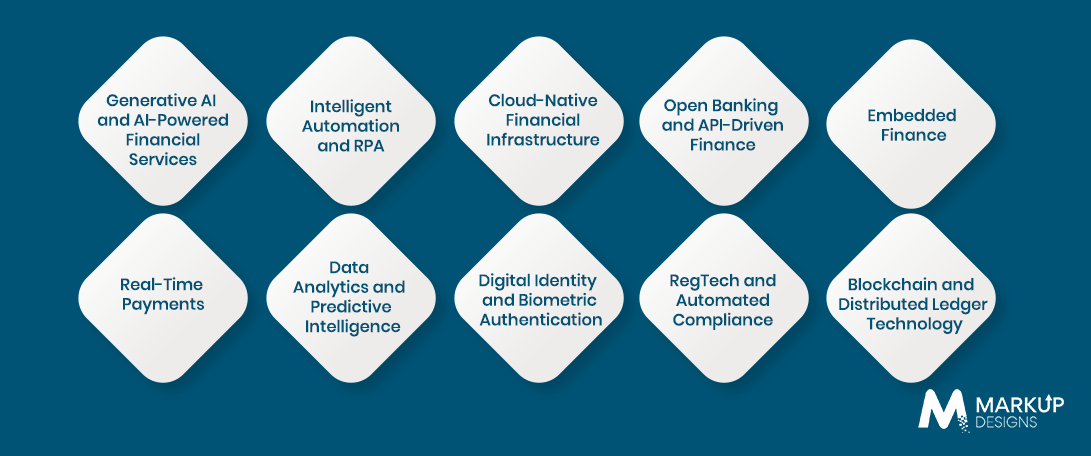
Digital transformation is evolving rapidly across the financial sector, with technologies such as AI, cloud computing, automation, and real-time data changing how institutions operate and serve customers.
Generative AI and AI-Powered Financial Services
AI is being used for customer support, fraud detection, risk assessment, financial recommendations, document processing, and other data-intensive tasks. Generative AI is also enabling more conversational and intelligent digital financial experiences.
Intelligent Automation and RPA
RPA and intelligent automation can handle repetitive tasks such as data entry, transaction processing, reporting, and document verification, helping financial institutions streamline operations and reduce manual effort.
Cloud-Native Financial Infrastructure
Cloud platforms provide flexible infrastructure that can support application modernisation, data management, disaster recovery, and the scaling of digital financial services.
Open Banking and API-Driven Finance
Open banking and APIs allow financial institutions and third-party platforms to securely connect services and exchange financial data, supporting more integrated digital experiences.
Embedded Finance
Embedded finance brings financial services such as payments, lending, insurance, or banking features directly into non-financial platforms, making these services available within existing digital journeys.
Real-Time Payments
Real-time payment infrastructure enables faster transactions and fund transfers, supporting customer expectations for immediate and convenient financial services.
Data Analytics and Predictive Intelligence
Financial institutions can use data analytics and predictive models to understand customer behaviour, identify risks, forecast demand, and support more informed decisions.
Digital Identity and Biometric Authentication
Digital identity solutions and biometric authentication can simplify customer verification while strengthening access control and security across financial platforms.
RegTech and Automated Compliance
RegTech solutions help financial institutions automate activities such as transaction monitoring, regulatory reporting, KYC, and compliance checks while improving oversight.
Blockchain and Distributed Ledger Technology
Blockchain can support applications involving digital assets, transaction records, smart contracts, and secure data sharing, although its use depends on the specific financial service and business requirement.
Technologies Powering Digital Transformation in Financial Services
Financial institutions use a combination of technologies to modernise operations, improve customer experiences, and build scalable digital services.
| Technology | Key Applications |
| AI & Machine Learning | Fraud detection, risk assessment, personalisation |
| Generative AI | Virtual assistants, document processing, knowledge management |
| Cloud Computing | Scalable infrastructure, application modernisation, disaster recovery |
| Big Data & Analytics | Customer insights, forecasting, risk analysis |
| RPA | Repetitive process automation and workflow management |
| APIs | Banking integrations and connected financial ecosystems |
| Blockchain | Digital assets, transaction records, smart contracts |
| IoT | Connected insurance and asset monitoring |
| Cybersecurity Technologies | Threat detection, identity management, access control |
Read Also: How IoT Is Transforming Banking Through Connected Technologies
Digital Transformation Strategy for Financial Services
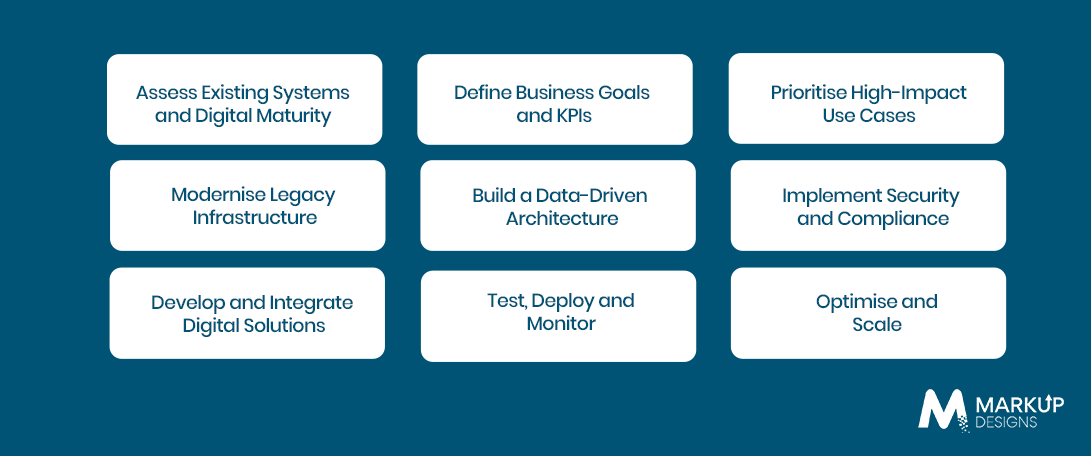
A successful transformation requires more than implementing individual technologies. Financial institutions need a structured approach that connects technology investments with business objectives, customer needs, and regulatory requirements.
1. Assess Existing Systems and Digital Maturity
Evaluate legacy applications, infrastructure, processes, data, and existing customer journeys to identify gaps and transformation opportunities.
2. Define Business Goals and KPIs
Establish clear objectives around operational efficiency, customer experience, revenue, risk management, and digital service performance.
3. Prioritise High-Impact Use Cases
Identify initiatives based on business value, technical feasibility, customer needs, and applicable regulatory requirements.
4. Modernise Legacy Infrastructure
Adopt approaches such as cloud migration services, APIs, microservices, or phased modernisation to improve flexibility and integration.
5. Build a Data-Driven Architecture
Connect and govern data across systems to create a reliable foundation for analytics, Artificial intelligence, reporting, and decision-making.
6. Implement Security and Compliance
Integrate cybersecurity, privacy, identity management, AML/KYC, and relevant regulatory controls throughout the development and transformation lifecycle.
7. Develop and Integrate Digital Solutions
Build or integrate applications, customer portals, AI solutions, payment systems, automation tools, and other digital services according to business requirements.
8. Test, Deploy and Monitor
Test solutions for performance, security, usability, scalability, and compliance before deployment, followed by continuous monitoring and optimisation.
9. Optimise and Scale
Use operational and customer insights to refine digital services and expand successful transformation initiatives across the organisation.
Security and Compliance in Financial Services Transformation
Security and compliance need to be considered throughout the transformation lifecycle, particularly when financial institutions handle sensitive customer and transaction data.
Data Privacy and Protection
Protect personal and financial information through appropriate data governance, access controls, and privacy measures.
AML and KYC
Support customer verification and transaction monitoring processes to meet applicable anti-money laundering and know-your-customer requirements.
PCI DSS
Apply relevant payment card security controls when handling cardholder data and payment card environments.
ISO 27001
Use information security management practices to establish structured controls for protecting organisational information.
SOC 2
Apply relevant controls around security, availability, confidentiality, processing integrity, and privacy where applicable.
GDPR
Consider GDPR requirements when financial services process personal data within its scope.
Identity and Access Management
Control access to systems and sensitive information through authentication, authorisation, and role-based access controls.
Encryption and Fraud Monitoring
Use encryption to protect sensitive information and monitoring capabilities to identify suspicious activities and potential threats.
Regulatory Reporting
Automate and streamline reporting processes where appropriate to improve accuracy and regulatory visibility.
Audit Trails and Data Governance
Maintain appropriate records of data access, transactions, and system activity while establishing clear data governance practices.
Challenges of Digital Transformation in Financial Services
Legacy System Dependencies
Older systems can limit integration, scalability, and the adoption of modern technologies. Phased modernisation, APIs, microservices, and integration layers can help institutions transition without disrupting critical operations.
Data Silos and Integration Issues
Fragmented data across applications can make it difficult to create consistent insights and connected services. Data governance, APIs, and interoperable architectures can help bring systems and information together.
Cybersecurity and Privacy Risks
Expanding digital services also increases the need to protect systems, application development, and sensitive financial information. Security-by-design, encryption, access controls, and continuous monitoring can strengthen protection.
Regulatory Complexity
Financial institutions operate within complex and evolving regulatory environments. Compliance-by-design and automated compliance processes can help integrate regulatory requirements into digital operations.
Skills and Talent Gaps
Transformation initiatives often require expertise across financial services, software development, cloud, AI, data, cybersecurity services, and compliance. Upskilling, specialist teams, and technology partnerships can help address capability gaps.
Transformation Costs and ROI Uncertainty
Large-scale modernisation can require significant investment, particularly when legacy systems and multiple integrations are involved. Prioritising measurable use cases and implementing transformation in phases can help organisations manage investment and evaluate outcomes.
Key Digital Transformation Trends in Financial Services
Digital transformation is evolving rapidly across the financial sector, with technologies such as AI, cloud computing, automation, and real-time data changing how institutions operate and serve customers.
Generative AI and AI-Powered Financial Services
AI is being used for customer support, fraud detection, risk assessment, financial recommendations, document processing, and other data-intensive tasks. Generative AI is also enabling more conversational and intelligent digital financial experiences.
Intelligent Automation and RPA
RPA and intelligent automation can handle repetitive tasks such as data entry, transaction processing, reporting, and document verification, helping financial institutions streamline operations and reduce manual effort.
Cloud-Native Financial Infrastructure
Cloud platforms provide flexible infrastructure that can support application modernisation, data management, disaster recovery, and the scaling of digital financial services.
Open Banking and API-Driven Finance
Open banking and APIs allow financial institutions and third-party platforms to securely connect services and exchange financial data, supporting more integrated digital experiences.
Embedded Finance
Embedded finance brings financial services such as payments, lending, insurance, or banking features directly into non-financial platforms, making these services available within existing digital journeys.
Real-Time Payments
Real-time payment infrastructure enables faster transactions and fund transfers, supporting customer expectations for immediate and convenient financial services.
Data Analytics and Predictive Intelligence
Financial institutions can use data analytics and predictive models to understand customer behaviour, identify risks, forecast demand, and support more informed decisions.
Digital Identity and Biometric Authentication
Digital identity solutions and biometric authentication can simplify customer verification while strengthening access control and security across financial platforms.
RegTech and Automated Compliance
RegTech solutions help financial institutions automate activities such as transaction monitoring, regulatory reporting, KYC, and compliance checks while improving oversight.
Blockchain and Distributed Ledger Technology
Blockchain can support applications involving digital assets, transaction records, smart contracts, and secure data sharing, although its use depends on the specific financial service and business requirement.
Technologies Powering Digital Transformation in Financial Services
Financial institutions use a combination of technologies to modernise operations, improve customer experiences, and build scalable digital services.
| Technology | Key Applications |
| AI & Machine Learning | Fraud detection, risk assessment, personalisation |
| Generative AI | Virtual assistants, document processing, knowledge management |
| Cloud Computing | Scalable infrastructure, application modernisation, disaster recovery |
| Big Data & Analytics | Customer insights, forecasting, risk analysis |
| RPA | Repetitive process automation and workflow management |
| APIs | Banking integrations and connected financial ecosystems |
| Blockchain | Digital assets, transaction records, smart contracts |
| IoT | Connected insurance and asset monitoring |
| Cybersecurity Technologies | Threat detection, identity management, access control |
Digital Transformation Strategy for Financial Services
A successful transformation requires more than implementing individual technologies. Financial institutions need a structured approach that connects technology investments with business objectives, customer needs, and regulatory requirements.
1. Assess Existing Systems and Digital Maturity
Evaluate legacy applications, infrastructure, processes, data, and existing customer journeys to identify gaps and transformation opportunities.
2. Define Business Goals and KPIs
Establish clear objectives around operational efficiency, customer experience, revenue, risk management, and digital service performance.
3. Prioritise High-Impact Use Cases
Identify initiatives based on business value, technical feasibility, customer needs, and applicable regulatory requirements.
4. Modernise Legacy Infrastructure
Adopt approaches such as cloud migration, APIs, microservices, or phased modernisation to improve flexibility and integration.
5. Build a Data-Driven Architecture
Connect and govern data across systems to create a reliable foundation for analytics, AI, reporting, and decision-making.
6. Implement Security and Compliance
Integrate cybersecurity, privacy, identity management, AML/KYC, and relevant regulatory controls throughout the development and transformation lifecycle.
7. Develop and Integrate Digital Solutions
Build or integrate applications, customer portals, AI solutions, payment systems, automation tools, and other digital services according to business requirements.
8. Test, Deploy and Monitor
Test solutions for performance, security, usability, scalability, and compliance before deployment, followed by continuous monitoring and optimisation.
9. Optimise and Scale
Use operational and customer insights to refine digital services and expand successful transformation initiatives across the organisation.
Security and Compliance in Financial Services Transformation
Security and compliance need to be considered throughout the transformation lifecycle, particularly when financial institutions handle sensitive customer and transaction data.
Data Privacy and Protection
Protect personal and financial information through appropriate data governance, access controls, and privacy measures.
AML and KYC
Support customer verification and transaction monitoring processes to meet applicable anti-money laundering and know-your-customer requirements.
PCI DSS
Apply relevant payment card security controls when handling cardholder data and payment card environments.
ISO 27001
Use information security management practices to establish structured controls for protecting organisational information.
SOC 2
Apply relevant controls around security, availability, confidentiality, processing integrity, and privacy where applicable.
GDPR
Consider GDPR requirements when financial services process personal data within its scope.
Identity and Access Management
Control access to systems and sensitive information through authentication, authorisation, and role-based access controls.
Encryption and Fraud Monitoring
Use encryption to protect sensitive information and monitoring capabilities to identify suspicious activities and potential threats.
Regulatory Reporting
Automate and streamline reporting processes where appropriate to improve accuracy and regulatory visibility.
Audit Trails and Data Governance
Maintain appropriate records of data access, transactions, and system activity while establishing clear data governance practices.
Challenges of Digital Transformation in Financial Services
Legacy System Dependencies
Older systems can limit integration, scalability, and the adoption of modern technologies. Phased modernisation, APIs, microservices development services, and integration layers can help institutions transition without disrupting critical operations.
Data Silos and Integration Issues
Fragmented data across applications can make it difficult to create consistent insights and connected services. Data governance, APIs, and interoperable architectures can help bring systems and information together.
Cybersecurity and Privacy Risks
Expanding digital services also increases the need to protect systems, applications, and sensitive financial information. Security-by-design, encryption, access controls, and continuous monitoring can strengthen protection.
Regulatory Complexity
Financial institutions operate within complex and evolving regulatory environments. Compliance-by-design and automated compliance processes can help integrate regulatory requirements into digital operations.
Skills and Talent Gaps
Transformation initiatives often require expertise across financial services, software development, cloud services, AI, data, cybersecurity, and compliance. Upskilling, specialist teams, and technology partnerships can help address capability gaps.
Transformation Costs and ROI Uncertainty
Large-scale modernisation can require significant investment, particularly when legacy systems and multiple integrations are involved. Prioritising measurable use cases and implementing transformation in phases can help organisations manage investment and evaluate outcomes.
How does Markup Designs support digital transformation in financial services?
Markup Designs supports financial institutions with digital transformation services covering software development, application modernisation, cloud solutions, AI and ML, data-driven solutions, API integrations, automation, and digital financial platforms. We align technology solutions with business objectives to help organisations modernise their systems and build scalable digital services.
Build the Future of Financial Services
Modernise legacy systems, adopt emerging technologies, and create digital financial experiences built around your business goals.

Conclusion
Digital transformation is changing how financial institutions build, deliver, and manage financial services. AI, cloud computing, automation, data analytics, APIs, and other technologies are creating opportunities to improve customer experiences, streamline operations, and develop more scalable services.
However, successful transformation requires more than adopting new technology. Financial institutions need a clear strategy that considers legacy infrastructure, data, security, compliance, integration, and long-term business objectives. A phased and business-focused approach can help turn digital investments into sustainable capabilities.
FAQs
1. How much does digital transformation in financial services cost?
The cost depends on the scope of transformation, existing infrastructure, number of systems involved, integrations, security requirements, compliance needs, and technologies being implemented. A focused digital initiative may require a smaller investment, while large-scale legacy modernisation and enterprise transformation can involve significantly higher costs.
2. How long does financial services digital transformation take?
The timeline depends on the complexity and scale of the project. A focused application or automation initiative may take a few months, while transforming multiple legacy systems, data environments, and customer-facing platforms can take considerably longer. A phased approach allows financial institutions to implement priority initiatives while continuing broader modernisation.
3. What are the biggest challenges in financial services digital transformation?
Common challenges include legacy systems, fragmented data, cybersecurity risks, regulatory requirements, integration complexities, talent shortages, and transformation costs. Establishing clear priorities and implementing modernisation in phases can help organisations address these challenges systematically.
4. How can financial institutions modernise legacy systems?
Financial institutions can modernise legacy systems through approaches such as cloud migration, API integration, microservices, application reengineering, and phased replacement. The right approach depends on the existing architecture, business requirements, data dependencies, and risk of disrupting critical services.
Author's Perspective
Financial services transformation should not be treated as a technology upgrade alone. The real value comes from identifying where technology can solve operational challenges, improve customer experiences, and support business growth. Financial institutions that align modern technology with their specific requirements can build a stronger foundation for continuous digital innovation.
Discuss Your Project NowJupinder Singh Arora
Founder and CEO
Related Posts

IoT in Banking: Transforming Financial Services Through Connected...

Digital Transformation for Australian Enterprises: Strategy, Technology &...

How to Hire AI Consultants for Enterprise Digital...
Insights Are Valuable & Execution is Priceless
You’ve read about the digital future. Now, let’s build the infrastructure to take you there. Move your strategy from the page to the product.
Design Your Solution Now
Contact Us
Schedule The Appointment At Your Convenience Date And Time.
30 Min
Web Conference
Time Zone
Indian standard time (08:30pm)

Thanks For Getting In Touch!
You’ve Taken The First Step Toward Transforming Your Digital Presence. Our Experts Will Reach Out Shortly To Take It Forward.
Launch Your Dream Project
Provide a brief overview of your project, and our specialists will evaluate your requirements. We will connect with you to explore how the right digital solutions can help you launch faster.