

In Brief
- Digital transformation is enabling Australian organizations to enhance their operational efficiency, customer experience, decision-making process, and competitiveness by using technologies like AI, cloud computing, automation, data analytics, IoT, and cybersecurity.
- Digital transformation begins with creating a sound strategy that determines the business objectives, digital maturity of an organization, technology gap, high-value initiatives, and a roadmap.
- The cost of digital transformation in Australia depends on various elements like the size of the enterprise, the scope of projects, legacy systems, technology needs, integration, security considerations, and maintenance. The ROI must be based on enhanced productivity, reduced costs, an increase in revenue, and better customer outcomes.
- Digital transformation needs efficient leadership, a skillful workforce, customer-oriented planning, scalable infrastructure, performance monitoring, and strategic technology adoption in place of market fads.
- Selection of a qualified digital transformation partner will allow Australian organizations to update legacy systems, use AI and cloud computing, automate business processes, integrate technologies, and create a scalable digital ecosystem.
Digital transformation is revolutionizing how Australian organizations conduct business and engage with their customers in a more digitally driven marketplace. Through AI, cloud computing, automation, and data analytics, organizations are integrating emerging technologies into their operations and processes to become more efficient and make better decisions. However, achieving digital transformation is not all about embracing new technology. Rather, a robust strategy and digital capability are essential for success.
This process is also associated with some specific difficulties faced by Australian companies, including the existence of legacy systems, cybersecurity issues, skills shortages, changes in customer demands, and careful management of technological investments.
In this blog, we will try to consider what digital transformation is and why it is necessary for Australian enterprises, what the main technologies that underlie digital transformation and its cost are, what the criteria for successful implementation are, and how to calculate the ROI from technological investments. In addition, we will consider how to select a digital transformation partner in Australia.
What is Digital Transformation for Australian Enterprises?
Digital transformation in Australia for enterprises involves the use of digital technology to enhance the performance of an enterprise in terms of operations, customer service, data management, and, more importantly, value creation. Digital transformation goes beyond just the transition from paper-based methods to digital means.
Examples of digital transformation include the implementation of cloud platforms to improve the infrastructure of the enterprise, the use of artificial intelligence to automate decision-making in the organization, and the implementation of data analytics to understand customer behavior. Modernization of legacy systems in order for departments to exchange data effectively is also an example of digital transformation.
An effective transformation involves integrating technology, people, and business processes. Transformation also necessitates a change in the way people work and a clear vision of what is needed from the leadership team.
Digital transformation will enable Australian companies to become more efficient in their operations, improve the experiences of customers, minimize the amount of manual work involved, and offer opportunities for growth in a competitive market environment.
Why Australian Enterprises Need Digital Transformation
Australian enterprises operate in an environment where customers expect quick services, workers require good digital devices, and organizations have to be able to react promptly to changes in the environment. This may be difficult due to the use of outdated systems and processes. Digital transformation is a way for organizations to overcome such limitations and create new, efficient work systems.
Some of the key reasons Australian enterprises are investing in digital transformation include:
- New customer requirements: Customers demand a digital experience, personalized service, and faster response.
- Higher efficiency: Automation helps businesses avoid routine tasks and mistakes, allowing employees to concentrate on tasks that have more value.
- Informed decision-making: Data analytics allows companies to learn about their operations, customers, sales, and market trends.
- Modernization of legacy systems: Upgrading legacy systems or integrating with other systems may enhance performance and facilitate adoption of new technology.
- Business resilience: Cloud platforms, connected systems, and digital processes will enable an enterprise to deal better with disruption.
- Business growth: Digitalization helps businesses introduce new products and services, retain customers, and find new ways to generate revenue.
Building a Digital Transformation Strategy
A successful digital transformation requires a solid strategy. Australian businesses should not jump on the technology simply because it is trendy. They should first identify their problems, set their business objectives, and decide where the implementation of digital solutions will add the most value.
A practical transformation strategy can include:
Define Clear Business Objectives:
Define what the purpose of the business is; if it is to save costs, improve customer experience, increase efficiency, or earn money.
Assessing the Digital Maturity of the Business:
Assess how mature the current systems, processes, data, people, and customer experience are in order to pinpoint opportunities for improvement.
Identify Opportunities and Shortcomings:
Point out outdated technologies, manual work, data silo, and other problems that hinder the growth of the business.
Prioritize Initiatives:
Begin with initiatives that are valuable to the business and yield measurable results.
Choose Right Technologies:
Get the solutions based on their requirements for business, scalability, security, and value.
Draw a measurable roadmap:
Create a timeline, accountability, budgeting, and KPIs to measure progress during the transformation journey.
In this way, companies will be able to convert their digital transformation efforts from a technological project to a well-planned growth strategy.
Key Technologies Driving Enterprise Transformation
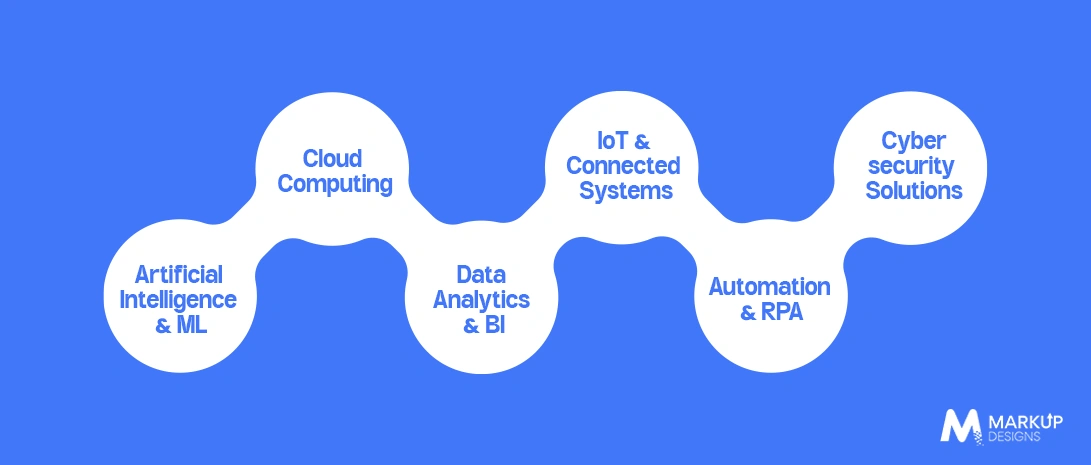
Digital transformation is a result of technology; however, organizations in Australia need to choose the appropriate technologies that will help solve their problems. Choosing the right technologies will assist in ensuring the success of an organization through process improvements and improved experiences.
Key technologies driving enterprise transformation include:
Artificial Intelligence & ML
Helps in automating decisions, predicting trends, personalized customer interaction, and business process improvement.
Cloud Computing
Provides scalability, application flexibility, and resource management in the enterprise environment.
Data Analytics & BI
Convert business data into valuable insights for more efficient decision-making.
IoT & Connected Systems
Help in connecting devices to enable real-time monitoring and predictive maintenance.
Automation & RPA
Helps in automating processes such as data entry, reporting, financial process, and customer service.
Cybersecurity Solutions
Provides safeguards against any cyber threats to systems, data, applications, and operations.
These technologies, when implemented effectively through a strategy, can help Australian enterprises construct smarter and more efficient enterprises of the future.
Ready to Start Your Digital Transformation Journey?
Digital transformation becomes more valuable when technology is connected to clear business goals. Whether you want to modernize legacy systems, automate operations, adopt AI, or move to the cloud, having the right technology partner can make the process more structured and measurable.

Digital Transformation Roadmap for Australian Enterprises
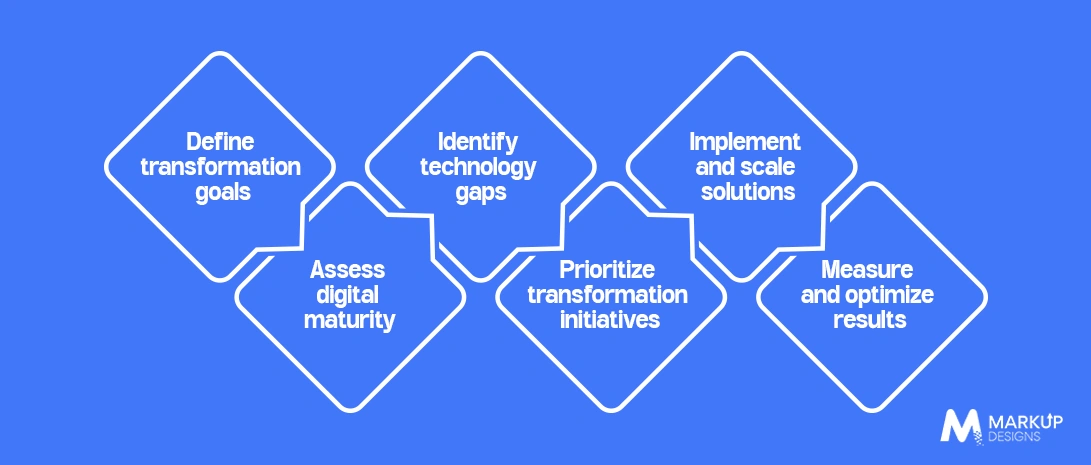
The digital transformation process is a continuous one, and for Australian firms to move from planning to implementation, there needs to be a clear roadmap that can help them in reducing the risks associated with the investment, make good investments and ensure that each technology project delivers a business goal.
Here are the key steps involved:
Define transformation goals
The initial process would involve setting objectives for the company, which could include increasing efficiency, reducing costs, customer satisfaction, and the creation of digital products/services.
Assess digital maturity
It includes analysis of existing infrastructure, data, processes, competencies of employees, and customer interactions in order to determine the current level of digital maturity.
Identify technology gaps
This process includes the assessment of gaps and prioritization of initiatives based on their significance, complexity, and impact on the business.
Prioritize transformation initiatives
Technologies like artificial intelligence, cloud computing, automation, analytics, and the Internet of Things can be selected according to the needs of the business instead of following fashion trends.
Implement and scale solutions
Begin with smaller projects or experiments, analyze their success and scale up successful ones.
Measure and optimize results
Measure performance indicators, cost savings, productivity, customer satisfaction and any other business outcome, and optimize your transformation strategy.
This roadmap enables organizations to achieve digital transformation that is more structured, measurable, and consistent with long-term growth.
Digital Transformation Costs in Australia
The cost of digital transformation in Australia differs greatly from one business to another. There is no fixed cost for this process, as it might range from digitalizing a specific process to changing the entire IT system of a company. Everything will depend on the scale and the goals of the digital transformation process itself.
Some of the important factors affecting the cost are:
- Size of the enterprise: Enterprises with many departments and branches will require greater investments.
- Technical infrastructure: The existing technical infrastructure will need some additional work to be done for integration, migration, or even upgrades.
- Technological needs: Investments in technologies such as AI, cloud computing, automation, big data analysis, IoT, and cybersecurity.
- Complexity of integration: Integration of new systems into existing ERP, CRM, database, and other enterprise systems will lead to higher development costs.
- Security and compliance: The Australian business may require higher investments in security controls, governance, and monitoring of data.
- Maintenance: Cloud services, software maintenance, staff training, and optimization will also become an important part of the budget plan.
Instead of concentrating on the capital expenditure alone, organizations need to consider the value they stand to gain from the project in order to determine whether a transformation project is worth investing in.
Key Success Factors for Digital Transformation
Digital transformation does not occur just because the enterprise has adopted digital technology. The user of the technology, the processes that enable it, and the objective for which it is being done all matter equally. There are certain key considerations that should be taken into account by Australian enterprises.
1. Strong leadership support
The management needs to back up any transformation efforts with leadership backing, direction, resources, and accountability.
2. Clear business objectives
All digital initiatives must have a business objective, including increased efficiency, cost reduction, improved revenue generation, and better customer experience.
3. Customer-focused approach
Technologies must be chosen from the perspective of how they can contribute to improving customer engagement and overall customer experience.
4. Skilled digital workforce
Employees need the right training and skills to confidently adopt new platforms, tools, and processes.
5. Scalable technology infrastructure
Businesses must invest in infrastructure that can adapt to changing business needs and technology usage.
6. Continuous performance measurement
Continuous measuring of metrics such as operating costs, productivity, revenue, and customer satisfaction helps the business measure success and identify areas for improvement.
By combining these factors with the right strategy and technology, Australian enterprises can make transformation more practical, sustainable, and focused on long-term business value.
How to Choose a Digital Transformation Partner in Australia
The selection of a digital transformation partner is important in order to ensure the success of an enterprise transformation program. The digital transformation company needs to be aware of both technological and business needs for the transformation to occur. An Australian company should select its partners after due evaluation and not just go by price alone.
Here are some important factors to consider:
- Industry-Specific Experience: Find a partner who has the experience of working with organizations similar to yours and who knows the needs of your industry.
- End-to-End Competencies: Ensure that the provider is able to deliver capabilities across strategy, consulting, software engineering, cloud, AI, automation, integration, and optimization.
- Technical Expertise: Verify that the team has real-world technical expertise with the technologies required for your transformation.
- Security & Compliance Awareness: The enterprise-level solutions must have adequate awareness of security, privacy, governance, and compliance considerations.
- Proven Expertise: Refer to the case studies, past projects, client testimonials, and tangible business results.
- Ongoing Support: The process of digital transformation doesn’t stop with the execution. Select a partner who will offer you maintenance, monitoring, and improvement of technology as your business matures.
Your transformation partner must be a strategic technology advisor who can help your company make better digital decisions while keeping business goals, scalability, and ROI in mind.
Why Choose Markup Designs for Digital Transformation?
We at Markup Designs assist Australian organizations in translating their vision of digital transformation into technology-based solutions by thoroughly studying their problems first before determining the technologies that can be used to solve them.
Our capabilities include artificial intelligence, cloud technologies, automation, big data, enterprise software, legacy systems transformation, and integration solutions.
We also realize that each transformation process is unique. Our solution is based on proper planning, staged deployment, measurable results, and scalability for the long term. From detecting technology gaps to deploying and optimizing digital technology solutions, we can assist enterprises in any phase of their transformation process.
Using our business-oriented perspective and technological knowledge, Markup Designs intends to assist Australian enterprises in becoming more efficient, improving customer experiences, making operations easier, and laying the groundwork for sustainable digital growth.
Ready to Transform Your Enterprise?
Your digital transformation journey does not have to start with a complete technology overhaul. Begin by identifying the areas where digital solutions can create the greatest business impact.

Conclusion
Nowadays, digital transformation has become a popular way of developing enterprises in Australia to increase effectiveness and adapt to changes in the market and customers’ demands. However, this process cannot be successful without a clearly defined strategy, an appropriate technology platform, competent people, and measurement.
There are many technologies that could be applied to transform businesses into something more advanced and up-to-date. AI, automation, cloud computing, analytics, and interconnections are examples of such possibilities. The point here is to choose technologies according to the needs of a particular company and implement them according to the roadmap.
The issues of cost and return on investment should not be forgotten, too. Setting specific goals and measuring outcomes allows knowing whether all efforts result in a certain benefit.
With a properly designed strategy and an appropriate technology partner, businesses will be able to modernize their operations and provide a better experience to customers.
FAQs
1. What is digital transformation for Australian enterprises?
Digital transformation involves using modern technologies and digital processes to improve business operations, customer experiences, decision-making, and overall enterprise performance.
2. Why is digital transformation important for Australian businesses?
It can help businesses improve efficiency, respond to changing customer expectations, modernize legacy systems, reduce manual work, and create new opportunities for growth.
3. What technologies are commonly used in enterprise digital transformation?
Common technologies include AI/ML development, cloud computing, data analytics, automation, IoT, cybersecurity solutions, and modern enterprise software.
4. How much does digital transformation cost in Australia?
Costs vary depending on enterprise size, project scope, existing infrastructure, technology requirements, integration complexity, security needs, and ongoing support.
5. How can enterprises measure digital transformation ROI?
Businesses can measure ROI through metrics such as cost savings, productivity improvements, revenue growth, customer satisfaction, process efficiency, and reduced operational risks.
Author's Perspective
By now, you should have a clear understanding of why digital transformation matters for Australian enterprises and how strategy, technology, and ROI work together. The goal is not to adopt every new technology, but to choose solutions that address your specific business needs and deliver measurable value.
A well-planned transformation can modernize operations, improve customer experiences, empower employees, and support long-term growth. However, success requires clear goals, proper planning, continuous measurement, and the right technology expertise.
If your enterprise is planning its next digital move, start by assessing your current capabilities, defining business objectives, and creating a practical roadmap focused on measurable outcomes and sustainable growth.
Discuss Your Project NowJupinder Singh Arora
Founder and CEO
Related Posts

Digital Transformation for Government Services in Kuwait: Key...

Why Businesses in Oman Need Digital Transformation Services

Digital Transformation in Financial Services: Trends, Benefits &...
Insights Are Valuable & Execution is Priceless
You’ve read about the digital future. Now, let’s build the infrastructure to take you there. Move your strategy from the page to the product.
Design Your Solution Now
Contact Us
Schedule The Appointment At Your Convenience Date And Time.
30 Min
Web Conference
Time Zone
Indian standard time (08:30pm)

Thanks For Getting In Touch!
You’ve Taken The First Step Toward Transforming Your Digital Presence. Our Experts Will Reach Out Shortly To Take It Forward.
Launch Your Dream Project
Provide a brief overview of your project, and our specialists will evaluate your requirements. We will connect with you to explore how the right digital solutions can help you launch faster.