

In Brief
- Realise how AI-powered bots understand customers’ intentions and direct shoppers to pertinent product ranges.
- Find out how tailored recommendations, conversational commerce, and immediate support can eliminate barriers to purchasing.
- Learn about the role of chatbots in recovering abandoned carts, as well as in upselling and cross-selling.
- Acquire knowledge about software, data integrations, and features needed for eCommerce-focused AI solutions.
- Grasp the nuances of security, accuracy, governance, and performance related to the use of AI chatbots for eCommerce.
Shopping online implies customers asking questions before making a purchase. Questions can relate to various issues, e.g., product search, product comparison, product availability, specifications, delivery, and return questions. AI chatbots turn that into a perfect opportunity to lead customers through the entire buying process without requiring them to explore product catalogues or help sections on their own.
Moreover, chatbots powered by AI do not depend on learning what questions customers raise because they examine natural language requests and use customer and product circumstances to give more relevant advice.
However, generating conversations is only part of the equation. To contribute meaningfully to sales, an eCommerce AI chatbot needs accurate data, thoughtful conversation design, reliable integrations, appropriate guardrails, and continuous performance monitoring.
How Do eCommerce AI Chatbots Turn Conversations Into Sales?
AI chatbots have the capability of turning customer conversations into meaningful conversations that allow customers to go from searching for a product to purchasing one in a seamless experience as the customer and chatbot have a conversation.
Understanding Customer Intent Through Conversations
AI chatbots are able to analyze natural language questions and, in doing so, identify customer needs, wants, budget, and desire to buy. This means that chatbots don’t respond generically, but are able to provide meaningful help to shoppers.
Turning Questions Into Product Discovery
Rather than having their customers search through many categories and filters, chatbots can narrow down all products with the help of a conversation. The chatbot is able to start asking relevant follow-up questions and even suggest options based on what the customer is looking for.
Personalising Recommendations in Real Time
By using available customer, product, browsing, and inventory data, AI chatbots can provide recommendations that are more relevant to the current conversation. Recommendations can also adapt as the customer’s preferences become clearer.
Removing Friction From the Purchase Journey
Customers often hesitate because they need information about product specifications, pricing, availability, shipping, returns, or compatibility. Providing these answers within the conversation can reduce the effort required to make a purchase decision.
Supporting Customers After the Purchase
The conversation does not need to end after checkout. AI chatbots can assist with order tracking, returns, product usage, and support queries while also identifying appropriate opportunities for future engagement.
How eCommerce AI Chatbots Drive Sales Across the Customer Journey
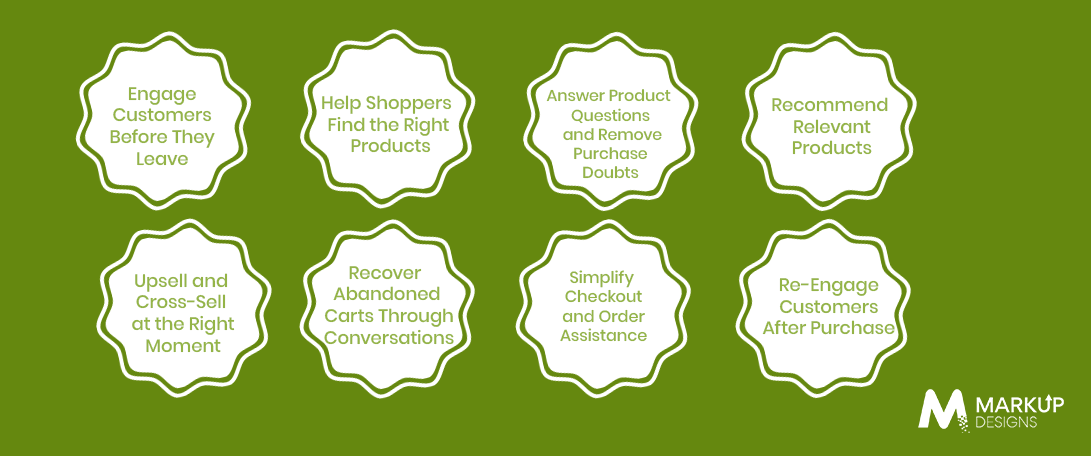
Artificial Intelligence chatbots can be used at different phases of the buying experience, from the beginning of interaction to post-sale communication.
1. Engage Customers Before They Leave
Chatbots can give response to browsing cues or customer inquiries instantaneously, solving their doubts before making exit from the online shop.
2. Help Shoppers Find the Right Products
Interactive product finding enables customers to articulate their needs in their very own words, as chatbots are capable of refining the available ranges.
3. Answer Product Questions and Remove Purchase Doubts
Customers can inquire about features, specifications, availability, delivery, returns, compatibility, etc. and receive answers from chatbots without checking lots of pages.
4. Recommend Relevant Products
Artificial Intelligence combines conversational context with the knowledge of the customer and product to recommend suitable products to buyers.
5. Upsell and Cross-Sell at the Right Moment
In certain situation chatbots can accompany customer decision-making with suggestions on upgrades, additions, or other items that go with the purchase instead of irrelevant offers.
6. Recover Abandoned Carts Through Conversations
Chatbots can reconnect customer to sessions interrupted with abandoned carts, by helping them with their questions or reminding them of their purchases that haven’t been completed yet.
7. Simplify Checkout and Order Assistance
Chatbots can guide customers through parts of the checkout and provide information about orders, payment status, shipping, and delivery after purchase.
8. Re-Engage Customers After Purchase
Based on previous purchases and interactions, chatbots can support replenishment reminders, relevant recommendations, loyalty engagement, and future shopping needs.
What Makes an eCommerce AI Chatbot Effective at Converting Customers?
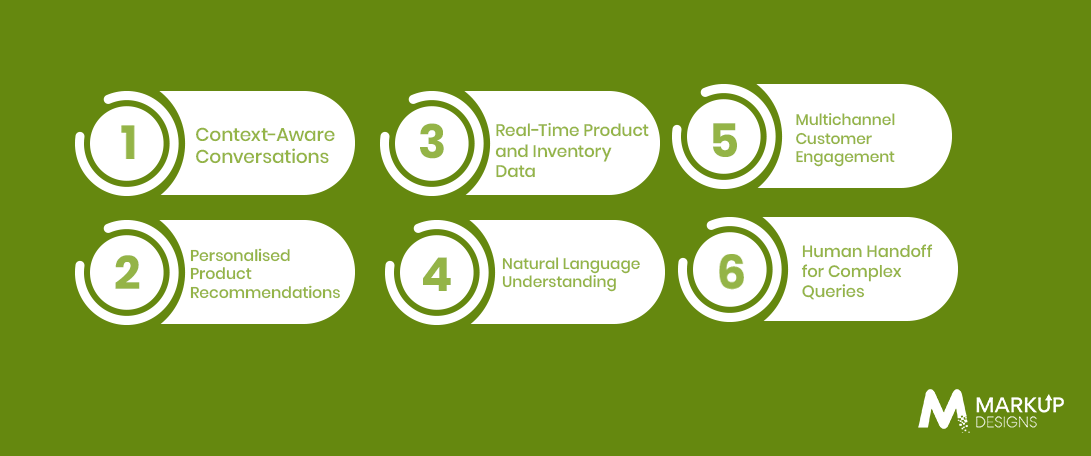
The performance of a chatbot that is designed to sell goes beyond the ability to engage in conversations. Such a chatbot will need reliable data, appropriate context and integration solutions, and an understood way to transfer complicated requests to human personnel.
Context-Aware Conversations
A chatbot must keep the relevant conversation context that allows customers not to repeat their requests.
Personalised Product Recommendations
The recommendations made by the chatbot must fully correspond to the needs stated by the customer as well as the business data.
Real-Time Product and Inventory Data
Connecting a chatbot requires up-to-date catalogs, pricing, and stock so that no outdated product information is used.
Natural Language Understanding
A chatbot must be able to understand the wider meaning of an inquiry, and not just word-for-word information.
Multichannel Customer Engagement
The ability to talk to a chatbot must be provided on many channels like websites, mobile applications, messaging apps, and social networks, and the context must be maintained.
Human Handoff for Complex Queries
Whenever the inquiry cannot be handled by a chatbot, the conversation will need to be transferred to a human employee without damaging the customer’s experience.
Enterprise Technology Stack Behind Sales-Driven eCommerce AI Chatbots
A sales-focused chatbot needs to connect conversational AI with the systems that contain the information required to support real shopping decisions.
Large Language Models and AI Orchestration
Large language models provide the conversational intelligence, while orchestration layers manage prompts, tools, workflows, context, and interactions with business systems.
Retrieval-Augmented Generation for Product Knowledge
RAG can connect the chatbot to approved product information and other business knowledge, helping it generate responses using relevant source data rather than relying only on model knowledge.
Product Catalog and Inventory Integration
Integration with product catalogues and inventory systems enables the chatbot to provide information about products, prices, variants, availability, and other changing attributes.
Customer Data and CRM Integration
CRM and customer data can provide relevant information about previous interactions, preferences, purchases, and customer status, subject to applicable privacy and access controls.
eCommerce Platform Integration
Connecting the chatbot with the underlying eCommerce platform allows it to interact with product, cart, customer, and order workflows.
Payment and Order Management Integration
Where appropriate, integrations with payment and order systems can support checkout assistance, order status queries, payment updates, and post-purchase workflows.
Analytics and Conversation Tracking
Conversation analytics can help businesses understand common customer questions, drop-off points, recommendation performance, and conversion behaviour.
How to Build an eCommerce AI Chatbot That Converts
Building a sales-focused chatbot requires more than connecting an LLM to a product catalogue. The chatbot needs clearly defined objectives, reliable data, useful conversation flows, appropriate integrations, and continuous testing.
1. Define Sales and Customer Experience Goals
Determine what the chatbot should achieve, such as improving product discovery, increasing conversions, reducing cart abandonment, or supporting repeat purchases. Define measurable objectives before development begins.
2. Identify High-Value Customer Conversations
Analyse where customers commonly need assistance and identify conversations that have a meaningful effect on purchasing decisions. Prioritise product discovery, comparisons, purchase questions, cart abandonment, and other high-impact interactions.
3. Map Customer Journeys and Buying Intent
Map the key stages from initial discovery to purchase and post-purchase support. Define the information customers need at each stage and identify where the chatbot can provide useful assistance.
4. Build and Organise the Product Knowledge Base
Create a reliable knowledge base containing product specifications, pricing information, policies, FAQs, availability data, and other approved content. Keep the information structured and regularly updated.
5. Choose the AI Model and Conversational Architecture
Select the appropriate model and define how it will handle conversations, retrieve information, use business tools, maintain context, and escalate requests. Architecture decisions should reflect the chatbot’s expected workload and business requirements.
6. Integrate Product, Customer, Inventory, and Order Data
Connect the chatbot to the systems required to provide accurate and useful responses. Establish appropriate permissions so the chatbot only accesses the information and actions required for its role.
7. Design Context-Aware Conversation Flows
Create conversational flows for discovery, recommendations, product comparisons, objections, checkout assistance, and support. Include fallback paths for unclear questions and scenarios where the chatbot cannot provide a reliable answer.
8. Implement Recommendations and Personalisation
Use relevant customer and product signals to tailor recommendations. Personalisation should remain useful and contextually appropriate rather than turning every interaction into an attempt to upsell.
9. Add Cart Recovery, Upselling, and Cross-Selling
Introduce sales-oriented workflows where they provide genuine value. Recommendations should be based on product relevance, customer intent, availability, and the context of the interaction.
10. Establish Human Handoff and Escalation
Define situations where the chatbot should transfer customers to human agents, such as complex complaints, exceptional orders, sensitive requests, or questions outside its approved knowledge.
11. Test Conversations and AI Responses
Test common questions, ambiguous requests, incorrect assumptions, product comparisons, edge cases, and critical purchase workflows. Validate both the accuracy of responses and the actions triggered by the chatbot.
12. Deploy, Monitor, and Optimise Performance
After deployment, monitor conversations, response accuracy, engagement, conversion behaviour, failed interactions, and escalation rates. Use these insights to improve knowledge sources, conversation flows, integrations, and overall chatbot performance.
Key Features of eCommerce AI Chatbots That Drive Conversions
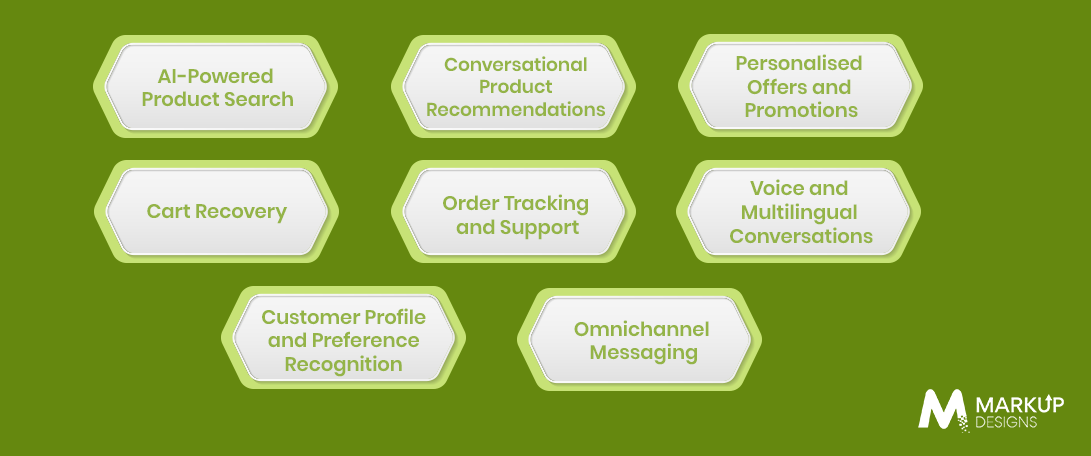
eCommerce AI chatbots combine conversational AI, customer data, and commerce systems to support shoppers throughout the buying journey. The right features can help businesses improve product discovery, personalise interactions, reduce purchase friction, and create more opportunities for conversion.
AI-Powered Product Search
Allow customers to search for products using natural-language queries instead of relying only on categories and filters. AI can understand product requirements and return relevant results based on factors such as features, price, size, or intended use.
Conversational Product Recommendations
Use the customer’s questions, preferences, and conversation context to recommend relevant products. The chatbot can refine suggestions through follow-up questions and help customers compare available options.
Personalised Offers and Promotions
Deliver offers based on customer preferences, purchase history, shopping behaviour, or current cart activity. Personalised promotions can make discounts and recommendations more relevant to individual shopping needs.
Cart Recovery
Re-engage customers who leave products in their carts by addressing unanswered questions, providing product information, or reminding them about their pending purchases.
Order Tracking and Support
Provide real-time assistance for order status, shipping updates, returns, exchanges, and other post-purchase queries. This keeps customers engaged while reducing the workload on support teams.
Voice and Multilingual Conversations
Support voice-based interactions and multiple languages to make conversational AI in online shopping accessible to a broader customer base and accommodate different communication preferences.
Customer Profile and Preference Recognition
Use permitted customer data to understand preferences, previous purchases, and interaction history. This helps the chatbot provide more relevant recommendations and avoid repetitive conversations.
Omnichannel Messaging
Extend chatbot interactions across websites, mobile apps, messaging platforms, and social channels. Maintaining relevant context across channels can provide customers with a more consistent shopping experience.
Measuring the Sales Impact of eCommerce AI Chatbots
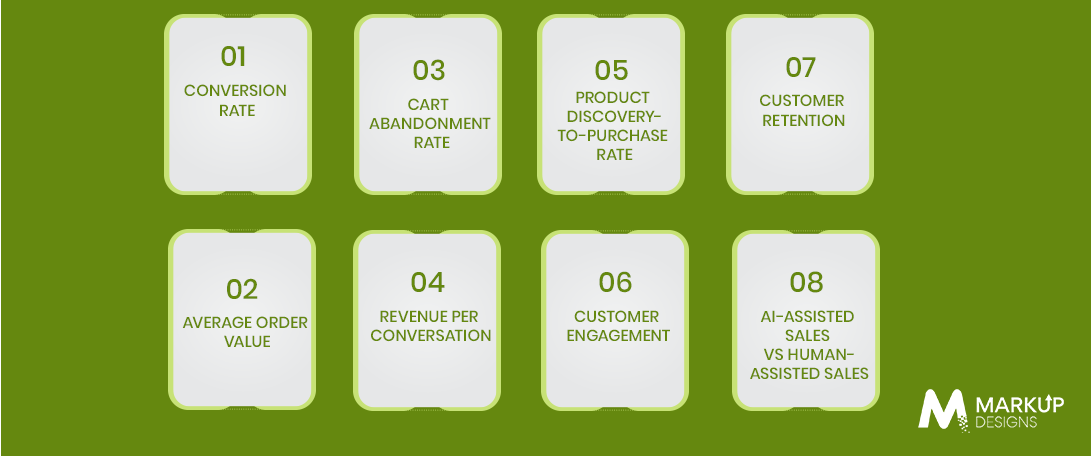
Chatbot performance should be measured using both sales outcomes and customer engagement metrics. Tracking these indicators helps businesses understand whether conversations are contributing to meaningful improvements across the purchase journey.
Conversion Rate
Measure the percentage of chatbot-assisted interactions that result in a completed purchase. Comparing conversion rates before and after chatbot implementation can help assess its contribution to sales.
Average Order Value
Track whether chatbot-assisted purchases generate higher or lower average order values. This can help evaluate the impact of recommendations, bundles, upselling, and cross-selling.
Cart Abandonment Rate
Monitor how often customers leave products in their carts without completing checkout. Changes in abandonment rates can indicate whether conversational assistance is helping resolve purchase barriers.
Revenue Per Conversation
Calculate the revenue associated with chatbot interactions to understand the commercial value generated by customer conversations.
Product Discovery-to-Purchase Rate
Track how many customers who discover or interact with products through the chatbot eventually complete a purchase. This helps evaluate the effectiveness of conversational product discovery.
Customer Engagement
Measure interaction volume, conversation length, repeat interactions, response rates, and other engagement signals to understand how customers use the chatbot.
Customer Retention
Analyse repeat purchases and returning customer interactions to determine whether chatbot-assisted experiences contribute to longer-term customer engagement.
AI-Assisted Sales vs Human-Assisted Sales
Compare sales outcomes from AI-assisted and human-assisted interactions using consistent metrics. The objective is to identify where automation performs effectively and where human assistance continues to add value.
Security, Accuracy, and Governance for eCommerce AI Chatbots
Sales-focused chatbots interact with customer information, product data, and business systems, making security and governance important throughout their lifecycle. Controls should cover data access, response accuracy, system permissions, human oversight, and conversation records.
Protecting Customer and Payment Data
Apply appropriate security controls to protect personal, account, and payment-related information. Sensitive data should only be accessed or processed when necessary and through authorised systems.
Preventing Incorrect Product Recommendations
Use approved product data, business rules, and availability information to reduce the risk of unsuitable recommendations, incorrect pricing, or unavailable products being presented to customers.
Keeping AI Responses Grounded in Trusted Data
Connect the chatbot to reliable and regularly updated knowledge sources. Retrieval-based approaches can help ensure responses are supported by approved product and business information.
Managing Access to Customer and Business Systems
Define permissions for the chatbot based on the actions and information it requires. Access to customer records, inventory, orders, and other systems should follow appropriate security controls.
Establishing Human Oversight and Escalation
Define clear escalation rules for complex, sensitive, or high-risk interactions. Human teams should be able to review or take over conversations when automated assistance is not appropriate.
Maintaining Audit Trails and Conversation Records
Maintain appropriate records of chatbot interactions, system actions, and escalations. These records can support troubleshooting, quality reviews, compliance requirements, and ongoing optimisation.
Common Challenges of Using AI Chatbots for eCommerce Sales
While AI chatbots can support sales at multiple stages of the customer journey, their effectiveness depends on the quality of their data, integrations, conversation design, and ongoing management.
Inaccurate or Outdated Product Information
If catalogue, pricing, inventory, or policy information is outdated, the chatbot may provide responses that do not reflect current business conditions.
Generic Recommendations
Recommendations that do not account for customer intent or context can feel irrelevant. Effective personalisation requires useful customer and product signals.
Hallucinated Responses
AI models can generate information that is not supported by business data. Grounded knowledge sources, validation mechanisms, and response guardrails can help reduce this risk.
Poor Integration With eCommerce Systems
Limited integration with product catalogues, carts, inventory, CRM, payment, or order systems can restrict what the chatbot can accurately assist with.
Privacy and Data Security Risks
Chatbots may process customer and transactional information, creating the need for appropriate data protection, access controls, and secure system integrations.
Complex Customer Queries
Some customers require specialised advice, exception handling, or human judgement. Chatbots need clear fallback and escalation mechanisms for these scenarios.
Maintaining Consistent Brand Voice
The chatbot should communicate in a way that aligns with the brand’s tone, terminology, policies, and customer service standards across different interactions and channels.
Balancing Automation With Human Support
Over-automation can create frustration when customers need human assistance. Businesses should identify which interactions can be automated and where human support should remain available.
Read Also: The Future of AI in Digital Transformation: Trends That Will Define the Next Decade
Best Practices for Turning Chatbot Conversations Into Sales
A sales-focused chatbot should help customers make informed decisions rather than simply push products. The following practices can help businesses create more useful and conversion-oriented conversational experiences.
Focus on Customer Intent Rather Than Hard-Selling
Understand what the customer is trying to achieve before presenting products or offers. Recommendations should address the customer’s requirements and buying stage.
Use Real-Time Data for Recommendations
Connect the chatbot with current product, pricing, availability, inventory, and other relevant business data to keep recommendations accurate.
Keep Recommendations Relevant and Explainable
Explain why a product or offer is being suggested when appropriate. Recommendations should be based on identifiable customer needs and product attributes.
Make Human Handoff Easy
Give customers a clear path to human assistance when the chatbot cannot resolve their request. Preserve relevant conversation context so customers do not need to start again.
Test Critical Purchase Journeys
Test product discovery, comparisons, recommendations, cart recovery, checkout assistance, order queries, and other high-value workflows before and after deployment.
Continuously Analyse Conversation Data
Review customer questions, failed interactions, drop-off points, escalations, and successful conversations to identify areas for improvement.
Optimise Based on Conversion Behaviour
Use conversion and engagement data to refine conversation flows, recommendations, prompts, knowledge sources, and sales workflows over time.
eCommerce AI Chatbots in Action: Key Sales Use Cases
AI chatbots can support different commercial use cases across product discovery, purchasing, customer service, and post-purchase engagement.
Guided Product Discovery
Help customers describe what they need in natural language and guide them towards suitable products through conversational questions and recommendations.
Personalised Shopping Assistance
Provide individualised support based on customer preferences, previous interactions, purchase history, and the products being considered.
Conversational Commerce
Enable customers to browse products, compare options, ask questions, receive recommendations, and complete parts of the purchasing journey through conversation.
Abandoned Cart Recovery
Reconnect with customers who leave items behind and help address questions or concerns that may have prevented them from completing their purchase.
Upselling and Cross-Selling
Recommend relevant upgrades, accessories, complementary products, or bundles based on the customer’s current purchase intent.
Customer Support-Driven Sales
Turn support interactions into relevant sales opportunities when customers ask about replacements, upgrades, complementary products, or additional services.
Loyalty and Repeat Purchases
Use previous purchase and interaction data to support replenishment reminders, relevant recommendations, loyalty engagement, and future purchases.
Omnichannel Shopping Assistance
Provide conversational shopping support across digital touchpoints while maintaining appropriate customer and conversation context between channels.
Turn Customer Conversations Into eCommerce Sales
Build an AI chatbot that understands customer intent, supports product discovery, personalises recommendations, and contributes to measurable sales outcomes.

Conclusion
At Markup Designs, our team of professionals creates advanced eCommerce chatbots powered by artificial intelligence. These chatbots integrate cutting-edge technology such as conversational AI to perform a variety of tasks, from product recommendations to engaging customers after the purchase. We design our chatbots for product exploration, cart recovery, order guidance, etc., and build into our solution all necessary technologies for secure integration, data retrieval, customer service, and powerful analytics. Our focus is on crafting conversation experiences with strong contextual understanding to help companies meet their sales targets.
FAQs
1. How does the use of AI chatbots contribute to the growth of eCommerce sales?
AI chatbots can benefit sales by helping customers to find products, solving issues related to purchases, giving relevant suggestions, minimizing difficulties with checkout processes, bringing back abandoned carts, and finding opportunities for upselling or cross-selling.
2. Can a chatbot give customers recommendations?
Yes. AI chatbots can give recommendations relying on data about customer inquiries, the background of the conversation, characteristics of products, history of interactions, stock data, and others. The effectiveness of the recommendations depends on the quality of data processing.
3. Do eCommerce chatbots help to recover abandoned carts?
Yes. Chatbots can help to bring back customers who abandoned their carts by answering questions, providing information about products or shipping, and guiding them towards making the purchase.
4. In what way do AI chatbots make the shopping process more personalized?
Chatbots can use available data regarding customers, history of interactions, their previous purchases, preferences, and the context of the conversation to provide customized offers.
5. What data does an eCommerce AI chatbot need?
The required data depends on the chatbot’s role but may include product catalogue information, pricing, inventory, customer profiles, purchase history, FAQs, shipping and return policies, order information, and relevant business rules. Access should be limited to the data required for the chatbot’s functions.
Author's Perspective
The real benefit of implementing conversational AI in eCommerce is not limited to automation of customer service. Instead, it is using chatbots to detect customer needs and help them make purchases when it is needed. A great eCommerce chatbot is capable of determining user intent, tapping into relevant information, answering concerns, and presenting suitable offers.
Companies should prioritize developing a viable conversation journey and linking it to reliable eCommerce data.The technology matters, but the results ultimately depend on how well the chatbot understands customers, supports purchasing decisions, and works with the systems and people behind the eCommerce experience.
Discuss Your Project NowAjit Kumar Jha
VP - Business Operations
Related Posts

Best Strategies to Hire Machine Learning Engineers for...
Insights Are Valuable & Execution is Priceless
You’ve read about the digital future. Now, let’s build the infrastructure to take you there. Move your strategy from the page to the product.
Design Your Solution Now
Contact Us
Schedule The Appointment At Your Convenience Date And Time.
30 Min
Web Conference
Time Zone
Indian standard time (08:30pm)

Thanks For Getting In Touch!
You’ve Taken The First Step Toward Transforming Your Digital Presence. Our Experts Will Reach Out Shortly To Take It Forward.
Launch Your Dream Project
Provide a brief overview of your project, and our specialists will evaluate your requirements. We will connect with you to explore how the right digital solutions can help you launch faster.