
In Brief
- AI is helping UK companies streamline operations, improve output, and make informed decisions based on data.
- Various industries, including financial services, health, retail, and manufacturing, are leveraging AI to solve real business issues.
- Some AI applications include preventing fraud, implementing predictive maintenance, generating customized customer experiences, enhancing cybersecurity, and forecasting demand.
- This successful application of AI requires that companies have clean and reliable data, proper technological infrastructure, and set clear goals for their businesses.
- Those firms that treat AI as a tool for strategic initiatives rather than an isolated technology have a better chance of achieving high results in the long run.
AI is no longer just an experiment. It has now become an effective tool for UK companies that helps them to process massive volumes of information, automate boring and repetitive tasks, transform customer experiences, and speed up the process of decision-making. In the long run, companies may be better positioned to benefit from the power of AI and take advantage of a range of its possibilities. Those British companies that have successfully integrated AI into their business practice may be more agile and adaptive than their competitors.
The use of AI technology in various sectors has enabled businesses to detect fraud, anticipate when their equipment might fail, customize customer interactions, have more efficient resource management, and boost cybersecurity, among many other capabilities. However, properly integrating AI into business operations is more than just installing the AI solution on top of the existing workflow. It involves selecting relevant applications, compiling quality data, integrating the AI solution into the existing system, and implementing proper governance regimes. The article lists 10 real-life examples of AI use in the UK as an illustration of how the technology was used in practice to have real business outcomes.
AI Adoption in the UK: Where Businesses Stand Today
The implementation of AI technology in the UK is becoming more widespread, with businesses moving from running experiments on using AI technology to solving concrete problems. Financial services are implementing AI solutions in fraud detection and risk assessment, retail stores are using this technology for personalization and demand estimation, while healthcare, manufacturing, logistics, and professional services are making use of AI to enhance efficiency and decision-making.
Moreover, a change is taking place on the organisational level as well. Instead of employing AI in limited independent tests, companies have started to incorporate it in their regular processes, customer-facing systems, and decision-making activities. Such evolution from pilot studies to broader, implementable solutions is the key advantage of applying AI at scale. Consider the use cases below, which illustrate how AI is being adopted by companies in different areas in the UK.
How AI Is Transforming UK Businesses: 10 Real-World Use Cases
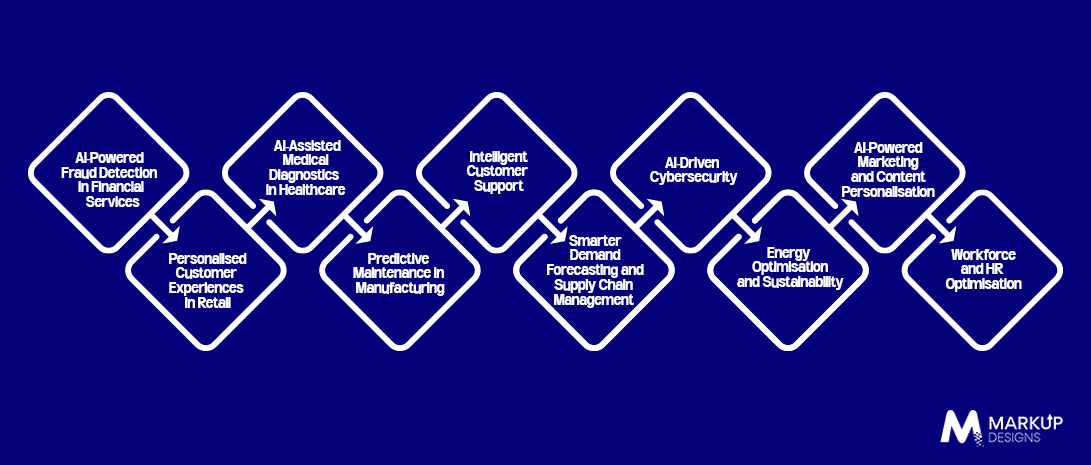
The value of AI for businesses is evident in the UK in activities involving a large amount of data and data processing, repetitive decision-making, difficult operations, or unpredictable customer needs. The following examples illustrate how companies apply AI to specific issues rather than having it simply for testing purposes.
AI-Powered Fraud Detection in Financial Services
Banks perform millions of transactions, and it is too slow and difficult for humans to prevent fraud manually. The AI accomplishments include real-time analysis of transaction patterns, customer behaviour, payment history and more.
Lloyds Banking Group, for example, is expanding its use of agentic AI for real-time fraud protection. The group says it prevented more than £1 billion in fraud during 2025 and is using multiple AI agents to support fraud teams in identifying threats and helping colleagues respond to customers more quickly.
Personalised Customer Experiences in Retail
Retailers are utilizing artificial intelligence (AI) technology to turn huge amounts of customer data into more targeted shopping experiences. AI enables retailers to analyze customer behavior, browsing habits, interests, and loyalty data to forecast the needs of the customer.
Tesco has taken it further by expanding its use of this concept in its Clubcard platform. In 2026, Tesco expanded its collaboration with Adobe to strengthen AI-enabled personalization by using Clubcard data to anticipate customer needs and provide relevant content.
AI-Assisted Medical Diagnostics in Healthcare
AI is also coming into play in the medical field. Healthcare experts are now using AI technology to analyze patient information and medical images. The AI technology does not aim to replace doctors but to help them in detecting problems, identifying the nature of patients’ issues, and reducing the time taken to provide a diagnosis.
The National Health Service (NHS) in the UK is using this technology effectively. According to reports, 4 million patients in 2026 were able to receive quicker lung cancer diagnoses or negative results thanks to the advanced AI tools employed in the NHS.
Predictive Maintenance in Manufacturing
Unexpected equipment failure can bring production to a halt and create significant repair and downtime costs. AI-powered predictive maintenance uses machine data, sensor readings, and operational patterns to identify signs of potential failure before equipment breaks down.
Rolls-Royce uses AI and real-time engine data to monitor equipment health and predict maintenance requirements. Its digital and AI initiatives include monitoring more than 10,000 engine parameters in real time, helping reduce unplanned downtime and unnecessary inspections.
Intelligent Customer Support
AI agents are changing customer support by handling routine enquiries, providing instant responses, and assisting human agents with information during more complex interactions. This allows businesses to offer faster service without requiring employees to manually handle every basic request.
BT Group has deployed AI-enhanced customer support through EE’s virtual assistant Aimee. The assistant handles up to 60,000 customer conversations a week, while AI-generated support and conversation summaries help agents focus on more complicated customer needs.
Smarter Demand Forecasting and Supply Chain Management
Demand forecasting becomes particularly difficult when businesses manage thousands of products, changing customer behaviour, and perishable inventory. AI can combine historical sales, real-time stock information, and other variables to improve forecasts, automate replenishment, and identify potential supply chain problems earlier.
Ocado Group provides a strong UK example. Its AI-driven supply chain platform performs more than 70 million supply chain calculations every day, using machine learning for demand forecasting, replenishment, stock balancing, and waste reduction.
AI-Driven Cybersecurity
Traditional security systems can struggle to keep pace with constantly changing cyber threats. AI can continuously analyse network activity, detect unusual behaviour, identify potential threats, and help security teams investigate incidents faster.
Darktrace, founded in Cambridge, uses an AI-based approach that learns an organisation’s normal activity and detects deviations that could indicate emerging threats. Its platform is designed to respond to unknown threats rather than relying solely on predefined attack signatures.
Energy Optimisation and Sustainability
AI can help organisations manage energy consumption by analysing usage patterns and responding to changing demand in real time. This can improve operational efficiency while supporting broader sustainability and carbon reduction goals.
A recent UK example comes from National Grid, which conducted a live trial of AI technology that dynamically adjusted data centre power consumption. During the trial, electricity demand from a 96-GPU cluster was reduced by more than a third in under a minute without disrupting critical computing workloads, demonstrating how AI can help balance energy demand with grid constraints.
AI-Powered Marketing and Content Personalisation
AI is giving marketing teams more sophisticated ways to understand customer behaviour and deliver relevant experiences at scale. Businesses can analyse customer data, identify audience patterns, personalise offers, and automate parts of content and campaign workflows while allowing marketers to focus on strategy and creative decisions.
Tesco provides a relevant example here as well, using AI alongside its Clubcard data to strengthen personalised marketing. Its 2026 partnership with Adobe is focused on using AI to better anticipate customer needs and improve the relevance of content and offers across customer interactions.
Workforce and HR Optimisation
AI is increasingly being applied to recruitment, workforce planning, employee development, and administrative HR tasks. It can help screen applications, identify skills gaps, support workforce planning, and reduce repetitive administrative work, although human oversight remains essential for decisions that affect employees and candidates.
UK government research shows that many medium and large businesses are already using AI for recruitment and workforce management. The technology is being used for activities such as initial candidate screening and tracking, while organisations are also expected to monitor issues such as algorithmic bias and fairness.
The wider shift is not necessarily about replacing employees. ONS data from June 2026 found that most businesses using AI reported no change in overall workforce headcount, while businesses were more commonly integrating AI skills through training and retraining existing employees.
Read Also: AI Software Development in the UK: Features, Cost, and Timeline
Key Benefits of AI Adoption for UK Businesses
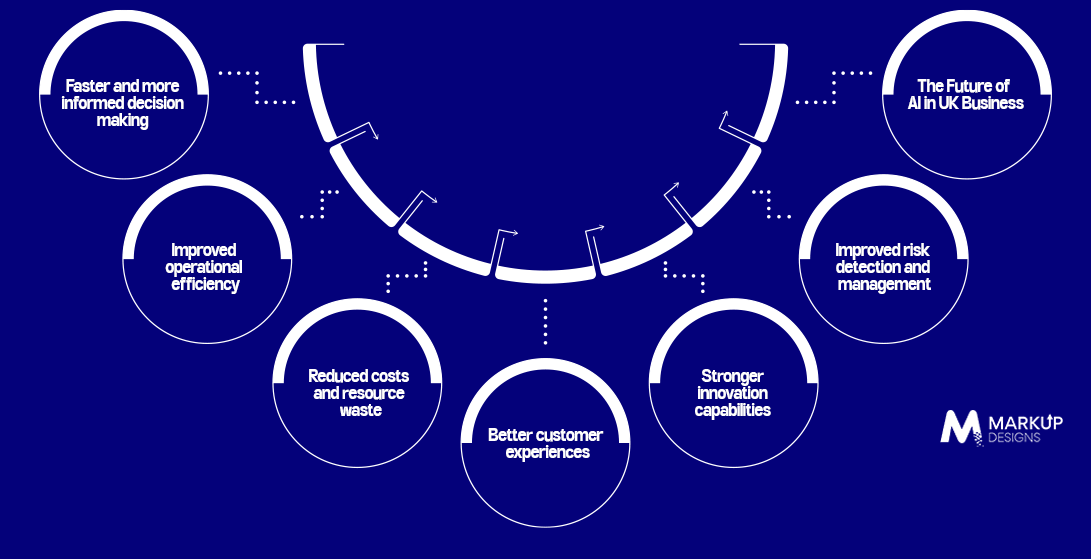
AI can deliver value across both day-to-day operations and long-term business strategy. When implemented around clear objectives, it can help UK businesses make faster decisions, reduce operational inefficiencies, improve customer experiences, control costs, and identify risks earlier. It can also create new opportunities for innovation by enabling teams to analyse information and respond to changing market demands more effectively.
Challenges UK Businesses Face When Implementing AI
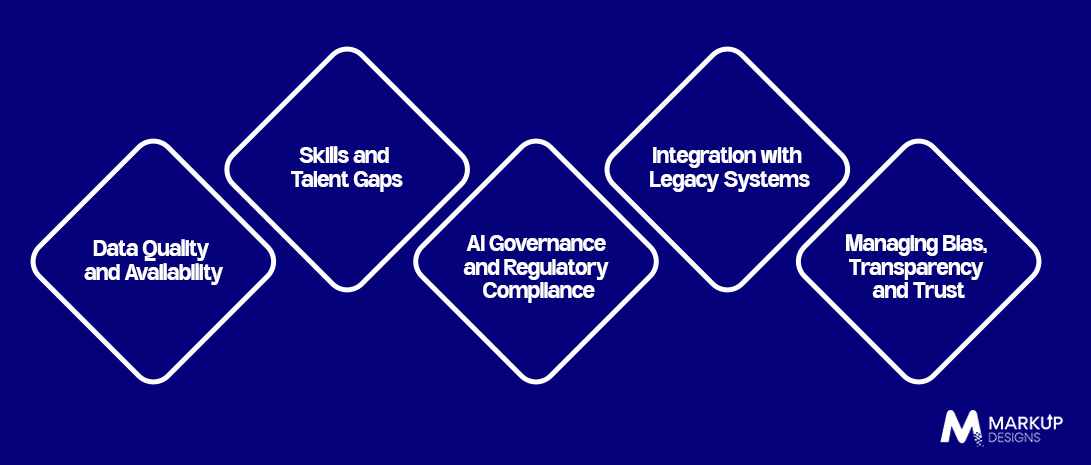
AI adoption is not without its challenges. Businesses need to address:
Data Quality and Availability
AI depends on accurate, relevant, and accessible data to produce reliable results.
Skills and Talent Gaps
Businesses may need specialist expertise to develop, integrate, and manage AI solutions effectively.
AI Governance and Regulatory Compliance
Organisations must ensure AI systems meet relevant UK regulations, privacy requirements, and internal governance standards.
Integration with Legacy Systems
Connecting AI with outdated or fragmented systems can create technical and operational complexities.
Managing Bias, Transparency and Trust
Businesses need appropriate human oversight and safeguards to ensure AI decisions are explainable, fair, and responsible.
How UK Businesses Can Implement AI Successfully
Successful adoption starts with the business problem rather than the technology itself. Organisations should identify high-impact use cases, establish a reliable data foundation, and begin with manageable pilot projects before scaling. Clear governance, continuous monitoring, and human oversight are equally important, particularly when AI influences sensitive or business-critical decisions.
The Future of AI in UK Business
AI adoption is likely to become more embedded in everyday business operations as technologies such as generative AI and agentic AI are transforming modern enterprise . UK businesses can expect more industry-specific solutions, greater automation, and stronger integration between AI and existing enterprise systems. At the same time, responsible AI practices and regulatory compliance will become increasingly important as organisations scale their use of the technology.
Read Also: Choosing Right AI Development Partner in the UK: Cost, Expertise, and Key Considerations
How Markup Designs Can Help UK Businesses Build AI Solutions
Markup Designs helps UK businesses turn AI opportunities into practical, scalable solutions. Our capabilities span AI strategy, AI solution development, data engineering, intelligent automation, system integration, and ongoing optimisation. By combining AI with existing business systems and workflows, we help organisations build solutions aligned with their operational requirements, customer needs, and long-term growth objectives.
Build AI That Solves Real Business Problems
From strategy and development to integration and optimisation, Markup Designs helps UK businesses turn AI opportunities into scalable, practical solutions.

Conclusion
AI is no longer limited to experimental projects for UK businesses. From fraud detection and medical diagnostics to supply chain management, cybersecurity, and workforce optimization, organisations are already using AI to solve practical business challenges. The businesses that gain the most value will be those that focus on relevant use cases, reliable data, responsible implementation, and measurable outcomes rather than adopting AI simply because it is available.
FAQs
1. How are UK businesses using AI today?
UK businesses are using AI for a wide range of applications, including fraud detection, customer personalisation, predictive maintenance, cybersecurity, demand forecasting, medical diagnostics, marketing automation, and workforce management. The focus is increasingly shifting towards AI solutions that deliver measurable operational or commercial value.
2. Which industries in the UK are benefiting most from AI?
Financial services, healthcare, retail, manufacturing, logistics, energy, and professional services are among the sectors making significant use of AI. However, the potential applications extend across almost every industry where businesses work with large datasets, repetitive processes, or complex decision making.
3. What are the biggest challenges of AI adoption for UK businesses?
Common challenges include poor data quality, limited AI expertise, integration with legacy systems, implementation costs, regulatory requirements, and concerns around privacy, bias, and transparency. Addressing these areas early can make AI adoption more practical and sustainable.
4. How can a UK business identify the right AI use case?
Businesses should start by identifying processes that are time consuming, data intensive, repetitive, or prone to errors. The potential business impact, data availability, implementation complexity, and expected return should then be assessed to determine whether an AI solution is justified.
5. Is AI suitable for small and medium-sized UK businesses?
Yes. SMEs do not necessarily need large AI transformation programmes to benefit from the technology. They can start with focused applications such as customer support automation, document processing, marketing personalisation, forecasting, or workflow automation and expand as the business sees measurable results.
Author's Perspective
AI is becoming less about whether businesses should adopt it and more about where it can create genuine value. The examples discussed in this article show that successful AI adoption does not depend solely on having the latest technology. It depends on identifying the right problem, having reliable data, integrating AI into existing operations, and maintaining appropriate human oversight. For UK businesses, a focused and outcome-driven approach is far more practical than attempting to introduce AI across every function at once.
Discuss Your Project NowAjit Kumar Jha
VP - Business Operations
Related Posts
How Artificial Intelligence Is Changing Mobile Game Development
How to Build Production-Ready Applications with AI Coding...
Cost, Benefits & Business Impact: Generative AI vs....
Insights Are Valuable & Execution is Priceless
You’ve read about the digital future. Now, let’s build the infrastructure to take you there. Move your strategy from the page to the product.
Design Your Solution Now
Contact Us
Schedule The Appointment At Your Convenience Date And Time.
30 Min
Web Conference
Time Zone
Indian standard time (08:30pm)

Thanks For Getting In Touch!
You’ve Taken The First Step Toward Transforming Your Digital Presence. Our Experts Will Reach Out Shortly To Take It Forward.
Launch Your Dream Project
Provide a brief overview of your project, and our specialists will evaluate your requirements. We will connect with you to explore how the right digital solutions can help you launch faster.