

In Brief
- Development Cost: Understand the estimated cost of building an auto insurance app and the factors that influence the final budget.
- Essential Features: Explore the core features needed for policy management, payments, claims, customer support, and renewals.
- Advanced Capabilities: Learn how AI, telematics, automation, and real time tracking can enhance an insurance app.
- Business Models: Discover different ways auto insurance apps can generate revenue through premiums, commissions, service fees, and partnerships.
- Development Process: Get an overview of the technology stack, development stages, security requirements, and scalability considerations.
The insurance industry is rapidly moving towards digital platforms that make buying policies, managing coverage, paying premiums, and filing claims easier. An auto insurance app can bring these services together in one place while giving insurers better ways to engage customers and manage policy-related operations.
However, building a successful insurance app involves more than creating a policy management interface. Businesses need to consider secure payments, customer data, claims processing, third-party integrations, regulatory requirements, and scalable architecture. The right combination of features and technology can help create an app that delivers a smoother customer experience while supporting long-term business growth.
Why Invest in Auto Insurance App Development?
An auto insurance app can simplify insurance operations while giving customers faster access to policies, payments, claims, and support. For insurers, it can also reduce manual processes, improve engagement, and create more opportunities for data-driven decision-making.
Growing Demand for Digital Insurance Services
Customers increasingly expect insurance services to be available through convenient digital channels. A mobile app allows them to manage essential insurance activities without relying on lengthy offline processes.
Faster Policy Management and Renewals
Users can view coverage, update information, renew policies, and access documents directly through the app, reducing delays and administrative work.
Simplified Claims Processing
Digital claim submission can allow customers to upload accident details, images, and documents while tracking claim progress from one place.
Better Customer Engagement
Push notifications, personalised offers, reminders, and in app support help insurers maintain regular communication with policyholders.
Data Driven Insurance Personalisation
Customer and vehicle data can help insurers develop more relevant policies, pricing strategies, recommendations, and services.
How Does an Auto Insurance App Work?
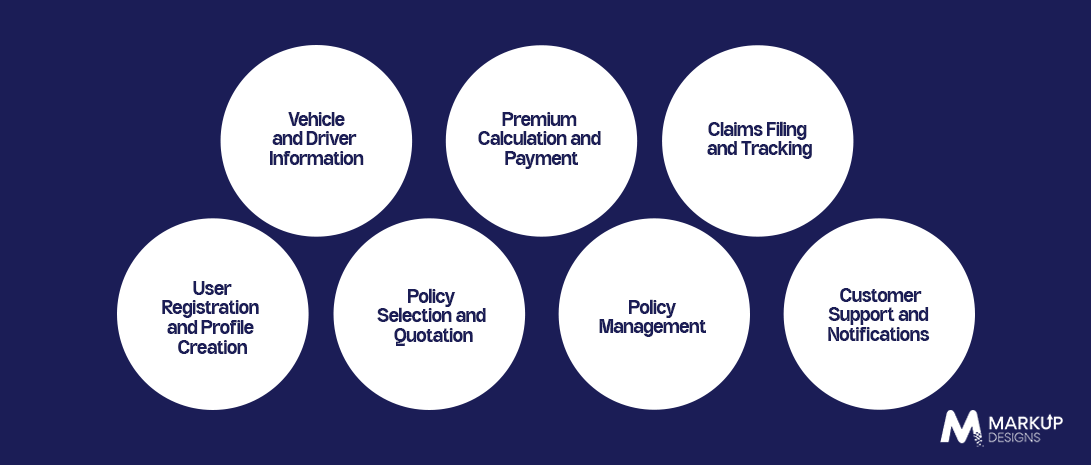
An auto insurance app connects customers with insurance services through a digital platform. The typical journey starts with account creation and vehicle details, followed by policy selection, payment, policy management, and claims support.
User Registration and Profile Creation
Users create an account using essential personal information and secure authentication methods.
Vehicle and Driver Information
The app collects details about the vehicle, driver, usage, and other information required for insurance assessment.
Policy Selection and Quotation
Users can enter their requirements and receive suitable coverage options and estimated quotes through the application.
Premium Calculation and Payment
The app calculates the applicable premium and allows users to complete payments through an integrated payment system.
Policy Management
Policyholders can view coverage details, download documents, update information, and manage renewals from their accounts.
Claims Filing and Tracking
Users can submit claims digitally, provide supporting documents, and monitor the status of their claims.
Customer Support and Notifications
Notifications keep users informed about renewals, payments, claims, and policy updates, while in app support provides assistance when needed.
Must Have Features of an Auto Insurance App
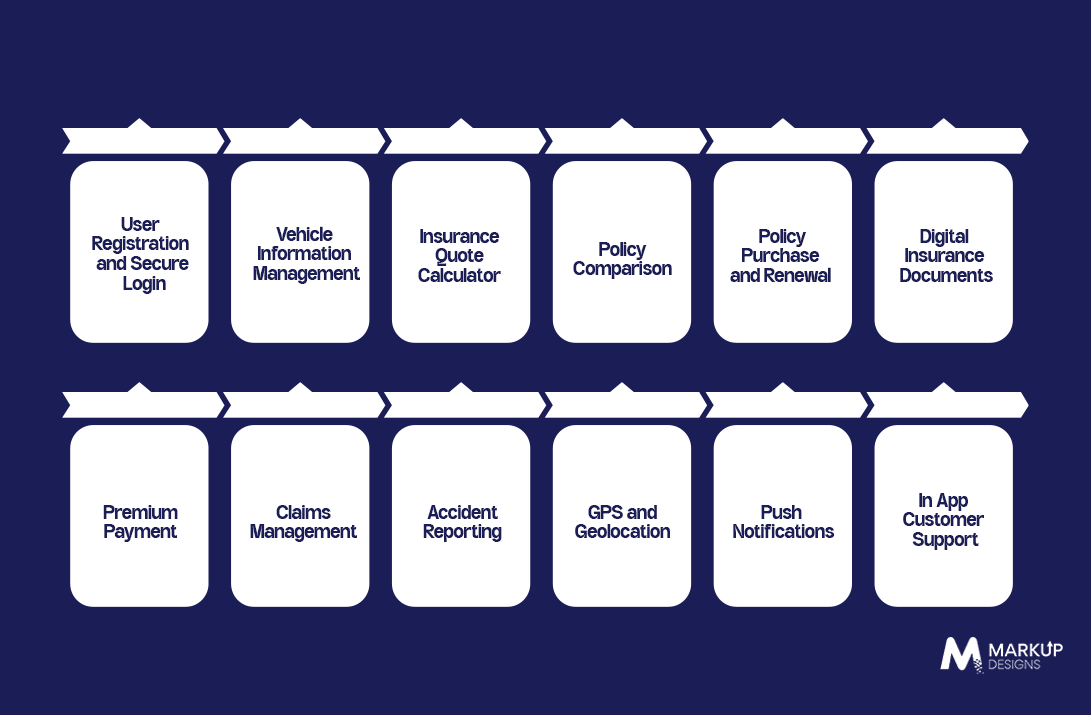
The core features should focus on making insurance management simple, secure, and accessible. The exact feature set can vary depending on whether the app is built for an insurer, broker, marketplace, or aggregator.
User Registration and Secure Login
Secure sign up and authentication allow users to access their policies and personal information safely.
Vehicle Information Management
Users can add and manage vehicle details, registration information, and relevant documents.
Insurance Quote Calculator
A quote calculator can estimate premiums based on factors such as vehicle details, coverage requirements, and driver information.
Policy Comparison
Users can compare available coverage options, premiums, deductibles, and benefits before selecting a policy.
Policy Purchase and Renewal
The app should support digital policy purchases and provide timely renewal options to prevent coverage from lapsing.
Digital Insurance Documents
Users can securely access policy documents, certificates, receipts, and other important records within the app.
Premium Payment
Integrated payment options allow users to pay premiums and view transaction records without leaving the application.
Claims Management
Customers can submit claims, upload supporting information, and track claim progress through the app.
Accident Reporting
Users can report accidents by providing incident details, photographs, location information, and other required evidence.
GPS and Geolocation
Location services can help capture accident locations, provide roadside assistance, and support location based services.
Push Notifications
Automated alerts can remind users about renewals, payments, claims updates, and policy changes.
In App Customer Support
Chat, FAQs, and support requests allow users to resolve common issues without relying entirely on phone or email support.
Advanced Features to Make an Auto Insurance App Stand Out
Advanced technologies can take an insurance app beyond basic policy management by improving risk assessment, claims handling, fraud detection, and customer experience.
AI Powered Risk Assessment
AI can analyse relevant customer, vehicle, and driving data to help insurers assess risk more efficiently.
Telematics and Usage Based Insurance
Telematics can collect driving data such as mileage, speed, and driving patterns to support usage based or behaviour based insurance models.
Automated Claims Processing
Automation can help validate submitted information, classify claims, and route cases to the appropriate teams for faster processing.
AI Chatbot for Customer Assistance
AI powered chatbots can answer routine questions, explain policies, assist with claims, and provide support at any time.
Fraud Detection
AI can identify unusual patterns across claims and transactions, helping insurers flag potentially fraudulent activity for further investigation.
Image Based Damage Assessment
Computer vision can analyse uploaded vehicle images to identify visible damage and support preliminary claim assessments.
Personalised Insurance Recommendations
AI can use customer and vehicle information to suggest relevant coverage options, add ons, and policy upgrades.
Features for the Admin and Insurance Provider
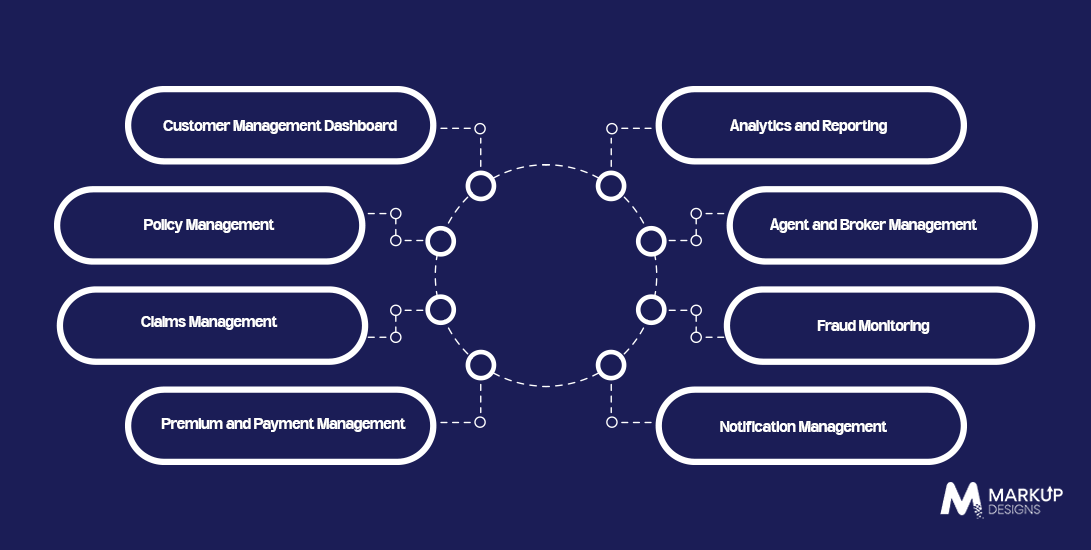
A strong customer facing app also needs a capable backend system that gives insurers control over policies, claims, customers, payments, and performance.
Customer Management Dashboard
Administrators can manage customer profiles, account activity, policy information, and service requests from a central dashboard.
Policy Management
Insurance teams can create, update, monitor, and manage policies through the administrative platform.
Claims Management
Admins can review submitted claims, verify documents, assign cases, update statuses, and manage the claims workflow.
Premium and Payment Management
The system can track premiums, payments, outstanding amounts, refunds, and transaction records.
Analytics and Reporting
Dashboards can provide insights into customer activity, policies, claims, revenue, renewals, and other business metrics.
Agent and Broker Management
Insurers can manage agents and brokers, monitor performance, and track their associated customers and policies.
Fraud Monitoring
Admin tools can flag suspicious claims or transaction patterns for investigation and further verification.
Notification Management
Teams can create and manage automated notifications for renewals, payments, claims, policy updates, and other customer communications.
Technology Stack for Auto Insurance App Development
The technology stack should support secure transactions, reliable data processing, third-party integrations, and future scalability. The exact technologies can vary based on the app’s features, target platforms, and business requirements.
Frontend Development
Technologies such as React, Angular, or Vue.js can support web-based insurance dashboards and customer portals.
Backend Development
Node.js, Python, Java, or .NET can be used to build APIs, business logic, authentication, claims workflows, and other backend services.
Mobile App Development
Flutter, React Native, Swift, and Kotlin can support iOS and Android applications depending on the required development approach.
Database
PostgreSQL, MySQL, MongoDB, or similar database technologies can store customer, vehicle, policy, payment, and claims data.
Cloud Infrastructure
Cloud platforms such as Microsoft Azure, AWS or Google Cloud can provide scalable infrastructure, storage, computing, backups, and monitoring.
APIs and Third Party Integrations
Payment gateways, mapping services, identity verification, vehicle data, communication tools, analytics, and insurance APIs can connect the app with external services.
Security Technologies
Encryption, secure authentication, API security, role based access controls, biometric authentication, and monitoring tools help protect sensitive insurance and financial data.
How Much Does It Cost to Develop an Auto Insurance App?
The cost of developing an auto insurance app can range from $30,000 to $250,000+, depending on the application’s complexity, features, platforms, integrations, security requirements, and development team. There is no universal fixed price because a basic policy management app requires significantly less development than a platform using AI, telematics, automated claims, and multiple insurance integrations.
Basic Auto Insurance App
A basic application with essential features such as registration, policy management, digital documents, payments, notifications, and basic claims functionality can cost approximately $30,000 to $60,000.
Mid Level Auto Insurance App
A mid level app with policy comparison, advanced claims management, third party integrations, analytics, and enhanced customer support may cost around $60,000 to $120,000.
Advanced Auto Insurance App
An advanced platform with AI, telematics, automated claims processing, fraud detection, image based damage assessment, and complex integrations can cost $120,000 to $250,000 or more.
| App Type | Estimated Cost |
| Basic | $30,000–$60,000 |
| Mid Level | $60,000–$120,000 |
| Advanced | $120,000–$250,000+ |
These figures are indicative estimates. Actual costs depend on the project scope, technology choices, integrations, team structure, and development location.
Factors Affecting Auto Insurance App Development Cost
Several factors can significantly change the overall development budget. Defining these early helps businesses create a realistic scope and avoid unnecessary development expenses.
Number and Complexity of Features
More advanced workflows, automation, dashboards, and user roles require additional design, development, and testing effort.
iOS, Android, or Cross-Platform Development
Building separate native applications can require more development resources, while cross-platform application frameworks can reduce duplication for suitable projects.
UI/UX Design Requirements
Custom interfaces, complex user journeys, animations, accessibility requirements, and multiple dashboards can increase design and development effort.
Backend Architecture
A scalable backend capable of handling policies, claims, payments, customer data, and integrations requires careful architecture and infrastructure planning.
Third Party Integrations
Payment gateways, vehicle databases, mapping services, identity verification, telematics, and insurance APIs can increase both development and maintenance costs.
AI and Telematics Implementation
AI-based risk assessment, fraud detection, computer vision, and telematics require specialised development, data processing, and infrastructure.
Security and Compliance Requirements
Insurance applications handle sensitive personal and financial information, making secure architecture, authentication, encryption, and compliance essential.
Development Team Location and Expertise
Development rates vary based on the team’s location, experience, technical expertise, and project complexity.
Maintenance and Post Launch Support
Ongoing costs can include bug fixes, security updates, infrastructure management, OS compatibility, performance optimisation, and new feature development.
Auto Insurance App Development Process
A structured insurance app development process helps businesses validate the concept before investing heavily in advanced functionality.
Business and Market Research
Analyse the target market, competitors, customer expectations, regulations, and business objectives.
Requirement Analysis
Define user roles, features, workflows, integrations, technical requirements, and the scope of the MVP.
UI/UX Design
Create user journeys, wireframes, prototypes, and interfaces that make complex insurance processes easier to navigate.
Read Also: How UI UX Design Impacts Mobile App Performance and Retention
MVP Development
Build the essential features needed to launch the initial product and validate it with real users.
API and System Integration
Connect payment systems, vehicle data, mapping services, insurance platforms, communication tools, and other required services.
Testing and Quality Assurance
Test functionality, security, performance, compatibility, integrations, and user workflows across supported devices.
Deployment
Prepare the application for release, configure production infrastructure, and publish it across the required platforms.
Maintenance and Continuous Improvements
Monitor performance, resolve issues, analyse user feedback, and continuously improve the application after launch.
Auto Insurance App Business Models
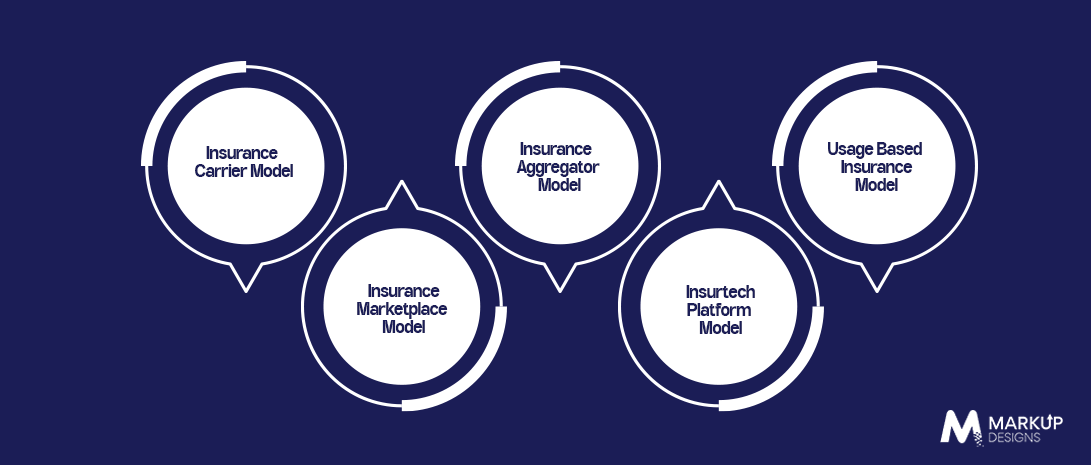
The right business model depends on whether the platform is operated by an insurer, aggregator, marketplace, or independent insurtech company.
Insurance Carrier Model
An insurance company develops its own app to sell policies, manage customers, process claims, collect payments, and provide digital services.
Insurance Marketplace Model
A marketplace brings multiple insurance providers together and allows customers to compare and select suitable policies.
Insurance Aggregator Model
An aggregator collects insurance products from different providers and generates revenue through commissions or referral arrangements.
Insurtech Platform Model
An insurtech company uses technology, data, automation, and digital workflows to deliver innovative insurance products or services.
Usage-Based Insurance Model
This model uses driving or vehicle data to calculate premiums based on actual usage or driving behaviour, often supported by telematics technology.
How Does an Auto Insurance App Make Money?
An auto insurance app can generate revenue through direct insurance sales, commissions, subscriptions, and additional services. The most suitable model depends on whether the platform is operated by an insurer, marketplace, aggregator, or insurtech business.
Insurance Premiums
Insurance providers can generate their primary revenue by selling policies and collecting premiums directly through the application.
Commission Revenue
Marketplaces and aggregators can earn commissions from insurance providers when users purchase policies through the platform.
Service Fees
The app can charge fees for selected services such as policy processing, document handling, roadside assistance, or other value-added services.
Subscription Plans
Businesses can offer premium subscription packages that provide additional benefits, enhanced support, or specialised services.
Partner and Referral Revenue
Partnerships with vehicle service providers, repair centres, roadside assistance companies, and other relevant businesses can create referral based revenue opportunities.
Premium Add On Services
Additional products such as roadside assistance, rental vehicle coverage, accident support, or enhanced protection can generate incremental revenue.
Third Party Integrations for an Auto Insurance App
Third party integrations allow an insurance app to connect with external systems and deliver services that would otherwise require separate platforms. These integrations should be selected based on the app’s actual business and operational requirements.
Payment Gateways
Payment integrations enable users to securely pay premiums, renewal charges, service fees, and other transactions.
Mapping and GPS APIs
Mapping and location APIs can support accident reporting, roadside assistance, navigation, and location based services.
Vehicle Data APIs
Vehicle data services can provide information needed for vehicle verification, insurance quotes, and risk assessment.
Identity Verification APIs
Identity verification services can help validate customer information during registration, policy purchase, and claims processing.
Communication APIs
SMS, email, voice, and push notification services can support customer alerts, verification, reminders, and claims updates.
Insurance and Claims APIs
Insurance APIs can connect the application with policy systems, underwriting platforms, claims management systems, and other insurance infrastructure.
Analytics and Monitoring Tools
Analytics and monitoring integrations help businesses track user behaviour, application performance, transactions, and operational metrics.
Security and Compliance Considerations for Auto Insurance Apps
Insurance apps handle sensitive personal, vehicle, financial, and policy information, making security a core development requirement. Strong protection should be implemented throughout the application’s architecture rather than added after development.
Data Encryption
Sensitive information should be encrypted during transmission and while stored to reduce the risk of unauthorised access.
Secure Authentication
Multi-factor authentication, biometrics, passkeys, and secure session management can help protect customer accounts.
Payment Security
Payment processing should use secure payment infrastructure and appropriate security controls to protect financial transactions.
Role-Based Access Control
Different access levels should be assigned to customers, agents, administrators, claims teams, and other users based on their responsibilities.
Data Privacy and Regulatory Compliance
The application should follow applicable insurance, data protection, financial, and regional regulatory requirements governing customer information and transactions.
Fraud Prevention
Automated monitoring, behavioural analysis, identity verification, and AI based detection can help identify suspicious claims and transactions.
How to Build an MVP for an Auto Insurance App?
An MVP should focus on the features necessary to validate the core insurance experience rather than attempting to launch every advanced capability at once. This keeps the initial product manageable while providing a foundation for future expansion.
Essential MVP Features
The first version can include secure registration, vehicle information, insurance quotes, policy management, digital documents, payments, basic claims submission, notifications, and customer support.
Features to Add in Phase Two
Once the MVP is validated, businesses can introduce AI-powered recommendations, telematics, automated claims processing, image-based damage assessment, advanced analytics, and fraud detection.
When to Scale Beyond the MVP
Scaling makes sense when the app demonstrates consistent user adoption, operational demand, and a clear need for additional functionality. User feedback, performance data, and business growth should guide the next development phase.
Read Also: The Investor-Approved Approach to MVP app developmet in 2026
Common Challenges in Auto Insurance App Development
Building an insurance application involves more complexity than a standard consumer app because it combines sensitive data, financial transactions, regulatory requirements, and multiple backend systems.
Handling Sensitive Customer Data
Protecting personal, financial, vehicle, and policy information requires strong security controls throughout the application.
Integrating Legacy Insurance Systems
Many insurers rely on older backend platforms, making integration with modern mobile applications technically complex.
Accurate Premium Calculation
Premiums depend on multiple risk factors, making accurate and consistent calculation essential for both customer trust and insurer operations.
Fraudulent Claims
False claims can create significant financial losses, requiring effective verification and fraud detection mechanisms.
Regulatory Compliance
Insurance regulations vary by market and can affect data handling, policy management, payments, claims, and customer communication.
Scaling for High Transaction Volumes
The platform needs scalable infrastructure to handle increasing users, policy purchases, renewals, claims, payments, and concurrent activity without performance issues.
Why Choose Markup Designs for Auto Insurance App Development?
Markup Designs can help businesses build secure and scalable auto insurance applications covering the complete development lifecycle, from strategy and UI/UX design to mobile development, backend engineering, API integration, testing, deployment, and post-launch support. The team can integrate payment gateways, vehicle data, mapping, identity verification, insurance APIs, and communication services while incorporating AI and automation for use cases such as fraud detection, risk assessment, personalised recommendations, and claims processing. The focus remains on creating a flexible insurance platform that can support current requirements and scale as users, transactions, and business needs grow.
Build a Smarter Auto Insurance App
Turn your insurance app idea into a secure, scalable digital insurance platform.

Conclusion
An auto insurance app can go beyond digitising traditional insurance services by simplifying policy management, accelerating claims, improving customer engagement, and creating new revenue opportunities. Businesses should begin with essential features and build a secure, scalable foundation that can later support AI, telematics, automation, and other advanced capabilities.
FAQs
How much does it cost to develop an auto insurance app?
An auto insurance app can cost approximately $30,000 to $250,000+, depending on its features, platforms, integrations, security requirements, AI capabilities, and overall complexity.
How long does it take to develop an auto insurance app?
A basic MVP may take around 3 to 5 months, while a more advanced insurance platform can require 6 to 12 months or longer, depending on integrations, workflows, testing, and regulatory requirements.
What features should an auto insurance app have?
Essential features include secure registration, vehicle management, insurance quotes, policy management, digital documents, payments, claims management, accident reporting, notifications, and customer support.
How can an auto insurance app make money?
Revenue can come from insurance premiums, commissions, service fees, subscriptions, referral partnerships, and premium add-on services.
Can AI be integrated into an auto insurance app?
Yes. AI can support risk assessment, personalised recommendations, fraud detection, customer support, claims automation, and image-based damage assessment.
Author's Perspective
The future of auto insurance is moving towards faster, more personalised, and increasingly automated digital experiences. Building an insurance app should not be about adding every available feature; it should focus on solving real customer and insurer challenges through secure architecture, intuitive workflows, and relevant technologies. A well-planned foundation allows businesses to introduce AI, telematics, automation, and advanced analytics as the platform evolves.
Discuss Your Project NowJupinder Singh Arora
Founder and CEO
Related Posts

Cost to Build a Mobile App in Qatar...

How Much Does It Cost to Build an...

How to Build a Car Wash App: Development...
Insights Are Valuable & Execution is Priceless
You’ve read about the digital future. Now, let’s build the infrastructure to take you there. Move your strategy from the page to the product.
Design Your Solution Now
Contact Us
Schedule The Appointment At Your Convenience Date And Time.
30 Min
Web Conference
Time Zone
Indian standard time (08:30pm)

Thanks For Getting In Touch!
You’ve Taken The First Step Toward Transforming Your Digital Presence. Our Experts Will Reach Out Shortly To Take It Forward.
Launch Your Dream Project
Provide a brief overview of your project, and our specialists will evaluate your requirements. We will connect with you to explore how the right digital solutions can help you launch faster.