
vaIn Brief
- AI and IoT together enable smart automation by connecting devices, collecting real-time data, and making intelligent decisions with minimal human effort.
- UAE is a leading hub for digital transformation, driven by smart city initiatives, strong infrastructure, and government-backed AI strategies.
- Industries like healthcare, logistics, retail, and real estate are rapidly adopting AI & IoT solutions to improve efficiency and reduce manual work.
- Market growth is strong, with rising investments in IoT devices, AI systems, and smart automation platforms across UAE.
- The future is moving toward fully connected smart ecosystems where AI and IoT will power cities, industries, and everyday operations.
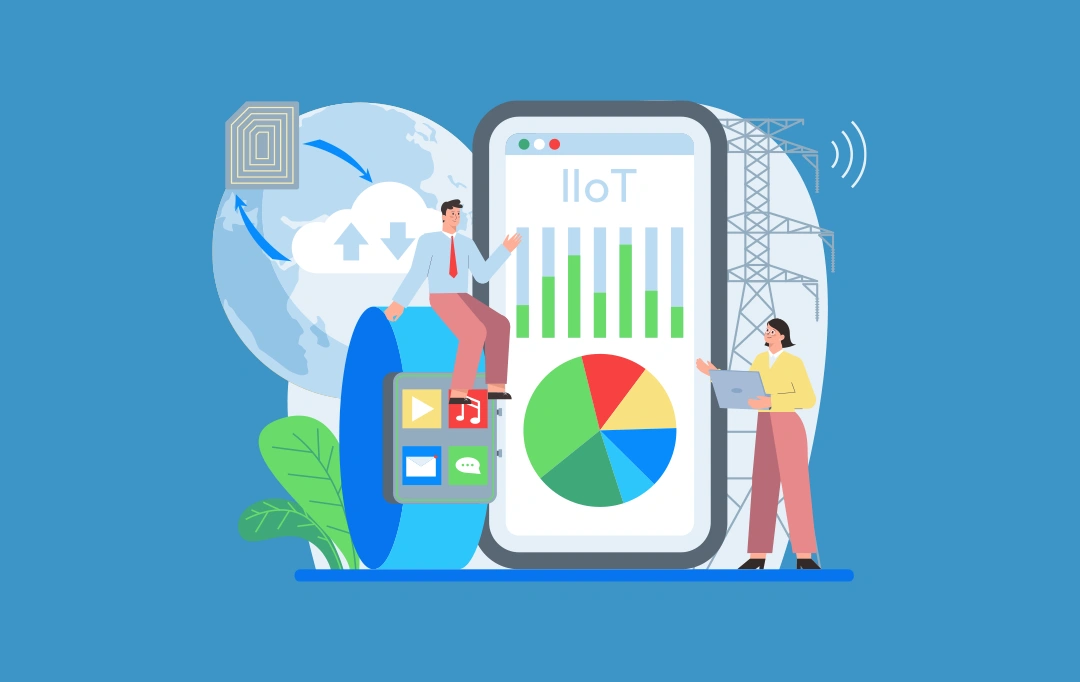
Technology is evolving at a rapid pace, with Artificial Intelligence (AI) and the Internet of Things (IoT) emerging as two key drivers of this transformation. When integrated, these technologies enable intelligent systems that can connect, analyze, and act on data with minimal human intervention, leading to more efficient and automated operations.
In simple words, IoT devices collect data from the real world, and AI uses that data to make smart decisions. This combination is now becoming the base of modern digital systems, especially in places like UAE, where innovation is growing quickly.
UAE is strongly focusing on digital growth, smart cities, and automation. Because of this, demand for AI and IoT development in UAE is increasing across many industries like transport, healthcare, retail, and real estate. Companies are now shifting from manual processes to smart systems that can run on their own.
This shift is also helping improve efficiency, reduce errors, and save time. That is why smart automation in UAE is becoming a key topic for startups and enterprises that want to grow in a smarter way.
In this blog, we will understand how AI and IoT work together, why they matter in UAE market, and how they are shaping the future of automation in a very simple and practical way.
Understanding AI and IoT
Before going further, let’s first understand these two technologies.
Artificial Intelligence is like a smart brain inside a system. It learns from data, finds patterns, and helps in making better decisions without needing constant human input.
On the other hand, the Internet of Things (IoT) is all about connected devices. These can be sensors, machines, vehicles, or even home appliances that collect and share real-time data through the internet.
Now, when both work together, something powerful happens. IoT collects data from the real world, and AI analyzes that data to take smart actions automatically. This is what makes modern automation systems so efficient.
For example:
- A smart building can adjust lighting and temperature based on people inside
- A delivery system can track vehicles and predict delays
- A healthcare device can monitor patient health and send alerts in real time
This combination is now widely used in digital solutions, and many companies are exploring IoT app development to build such connected systems.
At the same time, businesses are also looking at AI solutions for enterprises to improve decision-making and reduce manual work.
The main idea is simple, IoT collects information, AI understands it, and together they create systems that can act on their own. This is the foundation of modern smart technology, and it is becoming more common in everyday life without businesses even realizing it.
Why UAE is Leading in Smart Automation
UAE is one of the fastest-growing regions when it comes to digital transformation. The country is not just using technology, it is actively building a future where everything is connected, smart, and automated.
One of the biggest reasons behind this growth is strong government support. Initiatives like Smart Dubai and UAE AI Strategy 2031 are helping industries adopt advanced technologies in a structured way. Because of this, digital transformation in UAE has become an important focus area for both public and private sectors.
Another reason is the rapid growth of smart infrastructure. Cities like Dubai and Abu Dhabi are investing in connected systems that improve transport, safety, energy use, and daily services. This has created strong demand for smart city technology, where systems work together in real time.
Industries such as healthcare, logistics, retail, and real estate are also quickly adopting automation tools. They are moving away from manual processes and shifting toward smart systems that can predict, analyze, and respond automatically.
This environment is also pushing companies to explore IoT and AI integration services so they can build connected solutions that match UAE’s fast-moving digital ecosystem.
Another important factor is strong internet infrastructure, including 5G networks and cloud platforms. These technologies make it easier to run large-scale smart systems without delays.
Overall, UAE is not just adopting technology, it is building a complete ecosystem where AI and IoT can grow together smoothly, making automation a natural part of everyday operations.
Real-World Applications of AI and IoT
In UAE, AI and IoT are not just future ideas anymore, they are already being used in many real-life systems. Let’s look at where this combination is actually making a difference.
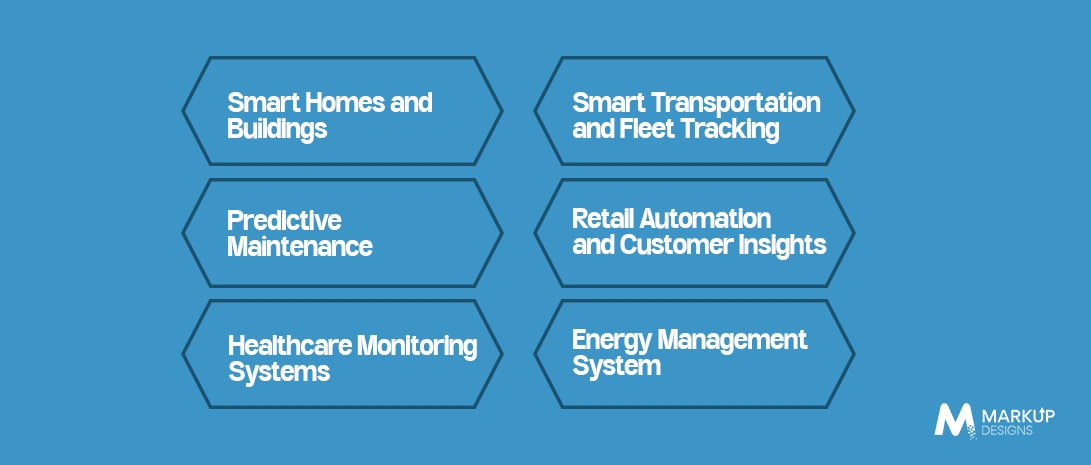
1. Smart Homes and Buildings
- Homes and offices are now becoming fully connected
- Lights, AC, security cameras, and appliances can work automatically
- Systems adjust settings based on presence and usage patterns
- This helps save energy and improve comfort
2. Predictive Maintenance
- Machines and equipment are connected with sensors
- IoT collects performance data in real time
- AI predicts when a machine might fail
- This reduces breakdowns and avoids costly repairs
3. Healthcare Monitoring Systems
- Wearable devices track heart rate, sleep, and activity
- Data is sent instantly to healthcare systems
- AI helps detect early health risks
- Doctors can respond faster with better insights
4. Smart Transportation and Fleet Tracking
- Vehicles are tracked using GPS and IoT sensors
- AI analyzes traffic patterns and delivery routes
- Helps reduce delays and fuel usage
- Improves overall logistics efficiency
5. Retail Automation and Customer Insights
- Stores use smart cameras and sensors to track customer movement
- AI studies buying behavior and preferences
- Helps improve product placement and recommendations
- Enhances overall shopping experience
6. Energy Management Systems
- Smart grids monitor electricity usage in real time
- IoT devices track energy consumption in buildings
- AI helps reduce waste and optimize usage
- Supports UAE’s sustainability goals
All these applications are becoming more common as companies in UAE are investing in smart business automation to improve speed, reduce manual work, and create more efficient systems.
At the same time, demand for IoT applications for enterprises is growing because organizations want better control and visibility over their operations without adding complexity.
Industry Statistics and Growth Insights for AI and IoT
To understand how fast AI and IoT are growing in UAE, let’s look at real market numbers. It clearly shows that the region is moving very quickly toward smart systems and automation.
- UAE IoT market was valued at around USD 5.11 billion in 2024, and it is expected to reach USD 17.48 billion by 2033, growing steadily every year.
- In the 5G-powered IoT segment, UAE market generated about USD 156.5 million in 2024, and it may grow to USD 1.71 billion by 2030 with very high speed expansion.
- UAE IoT devices segment alone was worth nearly USD 976.7 million in 2024, and it is projected to cross USD 3.02 billion by 2030.
- Wearable IoT devices in UAE also show strong growth, reaching USD 115.2 million in 2024 and expected to grow to USD 368.7 million by 2030.
- On the AI side, the Artificial Intelligence of Things (AIoT) market is smaller but rapidly growing, moving from USD 2.7 million in 2024 to USD 15.2 million by 2030.
At the same time, industries are actively investing in IoT app development to build systems that can handle real-time data, improve efficiency, and reduce manual work. UAE is not just adopting technology-it is scaling it across every major sector.
Process of AI and IoT Application Development
AI and IoT app development may sound complex, but the core idea is actually simple. It is all about connecting devices, collecting data, and using intelligence to take actions automatically.
In UAE, this process is becoming very important because companies want faster systems, fewer manual tasks, and better real-time control. This is where AI and IoT development in UAE plays a major role in building smart digital ecosystems.
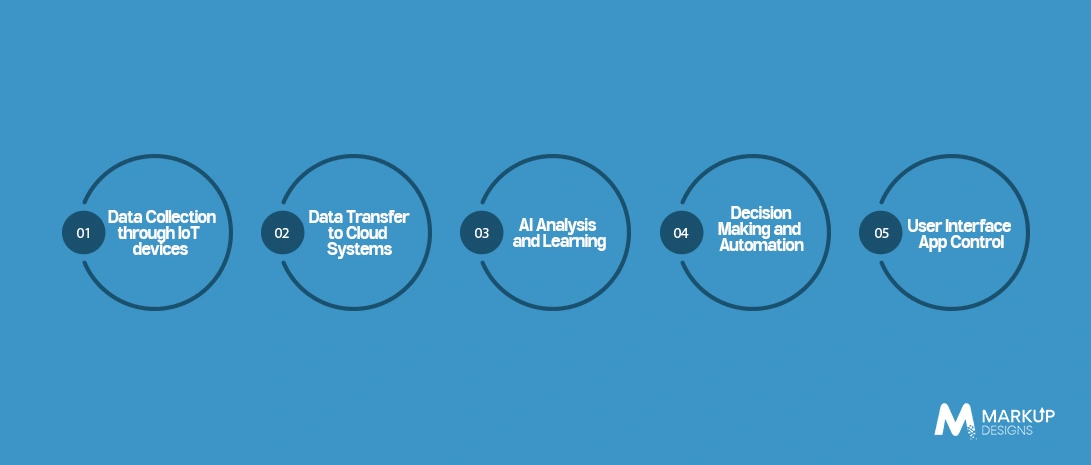
Step-by-Step Flow
- Data Collection through IoT devices
Small devices like sensors, cameras, machines, or wearables collect real-world data such as temperature, movement, location, or usage patterns.
- Data Transfer to Cloud Systems
This collected data is sent to cloud platforms using secure internet connections. Cloud systems store and organize this information for processing.
- AI Analysis and Learning
Now AI comes into action. It studies the data, finds patterns, and understands behavior. For example, it can detect unusual activity or predict future outcomes.
- Decision Making and Automation
Based on AI analysis, the system automatically triggers actions. This could be sending alerts, adjusting settings, or starting a process without human involvement.
- User Interface / App Control
Finally, users can monitor everything through dashboards or mobile apps. This makes it easy to control and track operations in real time.
In many industries, this setup is being used to build smart systems that reduce workload and improve accuracy. That is why companies in UAE are actively investing in AI solutions for enterprises to upgrade their operations.
At the same time, demand for IoT and AI integration services is increasing because organizations want smooth connectivity between devices, cloud systems, and intelligent automation layers.
Overall, this workflow is the foundation of modern smart applications that are shaping the future of automation in UAE.
Cost Analysis for AI and IoT Development in UAE
When it comes to building AI and IoT-based applications, cost is one of the most important things to understand. There is no fixed price because every solution is built differently based on features, scale, and complexity.
In UAE, development cost is usually higher than basic markets because systems are expected to be highly secure, fast, and scalable. That is why IoT app development companies in UAE carefully study requirements before giving final estimates.
Main factors that affect cost
- Size and complexity of the project
- Number of connected IoT devices
- Type of AI features (basic analytics vs predictive intelligence)
- Cloud setup and data storage needs
- Security and compliance requirements
- Real-time processing requirements
COST BREAKDOWN
| Type of Solution | Features Included | Estimated Cost |
| Basic AI + IoT App | Simple dashboard, limited devices, basic automation | $15,000 – $30,000 |
| Mid-Level System | Multiple integrations, real-time monitoring, AI insights | $30,000 – $80,000 |
| Advanced Enterprise Platform | Large-scale IoT network, predictive AI, cloud automation, high security | $80,000 – $200,000+ |
Smaller solutions are usually used for home automation, small tracking systems, or basic monitoring tools. These are easier to build and maintain.
Mid-level systems are more structured and are often used in retail, logistics, and facility management. They include better dashboards and real-time insights.
Advanced systems are designed for large-scale operations like smart cities, healthcare networks, and industrial automation. This is where smart business automation becomes a key focus, as everything runs in a connected and intelligent way.
Overall, cost is not just about development-it is about building a complete smart ecosystem where data, devices, and AI all work together smoothly and continuously.
Major Barriers in Deploying AI and IoT Solutions
Even though AI and IoT are growing fast in UAE, building and using these systems is not always easy. There are several real challenges that companies face during implementation.
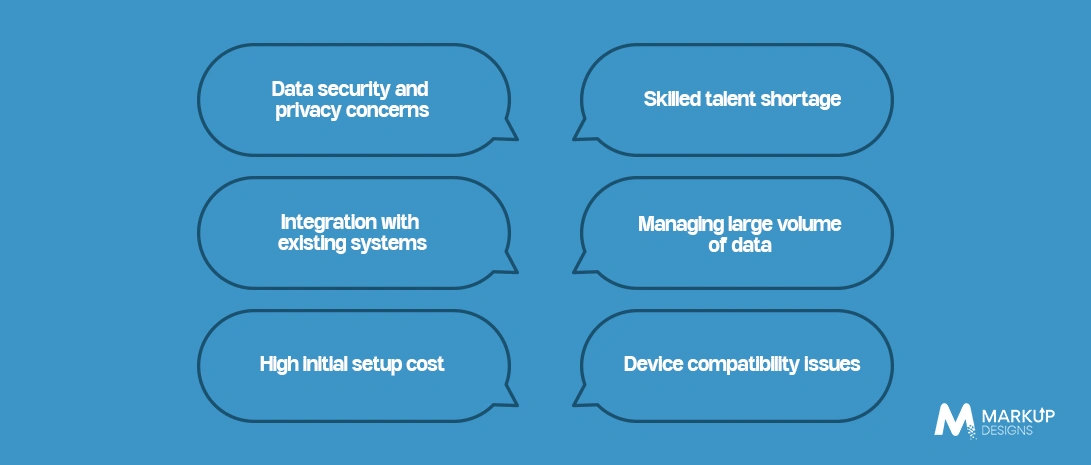
Data security and privacy concerns
- IoT devices collect large amounts of sensitive data
- If not protected properly, data can be misused
- Strong encryption and security layers are required
- This becomes more critical in industries like healthcare and finance
Integration with existing systems
- Many companies still use old legacy systems
- Connecting them with modern AI + IoT platforms is difficult
- It often requires system redesign or upgrades
- This increases time and cost of development
High initial setup cost
- Smart systems need devices, sensors, cloud, and AI models
- Initial investment can be high for small companies
- ROI comes later, not immediately
- This slows down adoption for some businesses
Skilled talent shortage
- AI and IoT require specialized technical knowledge
- Skilled developers and engineers are in high demand
- Hiring and training teams can take time
- This can delay project execution
Managing large volume of data
- IoT systems generate continuous real-time data
- Handling and processing this data efficiently is challenging
- Without proper architecture, systems can slow down
- Requires strong cloud and data engineering setup
Device compatibility issues
- Different IoT devices use different standards
- Making them work together smoothly is complex
- Needs proper integration frameworks and testing
Overall, these challenges are the reason why many companies prefer working with IoT and AI integration services to ensure smooth and reliable system performance.
The Future Landscape of AI and IoT
The future of AI and IoT in UAE is moving toward a fully connected and intelligent digital ecosystem. What we are seeing today is only the beginning of a much larger shift where automation will become a natural part of everyday life. In the coming years, cities, industries, and even small operations will depend more on smart systems that can think, learn, and act in real time.
One of the biggest changes will be the rise of fully smart cities. Services like transport, energy management, public safety, and utilities will become more automated and data-driven. Instead of manual monitoring, systems will respond instantly based on live data collected from connected devices. This will improve speed, reduce delays, and make city operations much more efficient.
Industries such as healthcare, logistics, and retail will also see major transformation. Hospitals will use connected devices for remote patient monitoring, while logistics networks will rely on real-time tracking and predictive systems. Retail experiences will become more personalized as AI understands customer behavior better and IoT captures in-store activity.
At the same time, sustainability will play a key role. Smart energy systems will help reduce waste by automatically managing electricity and water usage. Buildings and infrastructure will become more energy-efficient without manual intervention.
Even small and mid-sized companies will benefit as cloud-based automation tools become more accessible and affordable. This will increase the adoption of smart city technology in UAE and further strengthen the country’s position in global innovation.
Overall, UAE is steadily moving toward a future where digital transformation is deeply integrated into every sector, making AI and IoT a core part of daily operations rather than just advanced technology.
Transform Operations with AI and IoT in UAE
Develop smart automation platforms that connect devices, analyze live data, and improve efficiency across industries with minimal manual effort.

Conclusion
AI and IoT are no longer future technologies-they are already shaping how systems work in UAE today. From smart cities to healthcare and logistics, everything is moving toward automation and real-time decision-making. The combination of connected devices and intelligent systems is helping reduce manual effort, improve accuracy, and increase efficiency across industries.
UAE’s strong focus on innovation and digital transformation is making it one of the leading regions for adopting these technologies. As infrastructure continues to grow, more companies will shift toward smart automation solutions to stay competitive and efficient.
In simple terms, AI and IoT together are building a smarter, faster, and more connected future where systems can work almost on their own with minimal human intervention.
FAQs
1. What is AI and IoT app development?
It is the process of building applications where IoT devices collect real-time data and AI uses that data to make smart decisions and automate actions.
2. Why is AI and IoT growing in UAE?
Because UAE is strongly focused on smart cities, automation, and digital innovation, which makes AI and IoT a natural fit for many industries.
3. Which industries use AI and IoT in UAE?
Healthcare, logistics, retail, real estate, energy, transportation, and manufacturing are the main sectors using these technologies.
4. Is AI and IoT development expensive?
It depends on complexity. Basic systems are affordable, but large-scale automation platforms can be more costly due to advanced features and infrastructure.
5. Can small companies use AI and IoT solutions?
Yes, many cloud-based and scalable solutions are now available, making it easier for smaller companies to adopt automation step by step.
Author's Perspective
Over the years, the Middle East has rapidly evolved into a strong hub for digital innovation. What makes this region unique is its fast technology adoption, strong infrastructure, and increasing shift toward smart systems. From basic automation to advanced AI and IoT solutions, the transformation is clearly visible. In 2026 and beyond, businesses focusing on simple, user-friendly, and intelligent digital systems will naturally stay ahead in this fast-changing landscape.
Discuss Your Project NowGaurav Goyal
Global Sales- VP
Related Posts
AI Development Firm in the UK: How to...
Hiring an AI Development Partner in the UK:...

10 AI Innovations Transforming the UK Healthcare Industry...
Insights Are Valuable & Execution is Priceless
You’ve read about the digital future. Now, let’s build the infrastructure to take you there. Move your strategy from the page to the product.
Design Your Solution Now
Contact Us
Schedule The Appointment At Your Convenience Date And Time.
30 Min
Web Conference
Time Zone
Indian standard time (08:30pm)

Thanks For Getting In Touch!
You’ve Taken The First Step Toward Transforming Your Digital Presence. Our Experts Will Reach Out Shortly To Take It Forward.
Launch Your Dream Project
Provide a brief overview of your project, and our specialists will evaluate your requirements. We will connect with you to explore how the right digital solutions can help you launch faster.