
In Brief
- Dubai is leveraging AI to build a smarter, more connected city by improving transportation, infrastructure management, and public services through real-time data and automation.
- AI-powered systems help reduce traffic congestion, optimize energy usage, support predictive maintenance, and enhance overall operational efficiency across the city.
- Smart technologies are improving citizen experiences through personalized digital services, AI-driven healthcare solutions, and advanced education platforms.
- Sustainability remains a major focus, with AI supporting smart waste management, environmental monitoring, renewable energy integration, and resource optimization.
- Advanced technologies such as IoT, machine learning, computer vision, blockchain, and large language models are driving innovation across Dubai’s smart city ecosystem.
- Dubai continues to invest in future-ready initiatives such as autonomous transportation, intelligent buildings, and AI-powered governance to strengthen its position as a global smart-city leader.
Dubai has rapidly positioned itself as a global leader in innovation, urban development, and digital transformation. Once known primarily for its architectural marvels and luxury lifestyle, the city has evolved into a forward-thinking hub that leverages advanced technologies to shape the future of urban living. At the heart of this transformation lies Artificial Intelligence, a powerful force driving Dubai’s ambitious smart city vision.
A smart city goes beyond connected infrastructure; it represents a holistic ecosystem where technology, data, and human-centric design come together to enhance quality of life, improve operational efficiency, and ensure long-term sustainability. Dubai’s approach to becoming a smart city is not just about adopting new technologies but about creating a seamless, intelligent, and responsive environment for residents, businesses, and visitors.
AI plays a central role in this evolution. From optimizing traffic flow and managing energy consumption to enhancing public services and ensuring safety, AI is deeply embedded in the city’s digital framework. The government’s proactive strategies and investments have accelerated the integration of AI across various sectors, making Dubai a benchmark for other cities worldwide.
This blog explores how AI is powering Dubai’s smart city vision, transforming infrastructure, governance, citizen experiences, and sustainability, while also addressing challenges and future opportunities.
UAE’s Market Overview
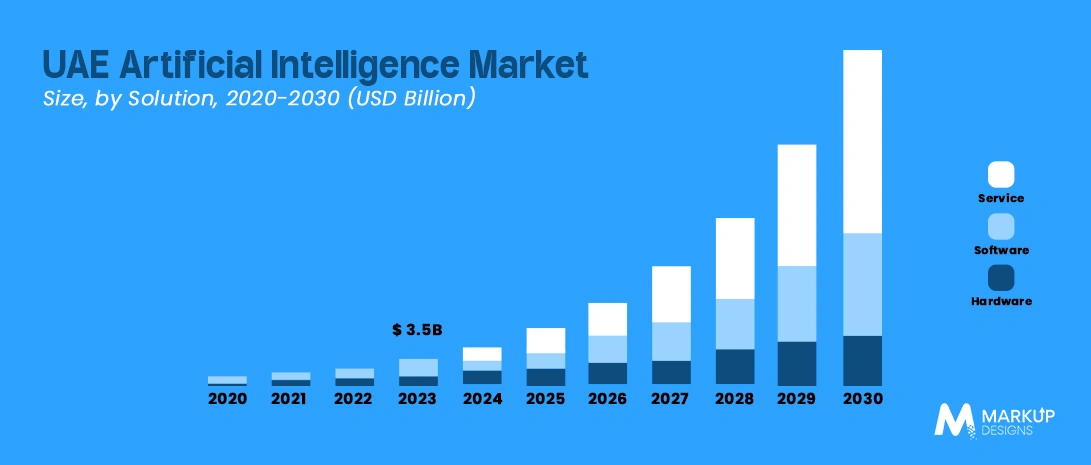
The artificial intelligence market in the United Arab Emirates is experiencing rapid expansion, with its value reaching approximately USD 3.47 billion in 2023 and expected to grow at a strong CAGR of 43.9% from 2024 to 2030. This growth is largely driven by the country’s well-defined AI strategy and the increasing adoption of advanced technologies such as large language models. Additionally, a strong focus on data security and privacy has encouraged significant investments in cutting-edge AI solutions.
The rising use of technologies like natural language processing (NLP), machine learning, and deep learning is further strengthening the region’s AI landscape. Combined with the widespread use of smartphones and expanding internet connectivity, these factors are accelerating the adoption of AI across industries, positioning the UAE as a key player in the global artificial intelligence market.
Understanding Dubai’s Smart Vision
20-Minute City Vision: Dubai is building communities where people can easily reach schools, offices, healthcare, shopping areas, and other daily services within 20 minutes by walking, cycling, or using public transport. The goal is to make city life more convenient, connected, and comfortable for residents.
Focus on Sustainability & Green Energy: Dubai is investing in eco-friendly infrastructure and clean energy solutions to achieve its net-zero emissions target by 2050. This includes the use of solar power, smart waste management systems, and energy-efficient buildings that help reduce environmental impact.
Smart Transportation & Mobility: Dubai is working towards making 25% of all transportation autonomous by 2030. The city is introducing self-driving taxis, drone taxis, and AI-powered traffic systems to improve travel, reduce traffic congestion, and make transportation faster and safer.
Digital Government & AI Integration: Through the Dubai Paperless Strategy, government services have become fully digital, reducing the need for paper transactions. AI and data-driven technologies are also being used to improve public services, support faster emergency response, and enhance safety through smarter city management.
Challenges in Implementing AI for Smart Cities
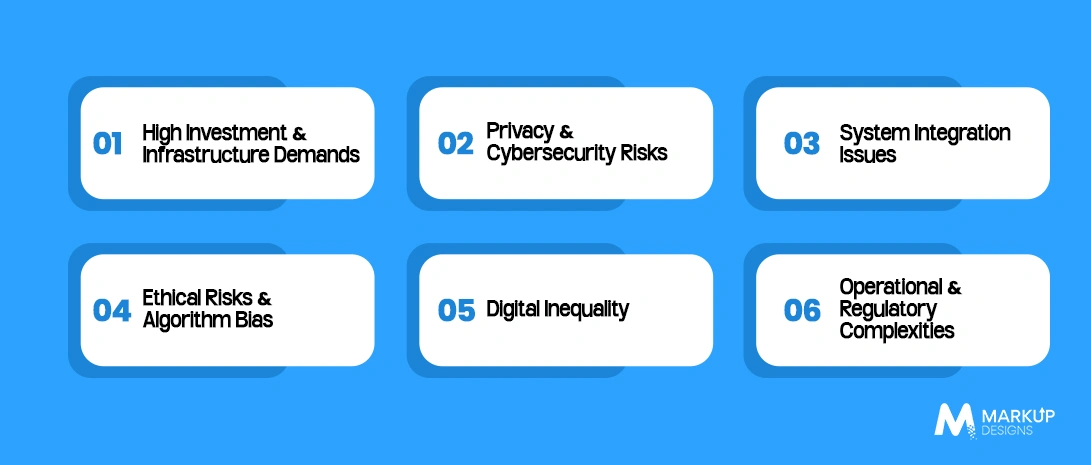
Implementing AI innovations in smart cities comes with several challenges, including high setup costs, privacy risks, and integration issues. Cities must invest in infrastructure while managing vast amounts of data and maintaining public trust. Making different systems work together smoothly while providing efficient services is a major challenge in itself.
Key Challenges in AI Implementation
- High Investment & Infrastructure Demands: Deploying sensors, cameras, and IoT networks requires significant funding, along with continuous upgrades and maintenance. Many cities are not fully equipped with the infrastructure needed to support advanced AI systems.
- Privacy & Cybersecurity Risks: Large-scale data collection raises serious concerns around user privacy and increases vulnerability to cyber threats, making strong security frameworks essential.
- System Integration Issues: Combining modern AI technologies with existing legacy systems can be difficult, especially when different platforms lack standardization and compatibility.
- Ethical Risks & Algorithm Bias: AI systems may unintentionally produce biased outcomes, highlighting the need for transparent and well-regulated ethical frameworks.
- Digital Inequality: Bridging the gap between different socioeconomic groups is critical to ensure fair access to AI-enabled services and avoid exclusion.
- Operational & Regulatory Complexities: Managing multiple stakeholders, navigating approvals, and handling logistical challenges like installation disruptions make implementation more demanding.
Read: Also: How AI Is Transforming UAE Businesses in 2026
The Role of AI in Smart City Infrastructure
Intelligent Transportation Systems
One of the most visible applications of AI in Dubai is in transportation. Traffic congestion is a common challenge in rapidly growing cities, but AI is helping Dubai tackle this issue effectively.
AI-powered traffic management systems analyze real-time data from cameras, sensors, and GPS devices to optimize traffic flow. Smart signals adjust dynamically based on traffic conditions, reducing congestion and travel time. Predictive analytics also helps authorities anticipate traffic patterns and implement preventive measures.
Smart Energy Management
AI is transforming how energy is produced, distributed, and consumed in Dubai. Smart grids equipped with AI capabilities monitor energy usage in real time, allowing for better demand forecasting and efficient distribution.
Predictive maintenance powered by AI helps identify potential issues in power infrastructure before they lead to failures, minimizing downtime and costs. Additionally, AI supports the integration of renewable energy sources such as solar power, ensuring a balanced and sustainable energy mix.
Smart Buildings and Urban Planning
AI is playing a critical role in shaping Dubai’s urban landscape. Smart buildings equipped with IoT devices and AI systems can automatically control lighting, temperature, and security based on occupancy and usage patterns.
Urban planners are using digital twins such as virtual replicas of physical environments to simulate and optimize city planning. AI analyzes data from these models to improve infrastructure design, resource allocation, and environmental impact.
AI in Governance and Public Services
AI-Powered Government Services
Dubai’s government is at the forefront of digital transformation. AI-powered chatbots and virtual assistants are widely used to provide instant support to citizens and businesses.
Routine administrative tasks are automated, reducing processing times and improving service delivery. Whether it’s applying for permits, renewing licenses, or accessing public information, AI ensures a seamless and hassle-free experience.
Predictive Analytics
Data is the backbone of smart governance, and AI enables authorities to make informed decisions based on real-time insights.
Predictive analytics helps in urban planning, resource management, and policy formulation. For example, AI can forecast population growth, infrastructure needs, and economic trends, allowing the government to plan proactively.
In crisis situations, such as emergencies or natural disasters, AI-driven systems provide real-time data and recommendations, enabling faster and more effective responses.
Public Safety and Surveillance
AI-enhanced security systems are a key component of Dubai’s smart city framework. Advanced surveillance technologies use facial recognition, behavior analysis, and anomaly detection to ensure public safety.
Smart policing initiatives leverage AI to identify potential threats, monitor high-risk areas, and respond quickly to incidents. These systems not only improve security but also enhance overall trust and confidence among residents.
AI and Sustainability
Sustainability is a key pillar of Dubai’s smart city vision, and AI plays a crucial role in achieving environmental goals.
AI-powered waste management systems optimize collection routes, reducing fuel consumption and operational costs. Predictive analytics help monitor water usage and detect leaks, ensuring efficient resource management.
Environmental monitoring systems use AI to track air quality, temperature, and pollution levels in real time. These insights enable authorities to take proactive measures to reduce environmental impact and improve living conditions.
By integrating AI into sustainability initiatives, Dubai is building a greener and more resilient city.
Key Technologies Enabling AI
AI does not operate in isolation, it is supported by a range of advanced technologies that form the backbone of Dubai’s smart city ecosystem.
- Generative AI & Large Language Models (LLMs): Organizations are increasingly implementing Retrieval-Augmented Generation (RAG) and deploying private LLMs within secure environments like Virtual Private Clouds (VPCs). This approach enhances data security while enabling more accurate and context-aware AI applications.
- Computer Vision & Autonomous Technologies: These solutions are transforming sectors like healthcare and logistics. In hospitals such as Rashid Hospital, AI-powered imaging systems significantly streamline radiology workflows, while in logistics, automation supports security monitoring and robotic handling of cargo.
- Predictive Analytics & Machine Learning: Businesses are leveraging these technologies for smarter decision-making, including optimizing supply chains in aviation, enabling real-time pricing strategies in retail, and detecting fraudulent activities in the financial sector.
- Edge AI & Internet of Things (IoT): A key component of smart city development, Edge AI processes data locally on devices like traffic sensors and surveillance systems, allowing faster and more efficient decision-making without relying solely on centralized systems.
- Blockchain and AI Integration: Emerging innovations are combining AI with blockchain to enhance data transparency, security, and traceability, particularly in industries such as logistics and retail.
- MLOps & Model Governance: Companies are adopting structured practices for managing AI models, including automated retraining and continuous monitoring, to ensure systems remain accurate, secure, and compliant with evolving regulations.
Future of AI in Dubai’s Smart City Evolution
Looking ahead, IoT is expected to play an even bigger role in shaping Dubai’s future. The city is preparing to roll out advanced IoT-based initiatives that will further enhance connectivity, efficiency, and innovation across urban systems.
Autonomous Infrastructure (Agentic AI): AI is evolving beyond basic data analysis and moving toward fully autonomous city management. Intelligent AI agents can independently control traffic signals, optimize energy distribution, and manage waste collection in real time. This reduces the need for constant human monitoring while improving efficiency, lowering costs, and creating smoother urban operations.
AI-Powered Digital Twins: Cities are now using digital twins, virtual models of real-world infrastructure, to test and improve urban planning decisions before implementing them. These AI-powered simulations can predict traffic flow, evaluate disaster response strategies, and identify infrastructure weaknesses, helping governments make smarter and more accurate decisions.
Predictive Public Safety: AI-driven systems are helping cities improve public safety by analyzing large amounts of real-time data. These technologies can predict high-risk areas, improve emergency response times, and support crime prevention efforts.
Environmental Sustainability: AI is playing a major role in helping cities achieve sustainability and net-zero target. Smart AI tools can monitor air quality, detect water leaks, optimize energy consumption, and improve renewable energy management. This allows cities to reduce waste, conserve resources, and build more environmentally responsible urban ecosystems.
Generative AI in Governance: Governments are increasingly using generative AI and AI-powered chatbots to improve citizen services. These systems provide 24/7 support, answer public queries instantly, and personalize interactions based on user needs.
FAQs
1. How is AI contributing to Dubai’s smart city vision?
AI enables Dubai to optimize traffic, manage energy consumption, enhance public services, and improve safety. By analyzing real-time data, it helps the city make faster, more informed decisions and deliver seamless digital experiences.
2. Which sectors benefit the most from AI in Dubai?
Key sectors include transportation, healthcare, energy, governance, and urban planning. From AI-powered traffic systems to smart hospitals and predictive analytics, multiple industries are leveraging AI to boost efficiency and innovation.
3. What role does the Roads and Transport Authority play in AI adoption?
The Roads and Transport Authority (RTA) uses AI to monitor traffic patterns, manage smart signals, and improve public transport systems. Its initiatives are central to reducing congestion and enhancing mobility across the city.
4. Is data privacy a concern in AI-driven smart cities?
Yes, data privacy and cybersecurity are major concerns. Dubai addresses these challenges by implementing strict data protection frameworks and investing in secure AI systems to maintain public trust.
5. How does AI support sustainability in Dubai?
AI helps optimize energy usage, monitor environmental conditions, and improve waste management. These initiatives reduce resource consumption and support Dubai’s long-term sustainability goals.
6. What technologies are driving AI innovation in Dubai?
Technologies such as IoT, machine learning, computer vision, blockchain, and large language models are key enablers of AI in Dubai’s smart city ecosystem.
7. What are the future prospects of AI in Dubai?
AI is expected to play a bigger role in autonomous transportation, smart infrastructure, and digital governance. Projects aligned with Saudi Vision 2030 also highlight the regional momentum toward AI-powered urban development.
Conclusion
Dubai’s smart city vision is a testament to its commitment to innovation, sustainability, and excellence. AI is at the core of this transformation, powering everything from infrastructure and governance to citizen experiences and environmental initiatives.
By embracing AI and fostering a culture of innovation, Dubai has created a dynamic and resilient urban ecosystem that serves as a model for cities around the world.
As the city continues to evolve, AI will remain a key enabler of progress, driving efficiency, enhancing quality of life, and shaping the future of urban living.

Author's Perspective
Dubai’s journey toward becoming a smart city reflects a clear vision backed by strong execution. What stands out is not just the adoption of advanced technologies but the strategic integration of AI into every aspect of urban living. The city has successfully moved beyond experimentation to real-world implementation, setting a global benchmark for innovation.
From an industry perspective, Dubai demonstrates how governments can lead digital transformation by fostering collaboration between public and private sectors. The emphasis on sustainability, efficiency, and citizen-centric services shows that technology can be both progressive and purposeful.
Discuss Your Project NowJupinder Singh Arora
Founder and CEO
Related Posts

How Artificial Intelligence Is Changing Mobile Game Development

Why Businesses in Oman Need Digital Transformation Services

Digital Transformation in Financial Services: Trends, Benefits &...
Insights Are Valuable & Execution is Priceless
You’ve read about the digital future. Now, let’s build the infrastructure to take you there. Move your strategy from the page to the product.
Design Your Solution Now
Contact Us
Schedule The Appointment At Your Convenience Date And Time.
30 Min
Web Conference
Time Zone
Indian standard time (08:30pm)

Thanks For Getting In Touch!
You’ve Taken The First Step Toward Transforming Your Digital Presence. Our Experts Will Reach Out Shortly To Take It Forward.
Launch Your Dream Project
Provide a brief overview of your project, and our specialists will evaluate your requirements. We will connect with you to explore how the right digital solutions can help you launch faster.