
In Brief
- AI-powered apps are rapidly transforming how businesses in the UAE operate, automate workflows, and engage customers.
- Strong government initiatives like the UAE AI Strategy 2031 and smart city programs are accelerating AI adoption across industries.
- Businesses are increasingly using AI-powered applications for automation, predictive analytics, customer support, personalization, fraud detection, and operational optimization.
- Industries such as healthcare, banking, retail, logistics, education, and government services are seeing the biggest impact from AI-driven applications.
- According to IBM, 42% of UAE organizations have already actively deployed AI, while 65% of IT professionals report accelerated AI rollout over the last two years. (IBM Newsroom – Middle East & Africa)
- UAE ranked among the top global countries for AI adoption growth, with adoption rates reaching 56% in 2025 according to recent reports. (Gulf Today)
- AI-powered apps are helping organizations improve efficiency, reduce operational costs, enhance customer experiences, and support faster decision-making.
- The future of AI app development in the UAE is shifting toward intelligent automation, AI agents, generative AI integration, and scalable enterprise ecosystems.
- Businesses investing early in AI-powered applications are positioning themselves for stronger long-term competitive advantages in an increasingly digital economy.
The UAE’s digital transformation journey has moved far beyond websites, basic mobile apps, and traditional automation systems. Over the last few years, businesses across the region have entered a new phase of technology adoption where intelligence itself is becoming part of digital infrastructure. Artificial intelligence is no longer being treated as a futuristic innovation reserved only for large technology companies. It is now becoming a practical business tool that helps organizations automate operations, improve customer experiences, analyze large volumes of data, and make faster decisions in real time.
This shift is happening particularly fast in the UAE because the country has aggressively positioned itself as a global technology and innovation hub. Government-led initiatives, smart city programs, advanced cloud infrastructure, AI-focused investments, and digital-first business environments are accelerating AI adoption across industries. As organizations face increasing customer expectations, rising operational complexity, and growing pressure to scale efficiently, AI-powered applications are emerging as one of the most important drivers of business transformation in the region.
The Growing AI Ecosystem in the UAE
The UAE has spent years building a strong digital ecosystem capable of supporting emerging technologies at scale. Unlike many markets where AI adoption is still largely experimental, the UAE has actively integrated artificial intelligence into national development strategies, infrastructure planning, public services, and private sector innovation.
One of the biggest milestones was the launch of the UAE AI Strategy 2031, which aims to position the country among the global leaders in artificial intelligence adoption and innovation. The strategy focuses on integrating AI across sectors, including healthcare, education, transportation, renewable energy, government services, and logistics. (Gulf News)
The country’s focus on digital infrastructure, cloud computing, smart governance, and technology investment has created an environment where AI-powered applications can scale more efficiently than in many other regions.
This ecosystem is also attracting major global technology investments. Companies like Microsoft have announced large-scale AI investments and upskilling initiatives in the UAE to accelerate digital innovation and workforce development. (The Times of India)
At the same time, enterprise adoption of AI is rapidly increasing. According to IBM’s AI Adoption Index, 42% of UAE organizations have already actively deployed AI solutions, while 65% of IT professionals stated that AI rollout has accelerated significantly over the last 24 months. (IBM Newsroom – Middle East & Africa)
These numbers clearly indicate that AI Innovations is no longer viewed as an option. It is increasingly becoming part of operational strategy.
Why Businesses are Investing in AI-Powered Apps
The rapid growth of AI-powered applications in the UAE is directly linked to changing business challenges and customer expectations.
Organizations today are dealing with:
- Rising operational costs
- Repetitive manual workflows
- Growing customer demands
- Large volumes of business data
- Faster competition cycles
- Real-time service expectations
Traditional applications often struggle to manage these challenges efficiently because they rely heavily on fixed logic and manual processes.
AI-powered applications introduce adaptive intelligence into digital systems. Instead of simply executing predefined instructions, these applications can:
- Analyze patterns
- Learn from user behavior
- Automate repetitive tasks
- Generate predictions
- Improve decision-making
- Personalize experiences
This dramatically improves operational efficiency while reducing dependency on manual intervention.
Businesses are no longer investing in AI simply because it sounds innovative. They are investing because intelligent systems directly improve productivity, scalability, and customer engagement.
According to IBM’s “Race for ROI” report, 77% of UAE senior leaders reported significant productivity improvements through AI adoption, outperforming the broader EMEA average. (IBM Newsroom – Middle East & Africa)
That operational impact is one of the biggest reasons AI-powered apps are becoming mainstream across industries.
AI-Powered Customer Experience Applications
One of the most visible use cases of AI-powered applications in the UAE is customer engagement and support.
Consumers today expect:
- Faster responses
- Personalized recommendations
- Real-time assistance
- 24/7 accessibility
- Seamless digital interactions
AI-powered customer applications help businesses meet these expectations more efficiently.
AI Chatbots and Virtual Assistants
Businesses across banking, retail, healthcare, travel, and e-commerce are heavily adopting AI-powered chatbots and virtual assistants.
These systems can:
- Handle customer inquiries instantly
- Automate appointment scheduling
- Resolve common support issues
- Recommend products or services
- Assist with transactions
- Reduce customer service workload
Unlike traditional chat systems, modern AI assistants can understand natural language, contextual intent, and customer behavior patterns.
This improves customer satisfaction while significantly reducing support costs.
In the UAE’s highly service-driven economy, AI-powered support systems are becoming essential rather than optional.
Personalized Recommendation Systems
Retail and e-commerce companies in the UAE increasingly use AI-powered e-commerce app recommendation engines to improve user engagement and conversion rates.
These applications analyze:
- User behavior
- Purchase history
- Browsing patterns
- Search intent
- Customer preferences
to deliver personalized shopping experiences.
This level of personalization improves:
- Customer retention
- Sales conversions
- Average order values
- Product discovery
As competition in the UAE’s e-commerce sector intensifies, personalization is becoming a major competitive differentiator.
Read: Also: Why Dubai is Becoming the AI Capital of the Middle East in 2026
How AI-Powered Apps Are Transforming Major Industries in the UAE
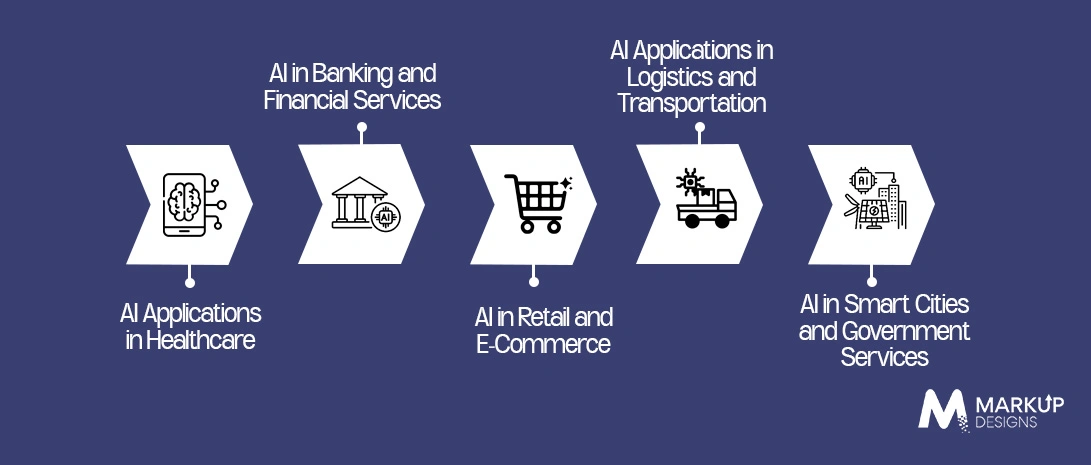
Artificial intelligence is no longer limited to experimental business tools or isolated automation systems. Across the UAE, AI-powered applications are transforming how industries operate, engage customers, optimize workflows, and make decisions. From healthcare and banking to retail, logistics, education, and government services, organizations are increasingly integrating intelligent applications into their core operational infrastructure.
AI Applications in Healthcare
Healthcare is one of the fastest-growing sectors for AI-powered applications in the UAE.
Hospitals, clinics, and healthcare providers are increasingly investing in intelligent systems to improve both patient experiences and operational efficiency.
AI-powered healthcare applications are being used for:
- Patient management
- Appointment automation
- Medical data analysis
- Virtual consultations
- Diagnostic support
- Predictive healthcare monitoring
AI systems can process medical information significantly faster than traditional manual workflows, helping doctors and healthcare providers improve diagnostic accuracy and patient management efficiency.
Virtual healthcare assistants are also becoming increasingly common. These systems help patients:
- Schedule consultations
- Access medical information
- Receive medication reminders
- Monitor symptoms
- Communicate with healthcare providers
As the UAE continues investing in smart healthcare infrastructure, AI-powered healthcare applications are expected to expand rapidly over the next decade.
AI in Banking and Financial Services
The UAE banking sector has become one of the strongest adopters of AI-powered applications.
Financial institutions are increasingly using AI for:
- Fraud detection
- Risk analysis
- Customer verification
- Transaction monitoring
- Predictive financial insights
- Automated customer support
AI-powered systems can analyze transaction behavior in real time and identify suspicious activities much faster than traditional monitoring systems.
This improves:
- Fraud prevention
- Security efficiency
- Compliance management
- Customer trust
Banks are also integrating AI-powered assistants into mobile banking applications to improve customer engagement and simplify financial interactions.
The UAE’s push toward digital finance and smart banking infrastructure is accelerating demand for AI-driven financial applications even further.
Recent developments like the UAE’s sovereign AI-powered financial cloud infrastructure highlight how deeply AI is becoming integrated into financial ecosystems. (The Times of India)
AI in Retail and E-Commerce
Retail businesses in the UAE are increasingly shifting toward AI-driven commerce ecosystems.
AI-powered retail applications help businesses:
- Forecast inventory demand
- Optimize pricing strategies
- Personalize shopping experiences
- Improve customer support
- Analyze consumer behavior
- Automate marketing campaigns
This level of automation allows retailers to respond faster to market trends and changing customer demands.
AI-powered visual search systems are also becoming more common in e-commerce applications. Customers can now search for products using images rather than text-based queries.
Additionally, AI-driven analytics help businesses better understand:
- Seasonal buying trends
- Product performance
- Customer preferences
- Purchasing patterns
This enables more intelligent decision-making across retail operations.
AI Applications in Logistics and Transportation
Logistics is another major sector where AI-powered applications are rapidly transforming operations in the UAE.
The region’s role as a global logistics and trade hub makes operational efficiency extremely important.
AI-powered logistics applications support:
- Route optimization
- Fleet management
- Warehouse automation
- Predictive maintenance
- Supply chain forecasting
- Delivery tracking
These systems help logistics companies reduce:
- Fuel costs
- Delivery delays
- Operational inefficiencies
- Inventory errors
Predictive analytics also help businesses anticipate supply chain disruptions before they create larger operational problems.
As UAE continues investing in smart transportation and logistics infrastructure, AI-powered operational systems are expected to become increasingly widespread.
AI in Smart Cities and Government Services
The UAE government has been one of the strongest drivers of AI adoption across the region.
AI-powered systems are already being integrated into:
- Traffic management
- Urban planning
- Public safety monitoring
- Citizen service platforms
- Smart governance systems
Smart city initiatives in Dubai and Abu Dhabi heavily rely on intelligent technologies to improve urban efficiency and digital accessibility.
AI-powered government platforms help automate:
- Public service requests
- Documentation processes
- Citizen communication
- Administrative workflows
This improves service speed while reducing operational bottlenecks.
The UAE’s long-term vision for intelligent cities is one of the major reasons AI-powered app development is expanding rapidly across public and private sectors simultaneously.
The Rise of Generative AI Applications
One of the biggest recent shifts in UAE’s AI ecosystem is the rapid rise of generative AI applications.
Generative AI is no longer limited to experimental tools or content generation platforms.
Businesses are now integrating generative AI into:
- Customer service systems
- Marketing automation
- Legal documentation
- Internal operations
- Financial reporting
- HR workflows
- Enterprise productivity tools
According to regional reports, 65% of MENA CEOs are accelerating Generative AI adoption, which is higher than the global average. (IBM Newsroom – Middle East & Africa)
This signals a major transition from simple automation toward intelligent enterprise ecosystems.
AI agents capable of performing multi-step tasks and operating within workflows are also becoming increasingly important in enterprise operations. (Reddit)
Read: Also: Future of Artificial Intelligence in UAE Economy in 2026
Challenges Businesses Face While Building AI-Powered Apps
Despite the growing opportunities, AI app development still comes with major challenges.
Many organizations underestimate the complexity involved in building scalable AI systems.
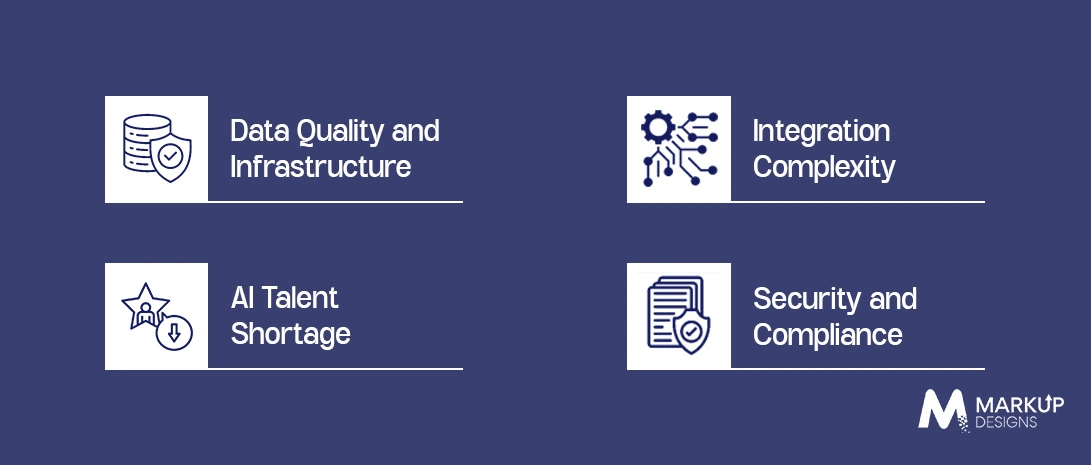
Key challenges include:
Data Quality and Infrastructure
AI systems depend heavily on:
- Structured data
- Clean datasets
- Scalable infrastructure
- Real-time data pipelines
Poor data quality significantly reduces AI accuracy and reliability.
Integration Complexity
Many businesses still operate on legacy systems that were never designed for AI integration.
Connecting AI applications with existing infrastructure often requires significant backend modernization.
AI Talent Shortage
Finding experienced:
- AI engineers
- Data scientists
- Machine learning specialists
- AI architects
remains a challenge globally, including in the UAE.
Security and Compliance
AI applications process large amounts of sensitive data, making:
- Data protection
- Governance
- Cybersecurity
- Regulatory compliance
critical during implementation.
Opportunities for Businesses in UAE
Despite these challenges, the opportunities around AI-powered applications remain massive.
Businesses adopting AI strategically can gain advantages through:
- Faster automation
- Better customer experiences
- Improved operational scalability
- Stronger predictive capabilities
- Intelligent decision-making
- Reduced manual dependency
The UAE’s aggressive focus on innovation, infrastructure, and digital transformation creates an ideal environment for AI-powered business ecosystems.
Recent reports also show that the UAE ranks among the world’s fastest-growing AI adoption markets, with adoption rates surging dramatically over the last few years.
This indicates strong long-term growth potential for organizations investing early in AI-powered systems.
Why Choosing the Right AI Development Partner Matters
Building AI-powered applications requires much more than integrating machine learning models into mobile or web platforms. Successful AI implementation depends heavily on architecture planning, scalable infrastructure, quality data pipelines, system integration, security, and long-term optimization strategies.
Many businesses fail during AI adoption because they focus only on AI features instead of building scalable operational ecosystems. Poorly structured AI systems often create:
- Inconsistent performance
- Weak scalability
- Data bottlenecks
- Integration failures
- Long-term maintenance issues
This is why businesses increasingly prefer working with experienced AI development teams capable of aligning technical execution with operational goals.
Organizations typically look for AI development partners that can support:
- Scalable AI architecture
- Intelligent automation systems
- AI-powered mobile and web applications
- Cloud and API integrations
- Data management and optimization
- Predictive analytics implementation
- Long-term AI scalability
Companies like Markup Designs help businesses develop scalable AI-powered applications designed around performance, usability, operational efficiency, and future scalability. As AI adoption continues accelerating across the UAE, businesses increasingly require technology partners capable of building systems that support both innovation and long-term business growth.
FAQs
1. Why are AI-powered apps growing rapidly in the UAE?
AI-powered apps are growing rapidly in the UAE because of strong government initiatives like the UAE AI Strategy 2031, increasing enterprise digital transformation, smart city investments, and rising demand for automation and personalized customer experiences across industries.
2. How do AI-powered apps improve customer experience?
AI-powered apps improve customer experience through personalized recommendations, AI chatbots, real-time support, predictive insights, and automated workflows that make interactions faster and more engaging.
3. What technologies are used in AI app development?
AI app development commonly uses machine learning, natural language processing, predictive analytics, cloud computing, automation systems, and API integrations.
4. What are the biggest challenges in developing AI-powered apps?
Common challenges include poor data quality, AI integration complexity, legacy systems, security concerns, infrastructure limitations, and shortage of AI specialists.
5. How are businesses using generative AI in the UAE?
Businesses are using generative AI for customer support, content creation, workflow automation, financial reporting, marketing, and enterprise productivity systems.
Conclusion
AI-powered applications are rapidly becoming one of the most important drivers of digital transformation across the UAE. What began as experimental automation is now evolving into intelligent operational infrastructure integrated across industries, including healthcare, banking, retail, logistics, education, and government services.
Strong government initiatives, advanced digital infrastructure, rising enterprise adoption, and increasing customer expectations are accelerating this shift even further.
Businesses are no longer investing in AI simply to appear innovative. They are adopting intelligent applications because AI directly improves efficiency, scalability, personalization, and decision-making capabilities in highly competitive digital environments.
As generative AI, predictive systems, automation platforms, and intelligent enterprise applications continue evolving, the role of AI-powered apps in the UAE will likely expand even more aggressively over the coming years.
Organizations that strategically invest in scalable AI ecosystems today will be better positioned to compete, adapt, and grow within the future digital economy of the UAE.
Author's Perspective
We are entering an era where technology choices dictate a company’s long-term survival. Across the UAE, the window for treating artificial intelligence as a trial project is officially closed. The organizations winning the market right now are those looking past basic features to focus heavily on structural scaling, robust data cleanliness, and secure cloud system design.
AI integration is not merely about launching a smart tool; it is about building an agile, learning software framework that self-optimizes over time. By building custom AI applications with a clear, architecturally sound strategy, forward-thinking enterprises clear out operational friction, protect profit margins, and unlock a highly responsive system built for long-term commercial dominance.
Discuss Your Project NowGaurav Goyal
Global Sales- VP
Related Posts
How to Build Production-Ready Applications with AI Coding...
Cost, Benefits & Business Impact: Generative AI vs....
Enterprise AI Agents: Practical Use Cases Driving Business...
Insights Are Valuable & Execution is Priceless
You’ve read about the digital future. Now, let’s build the infrastructure to take you there. Move your strategy from the page to the product.
Design Your Solution Now
Contact Us
Schedule The Appointment At Your Convenience Date And Time.
30 Min
Web Conference
Time Zone
Indian standard time (08:30pm)

Thanks For Getting In Touch!
You’ve Taken The First Step Toward Transforming Your Digital Presence. Our Experts Will Reach Out Shortly To Take It Forward.
Launch Your Dream Project
Provide a brief overview of your project, and our specialists will evaluate your requirements. We will connect with you to explore how the right digital solutions can help you launch faster.