
In Brief
- Farm management software allows the farms in Australia to manage the activities related to crops, livestock, inventory, machinery, workforce, finance, irrigation, and compliance through a single solution that automates these operations and eliminates the manual intervention.
- The usage of AI in farm management will make it more intelligent through monitoring crops, predicting yield, analyzing livestock health, intelligent irrigation, machinery maintenance, and providing assistance in managing the farm with AI.
- Development of such software requires understanding the requirements of the farm, planning an MVP for it, designing intuitive interfaces for users, choosing relevant technologies, including GPS, IoT, GIS, machinery, and weather, and testing for security and offline support.
- The cost of development may vary from about AUD 70,000 to AUD 700,000+ based on features, AI/ML functionality, technologies used, mobile and offline capability, cloud platform, etc.
- It is important to compare custom development with ready-made solutions based on your processes, requirements, budget, ROI, and other factors, and choose a development partner with agritech and modern technologies knowledge.
The agriculture industry of Australia has been moving more towards a digitalized environment. Information processing in the form of crop monitoring, animal tracking, machinery control, worker tracking, financial management, and resource management occurs on a regular basis on a typical modern farm. Handling such an abundance of information through manual processes can be tedious, error-prone, and hard for farm owners to gain insight into all the information.
This is why farm management software in Australia is becoming increasingly important. Such a system would enable farmers to consolidate all farm-related processes into a single system for better decision-making.
AI technology is taking this one step ahead. Using AI-based forecasting, crop management, livestock analysis, predictive maintenance, and intelligent recommendations, farm management software can assist farmers in moving from capturing information to understanding how they need to act.
In this blog, we will look at the important aspects, AI technology, development process, cost, and future trends for farm management software in Australia.
What is Farm Management Software?
Farm management software refers to an electronic tool that is used by farmers for managing and controlling the activities of their agricultural business from one point. Farmers do not have to create separate spreadsheets and keep other types of documents; instead, they will use one system for keeping all farm information organized.
In line with the needs of the particular farm, the software may deal with such aspects as crop planning, livestock management, inventory, equipment, personnel, finances, irrigation, field activities, and regulatory compliance documents. The software may also interface with GPS devices, IoT sensors, weather services, drones, satellite data, and farm machinery.
Nowadays, there are solutions that offer more than just data management possibilities thanks to AI and analytics, which allow finding patterns, giving forecasts, detecting any possible issues, and making decisions quickly.
In the case of Australian farms, this feature may become very important since farm operations can take place in a large territory, with unpredictable weather, and even without internet access.
Why Australian Farms Need Farm Management Software
There is an increasing level of complexity for the operation on the Australian farms. This includes varying weather conditions, water management, labor cost management, and large field operations, and they all require more efficient resource management and decision-making. Farm management software can help combine all of this into one system.
Some of the major factors responsible for the adoption of digital farm management systems by Australian farmers are:
- Better farm visibility: Crops, livestock, equipment, staff, and field activities can be tracked from one central dashboard.
- Efficient resource management: Resources such as water, fertilizers, feed, fuel, and other input materials can be tracked to avoid any wastage.
- Informed decision-making: Decision-making can be done based on real-time data and weather information.
- Automation of activities: Record-keeping, scheduling, reporting, and administrative tasks can be automated.
- Digital documentation and compliance: Digital documents and reports can be maintained to meet audit and sustainability requirements.
- Remote farm operation: Information can be tracked and maintained through mobile devices and in offline mode.
Key Features of Farm Management Software in Australia
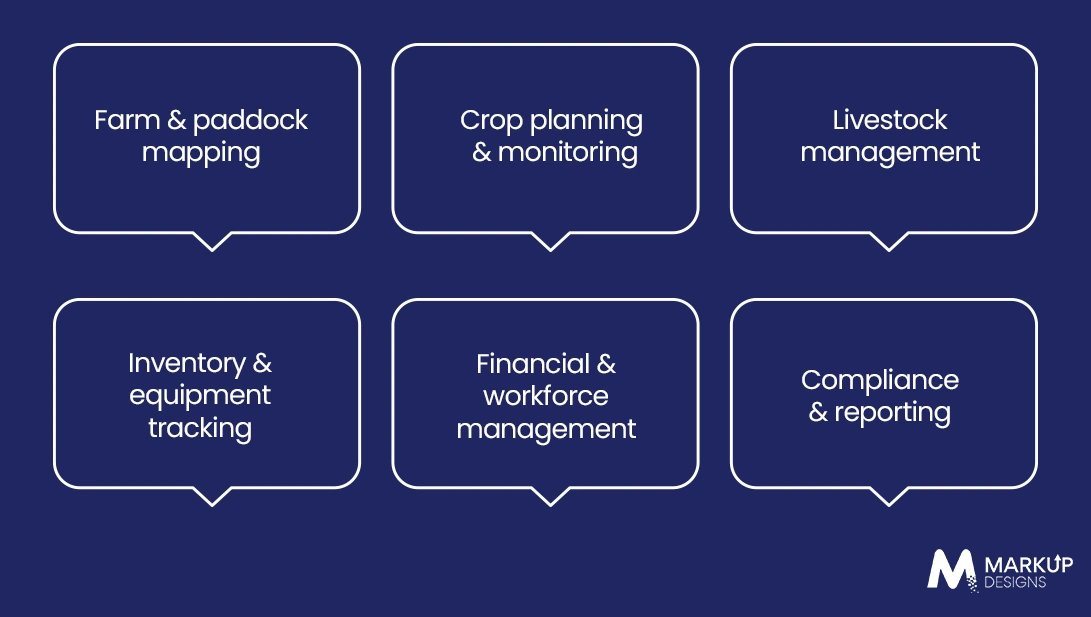
A successful farm management system must revolve around the needs of the farmers and agricultural businesses. The features will differ depending on the type of application to be used whether crop farming, livestock farming, or horticulture, among others.
The most important features include:
Farm & paddock mapping
Utilize GPS technology to map fields, boundary lines, soil information, and farm activities.
Crop planning & monitoring
Plan for planting activities, monitor crop growth, control input costs, and monitor harvesting activities.
Livestock management
Keep records of livestock, monitor their health status, and monitor breeding activities.
Inventory & equipment tracking
Monitor inventory levels, machinery usage, fuel consumption, maintenance schedule, and equipment activities.
Financial & workforce management
Assign farm duties, monitor farm labour, keep track of expenditure, and monitor farm profitability.
Compliance & reporting
Keep records digitally, create farm reports, and monitor sustainability and regulations.
How AI is Transforming Farm Management Software
AI technology will transform farm management from just recording to something much smarter. With the analysis of data gathered through farm records, sensors, weather systems, satellites, and equipment, AI will enable the farmer to recognize patterns and intervene before a minor problem becomes a major one.
Here are some practical ways AI can be used:
- Crop monitoring: AI can analyze photos and field information to detect signs of stress or illness on crops or abnormal growth.
- Yield forecasting: Using machine learning algorithms for analysis of past and present data, crop yields can be estimated.
- Livestock monitoring: Unusual behavior in animals and health monitoring can be done with the help of AI.
- Smart irrigation: AI can analyze weather and soil information to make suggestions about irrigation.
- Predictive maintenance: Data from machinery can be analyzed to predict potential breakdowns.
- AI farm assistants: Farm managers can ask questions in natural language and get answers on costs, operations, crops, livestock, or the performance of the farm.
Farm Management Software Development Process in Australia
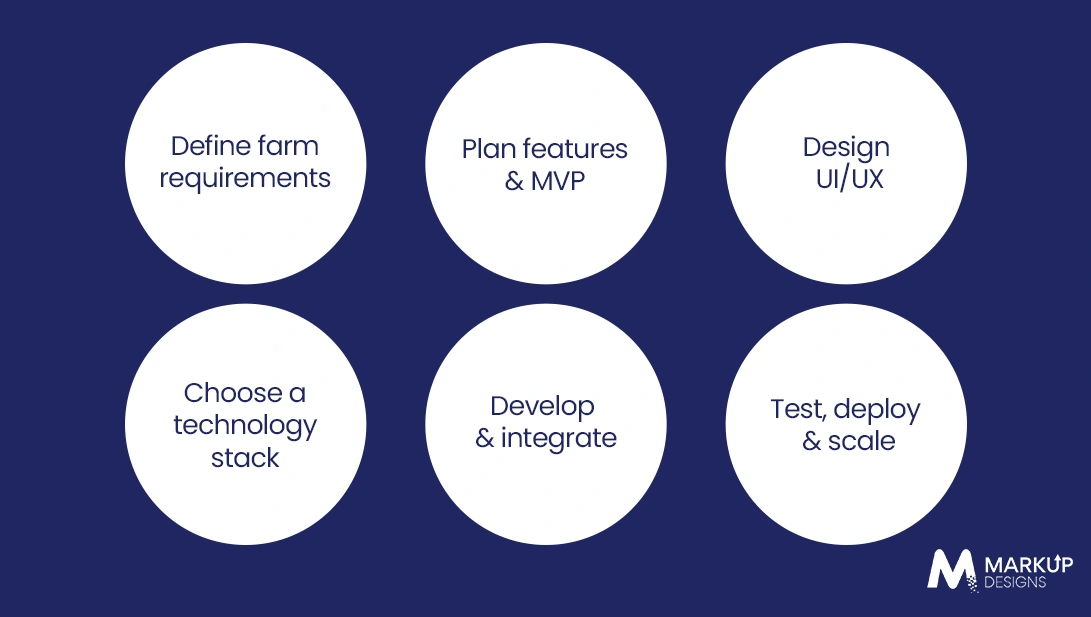
Developing farm management software involves much more than the implementation of a dashboard with farm-related capabilities. It should fit the realities of farming work processes, be applicable to the field conditions, and at the same time be user-friendly for various categories of users. A typical development process is as follows:
1. Define farm requirements
The type of farm, challenges, users, workflows, and business objectives are identified.
2. Plan features & MVP
The most relevant features of the first version are chosen – crop, livestock, inventory, and task management.
3. Design UI/UX
Simple dashboards and mobile applications are designed to be easy for farmers to operate on the field.
4. Choose a technology stack
Cloud computing, database, mobile applications, GIS, IoT, and AI technologies relevant to the scale of the project are selected.
5. Develop & integrate
The core of the platform and the sensors, machinery, weather service, maps, and other integrations are implemented.
6. Test, deploy & scale
Performance, security, offline operation, and other aspects are checked; further scaling is possible by implementing additional capabilities.
Farm Management Software Development Cost in Australia
The development cost of a farm management platform will depend upon the features, integration, and other elements of the platform. The development of a basic farm management MVP is obviously going to cost less than a complex enterprise-level farm management platform with IoT integrations and more functionalities.
As a general planning estimate:
| Software Type | Estimated Cost |
| Basic MVP | AUD 70,000–150,000 |
| Mid-level platform | AUD 150,000–350,000 |
| Advanced AI-powered platform | AUD 350,000–700,000+ |
Several factors can influence the final development budget:
- Feature count and complexity
- Functionality for mobile and offline use
- AI/ML and computer vision needs
- IoT, GPS, GIS, and machinery integration
- Cloud computing and security
- Third-party API and integration
- Development, testing, maintenance, and support
For this reason, businesses should define their MVP and long-term roadmap before finalising the development budget.
Build vs. Buy: Should You Develop Custom Farm Management Software?
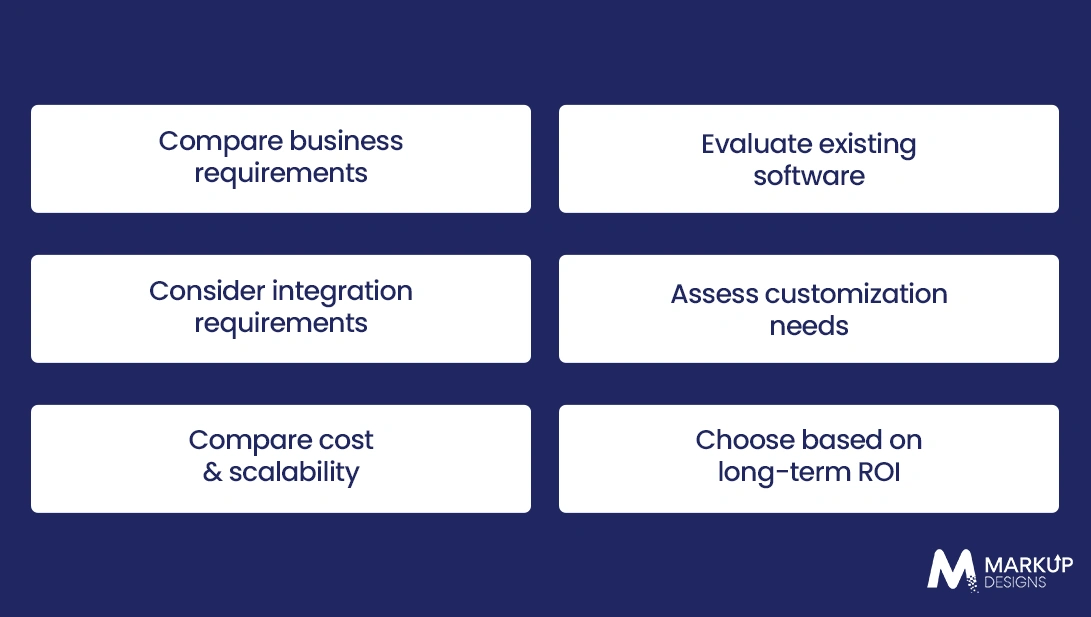
Australian farms and agribusinesses are presented with two major alternatives for using the digital technology of farm management: either purchase already available software or create a tailor-made system. Each of the options is beneficial in its own way, yet the decision-making process should take into account certain factors.
Compare business requirements
First, consider the purpose that the software is supposed to meet. Look into your farm size, farming type, user count, reporting requirements, fieldwork, and existing processes. Should you have basic requirements, then existing platforms will probably do for you. However, should your business have unique operational processes, then developing custom software might work better.
Evaluate existing software
Available farm management software will provide you with ready-to-use capabilities such as crop management, livestock management, inventory management, reporting, and financial software. Analyze how well these features fit your particular requirements. Consider other factors as well.
Assess customization needs
When there is no possibility for the standard solution to meet your needs, you will have to turn to customization. A custom solution gives businesses an opportunity to choose what functionalities, dashboards, automation features, and even AI functionalities they want to have.
Consider integration requirements
Modern farms use many different systems, such as GPS, IoT sensors, machinery, weather platforms, accounting software, drones, etc. You will need to evaluate if your current solution is capable of working with these systems. In case of multiple integrations, custom software development might be more flexible.
Compare cost & scalability
Purchasing software solutions usually means subscription or licensing fees, whereas custom development is initially more expensive. Nevertheless, businesses will have to take into consideration customization fees, integration fees, maintenance costs, upgrades, etc. With the custom solution, you will have the opportunity to expand further by adding new farms, users, devices, and features.
Choose based on long-term ROI
The final decision will have to be based on long-term benefits. If the current system already serves all the requirements of the user with only minor modifications, purchasing might be the way to go. However, in cases where a company has unique processes, advanced AI, or the need for control, development will provide better ROI.
How to Choose a Farm Management Software Development Company in Australia
Selecting an appropriate development partner may directly influence the effectiveness and usability of your farm management system. As agriculture software typically involves using mobile applications, cloud-based solutions, IoT devices, GPS systems, and even artificial intelligence, organizations need to search for more than just programming skills.
Consider these factors when selecting a development company:
- Agritech experience: Ensure that the vendor is aware of agricultural workflows and farm-based issues.
- Technical skills: Look for proficiency in mobile, cloud, AI/ML, IoT, GIS, and API integrations.
- Ease of use: The system must be easy enough for farmers and field personnel to operate without extensive training.
- Scalability: Ensure the solution will be able to handle more farms, users, devices, and data when the business scales.
- Data security and support services: Check the level of data security, testing, maintenance, monitoring, and post-launch support.
- Successful track record: Check previous projects, client testimonials, case studies, and the vendor’s ability to develop complex software solutions.
Want to build a smart farm management platform for the Australian market?
Markup Designs can help you turn your idea into a scalable solution with modern mobile, cloud, AI, IoT, and data technologies.

Conclusion
Farm management software is rapidly evolving into one of the key aspects of the current agricultural sector in Australia. The increasing digitization of farms, which relies on spreadsheets and disconnected tools, can complicate efficient management of business operations.
A modern solution can unite crop planning, livestock management, inventory, equipment, staffing, accounting, regulations, and farm data under one roof. The use of artificial intelligence can provide even more advanced opportunities such as yield prediction, crop monitoring, livestock monitoring, irrigation optimization, and fast decision-making based on the analysis of machine-generated reports.
Future farm management software can rely on such elements as automation, connectivity of IoT devices, AI-driven recommendations, digital twins, predictive analytics, and sustainable agriculture practices. Nevertheless, the success of this software will not depend on the quantity of technologies involved but rather on their ability to resolve practical issues faced by farmers.
Australian agribusinesses that invest in appropriate technology today can build a foundation for efficient, connected, and smart farms of the future.
FAQs
1. What is farm management software?
Farm management software is a digital platform that helps farmers manage activities such as crop planning, livestock, inventory, machinery, workforce, finances, irrigation, and compliance from one place.
2. How much does farm management software development cost in Australia?
Farm management software can cost around AUD 70,000 to AUD 700,000+, depending on the features, integrations, AI capabilities, mobile requirements, and overall complexity of the platform.
3. What are the key features of farm management software?
Common features include farm mapping, crop management, livestock tracking, inventory management, machinery monitoring, workforce management, financial tracking, reporting, and compliance management.
4. How can AI improve farm management software?
AI can analyse farm data to support crop monitoring, yield forecasting, livestock health tracking, smart irrigation, predictive machinery maintenance, and intelligent decision-making.
5. Can farm management software work without internet connectivity?
Yes. Farm software can include offline functionality that allows farmers to record information and access selected features without an active internet connection. The data can sync automatically once connectivity is restored.
Author's Perspective
Farm management software is evolving beyond digital record-keeping into a connected decision-making platform. For Australian farms, solutions should focus on offline access, simple interfaces, secure integrations, scalability, and practical AI applications. Combining AI, IoT, geospatial data, and automation can improve productivity, reduce waste, and manage risks. Starting with a focused MVP and adding advanced capabilities gradually can help businesses build a practical, scalable agritech solution.
Discuss Your Project NowJupinder Singh Arora
Founder and CEO
Related Posts
Knowledge Management System Development in Australia: Building AI-Ready...

Custom Software Development Cost in the UK: Features,...

UK Online Safety Regulations: A Compliance Guide for...
Insights Are Valuable & Execution is Priceless
You’ve read about the digital future. Now, let’s build the infrastructure to take you there. Move your strategy from the page to the product.
Design Your Solution Now
Contact Us
Schedule The Appointment At Your Convenience Date And Time.
30 Min
Web Conference
Time Zone
Indian standard time (08:30pm)

Thanks For Getting In Touch!
You’ve Taken The First Step Toward Transforming Your Digital Presence. Our Experts Will Reach Out Shortly To Take It Forward.
Launch Your Dream Project
Provide a brief overview of your project, and our specialists will evaluate your requirements. We will connect with you to explore how the right digital solutions can help you launch faster.