

In Brief
- Learn how knowledge management system development in Australia helps businesses unify, manage, and access essential business data.
- Study how AI-enabled features can be used, such as smart searching, knowledge graphs, generation-augmented retrieval (RAG), and enterprise AI agents.
- Learn the main stages of building a safe, scalable, AI-oriented knowledge management system.
- Learn about the Australian issues related to security, privacy, governance, integration, and data management.
- Get to know the aspects impacting the cost of KM systems, time of implementation, scalability, and value for business.
Australian companies create and handle a lot of information, including documentation, clients’ data, business processes, regulations, skills of employees, and business data. If this information is held in different databases and systems, company workers will have to spend a lot of time searching for it, teams will have to do the same work several times, and important information may become hard to access. The development of knowledge management systems is the smart way to unify data and make it easily discoverable, shareable, and usable by the workforce.
New-age knowledge management solutions no longer stop at document management. With the use of AI in semantic search, retrieval-augmented generation (RAG), knowledge graphs, and virtual assistants, a firm can leverage its internal knowledge and benefit from an intelligent layer of information, the role of which is to help in making everyday decisions and executing enterprise AI initiatives. For Australian companies, building such a system means not only choosing appropriate technology but also creating a reliable architecture, ensuring effective data delivery, integrating systems, defining governance procedures, and developing a compelling approach to keeping knowledge accurate.
What is a Knowledge Management System?
A Knowledge Management System (KMS) is an online tool that enables companies to collect, organize, store, and disseminate knowledge in a unified framework. It combines information coming from documents, databases, internal workflows, and expertise of employees in order to make the most crucial knowledge readily available.
Modern knowledge management systems utilize AI increasingly often to enhance the way employees access knowledge within the organization. An AI-empowered KMS is capable of interpreting the context and providing answers to questions when a simple repository is unable to do the job.
How Does a Knowledge Management System Operate?
A KMS collects knowledge from many different types of sources, sorts this information according to structured metadata and intelligent categorisation, and makes it accessible through search tools, dashboards, or conversational channels. Access controls make sure that employees will only see content necessary for their roles.
Using AI technology, the system can interpret natural language queries, search the materials from authorised sources, summarise the needed data, and provide context-specific replies.
What Kinds of Knowledge Can Be Managed by KMS?
Knowledge can be either of a structured or unstructured type, and the following knowledge can be managed by KMS:
– internal regulations, processes, and rules
– documentation about products and services
– knowledge about customers and support
– skills and expertise of employees
– training materials
– contracts, reports, and business documents
– records of various projects
Why Are Companies in Australia Investing Money in KMS?
Australian organisations are implementing knowledge management systems in order to eliminate information gaps and make accessing internal knowledge easier.
In the modern world in which companies rely on AI and digital workflows, they also need high-quality data stored in a safe place that will be easy to work with.
What Are the Key Features of a Modern Knowledge Management System?
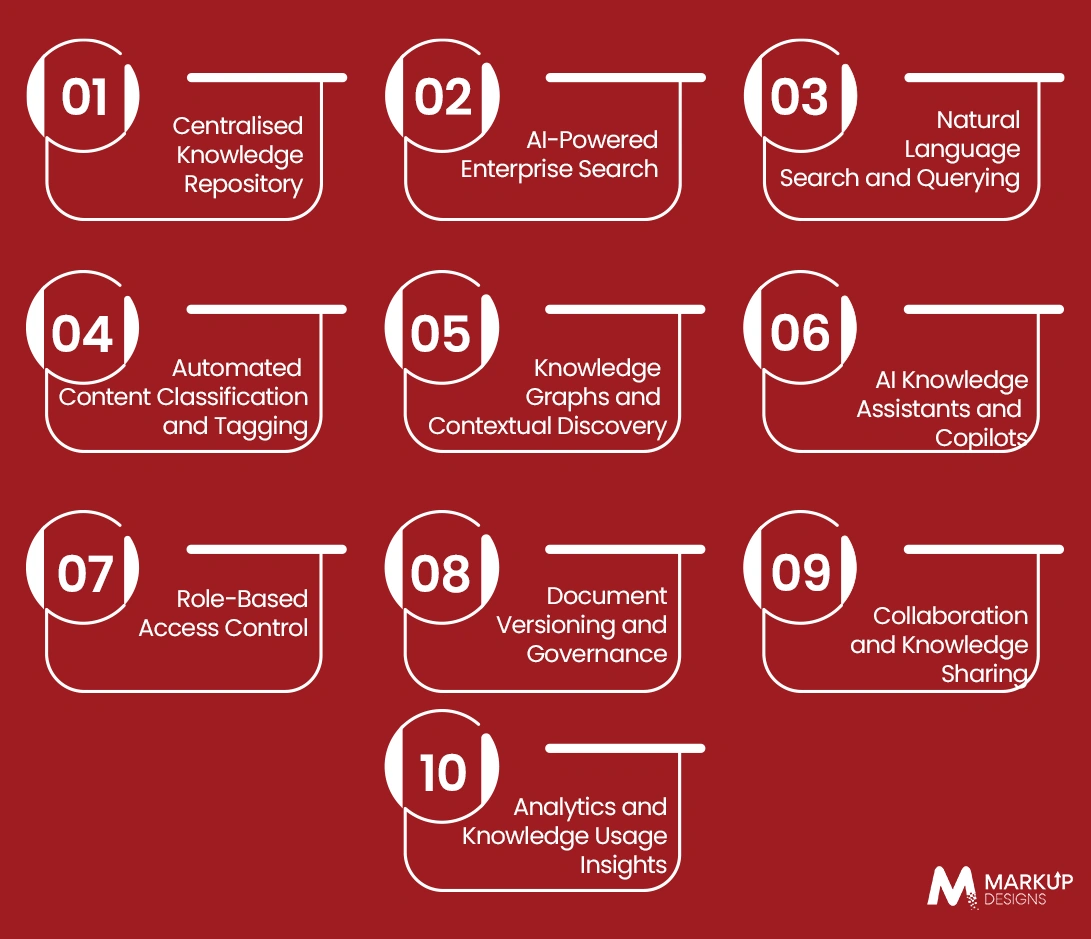
A modern knowledge management system combines traditional knowledge management features with the latest technologies such as AI, search, collaboration, security, and analytics. Main features include:
Centralised Knowledge Repository
This is the place for data collection, meaning that all documents, policies, procedures, media, and other knowledge will be gathered in one place instead of being spread over various locations.
AI-Powered Enterprise Search
Semantic search is used for gathering information that was not visible without AI capabilities.
Natural Language Search and Querying
Employees can ask their questions in colloquial language instead of looking for specific keywords.
Automated Content Classification and Tagging
The KM system automatically classifies and tags the content according to various criteria, including category, department of categorisation, etc.
Knowledge Graphs and Contextual Discovery
The knowledge graph connects all different concepts, data, documents, and other forms of information for the sake of discovering relationships not visible through usual search techniques.
AI Knowledge Assistants and Copilots
AI knowledge assistants enable access to approved organizational data without the need to do complex searches.
Role-Based Access Control
The knowledge management system grants access based on roles, departments, and other parameters.
Document Versioning and Governance
Tracks document changes, maintains version history, and supports policies for content ownership, approval, retention, and updates.
Collaboration and Knowledge Sharing
Enables teams to contribute expertise, share resources, provide feedback, and build a continuously updated knowledge base.
Analytics and Knowledge Usage Insights
Tracks search behaviour, content usage, unanswered queries, and knowledge gaps to help organisations improve their KMS over time.
How Is AI Transforming Knowledge Management Systems?
Artificial Intelligence is transitioning Knowledge Management Systems from being just data stores to more efficient systems, which can comprehend, process, and construct thoughtful suggestions.
Generative AI for Knowledge Discovery
Generative AI can analyze huge quantities of business data and assist personnel in extracting useful insights without scanning documents and systems.
Retrieval-Augmented Generation for Trusted Answers
RAG gives the opportunity to merge generative AI with verified company information, which makes it possible to obtain required information for the generation of responses.
AI-Powered Content Summarisation
AI can summarize lengthy texts, reports, policies, and minutes of meetings at a faster pace to improve handling useful information.
Intelligent Knowledge Extraction
AI can figure out essential entities, subjects, relations, and insights from unorganized text and produce usable knowledge from the data.
Predictive Knowledge Recommendations
Based on user activity and relationships between content, AI recommends needed documents, objects, and information to employees according to their needs.
AI Agents for Enterprise Knowledge Workflows
AI agents can assist in completing well-established knowledge processes that include searching for information, document processing, internal queries, and knowledge updating while operating within established restrictions.
What Are the Benefits of Developing a Knowledge Management System in Australia?
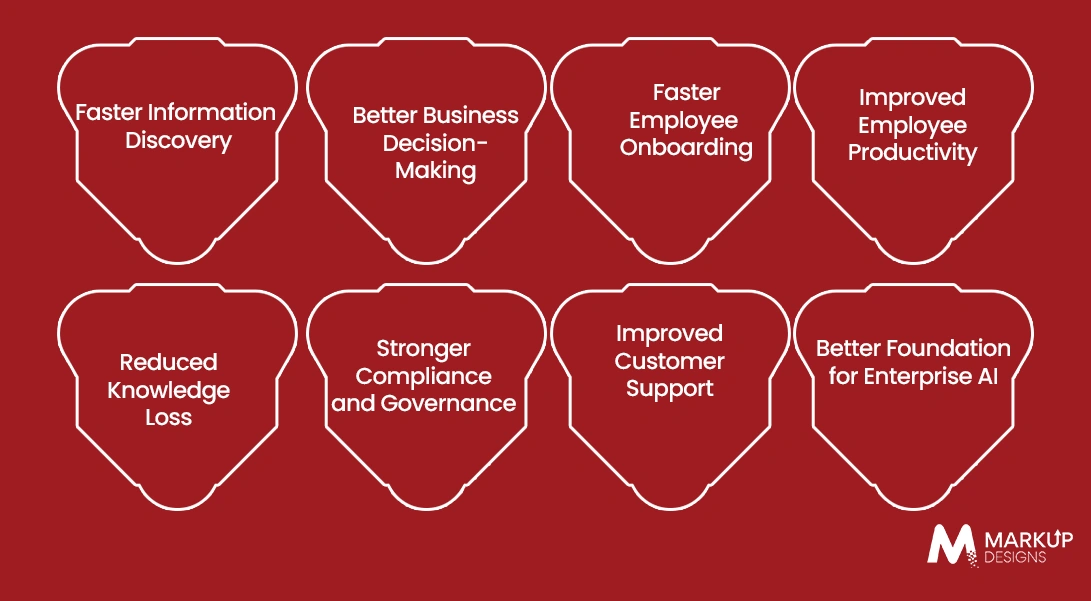
A well-designed KMS can improve how employees access information, collaborate, and make decisions across the organisation.
Faster Information Discovery
Employees can locate relevant information through centralised and intelligent search instead of checking multiple systems manually.
Improved Employee Productivity
Quick access to reliable knowledge reduces repetitive searches and allows employees to spend more time on higher-value work.
Better Business Decision-Making
Centralised and contextual information gives teams a stronger basis for evaluating options and making informed decisions.
Reduced Knowledge Loss
A KMS captures institutional knowledge, processes, and expertise so critical information does not remain dependent on individual employees.
Faster Employee Onboarding
New employees can access structured documentation, training resources, processes, and internal knowledge from a single platform.
Improved Customer Support
Support teams can quickly access product information, troubleshooting resources, policies, and previous knowledge to respond more effectively.
Stronger Compliance and Governance
Centralised controls, permissions, version tracking, and audit capabilities help organisations manage sensitive knowledge more consistently.
Better Foundation for Enterprise AI
A well-structured KMS gives AI applications access to governed and relevant organisational knowledge, creating a stronger foundation for enterprise AI adoption.
How to Develop a Knowledge Management System in Australia?
Developing a KMS requires more than building a searchable document library. The system should align with business objectives, existing data environments, security requirements, and future AI initiatives.
Define Business Goals and Knowledge Management Requirements
Identify the business problems the KMS needs to solve, the teams that will use it, and the types of knowledge that need to be managed.
Audit Existing Data and Knowledge Sources
Review documents, databases, cloud storage, business applications, and other sources to understand where organisational knowledge currently exists.
Design the KMS Architecture
Define the platform architecture, data model, search infrastructure, AI components, integrations, security layers, and scalability requirements.
Plan Data Migration and Knowledge Structuring
Clean, organise, classify, and migrate relevant information while removing outdated or duplicate content that could reduce search quality.
Develop the Core Knowledge Management Platform
Build the repository, search, content management, user management, collaboration, analytics, and other core KMS capabilities.
Integrate Enterprise Systems and Data Sources
Connect the KMS with CRM, ERP, HR, document management, collaboration, cloud storage, and other systems that contain valuable organisational knowledge.
Implement AI and Intelligent Search Capabilities
Add semantic search, RAG, knowledge graphs, AI assistants, summarisation, or other capabilities based on the organisation’s specific requirements.
Establish Security, Governance, and Access Controls
Implement authentication, role-based permissions, encryption, audit trails, data governance, and content management policies to protect enterprise knowledge.
Test, Deploy, and Monitor the Platform
Test search accuracy, integrations, security, performance, AI responses, and user workflows before deploying the system across the organisation.
Continuously Improve and Update Enterprise Knowledge
Monitor system usage, identify knowledge gaps, review content quality, and refine AI and search capabilities as business requirements evolve.
What Technology Stack Is Used for KMS Development?
The technology stack for a knowledge management system depends on the organisation’s data environment, integrations, security requirements, and AI roadmap. A typical KMS combines a modern application layer with enterprise databases, search infrastructure, AI services, cloud platforms, and identity management.
Frontend Technologies
React, Angular, or similar frameworks can be used to build responsive interfaces for knowledge search, content management, dashboards, and collaboration. The frontend should prioritise simple navigation and fast access to frequently used information.
Backend and API Technologies
Node.js, .NET, Java, or Python can support backend services, business logic, APIs, authentication, and integrations. The architecture should allow different enterprise systems and AI services to communicate securely with the KMS.
Databases and Knowledge Repositories
Relational databases such as PostgreSQL or Microsoft SQL Server can manage structured information, while document-oriented storage can support unstructured content. The choice depends on the type, volume, and structure of knowledge being managed.
AI and Machine Learning Technologies
Python-based AI frameworks and services from major cloud and AI providers can support natural language processing, summarisation, classification, recommendations, and intelligent knowledge assistants.
Vector Databases and Semantic Search
Vector databases and embedding technologies enable semantic search by representing content based on meaning rather than only matching keywords. This is particularly useful for AI-powered search and RAG-based knowledge systems.
Cloud Infrastructure
AWS, Microsoft Azure, or Google Cloud can provide scalable infrastructure, storage, computing, databases, AI services, monitoring, and backup capabilities for enterprise KMS platforms.
Security and Identity Management
Identity and access management technologies such as OAuth, SSO, Microsoft Entra ID, and role-based access controls can help protect knowledge and ensure users only access authorised information.
What Integrations Should an Enterprise Knowledge Management System Support?
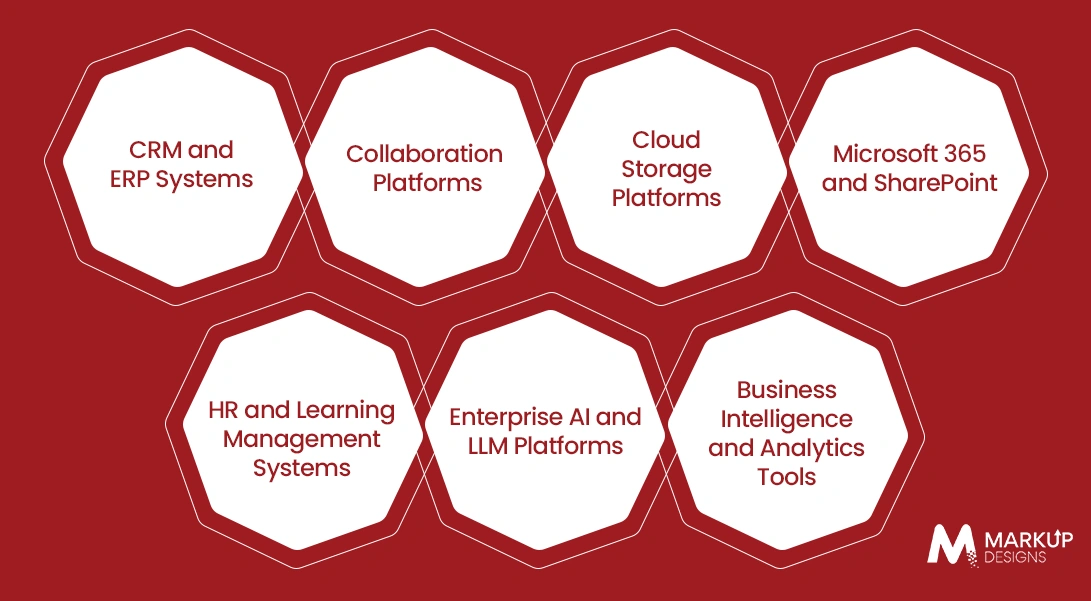
A KMS becomes significantly more valuable when it can connect with the systems where employees already create, store, and use information. Integrations also help prevent knowledge from remaining isolated across different business applications.
CRM and ERP Systems
Integrating CRM and ERP platforms allows the KMS to access relevant customer, product, operational, and business information without requiring employees to switch between multiple systems.
Microsoft 365 and SharePoint
Integration with Microsoft 365 and SharePoint can bring documents, collaboration content, and organisational knowledge into a more searchable and structured knowledge environment.
Collaboration Platforms
Platforms such as Microsoft Teams and Slack can be connected to capture relevant conversations, shared resources, and team knowledge while applying appropriate access controls.
HR and Learning Management Systems
HR and LMS integrations can connect employee information, training materials, onboarding resources, policies, and learning content with the wider organisational knowledge base.
Cloud Storage Platforms
Connections with services such as OneDrive, Google Drive, and other enterprise storage platforms can help organisations index and manage knowledge distributed across cloud repositories.
Business Intelligence and Analytics Tools
Integration with BI platforms allows organisations to combine knowledge insights with operational data and create more informed reporting and decision-making workflows.
Enterprise AI and LLM Platforms
KMS platforms can connect with enterprise AI and LLM services to support RAG, AI assistants, summarisation, natural-language search, and other intelligent knowledge capabilities.
What Security and Compliance Requirements Apply to KMS Development in Australia?
When developing KMS, Australian companies must take into account elements like privacy, access control, data protection, and governance. Security must be included in the design, instead of applied post-establishment.
Australian Privacy Act and Data Protection
Provisions for compliance with Australia’s privacy framework regarding the handling of personal and sensitive data must be part of the design of the KMS.
Role-Based Access and Identity Management
Access for users must be granted based on their roles, ensuring proper authentication and centralized identity management in protection of sensitive business knowledge.
Data Encryption and Secure Storage
Information must be encrypted during both transport and when stored, in addition to implementing adequate key management, backup, and infrastructure controls.
Audit Trails and Activity Monitoring
Audit records must be able to track access, modification, search, and administrative events, allowing an organization to investigate incidents and to ensure accountability.
Data Residency and Sovereignty
Organizations must be aware of where their data and backups are kept, and if their cloud system meets internal requirements and standards applied in Australia.
Knowledge Governance and Retention Policies
Clear policies must be established regarding knowledge ownership, content lifecycle, and timelines for archiving or eliminating older data.
What Challenges Can Businesses Face During KMS Development?
Building a KMS is rarely difficult because of the interface alone. The bigger challenges usually involve data quality, fragmented systems, user adoption, governance, and ensuring AI works with reliable enterprise information.
Fragmented and Unstructured Enterprise Data
Important knowledge may be spread across documents, emails, applications, shared drives, and employee records. Consolidating these sources requires careful data mapping and classification.
Poor Data Quality
Duplicate, outdated, incomplete, or inconsistent information can reduce search accuracy and lead users or AI systems toward unreliable answers.
Legacy System Integration
Older business applications may lack modern APIs or use incompatible data structures, making integration more complex and potentially requiring middleware or custom connectors.
Employee Adoption
A technically capable KMS will still fail to deliver value if employees do not use it or contribute knowledge. The platform should fit existing workflows and make information easier to access than current alternatives.
Maintaining Knowledge Accuracy
Knowledge needs ongoing ownership and review. Automated alerts, content expiry rules, approval workflows, and designated content owners can help keep information current.
Preventing Unauthorised Knowledge Access
Enterprise knowledge may include confidential customer, financial, employee, or operational information. Granular permissions and continuous access monitoring are therefore essential.
Managing AI Hallucinations and Incorrect Answers
AI-generated responses should be grounded in approved enterprise sources, with retrieval controls, citations where appropriate, confidence checks, and human oversight for sensitive use cases.
How Much Does It Cost to Develop a Knowledge Management System in Australia?
The cost of KMS development can significantly differ based on a variety of factors such as the level of functionality, number of integrations, amount of data, compliance with security regulations, etc. A basic internal knowledge platform will cost significantly less than an enterprise-grade KMS with RAG, AI agents, multiple integrations, and sophisticated governance mechanisms.
Factors That Influence KMS Development Cost
Among the main variables determining the cost of KMS development are the extent of the platform’s user base, complexity of the platform, requirements from the UI/UX point of view, needs in data migration, integrations with other systems, security measures, AI possibilities, cloud system architecture, and the support needed after implementation.
Development Cost by KMS Complexity
A simplified KMS with document management and searching tools will usually require fewer investments compared to a customized enterprise-level platform with semantic search, knowledge graphs, AI assistants, analytics tools, and complex access control methods.
AI and Integration Costs
The usage of AI models, vector databases, and API for integration with other platforms can greatly affect both the initial emergence and ongoing expenditure of the developed infrastructure.
Maintenance and Ongoing Optimisation Costs
Post-launch costs may include cloud infrastructure, security updates, model usage, monitoring, technical support, content governance, and continuous improvements to search and AI capabilities.
How Long Does It Take to Develop a Knowledge Management System?
The time frame for the project execution is dependent on the requirements of the system, complexity of data, integrations, and AI requirements. Implementing a focused internal KMS takes less time than developing a large-scale corporate platform that requires extensive migration from existing systems, custom integrations, and advanced AI.
Discovery and Planning
In this stage, all what is needed is defined, including business requirements, users roles, sources of information, integrations, security requirements and technical environment.
UI/UX and Architecture
The development team creates the UI/UX and technical architecture that includes a data model, search infrastructure as well as security.
Development and Integration
In this stage, all essential features of the KMS are created and integrated with currently used enterprise systems.
AI Implementation and Testing
AI search, RAG, assistants, classification, and other capabilities are implemented based on real business data.
Deployment and Optimisation
In this stage, the platform is deployed, monitored, and modified according to user feedback, system performance, and the quality of search and knowledge usage in the KMS.
Read Also: How to Build an EdTech App in Australia for 2026
What Are the Emerging Knowledge Management Trends in Australia?
The next generation of KMS platforms is moving towards more intelligent, contextual, and automated knowledge experiences. AI is becoming central to how enterprises discover, interpret, and use internal information.
Agentic AI for Knowledge Workflows
AI agents can perform multi-step knowledge tasks such as retrieving information, analysing documents, routing requests, and triggering predefined workflows.
AI-Powered Enterprise Search
Search is evolving from keyword matching towards semantic and conversational experiences that understand user intent and provide contextually relevant results.
Knowledge Graphs and Semantic Intelligence
Knowledge graphs help connect information across people, documents, systems, and business concepts, allowing organisations to discover relationships within enterprise data.
RAG-Based Enterprise Knowledge Systems
RAG enables AI applications to retrieve relevant information from controlled enterprise sources before generating responses, making it useful for internal knowledge assistants and support systems.
Cloud-Native Knowledge Platforms
Cloud-native architectures provide scalability, flexible infrastructure, easier integrations, and access to managed AI and data services.
Human-Centred AI Governance
As AI becomes more involved in knowledge workflows, organisations are placing greater emphasis on transparency, human oversight, responsible AI practices, and clear governance.
How Can Australian Businesses Choose the Right KMS Development Approach?
The chosen method ultimately relies on the specific technology infrastructure, the required knowledge management structure, the available budget, and the required degree of customisation of the desired system.
Custom Knowledge Management System
A tailor-made KMS gives its users higher flexibility in terms of functionalities provided and other technicalities of the system, such as system architecture, integrations, security, and AI.
Off-the-Shelf KMS Platform
The use of a ready-made platform enables faster installation of the system and the use of proven functionalities of the platform applicable to the business with standard requirements related to managing knowledge.
Hybrid KMS Approach
The hybrid model combines a ready-made solution with the possibility of custom development and integrations of those elements that are required for getting more functionalities, AI, or specialized workflow.
Real-World Use Cases of Knowledge Management Systems in Australia
Knowledge management systems can support organisations across industries where employees depend on large volumes of operational, regulatory, technical, or customer information.
Healthcare and Medical Organisations
KMS platforms can organise clinical documentation, policies, training resources, operational procedures, and approved internal knowledge while applying strict access controls.
Financial Services and Banking
Banks and financial institutions can use KMS platforms to centralise product information, compliance documentation, internal procedures, customer service knowledge, and risk-related information.
Government and Public Sector
Government organisations can use knowledge platforms to manage policies, legislation, procedures, service information, and institutional knowledge across departments.
Education and Training
Educational institutions can centralise course resources, academic documentation, staff knowledge, student support information, and administrative processes.
Manufacturing and Engineering
Manufacturers can use KMS platforms to manage technical documentation, SOPs, maintenance knowledge, product specifications, and engineering expertise.
Professional and Legal Services
Professional and legal organisations can centralise case knowledge, policies, research, precedents, client documentation, and internal expertise while maintaining strict access controls.
Why Choose Markup Designs for Knowledge Management System Development in Australia?
Markup Designs extensively helps Australian organizations to create tailor-made knowledge management systems that conform to their existing procedures, data, or future requirements for AI. We create platforms for knowledge management system development, which feature enterprise searching, AI-based knowledge discovery, and can be integrated with the software already in use in a particular enterprise.
One of our main focuses is the security and scalability of the designed system. From architecture and implementation of the KMS to further maintenance and support, we offer comprehensive services covering all the phases.
Build an AI-Ready Knowledge Management System for Your Australian Enterprise
Turn scattered business knowledge into a secure, intelligent, and searchable knowledge ecosystem built around your organisation’s workflows and AI goals.

Conclusion
Knowledge management systems have become one of the prerequisites for Australian enterprises that strive to improve their access to information, collaboration, management, and usage of AI technologies. In other words, a modern KMS gathers all scattered knowledge into a highly used and manageable environment thanks to the functions and characteristics inherent in KMS, which include semantic searches, RAG, knowledge graphs, etc. However, KMS development is not only about applying existing AI technologies for knowledge management system development.
FAQ
1. What is a knowledge management system?
Knowledge management systems are digital tools that enable businesses to gather, organize, store and disseminate knowledge. These days, businesses are using knowledge management systems powered by artificial intelligence to enhance search capabilities, summarize documents in an automatic manner, find out recommendations related to knowledge, and converse with machines to access business knowledge.
2. How much do you need to pay to have a knowledge management solution in Australia?
The cost of creating a knowledge management system depends on technological complexity, number of end-users, amount of integrations, data migration need, security demand, etc. Obviously, a simple KMS will cost much cheap than a corporate one with RAG and AI features, advanced search, and heavy integrations.
3. How long does it take to develop a KMS?
Though building of any knowledge management system requires a lot of time and efforts, the minimum period needed for creating such a tool is a few months. And one will have to take a number of factors into account to find out the exact amount of time needed for a system to be developed.
4. Which AI functions may be incorporated into a KM system?
KM systems comprise features such as AI-enabled enterprise search, natural language querying, RAG, document summarization, automatic classification, knowledge extraction, recommender systems, knowledge assistants, and AI agents for certain workflows.
5. What is a KMS and how is it different from a document management system?
Document management systems are concerned only with document storage, organization, protection, and management. KMS systems have a much wider scope; they are able to relate documents to company processes, expertise, structured information, and other sources of knowledge, as well as provide access to the use of information, collaboration, and discovery through AI capabilities.
Author's Perspective
From the industry perspective, the benefits of KM systems come from transforming scattered organization knowledge into available and actionable information. Australian companies that opt for AI should first ensure that they have correct, structured, and secured knowledge in their organization since otherwise the capabilities of advanced AI will be of no use in case of poor quality enterprise data.
Discuss Your Project NowAjit Kumar Jha
VP - Business Operations
Related Posts

Farm Management Software Development in Australia: Features, AI...

Custom Software Development Cost in the UK: Features,...

UK Online Safety Regulations: A Compliance Guide for...
Insights Are Valuable & Execution is Priceless
You’ve read about the digital future. Now, let’s build the infrastructure to take you there. Move your strategy from the page to the product.
Design Your Solution Now
Contact Us
Schedule The Appointment At Your Convenience Date And Time.
30 Min
Web Conference
Time Zone
Indian standard time (08:30pm)

Thanks For Getting In Touch!
You’ve Taken The First Step Toward Transforming Your Digital Presence. Our Experts Will Reach Out Shortly To Take It Forward.
Launch Your Dream Project
Provide a brief overview of your project, and our specialists will evaluate your requirements. We will connect with you to explore how the right digital solutions can help you launch faster.