
In Brief
- Understand how LLM-as-a-Judge evaluates AI-generated outputs at scale
- Use automated evaluation to strengthen enterprise AI quality and governance
- Measure accuracy, relevance, safety, factuality and instruction following
- Combine LLM evaluation with human oversight to reduce bias and false confidence
- Build continuous evaluation into the enterprise AI development and monitoring lifecycle
As enterprises deploy large language models across customer service, internal copilots, AI agents and knowledge systems, evaluating their outputs consistently becomes increasingly difficult. Human review can provide valuable judgement, but it becomes costly and difficult to scale when thousands of AI interactions are generated every day. LLM-as-a-Judge addresses this challenge by using an LLM to assess another model’s responses against defined criteria such as accuracy, relevance, factuality, safety and instruction following.
However, LLM-as-a-Judge is more than an automated scoring mechanism. When incorporated into an enterprise AI governance framework, it can provide continuous visibility into model behaviour, identify quality and safety issues, support standardised evaluation and help teams make informed decisions about AI systems. The approach still has limitations, including evaluator bias and false confidence, which means enterprises need to combine automated judgement with appropriate human oversight. This guide explores how LLM-as-a-Judge works, where it delivers value and how businesses can implement it responsibly.
What Is LLM-as-a-Judge?
LLM-as-a-Judge is an approach where one large language model evaluates the output generated by another AI system. Instead of relying entirely on human reviewers, the “judge” model assesses responses against predefined criteria and produces a score, ranking or feedback.
The basic process is straightforward: AI output → evaluation criteria → judge model → score or feedback → improvement. Unlike traditional human evaluation, this approach can assess large volumes of responses much faster and more consistently, although human oversight remains important for sensitive or high risk decisions.
How Does LLM-as-a-Judge Work?
The process starts with clearly defined evaluation criteria or a scoring rubric. The AI system generates a response, which is then passed to the judge model. The judge assesses it against the selected criteria and produces a score, comparison or qualitative feedback. These results can then be used to identify issues, monitor performance and improve the AI system.
What Can an LLM Judge?
An LLM judge can evaluate multiple aspects of an AI response, including:
- Accuracy – Is the information correct?
- Relevance – Does it address the user’s request?
- Factuality – Does it avoid unsupported claims?
- Helpfulness – Does it provide useful information?
- Safety – Does it avoid harmful or inappropriate content?
- Tone and consistency – Does it follow the expected communication style?
- Instruction following – Does it comply with the given requirements?
Why LLM Evaluation Matters for Enterprise AI Governance
As enterprises deploy AI across more workflows, they need a reliable way to monitor whether these systems continue to perform as expected. LLM evaluation provides a structured layer for measuring quality, identifying risks, and maintaining greater control over AI behaviour.
AI Systems Need Continuous Evaluation
AI performance can change when models, prompts, data or workflows are updated. Testing a system once is therefore not enough for production environments. Continuous evaluation helps enterprises detect performance changes before they become larger business problems.
Manual Evaluation Does Not Scale
Human reviewers can provide valuable context and judgement, but reviewing thousands of AI responses manually is expensive and time-consuming. LLM-as-a-Judge can handle large volumes of routine evaluations while allowing human experts to focus on complex or high risk cases.
Evaluation Supports Responsible AI Governance
A structured evaluation process helps enterprises monitor AI quality, identify potential risks and check compliance with internal policies. It also creates measurable records that can support auditing and continuous improvement.
What Are the Main LLM-as-a-Judge Evaluation Methods?
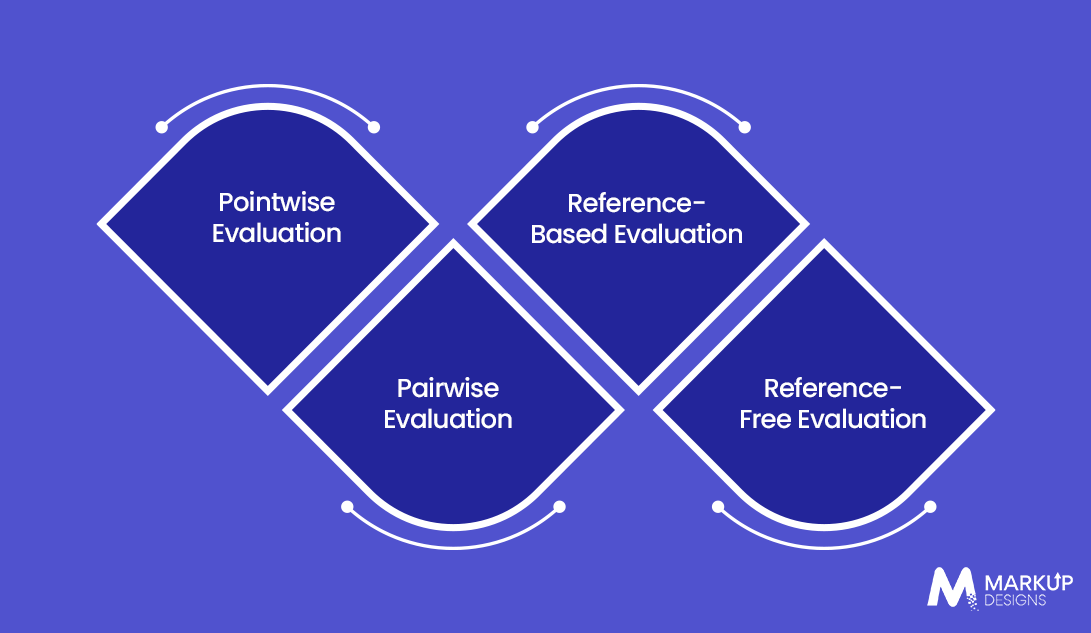
Different evaluation methods serve different enterprise requirements. The right approach depends on whether you need to score individual responses, compare outputs or assess them against known answers.
Pointwise Evaluation
The judge evaluates a single AI response against predefined criteria and assigns a score. This works well for measuring attributes such as relevance, accuracy, helpfulness or safety.
Pairwise Evaluation
Two AI responses are presented to the judge, who determines which one performs better according to specified criteria. This can be useful when comparing models, prompts or different versions of an AI application.
Reference-Based Evaluation
The generated response is compared with an approved reference answer. This approach is useful when enterprises have reliable expected answers against which AI outputs can be measured.
Reference-Free Evaluation
The judge evaluates the response without a predefined answer, relying instead on evaluation criteria or a rubric. This is useful for open ended tasks where there may be several valid ways to respond.
What Metrics Can Enterprises Measure with LLM-as-a-Judge?
LLM-as-a-Judge can evaluate AI outputs across several dimensions instead of treating quality as a simple right or wrong outcome. Enterprises can define the metrics that matter most for their use case and use them to monitor performance over time.
| Metric | What It Measures | Enterprise Relevance |
| Accuracy | Correctness of the output | Reduces unreliable responses |
| Relevance | Alignment with the user’s request | Improves user experience |
| Factuality | Whether claims are supported by available information | Helps reduce hallucinations |
| Safety | Harmful, inappropriate or risky content | Supports responsible AI |
| Consistency | Stability of responses across similar inputs | Improves reliability |
| Instruction Following | Compliance with prompts, policies and requirements | Supports workflow accuracy |
How LLM-as-a-Judge Improves Enterprise AI Governance
LLM-as-a-Judge gives organisations a measurable way to monitor AI behaviour instead of relying entirely on manual reviews. When integrated into existing AI workflows, evaluation results can support quality control, risk management and ongoing governance.
Establishing Standardised Evaluation Criteria
Enterprises can create consistent scoring frameworks for different AI applications. This makes it easier to apply the same quality standards across models, teams and use cases.
Detecting AI Quality and Safety Issues
Automated evaluation can flag issues such as inaccurate answers, irrelevant responses, hallucinations or potential policy violations. Teams can then investigate and address these issues before they affect more users.
Creating Audit Trails
Evaluation scores, feedback, and model performance data can be recorded over time. These records provide greater visibility into how an AI system performs and how its behaviour changes after updates.
Supporting Human Oversight
LLM evaluation should support rather than replace human judgement. Automated scores can identify routine or low-risk cases while directing complex, sensitive or high-risk outputs to human reviewers.
Where Can Enterprises Use LLM-as-a-Judge?
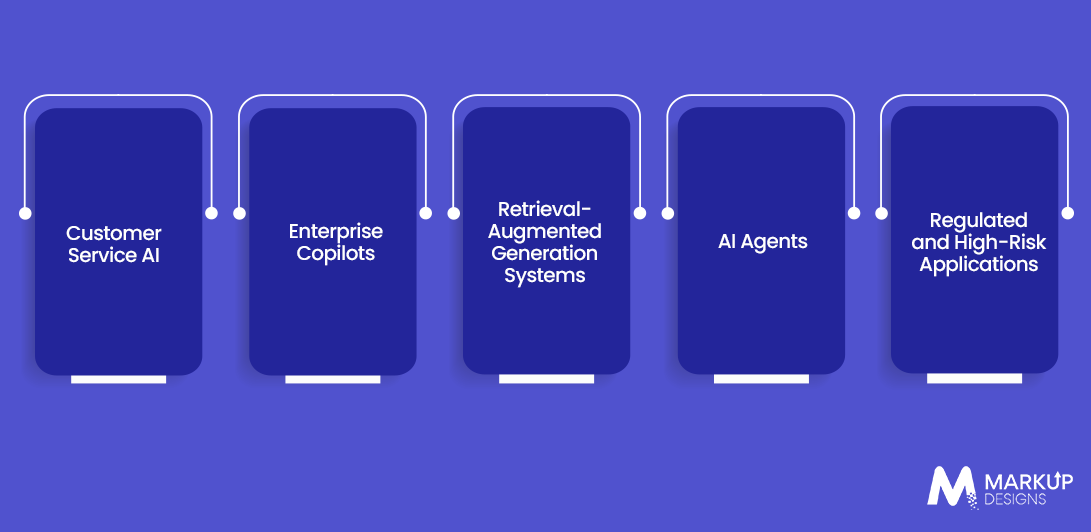
The approach is useful wherever an organisation generates large volumes of AI responses that need consistent evaluation.
Customer Service AI
Businesses can assess chatbot responses for accuracy, relevance, helpfulness and tone, helping maintain consistent customer interactions.
Enterprise Copilots
LLM-as-a-Judge can evaluate generated summaries, recommendations, reports and internal responses against defined business requirements.
Retrieval-Augmented Generation Systems
Enterprise RAG can assess whether generated answers accurately reflect the information retrieved from their knowledge sources and identify unsupported responses.
AI Agents
For AI agents, evaluation can go beyond the final response to assess whether tasks were completed correctly and whether business rules were followed.
Regulated and High-Risk Applications
Healthcare, finance, legal and other sensitive applications can use structured evaluation to monitor output quality, safety and compliance requirements. Human review remains particularly important in these environments.
What Are the Benefits of LLM-as-a-Judge for Enterprises?
When implemented properly, LLM-as-a-Judge can provide several operational benefits:
- Scalable evaluation across large volumes of AI outputs
- Faster quality assurance compared with fully manual reviews
- Consistent assessment using defined evaluation criteria
- Reduced manual workload for routine evaluations
- Continuous monitoring of production AI systems
- Better model selection through measurable comparisons
- Stronger AI governance through documented evaluation results
- Faster issue detection when model performance changes
What Are the Challenges and Limitations of LLM-as-a-Judge?
LLM-as-a-Judge is not an objective source of truth. The judge is itself an AI system, which means its evaluation can introduce additional risks.
Judge Bias and Inconsistency
The evaluation model can have biases or interpret criteria differently across responses. Poorly designed rubrics can make these inconsistencies worse.
Correlation Between Judge and Evaluated Model
If the judge and evaluated model have similar architectures, training influences or weaknesses, the judge may fail to identify certain errors.
False Confidence
A high evaluation score does not guarantee that an AI response is correct. Enterprises should treat scores as signals for decision-making, not absolute proof of quality.
Prompt Sensitivity
Small changes to the evaluation prompt or rubric can influence the judge’s assessment. Evaluation prompts therefore need to be tested and standardised.
Data Privacy and Security
Enterprise data may contain confidential or sensitive information. Organisations need appropriate controls for how evaluation data is processed, stored and accessed.
How to Build a Reliable LLM-as-a-Judge Evaluation Framework
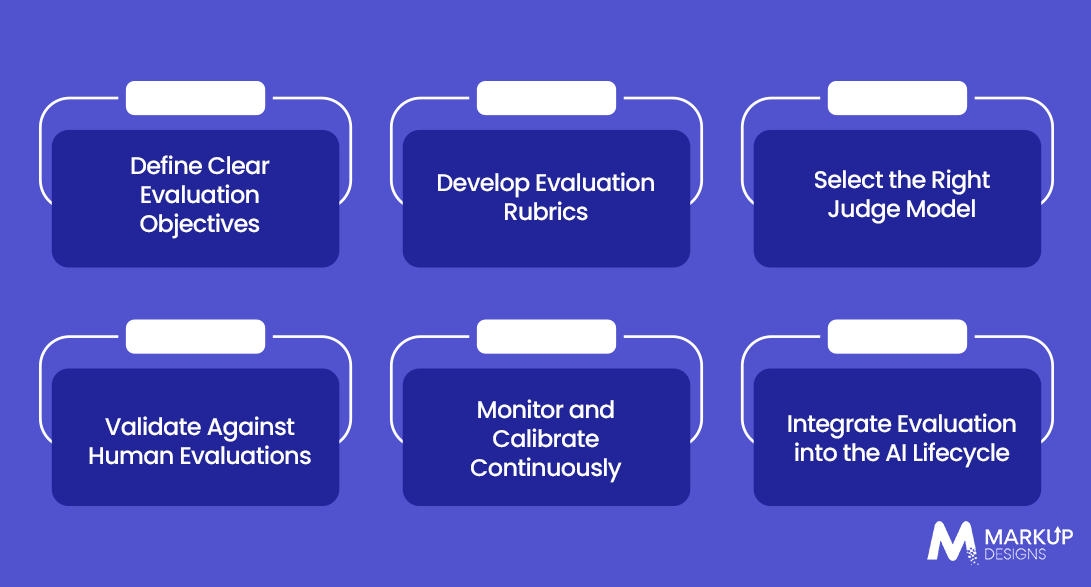
A reliable framework requires more than selecting a powerful judge model. Enterprises need a clear evaluation strategy and a way to validate whether the judge itself is performing effectively.
Define Clear Evaluation Objectives
Start by deciding what you actually need to measure. The criteria for a customer service chatbot may differ significantly from those for an internal coding assistant or regulated application.
Develop Evaluation Rubrics
Create specific and measurable criteria for each evaluation dimension. Clear rubrics make scores easier to interpret and compare.
Select the Right Judge Model
Consider the model’s evaluation capability, cost, latency, privacy requirements and ability to understand your business domain.
Validate Against Human Evaluations
Compare automated judgements with assessments from qualified human reviewers. This helps identify where the judge performs well and where human intervention remains necessary.
Monitor and Calibrate Continuously
Judge performance should be reviewed as models, prompts and business requirements change. Regular calibration helps maintain reliable evaluation over time.
Integrate Evaluation into the AI Lifecycle
Evaluation should be part of the complete AI lifecycle: development → testing → deployment → monitoring → optimisation. This makes quality assessment an ongoing process rather than a final checkpoint.
LLM-as-a-Judge vs Human Evaluation
Neither approach is sufficient for every enterprise scenario. LLM-as-a-Judge provides scale and speed, while human evaluation offers stronger contextual and subjective judgement.
| Factor | LLM-as-a-Judge | Human Evaluation |
| Scalability | High | Limited |
| Speed | Fast | Slower |
| Cost at Scale | Generally lower | Generally higher |
| Subjective Judgement | Limited | Strong |
| Contextual Understanding | Variable | Strong |
| Continuous Monitoring | Practical | Difficult at large scale |
The most effective enterprise approach is therefore usually LLM evaluation combined with human oversight. Automation handles scale, while people remain responsible for interpreting complex or high-consequence cases.
Best Practices for Implementing LLM-as-a-Judge
Enterprises can improve the reliability of their evaluation systems by following a few core practices:
- Use clear, objective and measurable evaluation criteria.
- Combine automated evaluation with human review.
- Validate judge performance against trusted datasets.
- Use multiple evaluation methods when a single metric is insufficient.
- Track false positives and false negatives.
- Protect sensitive enterprise and customer data.
- Recalibrate evaluation criteria as AI systems evolve.
- Never treat an LLM judge’s score as an unquestionable source of truth.
The Future of LLM-as-a-Judge in Enterprise AI
As enterprises move from experimenting with AI to operating it at scale, evaluation will increasingly become part of the standard AI development and governance lifecycle. Organisations will need continuous visibility into whether their models remain accurate, safe and aligned with business requirements.
Future evaluation frameworks are likely to incorporate multi-model judging, domain-specific evaluators, continuous production monitoring and automated risk escalation. This will make LLM-as-a-Judge less of a standalone testing technique and more of an evaluation layer embedded across enterprise AI systems.
How Markup Designs Can Help Enterprises Build AI Evaluation Solutions
AI Strategy and Consulting
Define practical AI evaluation strategies aligned with business objectives, risk requirements and governance needs.
LLM Evaluation Framework Development
Design evaluation frameworks with appropriate metrics, rubrics and testing methods to assess AI performance consistently.
AI Governance and Monitoring
Implement monitoring approaches that help enterprises track model quality, identify risks and maintain responsible AI practices.
Custom LLM Development
Develop custom LLM solutions with evaluation built into the development lifecycle from the beginning.
Integration with Enterprise AI Workflows
Connect evaluation capabilities with existing AI applications, RAG development, copilots, agents and enterprise workflows.
Testing, Optimisation and Continuous Support
Continuously test, evaluate and optimise AI systems as models, data, use cases and business requirements evolve.
Is Your Enterprise AI Ready for Continuous Evaluation?
Build a stronger AI evaluation strategy with the right frameworks, governance and monitoring capabilities.

Conclusion
LLM-as-a-Judge is not simply a faster way to score AI responses. Its real enterprise value lies in creating a continuous evaluation layer that helps organisations monitor quality, identify risks and strengthen AI governance at scale.
However, automated evaluation should not replace human judgement. The strongest approach combines LLM-based evaluation with human oversight, trusted benchmarks and continuous calibration. When implemented this way, LLM-as-a-Judge can become an important part of a reliable and responsible enterprise AI strategy.
FAQs
1. What is LLM-as-a-Judge?
LLM-as-a-Judge is an evaluation approach where one AI model assesses the output of another AI system against defined criteria such as accuracy, relevance, factuality, safety and instruction following.
2. How does LLM-as-a-Judge evaluate AI responses?
The judge model receives the AI-generated response along with an evaluation rubric or criteria. It then assesses the response and produces a score, ranking or written feedback based on the defined requirements.
3. Is LLM-as-a-Judge reliable?
It can provide scalable and consistent evaluation, but it is not infallible. Judge bias, prompt sensitivity, model limitations and false confidence can affect results. Human validation and continuous calibration remain important.
4. What metrics can LLM-as-a-Judge measure?
Common metrics include accuracy, relevance, factuality, safety, consistency, helpfulness, and instruction following. Enterprises can also define domain-specific criteria based on their use cases.
5. Can LLM-as-a-Judge replace human evaluation?
No. It can significantly reduce the amount of manual evaluation required, but human oversight remains important for complex, subjective or high-risk AI decisions.
Author's Perspective
LLM-as-a-Judge is most valuable when enterprises stop viewing evaluation as a final quality check and start treating it as an ongoing part of AI governance. Automated judgement can provide the scale and speed that manual reviews cannot, but it should never create a false sense of certainty. The real advantage comes from combining automated evaluation, human oversight and continuous monitoring to build AI systems that remain reliable as they evolve.
Discuss Your Project NowGaurav Goyal
Global Sales- VP
Related Posts

How AI is Revolutionising Industrial Automation in Australia

How UK Enterprises Can Build an Effective AI...

AI Voice Agent for Real Estate: Features, Benefits,...
Insights Are Valuable & Execution is Priceless
You’ve read about the digital future. Now, let’s build the infrastructure to take you there. Move your strategy from the page to the product.
Design Your Solution Now
Contact Us
Schedule The Appointment At Your Convenience Date And Time.
30 Min
Web Conference
Time Zone
Indian standard time (08:30pm)

Thanks For Getting In Touch!
You’ve Taken The First Step Toward Transforming Your Digital Presence. Our Experts Will Reach Out Shortly To Take It Forward.
Launch Your Dream Project
Provide a brief overview of your project, and our specialists will evaluate your requirements. We will connect with you to explore how the right digital solutions can help you launch faster.