

In Brief
- The technology is revolutionizing the way Australian real estate businesses deal with property valuation, purchase, sale, and investments.
- Investigate 10 essential AI applications, such as predictive analytics, property matching, virtual tours, and property management, among others.
- Identify the advantages of using AI in terms of operational efficiency and quality of service provided.
- Evaluate challenges associated with AI implementation, including privacy, bias, costs, and other regulatory concerns.
- Find out how Australian real estate businesses can leverage AI to optimize their operations and services in the future.
AI is revolutionizing the Australian real estate industry through changes made to the way properties are valued, marketed, managed, and evaluated as potential investments. AI technologies allow for analysing data related to the market, automating tasks that do not require human participation, predicting the dynamics of the market, and providing a more personalized experience for buyers, sellers, and tenants.
There are multiple ways in which the real estate business could benefit from using AI tools. However, in order to achieve tangible results, one needs to select proper applications and maintain accurate data while addressing various privacy, security, and regulatory issues. Understanding the most effective AI use cases can help businesses identify where the technology can deliver measurable value.
How Is AI Transforming the Real Estate Industry in Australia?
Artificial intelligence is changing how Australia’s real estate industry values properties, manages listings, analyses market trends, and serves buyers and tenants. AI-powered tools help businesses process large volumes of data, automate routine tasks, and make more informed decisions. From real estate agencies and property developers to investors and property managers, businesses are using AI to improve efficiency, personalise customer experiences, and identify market opportunities.
What Are the 10 Powerful Use Cases of AI in Australian Real Estate?
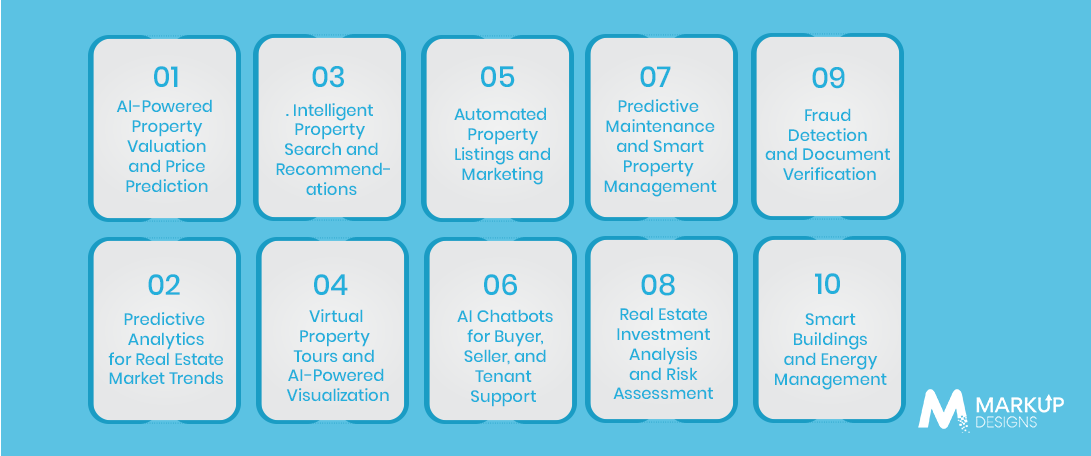
1. AI-Powered Property Valuation and Price Prediction
The AI model takes into account the historical sales, property characteristics, location, and current market situation to evaluate the value of properties. This allows Australian real estate companies to leverage this information when determining prices, comparing properties, and discovering opportunities. Still, the evaluation requires professional assessment and correct data.
2. Predictive Analytics for Real Estate Market Trends
Predictive analytics is helpful for evaluating the demand for housing, rent trends, price movements, and new investment opportunities in the real estate market. By analyzing the past and present market data, AI can find patterns that might not be noticed otherwise. It assists investors and developers with creating strategies, but does not eliminate the risks of forecasts.
3. Intelligent Property Search and Recommendations
The intelligent search tools take into account the budget, the preferred location, the needs of buyers/tenants, and their behavior on the website to offer the properties of interest to the users. It allows buyers and tenants to find the appropriate properties without manual sifting of hundreds of options. The agents can also use such tools for making relevant offers.
4. Virtual Property Tours and AI-Powered Visualisation
The ability to conduct virtual tours and visualise properties is made possible by AI technology. It enables potential customers to explore a property through virtual tours, digital staging, and interactive floor plans prior to a personal visit. In Australia, for example, agencies dealing with properties from various locations or targeting overseas customers can benefit from virtual tour services.
5. Automated Property Listings and Marketing
Generative AI can be used by real estate professionals to create property descriptions, listing summaries, emails, and other marketing messages based on property data. It can also tailor messages to particular customer segments, reducing writing activities and saving time spent on campaigns. Agents should always verify that property details, pricing, and advertisements are correct.
6. AI Chatbots for Buyer, Seller, and Tenant Support
Chatbots powered by AI technology can answer property-related queries, share property details, schedule property visits, and take care of any routine tasks of property management for tenants. They enable agencies to communicate at non-working hours while minimising repetitive tasks of customer service.
7. Predictive Maintenance and Smart Property Management
Artificial Intelligence algorithms examine maintenance logs, sensors’ readings, and the state of equipment to predict future failures before they cause any harm. Property managers can utilize such information to plan maintenance activities and monitor systems in the building more effectively. As a result, property management can be made more efficient by decreasing unplanned downtime and improving tenant experience and lifespan of assets.
8. Real Estate Investment Analysis and Risk Assessment
AI-based investment tools take into account various parameters of investment, including rental yield, vacancy rate, operating expenses, local demand, and price history. Thus, investors have more criteria for comparison when making a decision about the purchase or letting of a certain property. These tools can make the investment decision-making more systematic; however, they cannot substitute for financial assessment.
9. Fraud Prevention and Document Verification
AI algorithms can recognize fraudulent transaction patterns and anomalies in documents and data of properties’ identity, location, or other characteristics. These algorithms help in the prevention of fraud within transactions, applications for leasing, and other processes that involve document processing. With the ability to detect potentially problematic cases, AI allows companies to conduct more thorough examinations.
10. Smart Buildings and Energy Management
AI-powered building management systems analyse occupancy, temperature, lighting, and energy consumption to optimise daily operations. Property owners can use these insights to adjust heating and cooling, reduce unnecessary energy use, and improve indoor comfort. In Australia’s growing focus on energy efficiency, these applications can also help property managers control operating costs and support sustainability objectives.
What Are the Key Benefits of AI in the Australian Real Estate Industry?
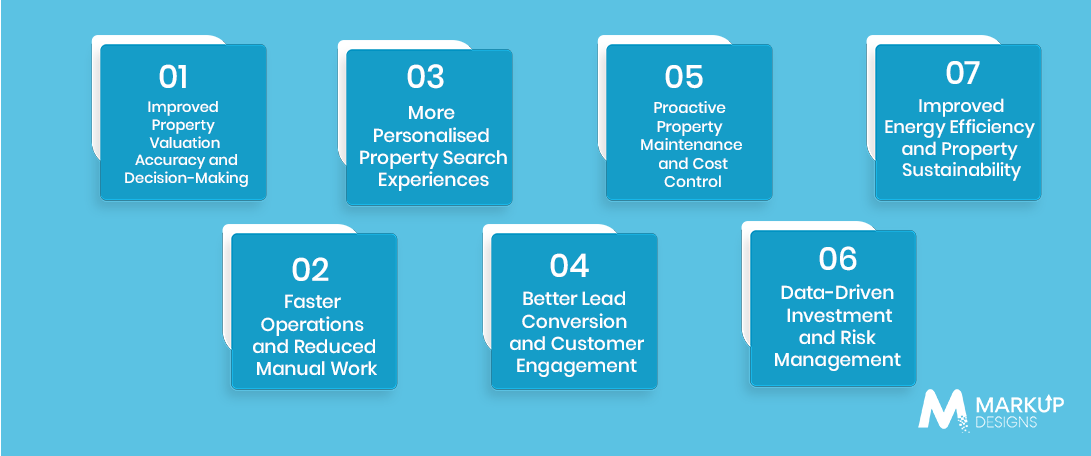
Improved Property Valuation Accuracy and Decision-Making
AI analyses data on property attributes, comparable sales, and market conditions to provide consistent valuation assessments. This enables agents, developers, and investors to make decisions on the basis of available data. However, actual accuracy will depend on the quality of data, local market conditions, and the limits of the models.
Faster Operations and Reduced Manual Work
The process of creating a listing, managing enquiries, handling documents, and generating reports becomes automated. Therefore, real estate professionals can use the time that was spent on such activities for building relationships and negotiating with clients. This increases the productivity of teams and allows agencies to handle an increased number of enquiries without additional administrative burden.
More Personalised Property Search Experiences
Recommendations of AI enable the matching of property listings and individual preferences, budgets, location needs, and searching patterns. As a result, buyers and tenants can find appropriate property offers faster, and real estate professionals get a deeper insight into the needs of customers. Thus, personalized experience of searching is provided, and the time needed for considering inappropriate offers can be minimized.
Better Lead Conversion and Customer Engagement
Artificial intelligence technology will be able to analyze lead behavior, give priority to potentially valuable leads, and enable agents to follow up promptly. AI-enabled chatbots and communication will ensure that potential clients get important information without experiencing any unnecessary delays. Overall, all these features will allow agencies to handle their sales funnel in a more efficient way.
Proactive Property Maintenance and Cost Control
With predictive maintenance, property managers will be able to predict any possible breakdowns in equipment and prevent them from happening. AI-based monitoring system will also help to detect any inefficient performance of a building and possible maintenance-related problems. All these capabilities will allow businesses to plan their maintenance budget properly.
Data-Driven Investment and Risk Management
AI combines market signals, performance, costs, and other details related to properties to help investors compare investment options. Despite the fact that AI cannot ensure profitability, it can give investors a much more rational basis for making decisions and managing investment portfolios.
Improved Energy Efficiency and Property Sustainability
AI-based energy systems analyze the performance of buildings and make changes to lighting, heating, cooling, and other systems according to occupancy. These adjustments can reduce unnecessary energy consumption and help control utility expenses. For Australian property owners and developers, AI can also support sustainability initiatives by providing clearer insights into energy use and building efficiency.
What Are the Challenges of Implementing AI in Australian Real Estate?
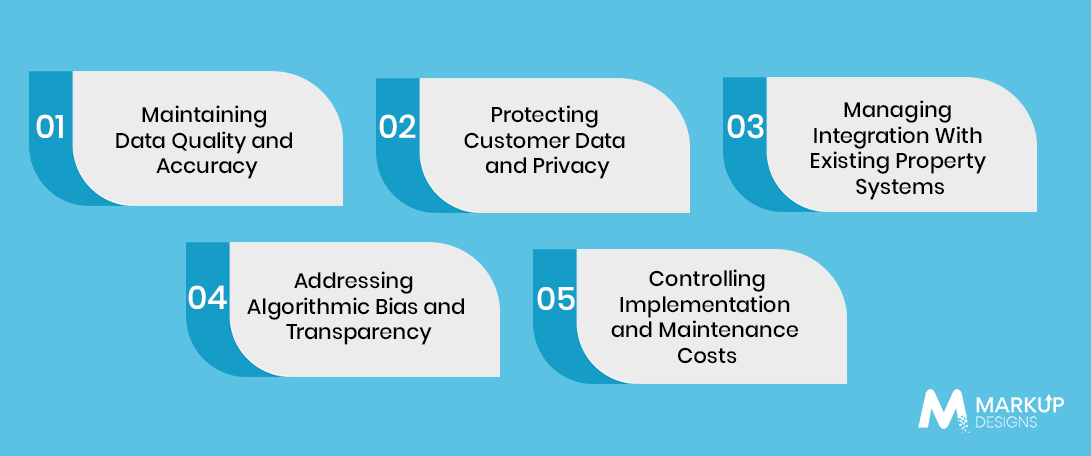
Maintaining Data Quality and Accuracy
Accurate information about property records, sales statistics, and the market in general is vital for getting valuable insights from AI solutions. However, incomplete or outdated data can result in incorrect assessments and inaccurate predictions. As such, companies will require constant data validation and maintenance in order to get meaningful outputs from their AI tools.
Protecting Customer Data and Privacy
Real estate companies possess confidential information related to tenants, sales transactions, financial data, and others. Using an AI-powered tool for processing the data will require proper access control and data security. Besides, companies have to ensure that they comply with Australian privacy legislation.
Managing Integration With Existing Property Systems
The process of integrating an AI solution with various other property systems can be quite complex due to the fact that some of those systems might be quite old and thus do not provide an API or a standardized data format. Thus, the gradual approach will be quite helpful in such a situation.
Addressing Algorithmic Bias and Transparency
An AI tool might provide biased recommendations and valuations based on an incorrect or incomplete training dataset. This can affect property assessments, tenant screening, and investment decisions. Businesses should regularly evaluate model outputs, document decision-making processes, and maintain human oversight for decisions that affect customers.
Controlling Implementation and Maintenance Costs
AI implementation involves more than software development. Data preparation, system integration, infrastructure, staff training, and ongoing maintenance can increase the overall investment. Businesses should prioritise high-value use cases, establish measurable objectives, and assess long-term costs before expanding their AI capabilities.
What Australian Regulations Should Real Estate Businesses Consider When Adopting AI?
Real estate businesses adopting AI must consider applicable privacy, consumer protection, anti-discrimination, and sector-specific requirements. The Privacy Act 1988, where applicable, governs the handling of personal information, while the Australian Consumer Law addresses misleading or deceptive conduct, including inaccurate AI-generated property claims. Businesses should also assess relevant state and territory property, tenancy, and anti-discrimination laws. Compliance requirements depend on the application, data involved, and business activities, so legal advice may be necessary for higher-risk implementations.
How Can Real Estate Businesses in Australia Implement AI Successfully?
Identify Business Goals and High-Value Use Cases
Start by identifying operational challenges that AI can realistically address, such as slow enquiry responses, repetitive listing creation, or inefficient maintenance scheduling. Prioritise use cases based on business value, implementation effort, and measurable outcomes. A focused starting point helps businesses validate results before investing in broader AI adoption.
Assess Existing Data and Technology Infrastructure
Review the quality of property records, customer databases, and existing software systems before selecting an AI solution. Identify data gaps, integration limitations, and security requirements that could affect implementation. This assessment helps establish whether the business has the necessary foundation to support reliable AI applications.
Choose Suitable AI Models and Tools
Select AI technologies based on the intended application, available data, accuracy requirements, and budget. Some businesses may benefit from existing AI platforms, while others may require customised models for property valuation, forecasting, or workflow automation. Evaluate performance, scalability, security, and vendor support before making a decision.
Integrate AI With Property Management and CRM Systems
Connect AI tools with existing CRM platforms, listing systems, and property management software to reduce fragmented workflows. Proper integration allows relevant information to move between systems and supports consistent operations. Testing integrations before deployment helps identify data errors, access issues, and workflow disruptions.
Establish Data Governance and Compliance Measures
Define how data will be collected, stored, accessed, and processed by AI systems. Establish security controls, review procedures, and clear responsibilities for monitoring AI-generated outputs. Businesses should also assess privacy obligations and relevant regulatory requirements before deploying applications that process sensitive information or influence customer decisions.
Monitor Performance and Scale Successful Solutions
Track performance using metrics such as response times, administrative workload, maintenance costs, lead conversion, and prediction accuracy. Compare results against the objectives established before implementation and investigate any unexpected outcomes. Once a use case demonstrates measurable value, expand it gradually while continuing to monitor performance and compliance.
What Does the Future of AI in Australian Real Estate Look Like?
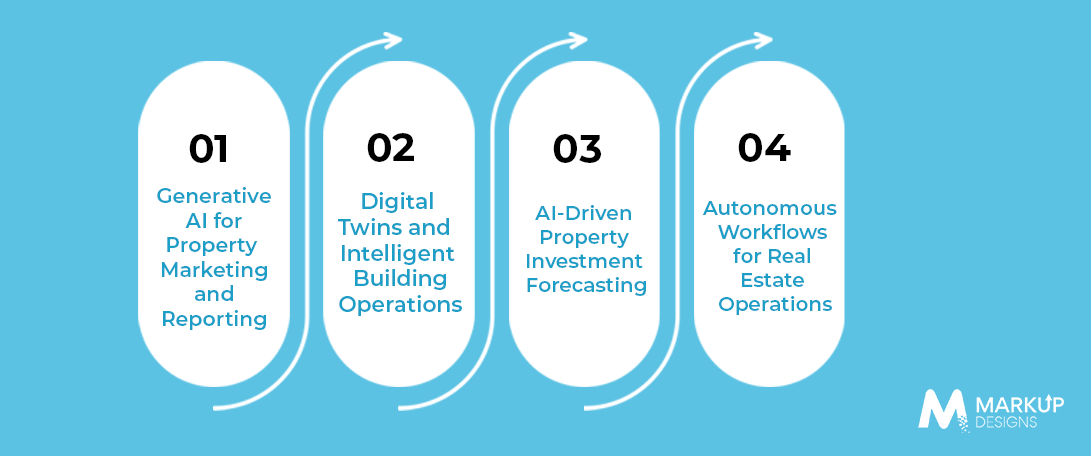
Generative AI for Property Marketing and Reporting
Generative AI can enable more personalized marketing texts, descriptions, reports, and communication efforts related to properties. These technologies may allow agencies to make content generation processes faster and adjust their messaging to target specific audiences. Manual human oversight will still be required to ensure accuracy, compliance with advertising regulations, and brand consistency.
Digital Twins and Intelligent Building Operations
Digital twins are virtual recreations of physical buildings based on real estate data and sensors. Combining them with artificial intelligence can help with monitoring energy consumption, building performance analysis, and facility maintenance needs. This can assist with efficient operations in commercial buildings and housing complexes and with larger property portfolios.
AI-Driven Property Investment Forecasting
Improvements in predictive analytics may help with estimating rental demand, development trends, property valuation, and other factors in real estate markets. This can allow comparing various investments and conducting scenario analysis. The results will still be dependent on market conditions that are hard to predict.
Autonomous Workflows for Real Estate Operations
AI agents can be responsible for coordinating many tasks like responding to requests from clients, updating CRM system records, generating reports, and scheduling inspections. These capabilities could reduce manual coordination across real estate teams. Human approval will remain important for financial commitments, contractual decisions, negotiations, and other activities with significant legal or commercial consequences.
How Can Markup Designs Help Real Estate Businesses Build AI-Powered Solutions?
Markup Designs helps businesses explore and develop technology solutions aligned with their operational requirements. From AI-powered property platforms and intelligent search features to predictive analytics and workflow automation, the right AI development approach can help real estate businesses address specific challenges and improve service delivery. A clear understanding of business goals, data requirements, and integration needs is essential to building solutions that can scale with changing market demands.
Build Smarter Real Estate Solutions With AI
Identify opportunities to apply AI across property management, customer engagement, and investment analysis with a solution tailored to your business needs.

Conclusion
AI is creating new opportunities for Australia’s real estate industry, from smarter property valuations and personalised searches to predictive maintenance and energy management. Businesses that select relevant use cases, invest in reliable data, and address privacy and integration challenges can use these technologies to improve operational efficiency and customer experiences. A phased implementation strategy, supported by ongoing performance monitoring and human oversight, can help real estate businesses achieve sustainable value from AI adoption.
FAQ
1. In what ways does AI influence the Australian real estate market?
AI assists real estate companies in Australia in automating business processes, analyzing property markets, valuing properties, personalizing property searching, and building management.
2. Which applications of AI are the most popular in Australian real estate?
These applications include property valuation, predicting market changes, property recommendations, virtual tours, automatic marketing, chatbots, prediction of future maintenance costs, investment analyses, fraud detection, and smart building management.
3. How is AI used for improving property valuation accuracy?
AI evaluates historical sales data, analyzes different features of each property, compares the properties and their prices with comparable listings, examines geographical location, and analyzes general market conditions to come up with the property valuation. It is effective only in terms of data availability and model development, as well as market conditions.
4. What would be the cost of developing an AI-driven solution for real estate in Australia?
Costs vary depending on the level of complexity of the solution, the amount of data used, integrations, and other factors. An AI-driven feature may require much less funding than a custom-made platform with predictive analytics or integrations. It is critical to assess the scope of the project to have an idea about the budget.
5. Is AI technology applicable for small real estate firms in Australia?
Absolutely. A small agency could use simple AI solutions for creating listings, managing inquiries, communicating with customers, and automating routine tasks. Starting from a particular need makes it possible to keep costs under control and to understand whether the investment pays off.
Author's Perspective
The value of AI in the field of real estate in Australia comes from using it to solve business problems. It is necessary for a property business to focus on using the technology in decision-making, automation of routine processes, improving customer service, and other important applications.
Discuss Your Project NowAjit Kumar Jha
VP - Business Operations
Related Posts

AI in the Australian Retail Industry: Trends, Examples...

How Much Does Custom AI Accounting Software Cost...

How to Build an App With Claude Code:...
Insights Are Valuable & Execution is Priceless
You’ve read about the digital future. Now, let’s build the infrastructure to take you there. Move your strategy from the page to the product.
Design Your Solution Now
Contact Us
Schedule The Appointment At Your Convenience Date And Time.
30 Min
Web Conference
Time Zone
Indian standard time (08:30pm)

Thanks For Getting In Touch!
You’ve Taken The First Step Toward Transforming Your Digital Presence. Our Experts Will Reach Out Shortly To Take It Forward.
Launch Your Dream Project
Provide a brief overview of your project, and our specialists will evaluate your requirements. We will connect with you to explore how the right digital solutions can help you launch faster.