

In Brief
- The integration of an insurance portal is done by linking the CRM system, claims management, billing systems, and policy administration systems together to help the insurance firms reduce manual work, improve data accuracy, and provide a good customer experience.
- Features include the customer self-service dashboards, policy management, claim submission, premium payment, document management, and real-time alerts.
- Creating an insurance portal includes identifying requirements, mapping the current systems, selecting integration architecture, integrating APIs, creating dashboards, automating processes, and securing and testing before launch.
- Some challenges faced during the creation of an insurance portal include legacy system integration, data synchronization problems, payments not going through, security issues, and third-party dependability. APIs, middleware, data validation, access control, and constant monitoring help mitigate such challenges.
- The cost of an integrated insurance portal can range between $40,000 and $400,000. Markup Designs helps insurance firms build secure and scalable insurance portals.
In recent years, the insurance industry has been shifting towards the provision of digitalized services that facilitate the management of policies and payments and the tracking of claims. However, many insurance companies utilize disparate systems that store customer information, process claims, and generate payments. Disconnected systems result in the generation of data inaccuracies, delays in claim settlement, payment errors, and poor customer experience.
An insurance portal with the integration of CRM, claims, and billing systems eliminates all the above-mentioned problems. It facilitates the access of insurance employees to updated data, the automation of certain processes, and the handling of customer requests in an efficient way. Additionally, it enables customers to view their policy details, file claims, make payments, and get updates on their account status without having to contact support for every minor issue.
Development of such a portal involves the utilization of proper technologies, integration strategies, and security measures. In the course of this blog post, we will discuss how to create an insurance portal with CRM, claims, and billing systems, its functionality, challenges, cost, and other essential issues.
What is an Insurance Portal?
The insurance portal is a website or a mobile app through which the customers, insurance agents, brokers, and internal teams are provided with an easy way to access the insurance services via one platform. The portal makes the process of managing the policies, filing the claims, making payments, uploading documents, and following up on requests possible without using any manual processes.
From the point of view of an insurance company, the portal can be connected to other platforms like CRM, claims management, billing, and policy administration. The connection allows access to the necessary data without switching between various apps.
For example, once the claim is submitted by the client via the portal, the information regarding this claim will be sent to the claims management system, while at the same time updating the customer’s information in the CRM and showing the policy information. If the payment is due, the amount and the ways to make it will also be displayed.
The prime purpose of an insurance portal is to facilitate better access to and management of insurance services. If integrated properly, it can save on redundant efforts, increase the accuracy of data, and provide customers with a better experience with insurance providers.
Why Do Insurance Companies Need an Integrated Portal?
Since insurance companies deal with a lot of customer and claim-related information daily, separate systems in use can make employees to look for the information, verify the record, and resolve any problems that may arise while doing so. In such cases, an integrated portal would come in handy for insurance companies.
Some important benefits of an integrated insurance portal are:
- Customer convenience: The customers can manage their policies, process their claims, and pay premiums all through the same portal.
- More efficient claims process: It will be much easier to verify the information and process the claim if there is an integration between the claims system and the policy records.
- Simplified billing: The integrated system will assist in tracking the premiums paid, balances, and payment status.
- Accuracy of information: With interconnected systems, it is easier to avoid duplicate information entries and maintain uniformity of customer/policy information.
- Reduced need for manual work: Processes will be automated for processing standard tasks, sending reminders, and directing requests to appropriate departments.
- Better team coordination: Staff in customer service, claims, and finance departments can get all the necessary information without switching from one software to another.
An integrated portal also provides a better base for future advancements, including AI-based customer support, claims analytics, and personalized services.
Key Systems to Integrate into an Insurance Portal
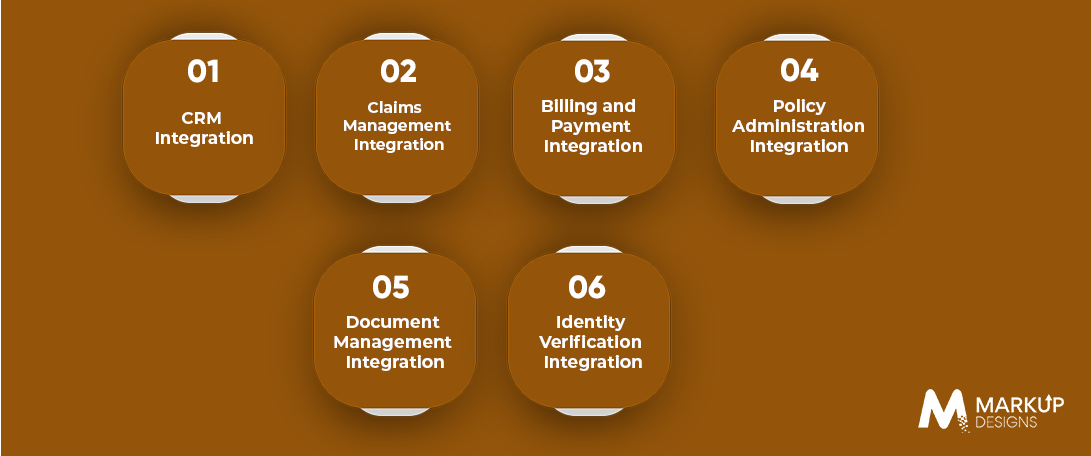
The insurance portal operates effectively when integrated with systems that manage customer data, policies, claims, and payments. This ensures access to relevant information, minimizes manual activities, and facilitates the processing of customer inquiries.
CRM Integration
The CRM system manages customer data, records of communication between the parties, inquiries, and service requests. The integration of the portal with CRM facilitates effective handling of customer inquiries by insurance professionals.
Claims Management Integration
Claims management is responsible for claim submission, documentation review, assessment, and settlement of claims. It provides an interface for customers to lodge claims and monitor their progress.
Billing and Payment Integration
Integration of billing refers to the link between the portal, premium calculations, bills, payment gateways, and payments. Clients will be able to pay their premiums through the portal, check balances, and get payment notifications.
Policy Administration Integration
A policy administration module involves handling policy creation, renewal, details, and modifications. The integration ensures that policy data is synchronized between the portal and internal systems.
Document Management Integration
The document management integration enables customers and employees to upload, retrieve, and manage documents such as policy documents, claims, bills, and related records.
Identity Verification Integration
Integration of identity verification services helps to verify client data in registration, application for a policy, and during claims handling. It may involve document verification services, identity verification services, and fraud detection services based on the needs.
How to Build an Insurance Portal with CRM, Claims & Billing Systems
To design the integrated insurance portal, it is not enough to just develop a user-friendly interface. It is necessary to integrate existing systems, organise processes and data flows and ensure proper functionality. Here are the important steps to be made.
Step 1: Define Business Requirements and Portal Goals
First of all, you should understand what functions the portal should have. Determine whether you will design the portal for customers, insurance agents, brokers, or your internal staff. Write down the major requirements, e.g., policy management, claims submission, payment processing, etc. Defining goals will help you to decide on required features and avoid any unneeded development efforts.
Step 2: Mapping existing systems and data flows
Analyze the systems you are currently using in your company for your CRM, claims, billing, and policy administration. Figure out what data each of these systems contains and how different teams work with it. Such analysis will help you to detect duplicates, obsolete software, missing data connections, and required integrations in advance.
Step 3: Select the Proper Integration Architecture
Choose an architecture that enables secure integration between the portal and existing systems. REST APIs are often used for application integration purposes, and webhooks send event-based notifications when certain activities take place. In case of more complex integrations, an integration platform/middleware may be used to facilitate communication between various systems.
Step 4: Implement APIs and Integrate Core Systems
Implement necessary APIs to exchange customer, policy, claims, and billing data. Determine the way in which data exchange between systems will take place. For example, if a customer has paid for a premium on their policy, the billing system must verify the payment and reflect the new payment status in the portal. Handling errors and retry scenarios is also critical not to disrupt the process in case of failure.
Step 5: Develop Portal Interface and User Dashboards
Design a streamlined interface that guides users in their search for information and completion of tasks without getting confused. The customers might need access to policies, claim status, the interface, and renewal notifications. Other dashboards for agents and internal employees could include customer profiles, claim reviews, and billing functions. Interface should be functional on desktop computers, tablets, and mobile phones.
Step 6: Automate Claims, Billing, and Customer Workflows
Spot repeatable processes that can be automated via linked systems. This means that the portal will automatically remind users about their payments, claim status changes, and sending of documents to the appropriate department. The automation process should also include exception handling for situations like failed payments, missing claim documents, or manual checks of policy information.
Step 7: Security and Compliance
As portals process private information, it is essential to ensure that security features are provided for data protection, including role-based access controls, encryption, authentication, and auditing. Moreover, you need to determine privacy laws and insurance regulations for your markets since security and compliance features must be part of the architecture from scratch and not be incorporated later.
Step 8: Test Integrations and Deploy the Portal
Test all integrations to see whether data is processed accurately through the portal, CRM, claims management system, and billing portal. Make sure that you will be able to deal with failures in payment, duplicates, wrong policy information, permissions, and other possible problems in case of system downtime. After successful testing, you may start deploying the portal in stages if possible. Observe how it works and fix possible problems after launching.
Read Also: Modernizing Maritime Insurance Claims with Digital Solutions
Ready to Build a Smarter Insurance Portal?
Connect your CRM, claims, and billing systems through an integrated insurance portal that simplifies daily operations and improves customer experience. Let’s discuss your project requirements.

Essential Features of an Integrated Insurance Portal
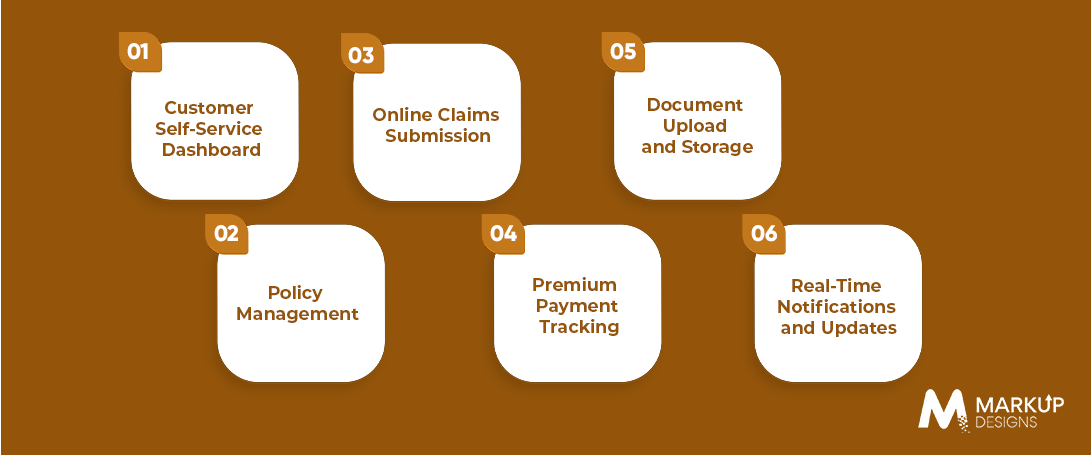
The ideal insurance portal should make it easy for customers to control their policies and, at the same time, enable insurance staff to operate effectively on a daily basis. Appropriate features will also help ensure integration of the CRM, claims, and billing systems.
Customer Self-Service Dashboard
The main dashboard will make it possible for customers to look at their policies, get information on premium deadlines, retrieve documents, and edit personal details without having to contact customer service for everything.
Policy Management
Customers should be able to look at their coverage details, see their policy expiration date, apply for changes, and renew their policies. This can be achieved through integration with the policy management system.
Online Claims Submission
The ideal portal will have a feature where customers can make their claims and even track the claim process. Through integration with the claims system, the process will be made easy for employees.
Premium Payment Tracking
Integration of the billing system makes it possible for customers to see their outstanding premium amount, payment history, generate receipts, and make the payment using the payment gateway. The system may also allow automated reminders to avoid any delayed payments by customers.
Document Upload and Storage
Customers and authorized staff members should be able to upload, access, and manage important documents such as policy certificates, claims forms, invoices, and identity documents. Secure permissions make it possible to avoid unauthorized access to the system.
Real-Time Notifications and Updates
Automatic notifications may make customers aware of any confirmed payment, renewal of the insurance, any missing claim documents, and changes in the status of the claim.
Common Challenges in Insurance Portal Integration and How to Solve Them
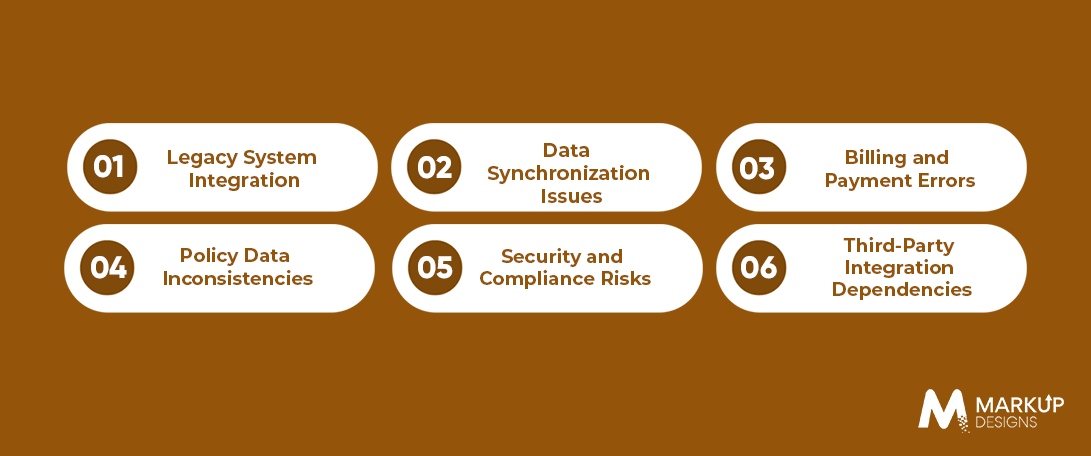
Integrating the systems mentioned can make insurance operations run more effectively; at the same time, there are some difficulties related to the integration process itself that need to be known beforehand to help insurance firms prevent potential issues.
1. Legacy System Integration
Most of the insurance companies have legacy systems that may not have modern APIs or capabilities for convenient exchange of data. Changing these systems can be costly and take too much time.
Solution: Implement API adapters/middleware to integrate legacy applications into the new portal. Check the capabilities of the system before development; modernize key elements if required.
2. Data Synchronization Issues
Information related to the customer, policies, and status of payments could vary across different systems because of delayed updates and lack of data format standards. It could cause confusion among customers and employees.
Solution: Set data ownership standards, create common data formats and define update flow between systems. Perform automated validation and detection of inconsistencies.
3. Billing and Payment Errors
Failures in payments, double payments, and delayed updates of the payment status may negatively influence customer satisfaction and add workload to the finance team of the company.
Solution: Use robust payment gateways, set unique transaction codes, and secure failure and reprocessing procedures. The portal should differentiate successful, pending, and failed payments.
4. Policy Data Inconsistencies
Policy information becomes outdated due to changes that happen in one system but do not happen in the other system. Customers might get inaccurate policy details, renewal dates or status.
Solution: Identify the main system that holds policy information and implement synchronization of any updates in the system and other connected applications. Implement the transfer to display any policy information.
5. Security and Compliance Risks
Integration of the portal leads to the transfer of sensitive personal, financial, and insurance information between many systems. Poor security practices can expose that information to unauthorized users.
Solution: Implement encryption, access control policies, secure authentication, and security practices for APIs. Stay informed about the privacy laws and insurance regulations.
6. Third-Party Integration Dependencies
Portals are frequently dependent on third-party services such as payment gateway services, identity validation services, document processing services, and communication channels. The unavailability of any of the above services could cause certain operations of the portal to be suspended.
Solution: Monitor the services provided by the third parties, set the requirements for integration, and put in place a timeout mechanism and retry logic to ensure the robustness of the portal.
How Much Does It Cost to Build an Integrated Insurance Portal?
Building costs for the insurance portal will be determined by the functions that need to be implemented, the number of systems to be integrated, and the current complexity of the technology infrastructure. A simple insurance portal that includes customer accounts and policies will be less expensive than a complex portal with automated claims processing, billing procedures, and integration with other third parties.
In order to plan an approximate budget, the cost of building the insurance portal can range anywhere from $40,000 to $400,000 or more.
Key Factors That Affect Development Costs
- Portal features: Customer dashboard, policy management, claims tracking, and payments processing impact the development time and cost.
- System integrations: The integration of CRM, claims, billing, and policy management systems is complex, particularly if there are several vendors.
- Modernization of legacy systems: Legacy systems can need more development due to integration through the API, data migration, and secure connections.
- Security and compliance: The process of authentication, encryption, audit logs, and any regulations that need to be followed increases the project scope.
- UI/UX development: Different dashboards for customers, AI agents, and internal users add to the project scope.
- Maintenance: Performance monitoring, bug fixing, and other maintenance tasks add to the budget.
Why Choose Markup Designs for Insurance Portal Development?
Markup Designs can help insurance organizations develop their portal technologies to make processes more efficient and enhance customer experience. Our specialists pay particular attention to developing the insurance portals that combine CRM, claims management, billing, and policy management software into one system.
We know that each insurance organization has its own processes and technological peculiarities, so we create the portal technologies according to your needs. API integration, workflow automation, user-friendly dashboard, and data management – those are some of the basic components of the insurance portal technology development. Scalability is another important point of our work with insurance portals because we know that later you might have the need for new features or integrations.
Looking to Simplify Your Insurance Operations?
Connect your CRM, claims, and billing systems with an integrated insurance portal built around your needs. Markup Designs can help you plan a secure, scalable solution that simplifies daily workflows.

Conclusion
Building a portal with CRM, claims management, and billing system integration will enable insurance organizations to streamline their processes and enhance their customer experiences. This allows customers to perform tasks such as managing policies, filing claims, and paying premiums from one platform only while ensuring less manual labor and access to the right information for all teams.
To create a successful portal, you need a proper integration architecture, data exchange, workflow automation, and high security. Testing and monitoring will be very essential in ensuring that you keep performing well.
It is also necessary for you to analyze your needs and your features. With the right insurance app development approach, Markup Designs will help you build an insurance portal that is safe and scalable.
FAQs
1. What is the time required to create an integrated insurance portal?
It depends on the complexity of the portal’s functions, number of systems that need integration, and level of automation of existing application(s). Basic portal creation can be completed within several months, while complex portals can take much longer to build.
2. How can integration with CRM benefit insurance customer service?
Integration with CRM allows insurers to access all customer information and details, communications, inquiries, and service requests from a single place.
3. Can an insurance portal automate claims management and billing?
Yes. Such a portal can perform operations like notifying about claim filing, collecting relevant documents, sending payment reminders, updating transactions, etc. Complex evaluations and approvals of claims might still require human intervention.
4. What is your approach to integrating the insurance portal with other existing systems?
First, there must be an evaluation of the current systems, including data formats and integration possibilities. There can be APIs, middleware, and integration adapters that facilitate connectivity from old systems into the portal. Also, data validation, security checks, and testing should be carried out.
5. What are the methods you use to make sure the insurance portal remains secure?
These include encryption, authentication, access control based on roles, securing the API, and logging. In addition, security testing and monitoring is essential. The portal has to conform to insurance laws and privacy standards relevant to the markets where it is being used.
Author's Perspective
An integrated insurance portal is an important step towards making insurance services simpler and more accessible. When CRM, claims, and billing systems work together, insurance companies can reduce repetitive tasks, improve information sharing, and give customers better visibility into their policies and payments. However, integration should be planned around real operational needs rather than adding technology for its own sake. A clear development strategy, reliable data exchange, and strong security measures help create a portal that works well today and can adapt to future requirements. The goal is to build a connected insurance experience that benefits both customers and internal teams.
Discuss Your Project NowJupinder Singh Arora
Founder and CEO
Related Posts

Custom Software Development Services in Abu Dhabi for...

Custom Software Development Cost in Bahrain: Factors, Benefits,...

How Much Does Healthcare Software Development Cost in...
Insights Are Valuable & Execution is Priceless
You’ve read about the digital future. Now, let’s build the infrastructure to take you there. Move your strategy from the page to the product.
Design Your Solution Now
Contact Us
Schedule The Appointment At Your Convenience Date And Time.
30 Min
Web Conference
Time Zone
Indian standard time (08:30pm)

Thanks For Getting In Touch!
You’ve Taken The First Step Toward Transforming Your Digital Presence. Our Experts Will Reach Out Shortly To Take It Forward.
Launch Your Dream Project
Provide a brief overview of your project, and our specialists will evaluate your requirements. We will connect with you to explore how the right digital solutions can help you launch faster.