
In Brief
- Healthcare app development costs vary according to their complexity, functional set, platform, integrations, and legal regulations.
- UI/UX design, technological stack, knowledge and experience of a development team, interfaces with third parties, and security measures have a serious impact on the budget.
- Applications for telemedicine, patient portals, remote patient monitoring, and AI-based healthcare systems have different requirements for development and price.
- Healthcare companies should take into account the cost of ensuring data protection, compliance with applicable regulations, security testing, cloud hosting, as well as ongoing maintenance.
- If the company focuses on the minimum viable product (MVP) and the most necessary features while working with a reliable partner, it will be possible to optimize expenses without exceeding the initial investment.
Healthcare companies are inclined to invest in different applications that will support better patient engagement, simplify workflow in clinical settings, and provide patients with access to quality healthcare. Applications for telemedicine and patient portals for remote monitoring, which can meet the expectations of patients while providing quality services for the medical sector, are among the most popular solutions.
Telehealth services and patient management applications support the establishment of a more efficient healthcare system. However, the process of creating a healthcare application is not limited to just creating an interface and developing essential features. Companies need to consider system integration options, data protection methods, regulatory compliance solutions, and the machinery that enables the provision of reliable healthcare.
It is very important for businesses planning to invest in high-tech digital healthcare platforms to know the average cost of developing a healthcare application in 2026. The total cost of development will vary with the purpose of the application, its complexity, operational characteristics, targeted platforms, and maintenance requirements.
This guide will consider matters concerning the costs of deploying healthcare application solutions, factors that influence their pricing, requirements related to the development costs of particular applications, matters related to compliance issues and continuous maintenance services. Moreover, ways of improving development budget efficiency will also be discussed in this article to help businesses make the right choice of pioneering high-tech digital healthcare solutions.
How Much Does Healthcare App Development Cost in 2026?
Usually, healthcare applications do not have the same cost, and therefore it is necessary to determine the healthcare app development expenses in 2026 based on the features of the application itself.
A basic app with appointment scheduling and patient profiles generally requires less investment than a telemedicine platform with video consultations, EHR integration, and advanced security controls. The development team’s location and the applicable regulatory requirements also influence the final budget.
Businesses should evaluate development costs alongside implementation timelines, ongoing maintenance, and infrastructure expenses. The following estimates provide a starting point for budgeting; actual costs depend on project scope and should be validated with a detailed technical assessment.
Healthcare App Development Cost by Complexity
The complexity of a healthcare app determines the level of design, development, testing, and integration required. A simpler application may rely on standard features, while a complex solution may require custom workflows, multiple user roles, external system integrations, and advanced data protection.
| App complexity | Estimated development cost (USD) | Typical timeline |
| Basic | 20,000–50,000 | 2–4 months |
| Medium | 50,000–120,000 | 4–7 months |
| Complex | 120,000–300,000+ | 7–12+ months |
These are indicative planning ranges, not fixed market prices. A basic patient-facing app may include profiles, appointment booking, and notifications. A medium-complexity app may add secure messaging, payment processing, and integration with selected healthcare systems. Complex applications may involve real-time remote patient monitoring, multiple clinical workflows, advanced analytics, and extensive interoperability requirements.
Healthcare App Development Cost by App Type
The type of healthcare application also affects the budget because each category has distinct functional and technical requirements.
| Healthcare app type | Estimated development cost (USD) |
| Appointment booking app | 20,000–50,000 |
| Telemedicine app | 40,000–120,000 |
| Patient portal | 30,000–100,000 |
| EHR/EMR application | 80,000–250,000+ |
| Remote patient monitoring app | 60,000–180,000 |
| Hospital management system | 100,000–300,000+ |
| AI-powered healthcare app | 80,000–250,000+ |
| Fitness and wellness app | 25,000–80,000 |
These ranges represent broad estimates for custom development and can overlap depending on scope. For example, an EHR application with limited functionality differs substantially from a platform designed to support multiple facilities, complex clinical workflows, and standards-based data exchange. Similarly, an AI-powered app’s cost depends on whether it uses an existing AI service or requires custom ai model development and clinical validation.
Estimated Development Timeline by App Type
Development timelines depend on the number of features, platform requirements, integration complexity, and testing needs. Healthcare applications may also require additional time for security reviews and compliance-related validation.
| App type | Estimated timeline |
| Appointment booking app | 2–4 months |
| Telemedicine app | 4–7 months |
| Patient portal | 3–6 months |
| EHR/EMR application | 6–12+ months |
| Remote patient monitoring app | 5–9 months |
| Hospital management system | 8–15+ months |
| AI-powered healthcare app | 6–12+ months |
| Fitness and wellness app | 3–6 months |
These timelines are indicative and may overlap with other project activities. Building for multiple platforms, integrating third-party healthcare systems, or developing regulated clinical functionality can extend the schedule. Businesses should confirm the delivery timeline after defining the scope and technical requirements.
What Factors Affect Healthcare App Development Cost?
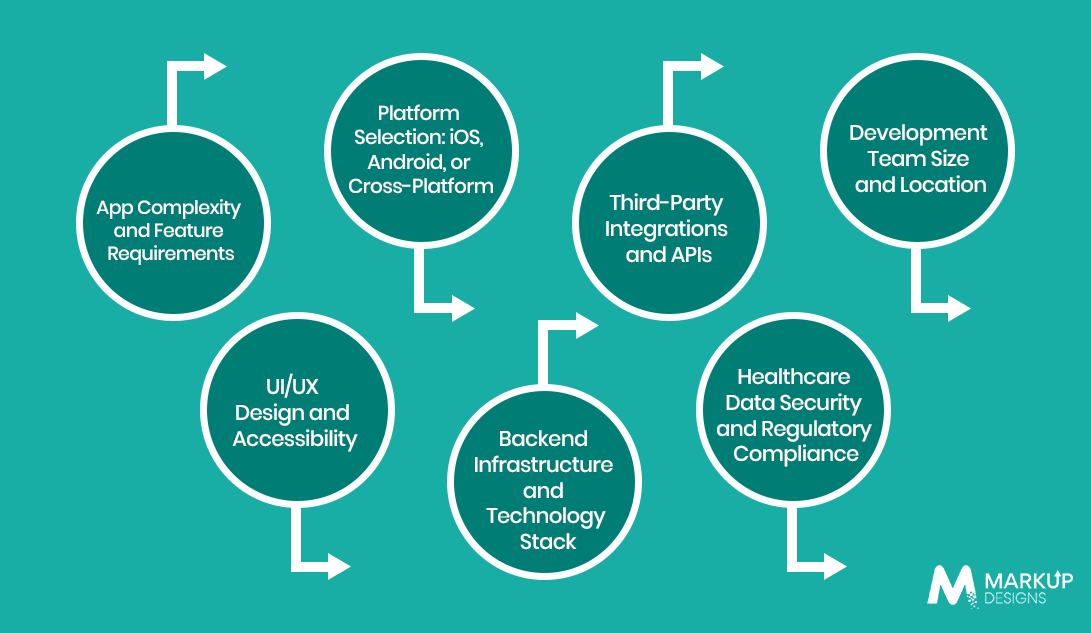
The expense of creating a healthcare application hinges on several major elements that relate to one another, starting from the complexity of its functionalities and going to the degree of professionalism required to develop the application as well as to support it afterward. Knowing these factors enables organizations to plan their budgets better and identify ways to minimize costs.
App Complexity and Feature Requirements
Every new feature implies additional requirements in design, development, testing, and support. For example, while the default functionalities are usually low-priced, if compared with sophisticated choices like real-time analytics or AI-related tools. Before beginning to develop the application, it is important to come up with a list of core functionalities in order to stay within the planned budget.
UI/UX Design and Accessibility
Information presented in healthcare applications should be clear and accessible to people with different levels of ability to use tech. The cost of design services will depend on the number of screens, roles playing the role of users, and the custom interface and usability testing needed. Accessible navigation, readable content, clear error messages, and appropriate support for users with disabilities should be considered from the beginning rather than added later.
Platform Selection: iOS, Android, or Cross-Platform
Creating two distinct native apps for both iOS and Android can cause expenses to go up due to an increase in development and testing requirements. Cross-platform technology may help reduce redundancy in codebase development; however, certain actions may necessitate platform-specific development. This decision is driven mainly by the target audience, needs of the devices used, performance, and the budget available.
Backend Infrastructure and Technology Stack
The main backend functions include authentication, storing data, managing appointments, notification processes, and ensuring proper communication between app components. The price of backend infrastructure will depend on the structure, anticipated traffic, anticipated data volumes, downtime, and technology decisions. Healthcare applications that deal with sensitive information will typically require more stringent access protocols and all the processes mentioned earlier.
Third-Party Integrations and APIs
Integrations connect healthcare apps and services needed to provide effective service. Each integration requires a thorough compatibility check, development, testing, and support. Some suppliers also demand licensing and operating fees, thus businesses need to remember about the recurring expenses connected with integrations.
Healthcare Data Security and Regulatory Compliance
Healthcare applications often handle sensitive personal and clinical information, making security a core development requirement. Encryption, identity verification, role-based access, audit trails, secure data storage, and vulnerability testing add to the initial investment. The applicable compliance requirements depend on the markets served, the organization involved, and the type of information processed.
Development Team Size and Location
The team’s composition and location affect hourly rates and total project costs. A typical healthcare app project may involve business analysts, UI/UX designers, mobile and backend developers, QA engineers, and security specialists. Hiring more experienced specialists may increase upfront costs but can help address complex integration, reliability, and security requirements. Businesses should compare expertise and delivery capabilities rather than choosing a vendor on hourly rates alone.
How Much Does It Cost to Develop Different Types of Healthcare Apps?
Healthcare apps have various functionalities, so their costs depend on the technical features and the workflows involved in their development. Here are estimates of the cost of common app types, but the final price will be based on their functions and how much they will be integrated into existing systems or not.
Telemedicine App Development Cost
Estimated cost: 40,000–120,000
Telemedicine apps allow patients to contact providers remotely via phone, online messaging, or scheduling appointments. Costs are higher for telemedicine applications that include secure video capabilities, e-prescriptions, payment processing, provider availability rules, and integration with the healthcare provider’s records. The telemedicine platform supporting several clinics will require more investment.
Electronic Health Records (EHR) and Electronic Medical Records (EMR) App Cost
Estimated cost: 80,000–250,000+
EHR and EMR applications manage medical records of patients, including health history, clinical notes, and other information. Development cost depends on reporting requirements, the complexity of records management, user rights, and system interoperability. The application requires more work to enable interaction with other players in the healthcare market based on HL7 and FHIR standards.
Remote Patient Monitoring App Development Cost
Estimated cost: 60,000–180,000
Remote patient monitoring apps collect health measurements from connected devices such as blood pressure monitors, glucose meters, and wearable sensors. Costs depend on device compatibility, data transmission, alert configuration, clinician dashboards, and integration with healthcare systems. Apps intended for clinical decision-making may also require more extensive validation and risk management.
Patient Portal Development Cost
Estimated cost: 30,000–100,000
Patient portal/ application is recognized as a channel that allows access to information about appointments, tests, prescriptions, payment, and communication with healthcare providers. Basic design and software requirements are rather simple, while advanced ones can provide secure messaging, the possibility to pay online, share documents with people, integrations with EHR, and so on. User authentication process, as well as the right and secure access to patients’ medical data, is a must-have.
Remote Patient Monitoring App Development Cost
Estimated cost: 60,000–180,000
A remote patient monitoring application is described as a tool that collects various data about patients’ health with the help of devices like blood pressure meters, glucose meters, and wearables. Pricing mostly depends on device compatibility and data transmission, alert settings, dashboards, and healthcare systems integration. Another point to take into consideration is that an application for clinical purposes must go through many approval and validation stages.
Hospital Management System Development Cost
Estimated cost: 100,000–300,000+
Hospital management systems last on the list but are still crucial as they allow coordinating processes such as patient registration, making appointments, billing, staff scheduling, management of stock, and everything related to clinical management. A comprehensive system may involve multiple departments, permission levels, reporting workflows, and connections with laboratory, pharmacy, and EHR platforms. The number of modules and the need to integrate with existing hospital infrastructure are major cost drivers.
AI-Powered Healthcare App Development Cost
Estimated cost: 80,000–250,000+
AI-driven healthcare applications may feature symptom tracking, medical documentation, patient enrolment, healthcare image processing, or operational forecasting. The total price varies depending on the choice of use case, type of AI model used, data preparation needs, costs of outside AI services, integration complexity, and testing. Medical apps that impact decisions of healthcare professionals require more testing than apps meant solely for administrative operations.
Fitness and Wellness App Development Cost
Estimated cost: 25,000–80,000
Fitness and wellness applications usually perform the functions of activity tracking, workout shaping, nutrition monitoring, goal setting, and progress tracking. The cost becomes higher if the app includes wearable devices, personalized fitness advice, subscription management, and social features. Such applications addressing the issues of healthcare may involve additional risks of being regulated.
Read Also: Healthcare App Development Cost in 2026
What Are the Key Features of a Healthcare App and Their Development Costs?
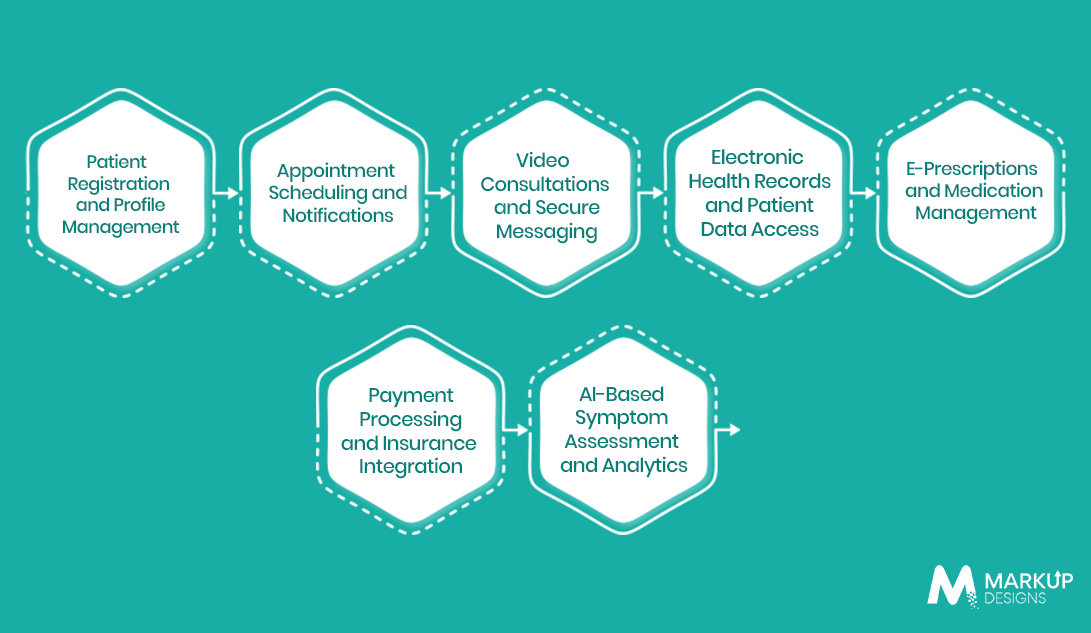
The selection of features has a major effect on the budget concerning the development of an app. Companies must always consider user needs and use purposes of their apps instead of adding as many functionalities as possible.
The following estimates represent approximate incremental development costs for individual features. They are not fixed rates, and costs may overlap when features share the same backend, authentication, or integration infrastructure.
| Feature | Estimated cost (USD) |
| Patient registration and profile management | 3,000–8,000 |
| Appointment scheduling and notifications | 5,000–12,000 |
| Video consultations and secure messaging | 8,000–20,000 |
| EHR integration and patient data access | 10,000–30,000+ |
| E-prescriptions and medication management | 5,000–15,000 |
| Payment processing and insurance integration | 5,000–20,000 |
| AI-based symptom assessment and analytics | 15,000–50,000+ |
Patient Registration and Profile Management
The patient registration and profile management process allows patients to create accounts, edit information about themselves, and set up their preferences. Development can include the following features: verifying by phone number or email, ensuring security, editing the profile, and viewing it according to patients’ roles. However, there are additional possibilities for identity verification and multi-factor identification that can increase the cost.
Appointment Scheduling and Notifications
The appointment scheduling and notification process allows patients to book, reschedule, or cancel appointments and assists service providers in controlling their availability. Such features as calendar connection, reminders, waitlists, and support for existing appointment systems can help in development.
Video Consultations and Secure Messaging
Video consultations and messaging allow remote communication among patients and medical professionals. The cost depends on the technologies used for communication, appointment management, distribution, control over access, and recording abilities if needed. It is worth evaluating the ongoing payment for third-party video solutions and the compliance of approaches with privacy requirements.
Electronic Health Records and Patient Data Access
Access to electronic health record implies that authorized users can access their medical history, outcomes of medical tests, and other medical facilities. The price of the solution is a factor of existing EHR integration used, or a custom system required.
Data mapping, permission management, and interoperability testing can significantly affect the budget.
E-Prescriptions and Medication Management
Drug administration functionalities may be in the form of a prescription that allows people to view their prescriptions, dosage schedules, as well as reminders for medicine refills, and the ability to send prescriptions to pharmacies or their doctors. The competence of healthcare regulations contributes to reaching the desired result. The functionalities of drug issuance must comply with clinical and legal specifications.
Payment Processing and Insurance Integration
The payment processing feature covers consultation fees and holds all the records of transactions. Any interaction with insurance companies is likely to bring about some additional features for verification of eligibility, filing of claims, and reconciliation of billing information. The price of services depends on payment methods and other details built into the functioning of the systems.
AI-Based Symptom Assessment and Analytics
AI capabilities allow one to collect the data on symptoms, analyze them, and provide summaries of patient reports as well as provide support to clinical processes. The cost of development is defined by the various formats available, use of the information collected, and existing data compatibility. All functionalities that improve diagnosis or treatment processes should be supervised on the level of healthcare offer.
How Do Healthcare Compliance and Security Requirements Affect Development Costs?
Architecture, AI development, testing, implementation, and maintenance of healthcare software are influenced by healthcare compliance requirements and security requirements. The obligations depend on the country of operation, the organization developing the application, the type of data used, and whether the software has any regulated medical function.
Companies must look into such issues while planning, rather than viewing compliance as a last step in development.
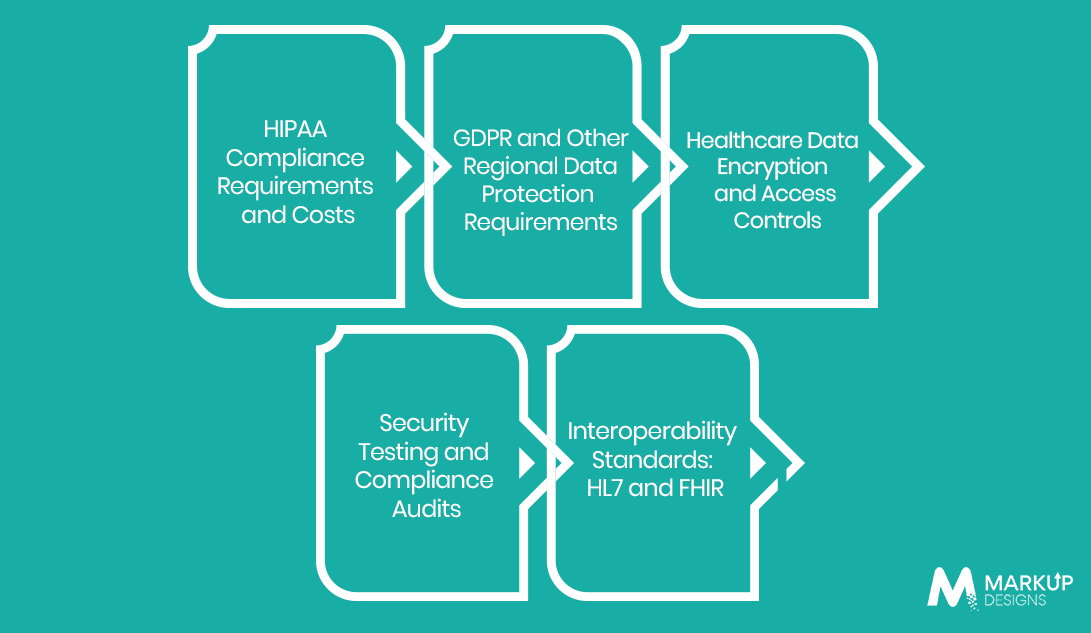
HIPAA Compliance Requirements and Costs
In the United States, companies falling under the Health Insurance Portability and Accountability Act (HIPAA) must comply with its requirements. Apps that process data must have sufficient protection measures ensuring access control, audit logging, risk assessment, secure data processing, and appropriate agreements with third-party vendors.
The implementation cost of HIPAA depends on the app design, available protection mechanisms, and work effort needed to fix the vulnerabilities. HIPAA compliance can’t be reduced to a simple certification or fixed cost of software development; instead, it requires organizations to analyze the requirements and implement appropriate measures continuously.
GDPR and Other Regional Data Protection Requirements
In order to run a healthcare company in the European Union, one would usually be required to follow the General Data Protection Regulation (GDPR), which consists of sensitive medical data processing regulations, or following the rules about lawful processing of data, information disclosure, as well as individual rights. There are also other regulations regarding privacy and healthcare in different areas.
Costs may include conducting assessments regarding privacy, conducting consent management, retaining data, processing data regionally, and documenting the process. Businesses need to look for the relevant laws applicable to their target regions before organizing the infrastructure.
Healthcare Data Encryption and Access Controls
The apps in use in healthcare need to be designed so that they ensure the safety of data at any moment, whether it is being transferred or stored. This can involve methods such as encryption of the data being processed, allowing only limited access, and avoiding using unauthorized access to the data. The level of protection required depends on the data’s level of sensitivity and risk profile.
Security Testing and Compliance Audits
Security testing can locate defects in the systems both before the final launch and after it. Some of the activities carried out as part of security testing include penetration testing, audits of the source code, and scanning the systems for vulnerabilities and malfunctions in their operation. Cost is influenced by different factors, such as system complexity, the scope of testing, and whether independent testing authorities were engaged.
Interoperability Standards: HL7 and FHIR
The standards in the healthcare industry aim at the exchange of data between compatible systems. Those standards must be implemented effectively and used for data exchange by means of various application programming interfaces and custom components.
Costs associated with standards implementation will depend on the number of systems that must be connected, their compatibility with each other, and the complexity of the data to be exchanged.
Editorial note: The pricing ranges in this draft are planning estimates, not independently verified 2026 market averages. Before publication, validate them against current vendor quotes or reliable industry research. Also distinguish initial development costs from recurring hosting, licensing, compliance, and maintenance expenses.
What Are the Hidden Costs of Healthcare App Development?
The initial cost does not account for all of the expenses that a healthcare app incurs once it is up and running. Businesses also need to consider the costs of the infrastructure of the app, the software subscriptions, the security updates, and technical support after the app starts operations. If these costs are not included in the cost calculations upfront, it can lead to an increased total cost of ownership that includes running the app but excludes the initial costs.
Cloud Hosting and Infrastructure
A healthcare app requires infrastructure such as storage for the data, processing the requests, and ensuring reliable access. The hosting costs will depend on the number of users, storage requirements, frequency of backup, workload, and availability requirements. In case of applications that deal with large volumes of clinical data or real-time applications, there is a need for additional computing power and recovery options.
Third-Party API and Software Licensing Fees
Many healthcare apps heavily rely on third-party services such as video consultations, payments, text, maps, analytics, and connection to EHRs. The providers can charge businesses using either a subscription, transaction-based, or usage-based model.
App Maintenance and Feature Updates
Maintenance is where bugs are fixed, dependencies are updated, and the app is still functioning properly with the operating system. Healthcare apps may also need modifications due to becoming more complex over time and the progressive nature of clinical workflows and corresponding integrations. The yearly budget for app maintenance is dependent on how complicated the app is, how often it is released, and what kind of support is required.
Security Monitoring and Compliance Maintenance
Security is still important after the software is uploaded. Companies may require conducting continuous assessments of possible gaps, reviewing rights for access, checking logs, installing updates and conducting security assessments. Organizations may also have to comply with some laws that require changing the documentation, policies, and methods of technology when the app is successfully delivered.
Technical Support and Performance Optimization
Technical assistance provides companies with solutions in order to deal with problems occurring while using the app. It may include solving issues occurring within a database. Depending on the app that is used, companies may set rules regarding how to deal with incidents and provide service.
How Can Businesses Reduce Healthcare App Development Costs?
In order to minimize costs of healthcare app creation, controlling the scope of the project and reducing unnecessary complexities are necessary, but without sacrificing security, usability, or reliability. This can be achieved through concentrating on must-have features, choosing proper technologies, and proactively thinking about future needs.
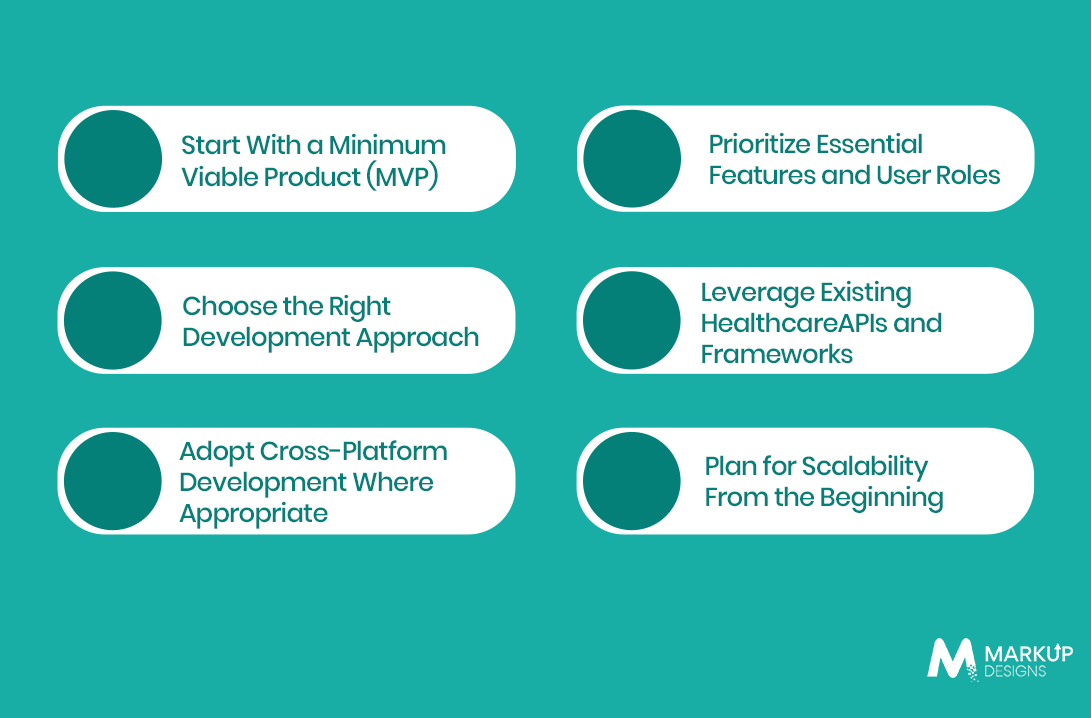
Start With a Minimum Viable Product (MVP)
MVP is meant specifically for tackling the essential needs of the target users. For example, a patient app may start with functions like registration, appointment scheduling, and notifications. Only after that, the app may employ advanced analytics and AI technologies. Doing so helps the business test the demand before making a big investment.
Prioritize Essential Features and User Roles
Precisely determine the functionality demanded by users, such as patients, doctors, managers, based on the purpose of the application. As a result, key functionalities will be separated from the desirables, which helps to avoid the significant waste of resources downstream.
Choose the Right Development Approach
Depending on the complexity of the project, internal capabilities, delivery expectations, and maintenance of the solution, select the appropriate development model. Native development can be employed only for those functionalities specific for a particular platform, while cross-platform development is recommended in order to reduce redundancy.
Leverage Existing Healthcare APIs and Frameworks
Using existing APIs and frameworks can significantly lessen the workload needed to create specific capabilities such as authentication, video calls, payment methods, and availability of healthcare data. Nevertheless, it is necessary for companies to evaluate such a vendor as far as reliability, safety, interoperability, licensing, and ongoing charges are concerned.
Adopt Cross-Platform Development Where Appropriate
Cross-platform frameworks like Flutter and React Native allow companies to share a significant amount of code in their application between iOS and Android environments, which, in turn, reduces development and maintenance costs of the project. Nevertheless, there could be some cases when the native components are essential for corresponding integrations or other functions that may require higher performance.
Plan for Scalability From the Beginning
A well-planned architecture enables the software to cope with an increasing number of users, volumes of data, and integration needs without the need for reconstruction. Companies need to select the right infrastructure, have clear interfaces defined, and be sure to monitor their expected usage. Good expectations regarding growth can save from costly architectural changes in the future.
What Is the Healthcare App Development Process and Its Cost Breakdown?
Healthcare app development typically involves several stages, each contributing to the overall budget. The exact allocation depends on the application’s complexity, regulatory requirements, and integration needs.
The following breakdown is an illustrative planning model for a custom healthcare app, not a fixed industry benchmark.
| Development stage | Indicative share of initial budget |
| Requirement analysis and market research | 5–10% |
| UI/UX design and prototyping | 10–15% |
| Frontend and backend development | 35–45% |
| Healthcare system integration | 10–20% |
| Testing, security, and compliance validation | 15–20% |
| Deployment and launch preparation | 3–5% |
These percentages are approximate and may overlap depending on how a vendor structures its project estimate. Post-launch maintenance and support should be budgeted separately.
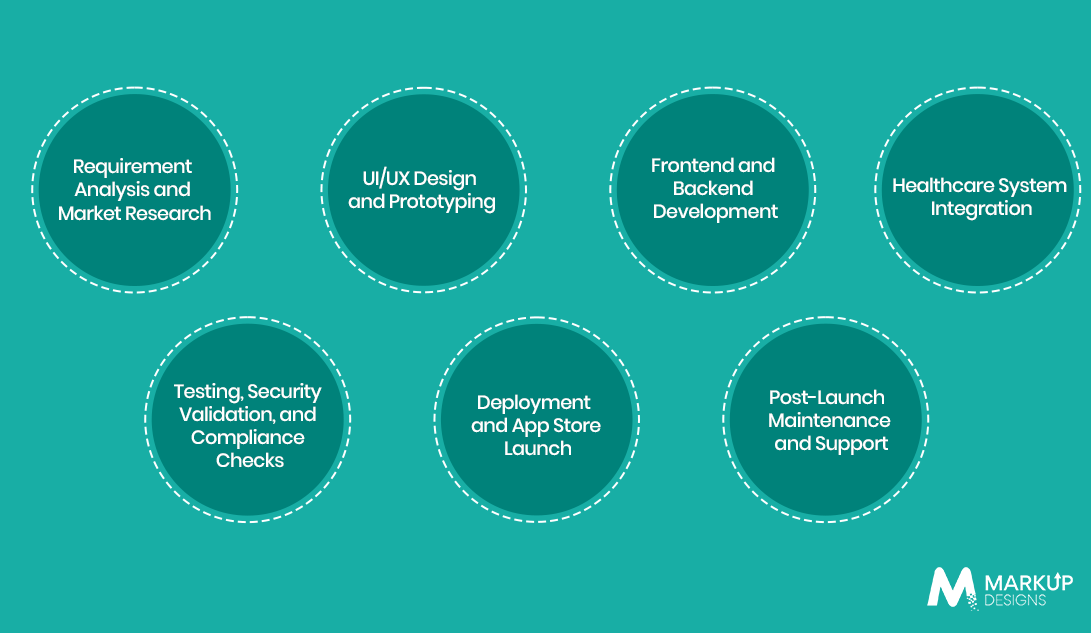
Requirement Analysis and Market Research
At this phase, the target audience, business goals, main features, technical requirements, and competitors are defined. The team also identifies the privacy compliance requirements, dependencies on other applications, and operational constraints. The accurate definition of the project scope helps minimize the chance of costly changes in the development process.
UI/UX Design and Prototyping
At this stage, designers create user flows, wireframes, and prototypes to provide a functional description of the application. Healthcare software interfaces should make key information comprehensible and routine operations simple to perform. User experience testing at this stage can detect possible issues before costly solutions are needed to fix them.
Frontend and Backend Development
Frontend development consists of creating the user interface, while backend development is responsible for business logic, authentication, data storage, as well as the application’s communication with other systems. The final budget depends on the number of platforms, user roles, workflows, and performance characteristics. Moreover, the complicated applications might require dashboards or different interfaces for the medical staff.
Healthcare System Integration
In this phase, the application is integrated with platforms like EHR, laboratory services, pharmacy systems, payment retrieval systems, and medical devices. The complexity of development depends on the availability of API, the compatibility of data, the process of validation, and the number of systems used. The testing of an integration is important to confirm that information is transmitted.
Testing, Security Validation, and Compliance Checks
Testing includes usability, performance, functionality, compatibility, and data handling. Testing of security may include security assessments, access control assessments, etc. Depending on the target of an application and the rules under which it should be developed, some additional risk assessment or independent assessments would need to be done before launching the application.
Deployment and App Store Launch
In this phase, the infrastructure for production needs to be set up, monitoring configured, and release versions prepared. The team should also check that backups function in compliance with standards and emergency response procedures are in place. The cost of implementation will depend on the hosting type and release requirements.
Post-Launch Maintenance and Support
In this phase, the team constantly checks how the application performs, corrects bugs, upgrades packages, and answers questions of the users.
A support plan should define responsibilities, response times, release schedules, and the budget available for future improvements.
Should Businesses Build a Healthcare App In-House or Outsource Development?
The choice between in-house and outsourced development affects the budget, access to expertise, delivery timeline, and long-term ownership of the application. Neither model is automatically cheaper; the right option depends on the business’s existing team and the complexity of the project.
In-House Healthcare App Development
An in-house team provides direct control over priorities, technical decisions, and ongoing product development. It can be a suitable option for businesses with established engineering teams and long-term development needs.
However, the total cost includes salaries, recruitment, benefits, development tools, infrastructure, and specialist expertise in healthcare security and interoperability. Building a team from scratch may also delay the initial release.
Outsourced Healthcare App Development
Outsourcing allows businesses to work with an external development partner that provides some or all of the required technical expertise. This can be useful when internal resources are limited, or the project requires specialized healthcare technology experience.
Costs depend on the partner’s location, team composition, engagement model, and project scope. Businesses should assess healthcare project experience, security practices, communication processes, code ownership, and post-launch support rather than comparing quotes on price alone.
Factors to Consider When Choosing a Development Model
Businesses should evaluate the following before deciding:
- Budget: Compare the full cost of recruitment, salaries, tools, vendor fees, and maintenance.
- Technical expertise: Determine whether the available team understands healthcare workflows, interoperability, and data protection.
- Time to market: Assess which model can deliver the required functionality within a realistic timeline.
- Control and ownership: Clarify decision-making authority, intellectual property, documentation, and access to source code.
- Long-term support: Establish who will maintain the application, manage security updates, and handle future integrations.
A hybrid model is also possible, with an internal product owner overseeing an external development team. This can provide greater control without requiring the business to recruit every technical specialist.
How Can Businesses Calculate the ROI of Healthcare App Development?
Return on investment (ROI) helps businesses evaluate whether a healthcare app’s financial and operational benefits justify its development and operating costs. The assessment should consider both measurable financial gains and improvements in service delivery.
A basic ROI calculation is:
ROI=TotalBenefits-TotalCostsTotalCosts100
Businesses should define a consistent measurement period and account for initial development, infrastructure, licensing, maintenance, and support expenses.
Development and Operational Costs
Calculate the initial investment alongside recurring costs such as hosting, software subscriptions, security monitoring, maintenance, and support. Including these expenses provides a more realistic view of the total cost of ownership than looking at the development quote alone.
Revenue Opportunities and Monetization Models
Depending on the business model, a healthcare app may generate revenue through consultation fees, subscriptions, service charges, or partnerships. Revenue projections should be based on realistic user adoption, pricing, conversion rates, and retention rather than assuming every registered user will become a paying customer.
Productivity Gains and Administrative Cost Savings
Automation can reduce manual scheduling, repetitive data entry, paperwork, and administrative processing. Businesses can estimate these benefits by measuring time saved, changes in staffing effort, fewer errors, and reduced operational expenditure. Any projected savings should be validated against actual workflows after launch.
Patient Engagement and Retention Metrics
Track indicators such as active users, appointment completion rates, repeat usage, patient retention, and satisfaction. These metrics help establish whether the app is meeting user needs. Their financial value depends on the business model and should not be treated as direct revenue without supporting evidence.
How Can Markup Designs Help You Develop a Healthcare App Within Budget?
Markup Designs helps businesses plan and develop custom software solutions around their operational requirements, user needs, and growth objectives. For healthcare app projects, a structured approach to requirements, feature prioritization, architecture, and integrations can help identify cost drivers before development begins.
From patient-facing applications and appointment platforms to more complex healthcare software, the focus should be on building maintainable solutions with appropriate security controls and a clear path for future expansion. Defining the initial scope carefully and evaluating third-party dependencies can also help businesses make informed budget decisions.
Before committing to a development plan, businesses should establish the app’s core purpose, identify applicable compliance obligations, and obtain a project estimate based on documented requirements. This creates a more reliable foundation for balancing initial costs with long-term value.
RBuild a Healthcare App That Fits Your Budget
Plan your healthcare app development investment with a clear scope, the right technology choices, and a strategy for long-term growth.

Conclusion
Healthcare app development costs in 2026 depend on the application’s functionality, technical complexity, integrations, security requirements, and development approach. The initial build is only part of the investment; businesses must also plan for hosting, licensing, maintenance, and ongoing security responsibilities.
The most effective way to control costs is to define clear objectives, prioritize essential features, and select an architecture that fits both current needs and realistic growth plans. By evaluating total cost of ownership alongside measurable business outcomes, healthcare organizations can make more informed investment decisions and build applications that remain useful and maintainable over time.
FAQ
1. How much does it cost to develop a healthcare app in 2026?
Healthcare app development can range from tens of thousands of dollars for a relatively simple application to several hundred thousand dollars or more for complex platforms. The actual cost depends on features, integrations, platform requirements, security controls, and project scope.
2. How long does it take to develop a healthcare app?
A basic healthcare app may take around two to four months, while a more complex application can require six to twelve months or longer. Integrations, compliance-related work, testing, and custom clinical workflows can extend the timeline.
3. What is the cost of developing a HIPAA-compliant healthcare app?
There is no single fixed cost for a HIPAA-compliant app. The budget depends on the application’s architecture, the safeguards already in place, risk assessment findings, vendor arrangements, and ongoing compliance responsibilities. HIPAA-related requirements should be evaluated as part of the overall project scope.
4. How much does telemedicine app development cost?
A custom telemedicine app may cost approximately 40,000–120,000 for a typical initial scope. Features such as video consultations, secure messaging, provider scheduling, payments, and EHR integration can increase the cost.
5. Does healthcare app development require HIPAA compliance?
Not every healthcare app is automatically subject to HIPAA. In the United States, applicability depends on whether the organization and its activities fall within the law’s scope, including whether a business is a covered entity or business associate. Other privacy and healthcare laws may still apply even when HIPAA does not.
Author's Perspective
Healthcare app development requires a balance between budget, usability, security, and long-term operational needs. The lowest initial quote is not necessarily the most cost-effective option if it excludes essential integrations, testing, or ongoing maintenance. Businesses should prioritize features according to real user needs, assess compliance obligations early, and compare development proposals using a consistent scope. A disciplined approach to budgeting helps organizations avoid unnecessary complexity while building healthcare applications that can evolve with their requirements.
Discuss Your Project NowJupinder Singh Arora
Founder and CEO
Related Posts

How to Build a Compliant HealthTech App in...

Complete Guide to Healthcare App Development in Saudi...
Remote Patient Monitoring App Development in the UAE:...
Insights Are Valuable & Execution is Priceless
You’ve read about the digital future. Now, let’s build the infrastructure to take you there. Move your strategy from the page to the product.
Design Your Solution Now
Contact Us
Schedule The Appointment At Your Convenience Date And Time.
30 Min
Web Conference
Time Zone
Indian standard time (08:30pm)

Thanks For Getting In Touch!
You’ve Taken The First Step Toward Transforming Your Digital Presence. Our Experts Will Reach Out Shortly To Take It Forward.
Launch Your Dream Project
Provide a brief overview of your project, and our specialists will evaluate your requirements. We will connect with you to explore how the right digital solutions can help you launch faster.