
In Brief
- The utilization of artificial intelligence (AI) in healthcare is no longer confined to pilot studies; the technology is coming into general use in the UK.
- The NHS is increasingly using AI for the purposes of improving diagnosis, clinical processes, and patient care.
- Generative artificial intelligence, predictive analytics, medical imaging, and remote patient monitoring are enabling new ways of providing care.
- As the use of AI expands, it is becoming necessary to introduce more regulations, establish good data governance practices, and introduce stronger clinical oversight.
- Most importantly, there is a possibility to use AI to make healthcare more proactive, personalised, efficient, and available to everyone.
Artificial intelligence is revolutionising healthcare delivery in the UK. The technology is moving from being used mainly in research and experimental intervention to being used in everyday healthcare procedures. AI is used for such tasks as analysing medical images, predicting disease risk, and producing clinical notes in addition to remote patient monitoring. In the next few years, this process is becoming more evident as the NHS and other medical institutions start to explore ways to make prevention, diagnosis, and treatment procedures technology-based.
The transformation is not only about the implementation of AI in hospitals, nor does it stop at replacing human labor with machines. In reality, the key value of such technology lies in the ability to merge artificial intelligence with already existing healthcare systems, medical know-how, and the needs of patients. Thus, the progress in generative AI, predictive analytics, computer vision, robotics, and wearable monitoring technology leads to new possibilities in healthcare. The following article describes the 10 AI innovations that contributed to the transformation of the UK healthcare industry in 2026 and illustrates all the benefits and challenges of utilizing these innovations by medical organizations.
10 AI Innovations Transforming UK Healthcare in 2026
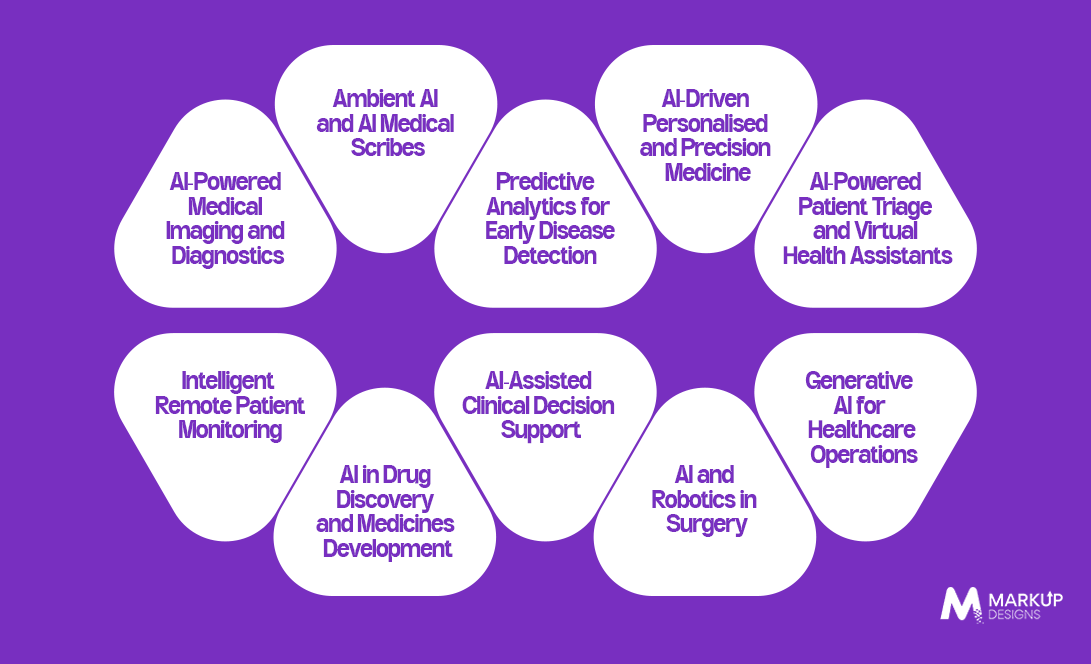
1. AI-Powered Medical Imaging and Diagnostics
AI technology has sped up and made the medical imaging process more analytical due to the contribution of artificial intelligence in analyzing X-ray images, CT scans, MRI scans, ultrasound images, pathology slides, and dermatology pictures. Thanks to machine learning and computer vision technology used in the process, the systems are able to detect key patterns and abnormalities that could be hardly found by humans.
The impact is particularly relevant in areas where faster diagnosis can influence treatment outcomes. In the UK, AI is already being used to support cancer diagnosis, with government funding in 2026 aimed at expanding proven AI technologies across NHS trusts to help identify lung cancer more quickly. This demonstrates how AI-assisted diagnostics are moving beyond experimentation towards practical applications within NHS care pathways.
2. Ambient AI and AI Medical Scribes
The administrative burden caused by clinical documentation for medical professionals cannot be overstated, especially as this can involve detailed notes being compiled during such consultations in addition to the updating of the electronic records. Ambient AI can solve this problem by using voice and language technologies to understand the dialogue during this kind of consultation and to pull out clinical information. Consequently, medical professionals can approve the results without having to write every note manually.
Such an innovation allows for a reduction in the amount of time spent on administration while also giving doctors the chance to spend more time with patients. The NHS strategy of the UK supports the use of ambient AI technology, which is evident with the implementation of the initiative.
3. Predictive Analytics for Early Disease Detection
A conventional approach to healthcare assumes that doctors provide their services only after some symptoms appear or after some disease is developed. Predictive analytics represents a more advanced approach where AI is utilized to identify possible health threats beforehand.
Healthcare organisations can use these insights to identify patients who may be at increased risk of cardiovascular disease, diabetes, cancer, stroke or hospital readmission. Clinicians can then prioritise monitoring, screening or preventative interventions for higher risk patients. The broader shift is from reactive treatment towards proactive and preventative healthcare, where data can help determine who may need attention before their condition becomes more serious.
4. AI Driven Personalised and Precision Medicine
Individuals diagnosed with the same disease react differently to a particular treatment. AI technology aids the healthcare system in moving towards a more personalised system by analysing various forms of clinical, diagnostic and genomic data. Such systems help to point out certain patterns connected to treatment outcome, disease progression and adverse events.
The UK is well-placed to be in the forefront of such a tendency due to its growing interest towards genomics and the use of health data integration. AI allows for combining genomic information with clinical data thereby providing more personalised treatment solutions and making it possible for doctors to take decisions taking into account individual characteristics of patients instead of relying only on average data of similar patient populations.
5. AI-Powered Patient Triage and Virtual Health Assistants
AI also changes what is happening before a patient meets a doctor. Intelligent triage systems allow for collecting symptoms, asking introductory questions, providing general health information as well as drawing patients’ attention to healthcare services. In addition, intelligent triage systems can assist in appointment arrangements and communication with patients, thus relieving the burden on healthcare professionals.
The value of these systems lies in improving access and directing patients to the right level of care more efficiently. However, there is an important distinction between AI-assisted triage and autonomous diagnosis. Patient-facing healthcare AI needs appropriate safeguards, clear escalation routes, and human oversight, particularly when symptoms could indicate an urgent or serious condition.
Read Also: How AI Is Transforming UK Businesses: 10 Real-World Use Cases
6. Intelligent Remote Patient Monitoring
Through the use of connected devices and wearable technologies, the practice of healthcare is increasingly going beyond just hospitals and doctors’ offices. AI can analyze the information collected from wearables such as smartwatches, blood pressure monitors, glucose monitors, pulse oximeters, connected medical devices, and other devices in order to identify important changes in a person’s health condition.
Rather than having everyone browse data and check every piece of information, computers using AI technology are able to recognize unusual patterns and point out patients who may need some help.
This is especially important for patients suffering from chronic diseases or those recovering from treatment. According to the UK healthcare strategy of the UK, the use of wearables as well as remote monitoring systems is extremely important in the practice of health preservation, chronic illness management, and post-surgery care, which is part of a larger trend towards the system of continuous healthcare.
7. AI in Drug Discovery and Medicines Development
Drug development is time-consuming, complex, and expensive. The AI application in this process allows researchers to collect and analyze extensive data, recognize the best molecules, predict their interactions, and evaluate the potential of drug candidates.
AI can also support safety assessment, identify potential adverse effects, and assist with aspects of clinical research. In the UK, the MHRA launched an AI sandbox in 2026 to explore how AI can contribute to medicines development and improve medicines safety. This reflects the growing need to develop AI technologies alongside appropriate regulatory and safety frameworks rather than treating innovation and regulation as separate processes.
8. AI-Assisted Clinical Decision Support
Healthcare practitioners routinely manipulate large quantities of information before arriving at a clinical decision. In compliant healthTech applications, AI-supported clinical decision support systems aggregate patient data, diagnostic results, clinical knowledge, and risk factors to provide meaningful information at the point of care.
Potential applications include risk scoring, clinical alerts, medication safety checks, differential diagnosis, advice on treatment options, and patient record summaries. The goal is not to turn clinical duties over to the algorithm. Rather, AI can help clinicians work through complex information faster while keeping the final say with an appropriately trained healthcare provider.
9. AI and Robotics in Surgery
The intersection of AI, robotics, and advanced imaging is inspiring innovative approaches to surgical treatment. Robotic systems help surgeons achieve precise motions in the operating room, while AI is used for planning prior to the operation, imaging and decision-making during surgery.
Postoperative care also has a component of intelligent systems used to identify potential problems needing physicians’ attention.
The United Kingdom’s national strategy for health indicates that healthcare delivery will be revolutionized by robotics technology and announces the advent of surgical robots in 2026 in compliance with respective NICE guidelines.
As these systems become more capable, the focus will increasingly shift towards determining where robotic and AI assistance can deliver measurable clinical value while maintaining appropriate human control.
10. Generative AI for Healthcare Operations
The influence of artificial intelligence on healthcare affects much more than just diagnosis and procedures. AI can streamline administrative processes within medical organizations, such as appointment bookings, patient communication, referral processing, discharge documentation, coding, and summarizing data. It is also capable of aiding workforce planning by evaluating significant quantities of operational data.
This is relevant as healthcare capacity is determined not only by the number of doctors, nurses, and hospital units, but by administrative inefficiencies that waste time and resources on healthcare delivery. Automating repetitive tasks and assisting staff with making the best use of their time have the potential of freeing up resources for high-quality patient care. Nevertheless, great importance is given to the accuracy and reliability of AI-generated output.
Why AI Adoption in UK Healthcare Is Accelerating in 2026
The increased use of AI in the UK health system is caused not only by technological improvement. The NHS’s digital transformation and greater governmental investments, along with the developing regulatory system make it easier for medical organizations to apply useful AI technologies in practice.
NHS Digital Transformation
The NHS is increasingly incorporating AI into clinical pathways and administrative workflows to improve efficiency and support better patient care. From AI assisted diagnosis to automated documentation and patient services, the focus is shifting towards technologies that can work alongside existing healthcare systems rather than operate as isolated tools.
Growing AI Investment
Government funding is also supporting this transition. In 2026, almost £30 million was announced for AI and digital technologies across NHS care, including technologies designed to support faster cancer diagnosis. This investment signals growing confidence in AI’s potential to address practical healthcare challenges.
Regulatory Infrastructure Is Maturing
As AI becomes more involved in healthcare decisions, regulation and safety evaluation are becoming equally important. The MHRA is developing frameworks for AI-enabled medical devices and launched an AI regulatory sandbox in London in 2026 to help assess innovative technologies in real-world NHS settings. This creates a more structured path for testing, validating, and responsibly deploying healthcare AI.
Challenges of Implementing AI in UK Healthcare
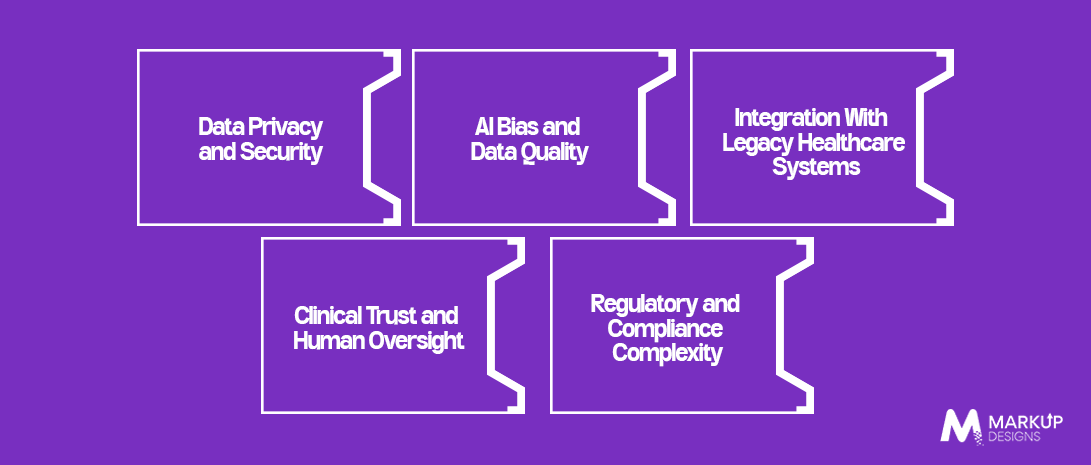
Despite its potential, implementing AI across healthcare is not simply a matter of adopting new software. Healthcare organisations must address data, infrastructure, regulatory and human factors before AI can be deployed safely and effectively.
Data Privacy and Security
Healthcare AI relies on highly sensitive patient information, making data protection a fundamental requirement. Organisations must maintain patient confidentiality, comply with applicable data protection requirements and implement strong security measures across data storage, processing and access.
AI Bias and Data Quality
AI systems are only as reliable as the data used to develop and operate them. Incomplete, inconsistent or poorly representative datasets can produce biased or unreliable results. Healthcare organisations therefore need to assess data quality and evaluate AI performance across different patient populations.
Integration With Legacy Healthcare Systems
Many healthcare organisations still operate with fragmented systems and older infrastructure. Integrating AI with electronic health records, clinical platforms and other data sources can be technically challenging. Interoperability needs to be considered from the beginning rather than treated as an afterthought.
Clinical Trust and Human Oversight
Healthcare professionals need to understand and trust the systems they use. AI outputs should be explainable where appropriate, clinically validated and subject to human review. Clear accountability is particularly important when an AI recommendation could influence patient care.
Regulatory and Compliance Complexity
Healthcare AI can fall under different regulatory requirements depending on its intended use and level of risk. Organisations need to consider classification, validation, monitoring and post-deployment safety throughout the AI lifecycle. The UK’s ongoing regulatory work reflects the need for different levels of assurance based on how AI is used in healthcare.
What Is the Future of AI in UK Healthcare?
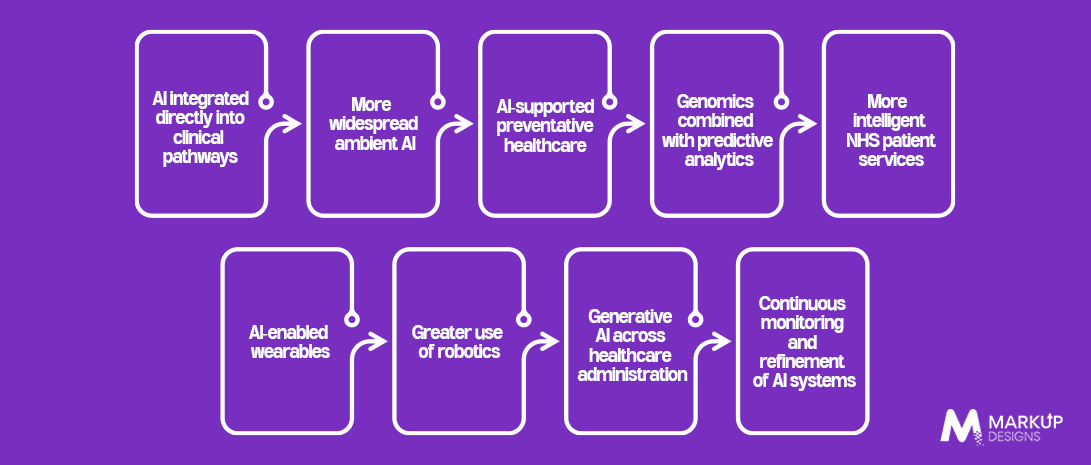
The next phase of UK healthcare AI will be less about standalone applications and more about AI becoming embedded within everyday healthcare infrastructure. Ambient AI, predictive analytics, genomics, connected wearables, robotics and generative AI are likely to become increasingly integrated into clinical and administrative workflows.
The NHS’s long-term strategy points towards AI being incorporated across most clinical pathways by 2035. This could mean more preventative care, continuous patient monitoring, smarter clinical support and increasingly automated administrative processes, provided these technologies continue to meet the required standards for safety, effectiveness and governance.
How Healthcare Businesses Can Prepare for AI Adoption
Healthcare organisations should approach AI adoption in UK healthcare as a business and technology transformation, rather than simply adding an AI feature to an existing product.
- Identify high-value use cases where AI can solve a measurable clinical or operational problem.
- Assess existing data infrastructure to determine whether the required data is accessible, reliable, and secure.
- Define security and governance requirements before selecting a technology.
- Choose appropriate AI models and technologies based on the intended use and risk level.
- Plan for interoperability with existing healthcare platforms and systems.
- Validate AI outputs with clinical expertise before wider deployment.
- Start with controlled pilots and measure real-world performance.
- Continuously monitor and improve the system after deployment.
How Markup Designs Can Help Build AI Healthcare Solutions
Markup Designs can help healthcare organisations turn AI use cases into secure and scalable digital solutions. Its capabilities can span healthcare AI application development, predictive analytics, virtual assistants, remote patient monitoring, healthcare data integration, and EHR/API integrations, supported by cloud infrastructure, cybersecurity, testing, and ongoing AI model optimisation.
The focus should be on solving a genuine healthcare workflow problem first and selecting AI where it creates measurable value. A well-designed healthcare AI solution needs to fit existing systems, protect sensitive data, and remain reliable as requirements and clinical workflows evolve.
Build Smarter Healthcare With AI
Turn complex healthcare challenges into secure, scalable AI solutions designed around real clinical and operational needs.
Conclusion
AI is no longer being introduced into UK healthcare as a collection of isolated experiments. In 2026, its role is expanding across the entire healthcare journey, from medical imaging and clinical documentation to disease prevention, patient monitoring, drug development and hospital operations. The real transformation lies in connecting these capabilities with existing healthcare systems and clinical expertise.
The next stage of healthcare AI will therefore be defined less by individual breakthroughs and more by how intelligently and responsibly these technologies are integrated into everyday care. For UK healthcare organisations, the opportunity is to adopt AI where it can improve outcomes, reduce operational pressure and create more proactive models of care while maintaining the security, oversight and trust that healthcare demands.
FAQs
1. What role is AI playing in the UK’s healthcare by 2026?
AI is aiding healthcare in diagnosis, clinical documentation, patient triage, predictive analytics, remote monitoring, custom treatment, and administrative tasks. This expanding influence of the technology allows the healthcare industry to optimize its processes.
2. What are the main examples of AI in NHS healthcare?
The main examples of AI technology include AI-assisted medical imaging, Ambient AI scribes, predictive analytics, clinical decision support systems, remote patient monitoring, and virtual health assistants.
3. What is the place of AI in medical diagnostics in the UK?
AI can analyze images, pathology, and patient data to discover disease patterns. Thus, it prioritizes numerous cases and assists specialists, but the final diagnosis is made by qualified staff.
4. Is AI pushing physicians and medical workers out of the labor market?
No. AI will not drive anyone out of the market, but it will help health specialists in their work. AI technology can automate routine operations and huge amounts of data, thus freeing specialists to concentrate on providing care and making more complex decisions.
5. In what way is generative AI applicable to the health sector in the United Kingdom?
Generative AI has the potential to aid with clinical documentation, communication with patients, recording summarisation, as well as administrative processes, managing referrals, and many other data-intensive processes. The use of this technology, however, must be subject to proper validation, ensuring the safety of data and the input of specialists.
Author's Perspective
The most appropriate conclusion drawn from the current state of healthcare services in the United Kingdom is that in 2026 the usage of AI tools will transform into a holistic approach to AI integration into the healthcare industry. It has been stated that the importance of AI solutions depends not on the sophistication of the model itself but on its adoption in the system as a whole.
From diagnosis and clinical workflows to prevention, treatment and operations, the opportunity is to build AI around genuine healthcare needs rather than adding AI simply because the technology is available. This approach aligns more closely with the UK’s wider direction towards digitally enabled, preventative and technology-supported healthcare.
Discuss Your Project NowAjit Kumar Jha
VP - Business Operations
Related Posts
How to Build an App With Claude Code:...
AI Development Firm in the UK: How to...
Hiring an AI Development Partner in the UK:...
Insights Are Valuable & Execution is Priceless
You’ve read about the digital future. Now, let’s build the infrastructure to take you there. Move your strategy from the page to the product.
Design Your Solution Now
Contact Us
Schedule The Appointment At Your Convenience Date And Time.
30 Min
Web Conference
Time Zone
Indian standard time (08:30pm)

Thanks For Getting In Touch!
You’ve Taken The First Step Toward Transforming Your Digital Presence. Our Experts Will Reach Out Shortly To Take It Forward.
Launch Your Dream Project
Provide a brief overview of your project, and our specialists will evaluate your requirements. We will connect with you to explore how the right digital solutions can help you launch faster.