

In Brief
- Data analytics will assist UK companies in transforming their vast business data into actionable insights that will lead to more informed decisions relating to customer experience, operations, financials, risk management, and logistics.
- The type of decision the company needs to make determines whether they should adopt descriptive analytics, diagnostic analytics, predictive analytics, prescriptive analytics, real-time analytics, or AI-based augmented analytics.
- Some of the benefits of adopting data analytics are rapid decision-making, accurate forecasting, reduced cost of operations, improved customer experience, robust risk management, and improved agility.
- Effective implementation comes with various challenges such as lack of data quality, fragmented data, legacy IT, privacy and security considerations, skills shortages, and inability to take action.
- UK businesses are advised to adopt a data analytics strategy focusing on business goals, data integration and governance, appropriate technologies, high-value use cases, and measurement in partnership with the right analytics provider.
In modern times, companies are able to accumulate more data than before. This is because there is always something happening with regard to customers’ transactions and company operations. Enterprises within the UK are continually gathering useful data from all these events. However, accumulating data alone does not solve much of the problem. Companies need to be able to analyze and interpret their data.
Data analysis is becoming more significant for businesses in modern times because of its many uses in the business world. Through the analysis of data, a business is able to recognize patterns and understand what is happening, among other things.
In this blog, we are going to explore how data analytics is helping UK firms make better decisions in their business, the various types of analytics that can be adopted by business firms, the benefits of data analytics, the issues that might arise during its implementation, and how enterprises can create their own data analytics strategy.
Section 2: What is Data Analytics and Why Does It Matter to UK Enterprises?
Data analytics refers to an activity carried out to analyze organizational data in order to make discoveries about patterns and trends that may guide decision-making. As opposed to making decisions based on assumptions or past experience, data analytics enables organizations to analyze information and gain an understanding of what is happening around them.
This becomes especially crucial for UK-based companies as organizations are facing fluctuating consumer needs, increased competition, increasing costs, and vast amounts of data coming from diverse sources. This type of analysis can gather all of this information and generate insights that can be used by business executives.
For example, retailers may perform analysis of consumer transactions to determine demand, financial institutions may perform such analysis to detect suspicious transactions or risks, and manufacturers may examine data on equipment in order to foresee possible problems with its performance.
The key value of data analytics is simple: it helps enterprises replace guesswork with informed decision-making.
The Growing Role of Data Analytics in the UK Business Landscape
Data analytics is fast becoming a core element of the functioning, competition, and future planning in UK enterprises. Companies in different industries use data generated by customers, employees, operational processes, financial statements, and digital tools to get a better understanding of their performance.
The development of such technologies as cloud computing, artificial intelligence, machine learning, and the Internet of Things makes the collection and analysis of data even more convenient. Enterprises no longer have to wait for monthly or quarterly reports as they have access to insights instantly.
This factor is especially relevant in a changing business environment when the interests of customers and the market situation may vary rapidly. Data analytics helps enterprises to find opportunities, discover risks, and optimize their performance.
With the increasing number of UK enterprises adopting a digital-first approach to business, data analytics is no longer limited to mere reporting. It has become a strategy enabler that can assist in all spheres, ranging from customer experience to finance and operations.
How Data Analytics Helps UK Enterprises Make Smarter Decisions
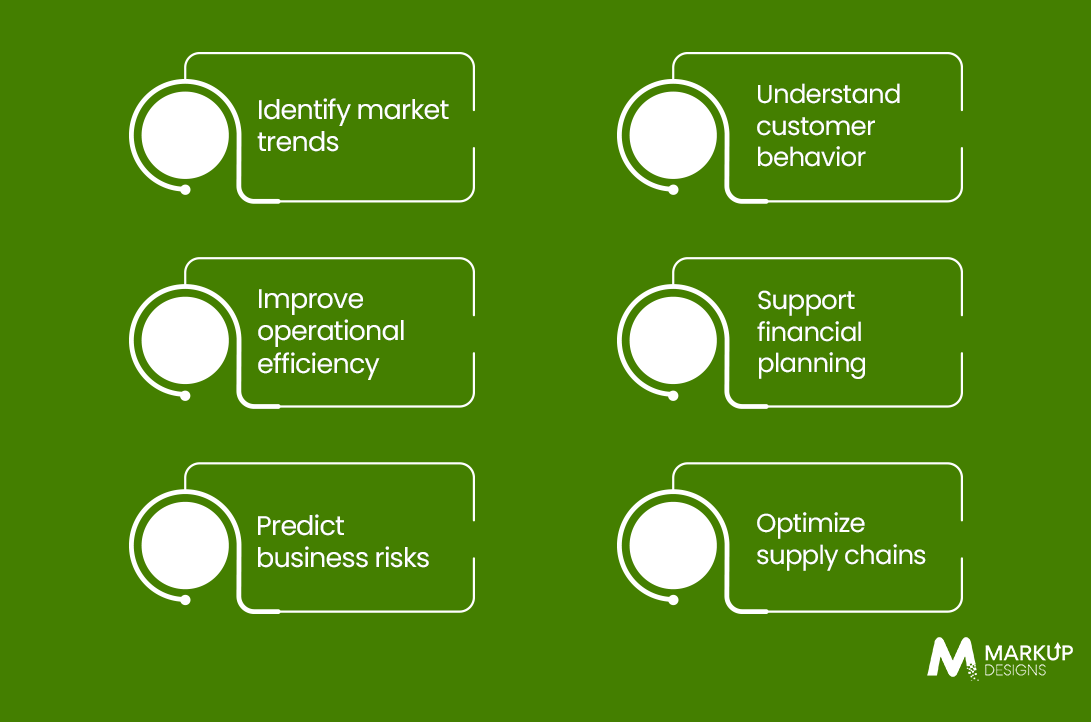
Data analytics is essential in helping organizations convert their huge volume of business data into useful insights. In effect, when used wisely, these insights can be useful in decision-making within various departments.
Identify market trends
Firms can utilize analysis of market and customer data to detect changes in demand and new opportunities.
Understand customer behavior
Through customer purchase history, interactions, and feedback, organizations can find out how their customers think and what could be improved.
Improve operational efficiency
Analyzing processes can provide organizations with insights into process inefficiencies and ways to enhance them.
Support financial planning
Using revenue and expense information, firms can forecast their future performance and budget.
Predict business risks
Predictive analytics can identify unusual patterns and potential risks before they become larger problems.
Optimize supply chains
Business organizations can optimize logistics processes and improve demand and inventory management by analyzing data.
The result is a more informed decision-making process where business leaders have clearer evidence to support their next move.
Want to turn your business data into actionable insights?
Partner with an experienced data analytics team to build solutions that support smarter, faster, and more informed business decisions.

Types of Data Analytics UK Enterprises Are Using
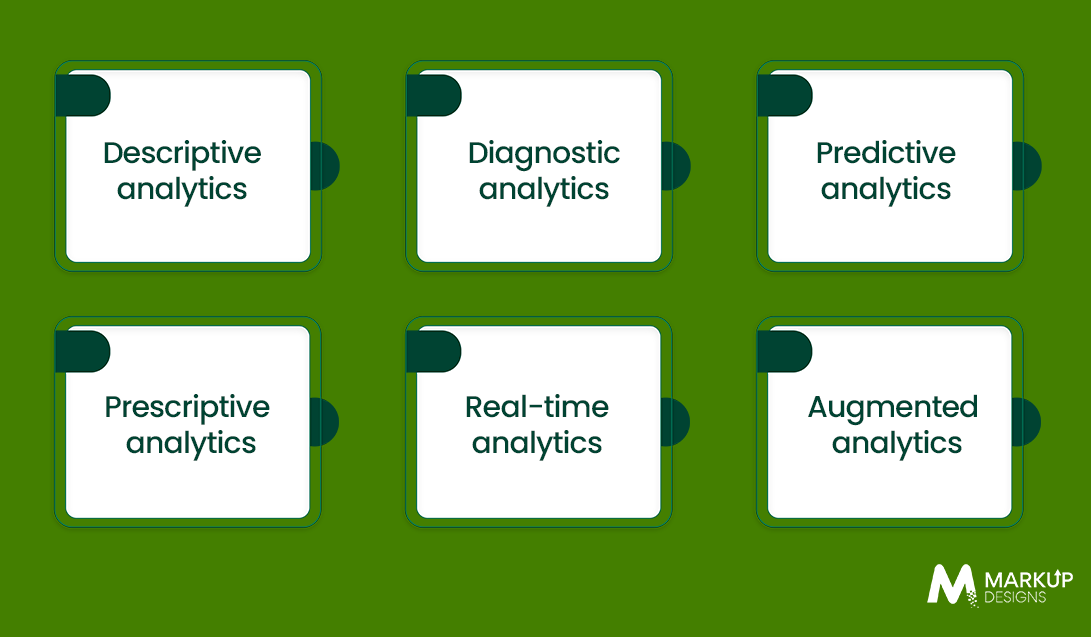
There are various types of analytics that help organizations to answer different kinds of business questions. While some analytics help in evaluating past performance, others are useful in predicting future events and finding out the best way forward.
Descriptive Analytics
Descriptive analytics analyzes historical data to find out what has happened. Organizations can use it to monitor sales, revenue, customer activity, etc.
Diagnostic Analytics
Diagnostic analytics takes analysis one level further by trying to find out the reasons behind certain events. It is useful in discovering reasons for poor sales or customer churn, etc.
Predictive Analytics
This approach involves using history, statistics, and artificial intelligence to figure out what might happen in the future. Predictive analytics may assist in AI demand forecasting, risk assessment, and customer behavior prediction.
Prescriptive Analytics
Prescriptive analytics centers on what needs to be done. This approach helps enterprises choose proper actions based on the data provided.
Real-Time Analytics
With real-time analytics, companies are able to analyze data promptly. This approach applies to many fields such as fraud detection, logistics, customer monitoring, and operations management.
Augmented Analytics
The approach that implies the use of analytics in combination with artificial intelligence and machine learning to automate certain aspects of data processing and analysis.
Key Benefits of Data Analytics for UK Enterprises
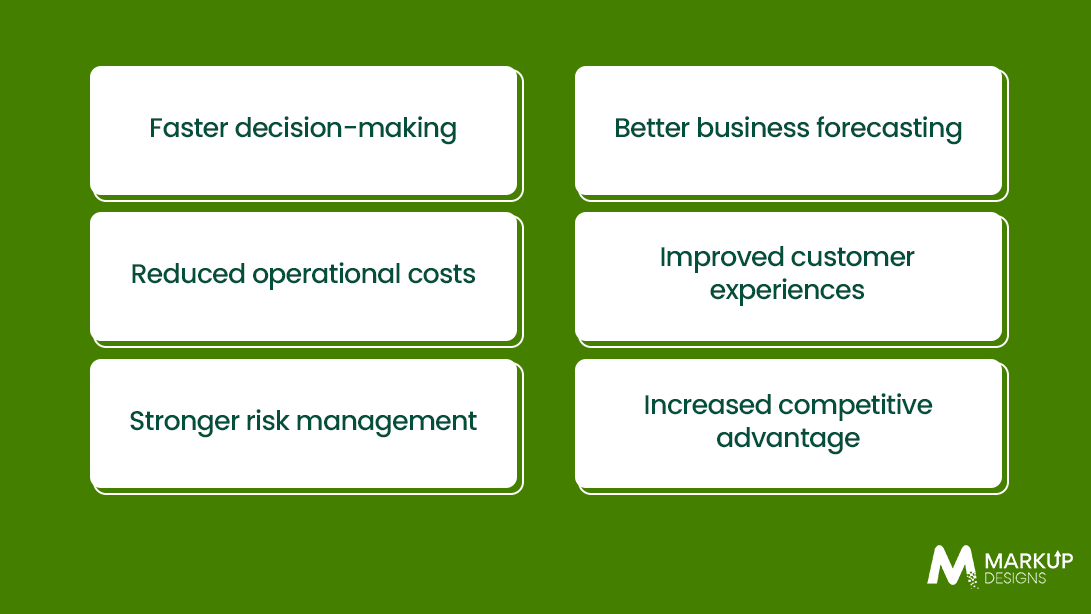
In the case of UK businesses, data analysis is more than producing reports or dashboard views. If linked to the objectives of the company, it could assist in planning, operations, and reacting to market dynamics.
Faster decision-making
The team can be able to get information instantly and not spend many hours examining information.
Better business forecasting
Current and historical data can help organizations forecast their revenues, demands, and trends.
Reduced operational costs
Information can assist companies in identifying inefficient operations, waste of money, and resource shortages.
Improved customer experiences
Organizations will be able to understand the needs of customers and deliver better products and services to them.
Stronger risk management
Organizations can be able to detect unusual activity and risks using data analysis.
Increased competitive advantage
Companies can react faster than competitors because they have analyzed their information.
Challenges UK Enterprises Face When Implementing Data Analytics
Although data analytics can bring about tremendous benefits, deploying it throughout the organization may not be easy. Most companies in the UK will have to solve a number of issues before they start receiving any consistent results.
- Low-quality data: Data that is incomplete, outdated, or inaccurate could produce incorrect insights.
- Information silos: Information scattered between various departments and systems can hamper a holistic understanding of the enterprise.
- Legacy systems: Some older enterprise software solutions could prove hard to integrate with current analytics systems.
- Data privacy and security: Enterprises should handle data carefully and adhere to necessary regulations such as GDPR.
- Skills shortage: Enterprises will find it difficult to source talent in the areas of data engineering, analytics, artificial intelligence, and data science.
- Difficulty turning insights into action: Insights are of little use if one does not know how to implement them into day-to-day decision-making processes.
This process is not simply dependent on the adoption of an analytics platform but also demands that companies have proper data governance, infrastructure, people, and business objectives.
How UK Enterprises Can Build an Effective Data Analytics Strategy
The successful data analytics approach begins with an analysis of business requirements rather than focusing on technology only. The enterprise needs to determine what areas will get the maximum benefit from using the data before implementing the analytics capability.
Define business objectives:
Understand what decisions, challenges, or opportunities need to be addressed with analytics.
Integrate data sources:
Link relevant data from CRM, ERP, finance, customer, operational, and other enterprise software applications.
Develop data governance:
Define guidelines around data quality, availability, privacy, security, and ownership.
Select appropriate technologies:
Pick the right analytics, cloud, AI, and visualization technologies based on true business needs.
Start with high-value use cases:
Start small and then move into broader areas once you’ve proved value.
Measure results continuously:
Measure performance, obtain feedback, and refine your analytics models and processes.
By doing so, you’ll incorporate data analytics into your everyday decision-making instead of keeping it a separate reporting activity.
How a Data Analytics Partner Can Help UK Enterprises
Building a data analytics ecosystem will involve skills related to data engineering, cloud, business intelligence, artificial intelligence, security, and governance. A data analytics partner can help UK firms leverage all of these skills without having to do everything internally.
A reliable partner can support enterprises with:
- Data Analytics Consulting: Establishing business objectives, data needs, and appropriate analytics approaches.
- Data Integration and Engineering: Bringing data from disparate systems within the enterprise and laying down a strong foundation for data.
- BI Solutions: Creating dashboards and reports providing insight to business performance for decision-makers.
- Predictive Analytics: Constructing models to assist businesses in forecasting their demand, assessing their risks, and understanding customer behavior.
- AI-enabled analytics: Making use of artificial intelligence and machine learning to automate processes and reveal deeper business insights.
A correct partner can also guide the organization in transitioning from the initial phase of analytics as a pilot project to its implementation in daily operations.
Ready to make your enterprise data work harder?
Connect with a data analytics partner to turn complex business data into clear, actionable insights that support smarter decision-making.

Conclusion
Data analytics is redefining the way UK businesses operate and make decisions. No longer confined to guesswork, past reports, or gut instincts, organizations can now leverage data to analyze customers, improve operations, mitigate risks, and discover new business opportunities.
Whether it comes in the form of descriptive, diagnostic, predictive, prescriptive, or artificial intelligence-based analytics, enterprises now have multiple options for translating data into actionable business intelligence. Still, a successful analytics process is about more than just technological tools. The quality of data, governance, security, skilled personnel, and business goals are equally important.
To succeed in this new business environment, UK organizations must view data analytics not as an IT function but as a strategic business competency. By leveraging high-quality data and the appropriate technologies and processes, organizations will be able to make faster and more informed decisions.
FAQs
1. What is data analytics for UK enterprises?
Data analytics involves examining business data to identify patterns, trends, and insights that help UK enterprises make informed decisions and improve business performance.
2. How does data analytics improve business decision-making?
It gives decision-makers access to reliable insights about customers, operations, finances, risks, and market trends, helping them make decisions based on evidence rather than assumptions.
3. Which UK industries can benefit from data analytics?
Almost every industry can benefit, including retail, banking, healthcare, manufacturing, energy, logistics, transportation, professional services, and the public sector.
4. What are the main types of data analytics?
The four main types are descriptive, diagnostic, predictive, and prescriptive analytics. Enterprises may also use real-time and AI-powered augmented analytics.
5. What are the biggest data analytics challenges for UK enterprises?
Common challenges include poor data quality, fragmented data, legacy systems, privacy and security requirements, skills shortages, and difficulty turning insights into business actions.
Author's Perspective
Data analytics is becoming essential for UK enterprises making both everyday and strategic decisions. The real value lies in using the right data to answer meaningful business questions, from understanding customers to predicting demand and managing risks. Rather than adopting tools without purpose, businesses should focus on clear objectives and reliable data. As AI and real-time analytics evolve, strong data foundations will help enterprises turn insights into lasting business value.
Discuss Your Project NowJupinder Singh Arora
Founder and CEO
Insights Are Valuable & Execution is Priceless
You’ve read about the digital future. Now, let’s build the infrastructure to take you there. Move your strategy from the page to the product.
Design Your Solution Now
Contact Us
Schedule The Appointment At Your Convenience Date And Time.
30 Min
Web Conference
Time Zone
Indian standard time (08:30pm)

Thanks For Getting In Touch!
You’ve Taken The First Step Toward Transforming Your Digital Presence. Our Experts Will Reach Out Shortly To Take It Forward.
Launch Your Dream Project
Provide a brief overview of your project, and our specialists will evaluate your requirements. We will connect with you to explore how the right digital solutions can help you launch faster.