
In Brief
- There are increasing efforts aimed at using AI in the field of UK healthcare in the areas of diagnosis, patient triage, predictive analytics, remote patient monitoring, virtual health assistants, and clinical documentation.
- The use of AI in practical situations will help in the improvement of the outcome of patients through early diagnosis, fast decision-making, a proactive approach to dealing with issues, increased access to healthcare services, and personalized care.
- Some of the obstacles that may prevent the implementation of AI in the healthcare industry include issues related to patient data privacy, data quality, biasness of AI, integration with existing systems, regulation, clinician trust, and digital inclusion.
- Deployment of AI should include the human aspect, data security, clinical validation, transparency, constant monitoring, accountability, and governance.
- Healthcare institutions can prepare for the use of AI technology through finding the relevant applications, having a good database, including clinicians in the process, and ensuring system compatibility and performance.
Artificial intelligence is not just an idea of the future in the healthcare industry. In the UK, AI technologies are progressively changing the procedures of diagnosing illnesses, managing information, monitoring, and delivering health services by practitioners. Starting from helping doctors detect disease early and finishing with helping patients through digital health gadgets, many new solutions make healthcare delivery faster, more convenient, and more effective.
Increased pressures put on the UK healthcare system have resulted in growing needs for smart technologies. High expectations of patients, staff issues, long waiting times, and large amounts of healthcare-related information encourage organizations to consider the implementation of AI technologies.
In this blog, we will look into AI applications in UK healthcare in accordance with real-life examples, benefits for patients, and some challenges faced by organizations when implementing AI.
Why AI Matters for the UK Healthcare System
In the UK healthcare industry of the UK, there are many patients and much health information processed every day under high pressure on healthcare professionals. In such a scenario, conventional methods may not be enough to guarantee quick and efficient services in the future because of increased demand. This calls for AI.
AI is capable of processing large amounts of health data, finding patterns, automating routine tasks, and assisting in decision-making. For healthcare professionals, this implies less administrative time and more patient-focused time. For patients, it enables them to be diagnosed easily, access services, and receive personalized services.
Some of the key factors that are contributing to making AI more important in UK health care include:
- Accurate diagnosis: AI can help diagnose potential diseases from medical records and images.
- Reduction in workload: AI technology can be used to perform routine administrative activities.
- Proactive treatment: Predictive AI can help identify patients who need treatment early on.
- Increased accessibility: AI technology in digital form can aid in treating patients outside the purview of conventional health facilities.
- Efficient functioning: AI can help healthcare firms operate efficiently.
Real-World Applications of AI in UK Healthcare
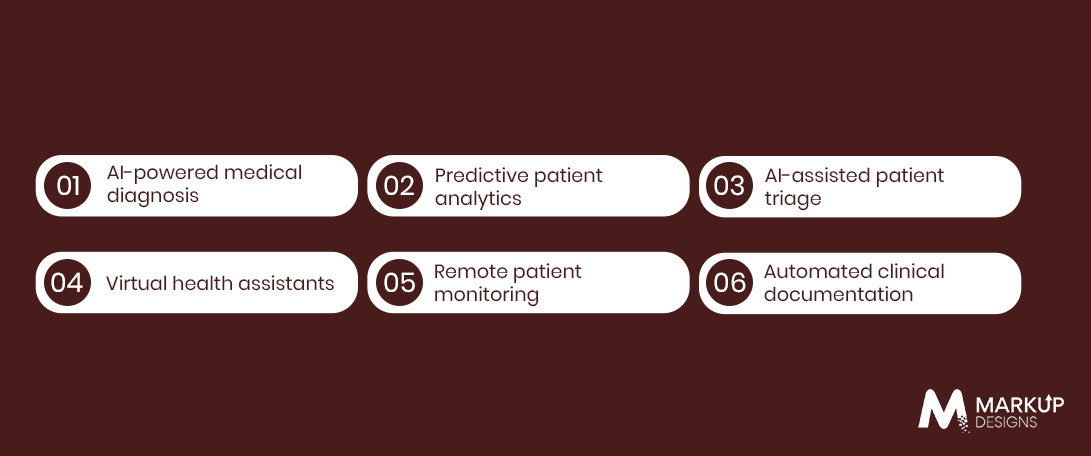
AI is currently making progress from research and trials to become a reality in the healthcare industry in the UK. It has been valuable in fields such as diagnosis and monitoring of patients to administration and care services. These AI application developments do not seek to replace healthcare workers but rather to make their work easier.
Here are some of the key real-world applications of AI in UK healthcare:
1. AI-powered medical diagnosis
AI can examine X-rays, CT scans, MRI scans, and other imaging technologies to detect possible anomalies. It can help medical professionals examine patients quickly and diagnose them early.
2. Predictive patient analytics
AI can analyze data and find out any possible patterns of patients who have the risk of getting a condition.
3. AI-assisted patient triage
AI-enabled triaging systems can examine symptoms of patients and assist them in getting into contact with proper healthcare services.
4. Virtual health assistants
Virtual assistants powered by AI can answer general inquiries of patients, give necessary health-related information, and guide them in getting into contact with healthcare services.
5. Remote patient monitoring
The system can analyze the data collected through connected devices and wearables to detect any change in the condition of a patient and notify healthcare providers.
6. Automated clinical documentation
AI-enabled transcription system can transcribe consultations of patients, summarize conversations, and save time spent on documentation.
How AI Applications Are Improving Patient Outcomes
The true importance of AI in healthcare lies not in its technical abilities, but rather in the benefits that such technology can bring to patient care. By accelerating the processing of information and early detection of possible risks, AI will help to make faster and more informed clinical decisions. In particular, AI-assisted diagnosis could help to diagnose certain diseases in advance, while predictive analytics would point out to those patients who need timely intervention.
AI would also contribute to improving the patient experience. Using virtual assistants and AI-based triage tools would help patients to access the necessary care more easily, while remote monitoring would provide some patients with care without constant trips to the hospital. On the other hand, by automating some processes, AI would lower the administrative workloads of healthcare professionals and free up their time for more patient interaction. Thus, the use of AI in healthcare could help to make healthcare more patient-oriented and faster in the UK.
Ready to Bring AI Into Your Healthcare Strategy?
AI can help healthcare organisations improve workflows, support clinicians, and deliver more responsive patient care. The key is choosing the right use cases and implementing them responsibly.

Challenges of Implementing AI in UK Healthcare
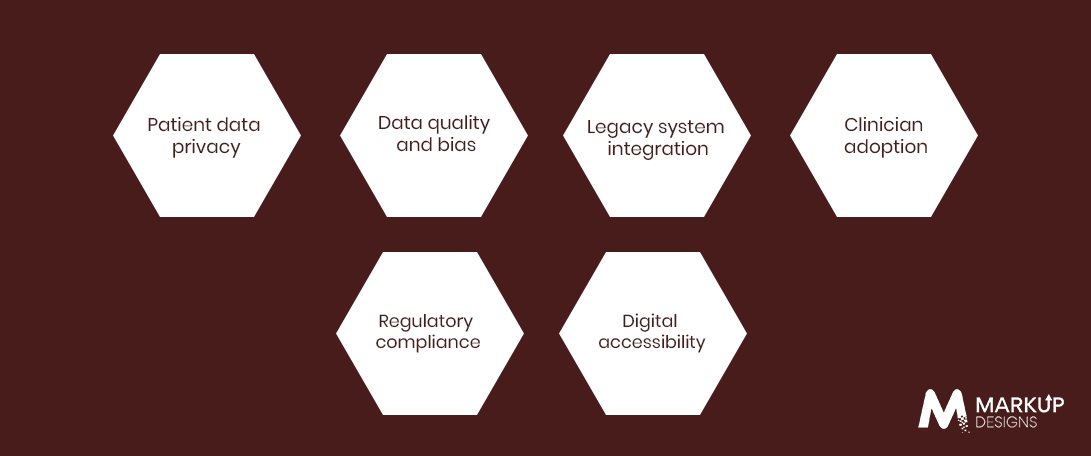
Although AI presents some potential advantages in the UK healthcare industry, implementing HealthTech compliance successfully involves a number of issues. Healthcare institutions must deal with these aspects carefully before using AI in their operations.
Patient data privacy
The effective use of AI in the field of healthcare depends on sensitive data. Therefore, high data protection standards, control over access, and safe data management are critical.
Data quality and bias
The performance of AI technologies is based on accurate data. Incorrect, outdated, and imbalanced data can influence performance and cause discriminatory results towards specific patients.
Legacy system integration
The majority of hospitals and clinics use legacy systems. Thus, integration with AI technologies without interrupting regular activities may become an obstacle.
Clinician adoption
The key to successful implementation of artificial intelligence in healthcare is the trust of healthcare professionals. Adequate explanation and training are important.
Regulatory compliance
AI technology must comply with the appropriate laws and regulations of the UK, including privacy, healthcare, safety, and medical devices, depending on the application.
Digital accessibility
There are differences in digital accessibility among all patients. That is why the implementation of AI must complement the existing care channels.
Addressing these challenges from the beginning can help organisations introduce AI more safely while keeping patient wellbeing, clinical responsibility, and long-term value at the centre.
Read Also: Choosing an AI Development Partner in the UK: Cost, Expertise, and Key Considerations
Responsible AI Adoption in the UK Healthcare Sector
The use of responsible AI becomes crucial if technology impacts the delivery of care and treatment decisions for patients. UK health systems should strive to strike a balance between being innovative and ensuring safety, privacy, transparency, and human oversight. It is important to focus on adding value rather than being innovative for the sake of being innovative.
A responsible approach should focus on:
- Human Oversight: The application of AI technology should assist healthcare practitioners, but clinical decision-making should be under proper human oversight.
- Data Protection: Patient data should be acquired, stored, and processed according to the relevant UK data protection regulations.
- Fairness and Transparency: Organisations should evaluate the AI technologies for any form of bias and how the system produces results.
- Clinical Validation: AI should be assessed and validated prior to deployment into a clinical setting.
- Performance Monitoring: There should be continuous performance assessment to determine any form of errors and unintended effects on performance.
- Accountability: There should be clear accountability of how the AI technology is applied and reviewed in a healthcare setting.
By following these principles, organisations can build greater trust among healthcare professionals and patients while creating a safer foundation for long-term AI adoption.
Read Also: How AI Is Transforming UK Businesses: 10 Real-World Use Cases
How Healthcare Organisations Can Prepare for AI Adoption
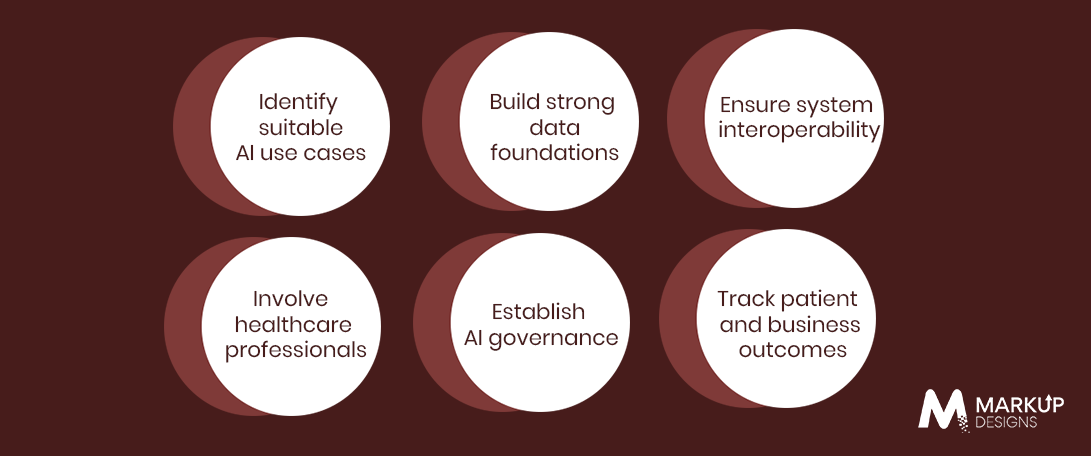
The deployment of AI does not only revolve around the selection and application of the technology. What health care organizations should focus on is creating a strategy that relates the use of AI to the general organizational objectives.
Identify suitable AI use cases
Start by considering those use cases where the use of AI could provide value through diagnosis, patient triage, monitoring, and automation of administrative tasks.
Build strong data foundations
Make sure that the data required for the development of an AI solution is accurate, available, secure, and governed effectively.
Ensure system interoperability
It is essential that the AI solution be rolled out within the existing IT platform in the healthcare industry without creating separate process flows.
Involve healthcare professionals
The appropriate healthcare practitioners, like doctors, nurses, administrators, and other personnel, must be involved in selecting and using AI solutions.
Establish AI governance
The governance policies for such issues as privacy, security, accountability, clinical supervision, and performance measurement for AI solutions need to be developed.
Track patient and business outcomes
Such benefits as reduced wait time, increased process speed, improved patient engagement, and decreased administrative efforts need to be measured.
Proper planning will help healthcare institutions adopt AI-based solutions in an incremental and responsible manner and build the foundation for further innovation in digital healthcare.
Why Markup Designs for AI-Powered Healthcare Innovation?
Finding a correct technological partner will be essential after AI integration into the processes or services performed by companies operating in the healthcare industry. At Markup Designs, we aim to create AI-based solutions that will solve the specific problem of a business or healthcare company and not just integrate some technologies into the process.
Our expertise will allow us to assist healthcare companies in going from understanding the need for the use of AI solutions to implementing them and improving the current situation.
Some of the AI solutions we provide are AI-based automation, intelligent virtual assistance, predictive analytics, patient engagement solutions, and AI-based workflow optimization.
This ensures that our results always keep our minds occupied. Be it reduction of administrative overheads, enhancing patient communications, process acceleration, or operational optimization, everything we do is geared towards creating value. With our knowledge about artificial intelligence end-to-end and a hands-on approach to implementation, Markup Designs can assist in realizing AI innovations in the health industry.
Turn Your Healthcare AI Vision Into Reality
AI can help healthcare organisations improve efficiency, support healthcare professionals, and create better patient experiences. The right implementation strategy can turn these opportunities into practical, scalable solutions.

Conclusion
AI will become an important component for the transformation of the UK’s healthcare system. Some examples of the implementation of AI already exist, including medical imaging, predictive analytics, patient triaging, remote patient monitoring, and clinical documentation.
However, there are some additional factors that should be considered when it comes to the implementation of AI. Those factors are data privacy, integration, clinical validation, regulation, and patient access. What is more important, any implementation of AI should have its goals and outcomes.
During the transformation of the UK’s healthcare sector, AI can become an important factor for ensuring that organizations are able to deliver their services effectively and efficiently. The most effective way of implementing AI is to provide healthcare professionals with better tools and time to work with their patients.
FAQs
1. How is AI being used in UK healthcare?
AI is being used for medical imaging, diagnosis, patient triage, predictive analytics, remote monitoring, virtual assistants, clinical documentation, and healthcare administration.
2. How does AI improve patient outcomes?
AI can support earlier diagnosis, faster decision-making, proactive intervention, personalised care, and easier access to healthcare services.
3. Is AI replacing doctors in the UK?
No. AI is primarily being developed as a support tool for healthcare professionals. Human clinical judgement and oversight remain important, particularly for significant healthcare decisions.
4. What are the main challenges of AI adoption in UK healthcare?
Key challenges include patient data privacy, data quality, system integration, regulatory requirements, clinician adoption, AI bias, and digital accessibility.
5. How can healthcare organisations prepare for AI adoption?
Organisations should identify suitable use cases, strengthen their data infrastructure, evaluate system compatibility, involve healthcare professionals, establish governance, and measure outcomes.
Author's Perspective
By now, it should be clear that AI in UK healthcare is moving beyond experimentation and becoming a practical part of modern healthcare delivery. From supporting diagnosis and patient triage to reducing administrative workloads, its real value lies in how effectively it can solve everyday healthcare challenges. But technology alone is not enough. Successful AI adoption requires the right data, responsible governance, clinical involvement, and a clear focus on patient outcomes. As healthcare organisations continue exploring these opportunities, the focus should remain on using AI responsibly, practically, and purposefully to support professionals and create better experiences for patients.
Discuss Your Project NowAjit Kumar Jha
VP - Business Operations
Related Posts
Healthcare 4.0 Explained: Technologies Driving the Next Era...

Healthcare IT Outsourcing: A Strategic Guide for Modern...
AI-Powered Smart Hospital Systems: The Future of Healthcare...
Insights Are Valuable & Execution is Priceless
You’ve read about the digital future. Now, let’s build the infrastructure to take you there. Move your strategy from the page to the product.
Design Your Solution Now
Contact Us
Schedule The Appointment At Your Convenience Date And Time.
30 Min
Web Conference
Time Zone
Indian standard time (08:30pm)

Thanks For Getting In Touch!
You’ve Taken The First Step Toward Transforming Your Digital Presence. Our Experts Will Reach Out Shortly To Take It Forward.
Launch Your Dream Project
Provide a brief overview of your project, and our specialists will evaluate your requirements. We will connect with you to explore how the right digital solutions can help you launch faster.