
In Brief
- Banks utilize the benefits of AI chatbots to deliver instant, individualized, and 24/7 customer service through natural language processing and assistance in routine banking tasks.
- Some examples of use cases are account and transaction management, Know Your Customer (KYC) process and onboarding, loans, fraud detection and prevention, customer service, and personalized recommendations.
- The price of implementing AI chatbots at banks ranges between $20,000 and $300,000+ based on such criteria as chatbot complexity, AI, banking integrations, security, communication channels, and maintenance.
- Some important criteria for implementation are banking integration and security, user authentication and protection, AI accuracy, regulatory compliance, handover, testing, and performance monitoring.
- The future of banking chatbots is creating an intelligent digital assistant.
Banks have digitized, and customers expect instant, hassle-free, and personalized services at all times. They would not like to wait on the phone or try finding solutions from lengthy help documents. This is where AI-powered chatbots become necessary.
We are going to discuss how AI-driven chatbots are employed by banks to automate conversation and deliver more effective customer service, which is instant and timely. From answering any questions regarding account issues to assisting customers with their loans and warnings about any frauds, chatbots can be employed in many different ways in the banking industry.
While rule-based bots were capable of just one task – to answer queries related to banking and accounts – today’s AI-powered chatbots not only understand natural language and recognize intent but are also capable of performing tasks when integrated with the system.
This blog will provide an insight into various applications of AI chatbots in the banking industry including its cost, benefits, challenges, and possible future prospects.
What Are AI Chatbots in Banking?
AI chatbots for banks are intelligent AI software tools that utilize techniques like NLP, machine learning, and generative AI to converse with clients through text-based or voice communication. These chatbots differ from conventional chatbots that are rule-based since AI chatbots comprehend the intentions behind client questions and answer in a more conversational manner.
These chatbots can be integrated into the banking platform, CRM software, payments gateway, or any other secure API that would enable them to offer instant help to customers. This means that the customer could enquire about some transaction, card status, loan suitability, or account services; in such a case, the chatbot will help him/her without needing to call customer service.
The modern generation of banking chatbots is capable of delivering more context-based answers based on the user and verified information sources. Once the proper level of security and authentication has been established, they would go beyond just answering the FAQs.
Therefore, it shows how critical AI chatbots have become in the era of digital banking.
Why Are Banks Investing in AI Chatbots?
The banks face the challenge of meeting customers demands for faster responses and availability of services through multiple digital channels. The customers expect quick and easy access to solutions and availability of support services at all times. Chatbots driven by artificial intelligence can assist banks in meeting those demands without increasing the burden on their customer support departments.
Here are some key reasons banks are investing in AI chatbots:
- Customer support availability: Chatbots are capable of answering customer inquiries anytime, even outside the banking working hours.
- Quick answer provision: Customer inquiries can be answered instantly, rather than having to wait for the agent’s response.
- Reduced workload: Routine tasks can be automated so that workers can concentrate on complicated issues.
- Personalized conversations: Relevant customer data can be used by AI to make conversations more informative and effective.
- Scalability: The chatbot can communicate with thousands of people at once in peak times.
- Digital experience improvement: Chatbots make using banking apps or websites much easier because help is provided throughout the customer journey.
With increasing improvements in AI technology, banks have been shifting their focus from considering chatbots to be just support systems to incorporating them into their overall digital banking strategy.
How AI Chatbots are Transforming Customer Experience
The customer experience is now a major differentiator in the world of banking. Consumers now want their bank to be as easy to access as the other technologies they interact with on a daily basis. The use of AI chatbots assists in fulfilling consumer demands.
Here are some ways AI chatbots are improving the banking experience:
- Instant help: Customers will have access to answers to their most common questions without having to wait for the support agent to reply.
- Personalized support: AI will understand the situation of the customer and provide relevant advice and recommendations.
- Easy bank experience: Chatbots will be able to guide customers in their account services, payments, and even loan applications.
- 24/7 availability: Customers will have the opportunity to receive support around the clock.
- Seamless handoffs to humans: If the request is too complicated, the chatbot will transfer the conversation to human agents with relevant context.
- Consistency: Customers will receive consistent responses regardless of which digital platform they use.
The outcome is an experience that is more responsive and simpler, while human teams can concentrate on the conversations that demand their attention.
Read Also: How AI Agents Are Transforming Customer Service
Key Use Cases of AI Chatbots in Banking
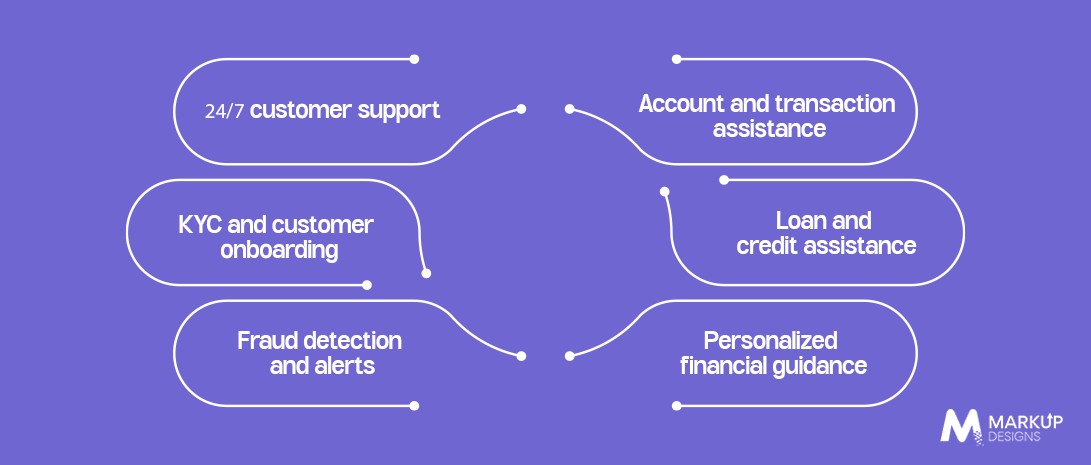
Today, AI chatbots do not only cater to FAQs on banking services but through integration and automation, they can serve their customers across various stages of their banking experience.
24/7 customer support
Help customers resolve questions concerning their accounts, cards, transactions, fees, branch services, and other general banking-related questions.
Account and transaction assistance
Help customers with questions regarding their accounts and transaction histories.
KYC and customer onboarding
Help customers in the process of opening an account and comply with KYC guidelines.
Loan and credit assistance
Informed customers of the available borrowing services, eligibility criteria, repayment period, and the entire procedure of loan application.
Fraud detection and alerts
Assisted customers in recognizing fraud activities and alerts and made them connect to the fraud team instantly.
Personalized financial guidance
Provided information to customers regarding their expenses, financial advice, savings, and other related queries.
Automation of such interactions will enable banks to provide efficient services to their clients and reduce the burden on their customer service personnel.
Ready to Make Banking Support Smarter?
Give your customers faster answers, personalized assistance, and seamless self-service with an AI chatbot built around your banking workflows and business goals.

AI Banking Chatbot Development Cost
The cost incurred by developing the banking AI chatbot depends on the nature of the chatbot and how advanced the chatbot is. For instance, a chatbot that is used to address frequently asked questions (FAQs) is less costly than an enterprise chatbot that is involved in transactional processes.
Some of the major factors that influence development cost include:
- Chatbot complexity: The basic chatbot, artificial intelligence chatbot, and transaction chatbot need different development efforts.
- AI technology: The expenses may depend on whether the solution uses NLP, generative AI, LLM, RAG, and other technologies.
- Integration with banking systems: The integration of the chatbot with the core banking, CRM, payments, KYC, and lending systems increases development complexity.
- Security and compliance: Security and compliance are an essential part of any banking solution and require appropriate efforts.
- Communication channels and languages: Mobile app integration, website integration, voice communication, or multilingual support may increase costs.
- Maintenance and improvements: Monitoring, retraining models, testing for security, and optimization also require additional effort.
Estimated AI Banking Chatbot Development Cost
| Chatbot Type | Estimated Cost |
| Basic FAQ Chatbot | $20,000–$40,000 |
| AI Customer Support Chatbot | $40,000–$80,000 |
| Transaction-Enabled Banking Chatbot | $80,000–$150,000 |
| Enterprise AI Banking Assistant | $150,000–$300,000+ |
Benefits of AI Chatbots for Banks and Customers
AI chatbots add value not only to the bank but also to its clients. Thanks to their automation capabilities, they can make the banking experience more pleasant for people and help financial institutions work better.
Key Benefits for Customers
- Faster Support: Instead of being put on hold while waiting for a call center representative, customers can immediately receive their answer.
- 24/7 Availability: The banking help desk operates round the clock.
- Personalized Responses: AI can draw from relevant context and give personalized responses.
- Simplified Services: Through the use of chatbots, customers can be assisted with complicated procedures such as onboarding, applying for loans, and requesting services.
- Self-service: Customers will have the ability to conduct their business without having to contact customer support repeatedly.
Key Benefits for Banks
- Decreased Workload: Chatbots answer routine inquiries, thereby allowing staff to deal with more complicated situations.
- Cost-Effective: By automating routine tasks, companies can reduce the cost of supporting simple customer requests.
- Increased Capacity for Customer Service: An AI can process multiple chats at once, especially during peak hours.
- Increased Efficiency of Agents: If a live agent is needed, they get all the necessary information about the conversation beforehand.
- More Customer Information: Chatbots give insight into typical customer questions, their needs, and preferences.
The biggest advantage is the combination of automation and convenience. Banks can serve more customers efficiently while customers receive faster, simpler, and more consistent support.
How to Implement an AI Chatbot in Banking
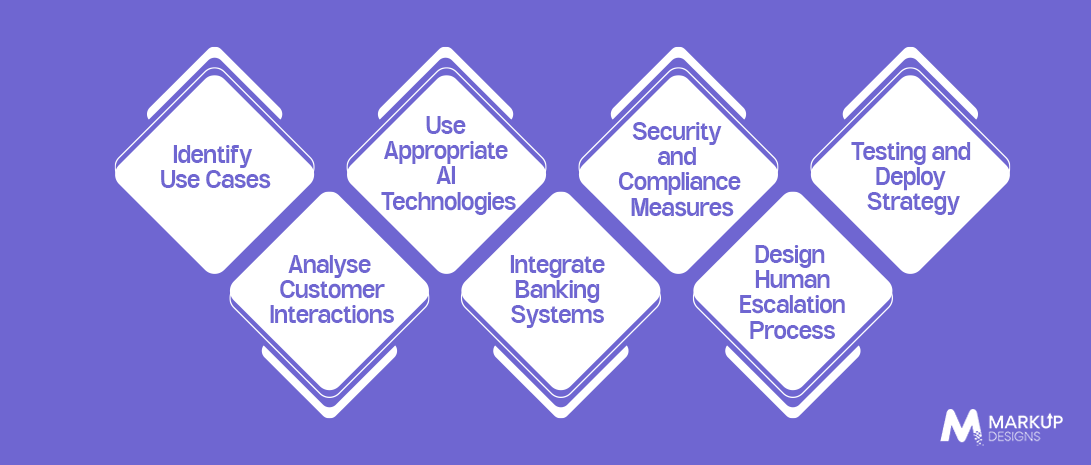
An AI chatbot for banks is much more complicated than simply installing a chatbot in the website or app. AI Integration should be done correctly using appropriate data and systems to give a good customer experience.
Here is a practical implementation process:
Identify Use Cases
Start with broad queries from the customer and routine tasks such as Account help, Card help, Onboarding, Loans help.
Analyse Customer Interactions
Analyse the support tickets, Call Centre Queries, FAQ and Customer Feedback to know what exactly the customer wants.
Use Appropriate AI Technologies
Select right NLP, LLM, RAG or hybrid AI technologies depending upon chatbot use cases and risks involved.
Integrate Banking Systems
Integrate the chatbot securely with CRM, core banking, payments, KYC, loan management, and other required systems via APIs.
Security and Compliance Measures
Appropriate authentication, authorization, encryption, access control, logging, and appropriate data protection.
Design Human Escalation Process
Design robust human escalation processes to deal with customer requests that are critical, complex, and difficult to resolve by the chatbot.
Testing and Deploy Strategy
Test the chatbot on accuracy, security, performance, and customer journey before starting any gradual rollout.
Monitor and Enhance
Monitor chatbot performance, customer feedback, failures, and business metrics.
Challenges of Implementing AI Chatbots in Banking
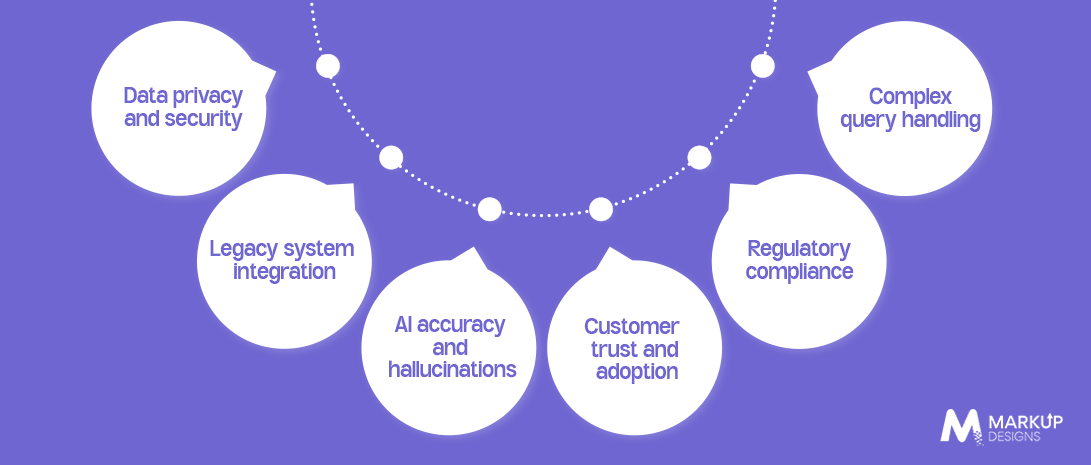
Though AI chatbots would make the banking experience more efficient, there are numerous challenges that will be encountered while implementing it. This is due to the fact that banks store highly confidential data and, therefore, it must be highly secure and accurate.
Data privacy and security
The bank chatbot could receive confidential data and, therefore, needs encryption, authentication, authorization, and proper data management.
Legacy system integration
Incorporating the existing AI solution into the existing core banking and enterprise applications might be challenging.
AI accuracy and hallucinations
Incorrect and inappropriate replies from the chatbot could have an impact on the client relationship. There are a few approaches to solving this problem: knowledge base, RAG, testing, and AI guardrails.
Customer trust and adoption
Customers might be worried about the use of the AI for their financial services. Transparency and the opportunity to get in touch with human agents would help here.
Regulatory compliance
It is important for the chatbot to operate in compliance with all legal requirements.
Complex query handling
Sometimes, certain financial situations need human reasoning or professional skills. Chatbots need to know when to do that.
The goal here is not the automation of every customer experience. It is for banks to leverage AI where it brings true value, while still maintaining human help when needed.
Why Partner with Markup Designs for AI Chatbot Development in Banking
Development of AI-powered chatbot for the financial services sector requires AI skills, secure development, integration of systems, and understanding the needs of the clients. The right technological partner can implement all of these requirements into practice.
Markup Designs’ team creates AI-powered software solutions that fulfill the actual business needs. Besides, the development of our chatbot for the financial services includes the usage of advanced AI technologies and systems integration.
Our team possesses AI skills and automation, integration of systems in a secure way, customer-oriented development, scalable architecture, and full-cycle development. The solutions will be integrated with CRM, banking, payments, and other enterprise systems and will help increase the customer interaction.
All of the processes, starting from planning and development up to the optimization of the solution, will be done by us. We are ready to develop the customer-support chatbot or AI banking assistant for you.
Make Banking Customer Support Smarter
Ready to improve customer service with intelligent automation? Partner with Markup Designs to build an AI-powered banking chatbot that delivers faster, more convenient, and scalable customer experiences.

Conclusion
AI-enabled chatbots are transforming the banking industry by providing faster, more efficient, and convenient customer support service. From answering simple queries to the process of onboarding, loan applications, and even frauds, chatbots can automate several basic tasks.
But to achieve that, only having AI will not work. What banks need to do is make sure that they have proper AI integration, data, control, human intervention, and regular monitoring. With the evolution of conversational AI, chatbots will become intelligent assistants in the banking industry. And hence, customers will have a great experience while dealing with banks, and banks will get rid of many tasks.
FAQs
What is a banking AI chatbot?
A banking AI chatbot refers to a type of conversational software that makes use of technologies like NLP, machine learning, and generative AI to help the bot understand customer questions and give out answers.
How do AI chatbots enhance banking customer experience?
They enhance customer experience through fast response time, availability all year round, providing personal assistance, self-service capabilities, and a seamless customer journey through banking digital channels.
What does an AI banking chatbot do?
It assists in answering questions from customers about accounts, transactions, onboarding, KYC, loans, services, fraud, among others.
Is an AI Chatbot safe for use in banking?
It could be secure if it is properly designed using necessary methods like authentication, encryption, authorization, monitoring, data security, and compliance measures.
What is the cost of developing an AI chatbot for banking?
The cost would depend on many factors including the complexity of the chatbot, AI technology, integration needs, security measures, channels and customization required.
Author's Perspective
AI chatbots are becoming an important part of modern banking, but their success should not be measured by replacing human interactions. The real value lies in making banking faster, simpler, and more convenient. Banks should focus on relevant use cases, secure integrations, personalization, and human support. As AI evolves, the goal should be to create banking experiences that are not only automated but also secure, responsive, and meaningful for customers.
Discuss Your Project NowJupinder Singh Arora
Founder and CEO
Related Posts
How to Build an App With Claude Code:...

AI Development Firm in the UK: How to...
Hiring an AI Development Partner in the UK:...
Insights Are Valuable & Execution is Priceless
You’ve read about the digital future. Now, let’s build the infrastructure to take you there. Move your strategy from the page to the product.
Design Your Solution Now
Contact Us
Schedule The Appointment At Your Convenience Date And Time.
30 Min
Web Conference
Time Zone
Indian standard time (08:30pm)

Thanks For Getting In Touch!
You’ve Taken The First Step Toward Transforming Your Digital Presence. Our Experts Will Reach Out Shortly To Take It Forward.
Launch Your Dream Project
Provide a brief overview of your project, and our specialists will evaluate your requirements. We will connect with you to explore how the right digital solutions can help you launch faster.