
In Brief
- Custom LLM Development (Custom large language model) allows companies to utilize large language models (LLMs), like GPT-3, BERT, or T5, to create their own custom-built AI solutions. LLMs are trained using multiple approaches, including reinforcement learning with human feedback (RLHF), private deployment, and fine-tuning on company-specific datasets, among others.
- You will learn about the entire LLM development process, including the key technologies involved, the foundational technologies (such as GPU-based computing), security practices, costs, timelines, and deployment strategies needed to implement successful LLMs in the enterprise.
- You will learn how to compare different development approaches when developing an LLM, such as reinforcement learning versus fine-tuning models. You will also learn about the various customizations available for LLMs (e.g., based on domain), the appropriate foundation model for your application, and how different customizations will impact the performance/success of your enterprise.
- You will learn about the various challenges that enterprises face when implementing LLMs (e.g., compliance issues, AI governance), and you will also learn best practices for building AI applications that are reliable, secure, scalable, and effective.
- You will be provided with a detailed understanding of contemporary trends related to LLM use in various industries, the types of use cases for purchasing and implementing LLMs, and how to maximize your enterprise’s ROI when adopting custom LLM solutions.
Artificial Intelligence has quickly moved from being a competitive advantage to a business requirement. At the forefront of this evolution are large language models (LLMs). These models allow companies to automate processes, enhance decision-making, provide personalized experiences for their customers, and extract answers from large amounts of data that are generated by their organizations. Although there are many publicly available AI models that have shown incredible capabilities, many businesses have learned that these generic models alone cannot meet their individual needs for AI development.
With the rise in regulation surrounding data privacy, security and compliance, all organizations today work in heavily regulated environments and depend on proprietary knowledge, unique documents, and specific industry jargon that are difficult for generally available models to understand. This has led to the increased need for Custom LLM Development as a means to help organizations develop AI systems that are specifically designed for their unique data, processes, and overall strategic goals.
Unlike public AI tools, Custom LLMs can be trained, tuned, and improved with enterprise knowledge, and thus generate correct responses that are relevant to the real world as well as data-driven and compliant in nature. Examples of how organizations can leverage Custom LLMs include providing clinical documentation assistance for medical professionals, assisting with risk analysis for financial institutions, or providing instant access to technical documentation for manufacturing companies.
The purpose of this guide is to provide all the necessary information that an enterprise should consider in the development of its own Custom LLM, including what types of development approaches exist, how to select the right foundation model, how to implement RAG, trending regulations related to the development, and how best to implement the deployment of scalable LLMs.
What Is Custom LLM Development?
The development of custom large model language (LLM) is when an organization adapts, improves, or builds a large language model that meets the unique needs of that organization. Enterprises build AI models that can understand the proprietary business information, industry jargon, and internal business process and policy of that enterprise, instead of just using a publicly available AI system.
The custom development of AI models allows enterprises to create intelligent applications that provide accurate, relevant, and secure answers while supporting the enterprise’s goals.
Although non-customized AI assistants are built on a vast amount of data from the internet, large model language (LLM) models developed by an enterprise are based on the specific knowledge base of that enterprise.
How Custom LLM differs from Traditional Models?
The key difference between LLM and foundation models such as GPT, Llama, Claude, or Mistral is that the foundation models have been built using a large amount of general knowledge and while foundation models are capable of accomplishing lots of tasks, they are limited in the domain-specific knowledge needed by many enterprises.
Custom developments of large model language (LLM) extend the foundation models by adding enterprise-specific data, terminology, business rules, and business processes.
Examples include
- A healthcare organization may custom-build an AI assistant that can use clinical terms and
follow hospital protocols.
- A legal firm may customize an LLM to analyze a contract while considering the specific jurisdiction rules.
- A manufacturer may create an internal AI assistant that retrieves equipment manuals and troubleshooting procedures.
The result is a more reliable AI system that delivers business-specific intelligence.
Different Approaches to Custom LLM Development
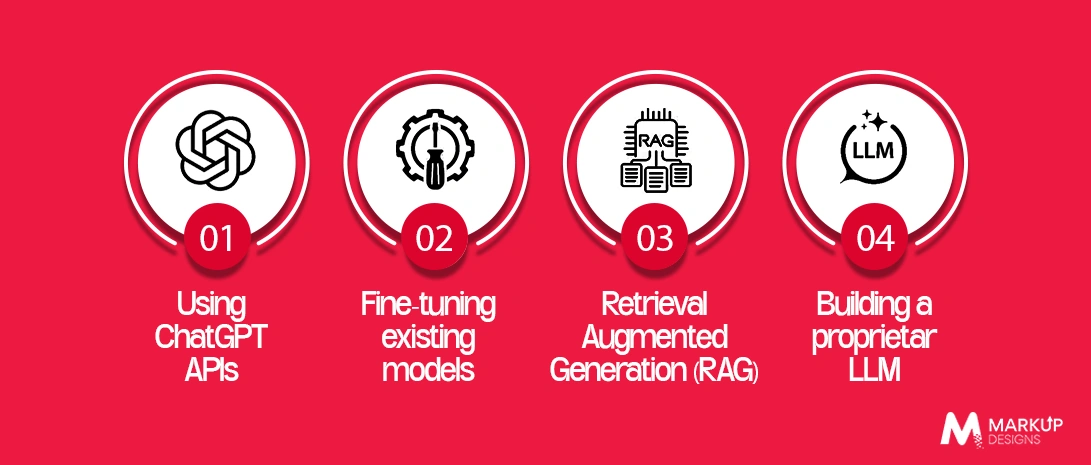
Enterprises can choose different strategies depending on their objectives, budget, and timeline.
| Approach | Description | Best For |
| Using ChatGPT APIs | Integrating existing LLM APIs into applications | Fast implementation |
| Fine-Tuning Existing Models | Training a model on proprietary enterprise data | Specialized tasks |
| Retrieval-Augmented Generation (RAG) | Combining LLMs with enterprise knowledge retrieval | Knowledge assistants |
| Building a Proprietary LLM | Training a model from scratch | Highly specialized enterprise requirements |
Each approach offers different levels of customization, cost, and complexity.
Why do Enterprises need custom LLMs?
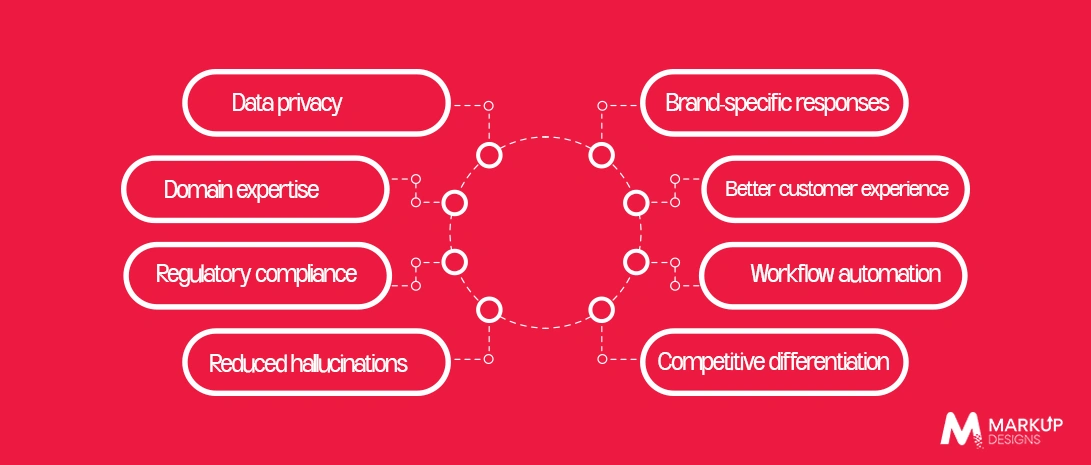
While generic AI models can be effective, they will have difficulties with organization-specific knowledge, compliance standards, and company processes. That’s why creating a custom LLM is important.
Improved Data Privacy
Companies in a number of industries do not have the ability to send sensitive material to publicly accessible AI models.
Through private LLM development, companies can create models and use them in private cloud-based or non-cloud-based infrastructure, which will provide security to their customers’ private information, patents, and confidential company materials.
Domain-Specific Knowledge
Enterprise AI solutions frequently require domain-specific knowledge that does not exist in publicly available datasets.
Examples of domain-specific knowledge are:
- Medical Terminology
- Insurance Regulations
- Financial Reporting
- Manufacturing Processes
- Legal Documents
Custom AI model development is used to construct models that can comprehend this information.
Regulatory Compliance
Several industries must comply with multi-faceted regulations (such as healthcare, banking, insurance or government).
Custom LLMs can be built to accommodate:
- GDPR Compliance
- HIPAA Requirements
- SOC2 Controls
- ISO 27001 Security Standards
This helps to mitigate compliance risks while increasing operational effectiveness.
Minimized Hallucination
Publicly available AI models can give inaccurate information.
Using enterprise data by employing RAG or fine-tuning LLMs, organizations can develop a higher level of accuracy in their answers and will decrease the incidence of hallucinations.
Brand-Specific Answers
Every organization has a unique style, terminology and strategy for engaging with its customers.
Customization of AI models allows organizations to have consistent messaging through customer service, marketing, sales, and internal communications.
Improving Customer Experience
LLM-powered custom assistants provide customers with:
- Recommendations based on personalization
- Timeliness in resolving issues
- Understanding the context of conversations
- Language options for more than one language
- 24/7 support.
These features enable customers to have better experiences, which positively impacts their satisfaction and retention rates.
Automating Workflow
Enterprise Generative AI will automate repetitive workflows for employees by automating tasks such as:
- Summarizing documents
- Finding knowledge
- Drafting emails
- Generating reports
- Supporting employees with help
- Extracting data
By automating these tasks, employees can spend less time on mundane tasks and more time on strategic work.
Differentiating from the Competition
Businesses that invest in enterprise AI solutions provide faster innovation, improved employee productivity, and provide customers with superior customer experiences, generating a long-term advantage over their competition.
Enterprise Use Cases of Custom LLMs
Custom LLMs are transforming industries by automating repetitive tasks, improving decision-making, and enabling faster access to business-critical information. From healthcare and finance to retail, manufacturing, legal, and HR, enterprises are leveraging AI-powered solutions to enhance productivity, streamline operations, and deliver more personalized experiences.
Healthcare
Healthcare companies have begun developing applications powered by large language models (LLMs) for clinical automation, powering patient support assistants, helping with medical retrieval of knowledge, recommending treatment and accelerating the claims process from insurance, thereby allowing healthcare professionals to apply more of their time to providing care to patients.
Finance
Companies in the finance industry are developing enterprise LLMs to assist with assessing risk, helping to investigate fraud, summarizing financial reports, supporting regulatory compliance, conducting investment research, and automating customer service, all while improving the efficiency of their operations and the quality of the decisions they make.
Retail and E-Commerce
Retailers have implemented generative AI as an intelligent shopping assistant; personalized product recommendation, automated customer support, product inventory assistant, review summarization tool, and personalized marketing material to increase customer engagement and conversions.
Manufacturing
Manufacturers use customized LLMs as an SOP guide, predictive maintenance tool, equipment troubleshooting support, technical documentation search engine, knowledge management tool, and production support; thus allowing employees instant access to critical operational information.
Legal
Legal firms/teams develop customized LLMs to aid with contract review, summarizing legal documents, researching compliance, retrieving case law, performing due diligence, and analyzing policies. By using customized LLMs/developing customized LLMs, they reduce or even eliminate research time while increasing the consistency and accuracy of their output.
Human Resources
HR departments develop/provide enterprise AI solutions for automating recruitment support, automated resume screening, employee onboarding process, HR knowledge database, internal policy support, and providing personalized learning recommendations to employees. This allows teams to devote more time/energy/resources toward strategically developing/engaging the workforce.
Custom LLM Development Approaches
Selecting the appropriate development strategy depends on business objectives, available data, security requirements, and budget.
| Approach | Cost | Timeline | Advantages | Limitations | Best For |
| Prompt Engineering | Low | Days | Fast, inexpensive | Limited customization | Quick prototypes |
| RAG | Medium | Weeks | Real-time knowledge, minimal retraining | Requires knowledge management | Enterprise search |
| Fine-Tuning | Medium-High | 1–3 months | Better domain expertise | Requires quality training data | Specialized tasks |
| Continued Pre-training | High | Several months | Strong domain adaptation | Higher infrastructure cost | Industry-specific AI |
| Training from Scratch | Very High | 6–18 months | Full control | Massive cost and data requirements | Large enterprises with unique needs |
For most organizations, combining RAG with selective fine-tuning offers the best balance between performance, flexibility, and cost.
Step-by-Step Enterprise LLM Development Process
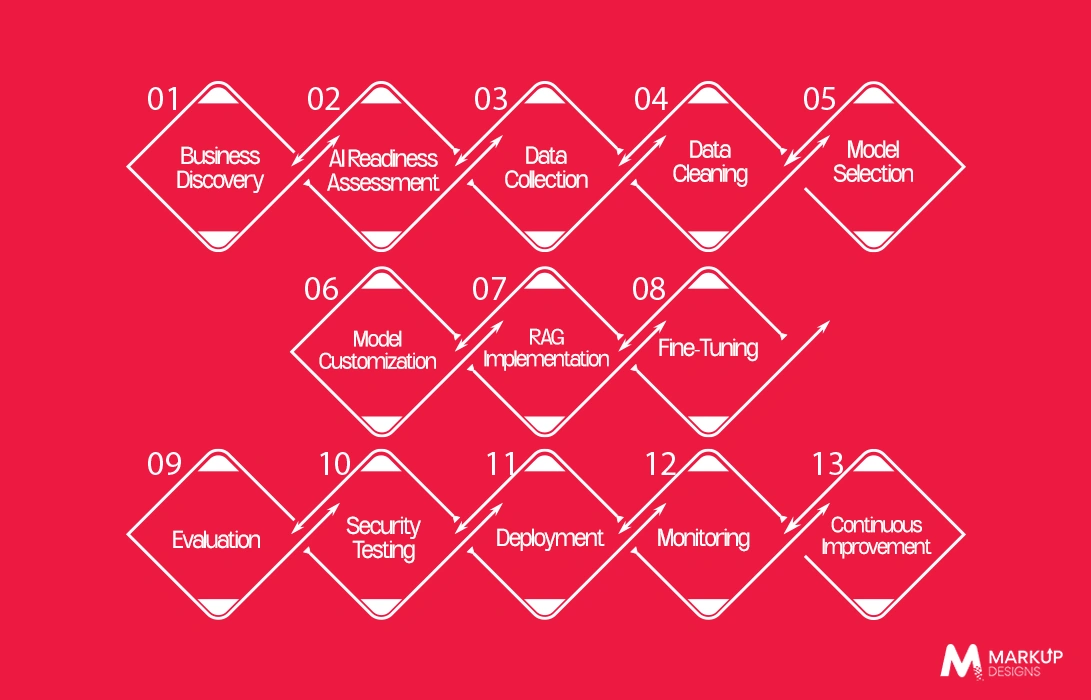
The development of successful custom LLMs follows an established lifecycle to ensure that the project is aligned with business goals and will provide security, scalability, and long-term value.
Step 1. Business Discovery:
The first step is to establish measurable business objectives and identify pain points of the company, as well as key stakeholders, end-users, desired outcomes, and possible AI use cases. In doing this, an overall development roadmap can be created.
Step 2. AI Readiness Assessment:
Companies assess the availability of their data, current infrastructure, security needs, level of AI maturity, and technical abilities, as well as how their existing business processes integrate with LLM technology to determine if they are ready to implement an enterprise-level LLM.
Step 3. Data Collection:
In this step, enterprise knowledge that is relevant to the project must be collected from records, databases, CRM systems, ERP systems, knowledge bases, customer interactions, internal applications, or other sources of data (both structured and unstructured).
Step 4. Data Cleaning:
After collecting the relevant enterprise knowledge, the data must be cleaned and standardized by removing duplicates, outdated records, inconsistent formats, missing values, and irrelevant records. The objective of this step is to ensure that the data used to customize the models will be of high quality.
Step 5. Model Selection:
After the relevant enterprise knowledge has been collected, companies must select their foundation model based on several criteria, including: degree of accuracy of the models; licensing terms; cost; context window size; deployment flexibility; performance; and overall readiness of the enterprise.
Step 6 – Model Customization
The model selected for use is custom-built through prompt engineering, Retrieval-Augmented Generation (RAG), fine-tuning and/or continued pre-training, or a combination thereof to accomplish specific business goals and to address unique requirements within the selected industry.
Step 7 – Implementing RAG
Vector embeddings of the enterprise’s documents will be created and stored in a vector database, allowing for the model to access the most relevant up-to-date document prior to forming its response, which will help improve response accuracy and reduce the occurrence of hallucination.
Step 8 – Fine-tuning
– When the model needs to be improved for specialised domain knowledge, it will be fine-tuned on data specific to the organization to help it understand specialised terms, the organization’s business practices, and language distinct to the industry.
Step 9 – Evaluation
– The custom модель will be evaluated against KPIs, including but not limited to accuracy, response relevance, hallucination rates, latency, consistency, and user satisfaction to ensure it meets both business and technical specifications.
Step 10 – Security Testing
The solution will be subjected to extensive security validation and testing, including but not limited to checking the integrity of data protection, access control, vulnerability assessments, compliance checks, and penetration testing, where applicable, prior to deployment.
Step 11 – Deployment
The enterprise LLM will be deployed either in a public cloud, private cloud, hybrid, or on-premises environment, based on the organization’s security, compliance, scalability and operational requirements.
Step 12: Monitoring and Continuous Improvement
Enterprise AI systems require continuous monitoring to identify performance issues, model drift, changing business requirements, and new training opportunities.
Organizations should regularly update knowledge bases, refine prompts, retrain models where necessary, and evaluate user feedback to maximize long-term value.
Read Also: What Businesses Should Evaluate Before Hiring AI Consultants
Technologies for Custom LLM Development
Designing enterprise-level LLMs requires an extensive technology stack that supports model-building, orchestration, deployment, and monitoring. A successful combination of technologies results in scalable, secure, and production-ready enterprise-level LLM applications.
Programming & Frameworks
Python forms the base language for all AI development due to having an extensive list of frameworks, including PyTorch and TensorFlow, which provide a powerful method for training, fine-tuning, and deploying full-text models.
Building & Orchestration
Hugging Face gives you access to countless pre-trained transformer models and datasets, while LangChain and LlamaIndex make your LLM application easier to build by providing prompt management capabilities, workflows, tool integrations, and Retrieval-Augmented Generation (RAG).
Data & Infrastructure
Vector databases, such as Pinecone, Weaviate, Milvus, Chroma, and FAISS, provide the ability to store embeddings for performing semantic search, while containers, such as those with Docker or Kubernetes, are used to accomplish consistent deployment, convergence across environments, scalability, and an efficient method of managing both hardware and software resources.
MLOps & Performance Improvement
MLflow helps with carrying out Machine Learning processes by having a way to track how well a model (or system) works with respect to an objective. The Ray framework is used to help train and predict machine learning models by processing large data sets across different computers. And GPU-based compute infrastructure from NVIDIA provides the required computing capacity for effectively training and minimally delaying predicted outcomes using a fully developed system with a large enterprise dataset of large language models (LLMs).
Cloud-Based Solutions
Services delivered by public cloud providers such as Microsoft (Azure AI), Google (Vertex AI), AWS (SageMaker), IBM ( Watsonx), and Oracle (AI) have democratized the infrastructure required to power enterprise applications, while also making it easier to offer scalable computing, reliable business operations, security, and enterprise-ready deployment solutions from within a single platform.
RAG or Fine Tuning? Which Is Better for My Enterprise?
Retrieval Augmented Generation (RAG) and Finetuning are two common strategies for tailoring enterprise-based LLM models to meet specific business needs. Although both strategies expand the ability of the model to provide value, they are designed to address different business problems. An LLM that uses RAG accesses additional information from outside of the system (e.g., a corporate knowledge database) to generate a more accurate prediction. On the other hand, a finetuned LLM uses additional training to modify the existing model’s parameters based on information that comes from the company or the industry in general (e.g., terminology, writing styles, types of reports), so it can produce more accurate results based on the different factors associated with the industry.
RAG vs Fine-Tuning Comparison
| Feature | RAG | Fine-Tuning |
| Cost | Lower implementation cost | Higher due to training infrastructure |
| Accuracy | Excellent for knowledge retrieval | Better for specialized language understanding |
| Updates | Instantly by updating documents | Requires retraining for new information |
| Security | Sensitive data remains in enterprise repositories | Sensitive data becomes part of the training process |
| Best For | Knowledge assistants, enterprise search, documentation | Domain-specific tasks, classification, specialized content generation |
How Enterprises Need to Prepare for AI Co-Workers
Explore how enterprises can prepare for AI co-workers with a strategic AI readiness roadmap. Explore AI governance, workforce transformation, human-AI collaboration, and AI-native workplace strategies that will be capable of executing multiple complex workflows.
What Is the Best Approach for Enterprises?
When starting on your enterprise journey, most organizations should pursue RAG solutions first because of lower cost, quicker time to market, and easier support requirements.Fine-tuning becomes valuable when the AI must consistently understand specialized terminology, industry-specific language, or unique business workflows. In many enterprise AI solutions, combining RAG with selective fine-tuning provides the best balance between performance, scalability, and cost.
Enterprise AI Architecture
A well-designed enterprise AI architecture ensures that custom LLM applications are secure, scalable, and capable of integrating with existing business systems. While implementation varies by organization, most enterprise LLM architectures follow a similar workflow.
Enterprise AI Workflow
Data Sources
↓
Business documents, CRM, ERP, databases, emails, knowledge bases, APIs
ETL (Extract, Transform, Load)
↓
Data cleaning, normalization, preprocessing, and indexing
Embedding Models
↓
Convert enterprise data into vector embeddings
Vector Database
↓
Store embeddings for semantic search and retrieval
Large Language Model
↓
Generate accurate, context-aware responses using retrieved enterprise knowledge
API Layer
↓
Expose AI capabilities to web applications, mobile apps, chatbots, and enterprise software
Security Layer
↓
Authentication, authorization, encryption, audit logging, compliance controls
Monitoring & Analytics
↓
Track usage, latency, hallucination rates, user feedback, and operational performance
This architecture supports scalable LLM integration services while maintaining enterprise-grade security and governance.
Security, Privacy & Compliance
Security and compliance are fundamental considerations in enterprise AI adoption. Organizations handling sensitive customer, financial, or healthcare data must ensure that custom LLM deployments align with industry regulations and internal governance policies.
Key security and compliance considerations include:
GDPR Compliance
Organizations operating in Europe must ensure that AI systems process personal data lawfully, support data deletion requests, and minimize unnecessary data collection.
HIPAA Compliance
Healthcare organizations using AI must protect patient information through strict access controls, encryption, and secure data processing practices.
SOC 2
SOC 2 demonstrates that an organization follows recognized standards for security, availability, confidentiality, processing integrity, and privacy.
ISO 27001
ISO 27001 provides a comprehensive framework for establishing and maintaining an information security management system.
Role-Based Access Control (RBAC)
Restricting AI access based on employee roles minimizes unauthorized exposure to sensitive enterprise information.
Encryption
Both data at rest and data in transit should be encrypted using enterprise-grade encryption standards.
Audit Logging
Comprehensive logs provide visibility into AI interactions, supporting compliance audits, security investigations, and governance initiatives.
Data Governance
Organizations should establish clear policies for data ownership, retention, quality, and lifecycle management to ensure reliable AI outputs.
Private Deployments
Many enterprises choose private cloud or dedicated infrastructure to maintain complete control over sensitive information and intellectual property.
On-Premise Hosting
Industries with strict regulatory requirements often deploy LLMs entirely within their own data centers, preventing confidential information from leaving organizational boundaries.
AI Governance
An enterprise AI governance framework should define ethical AI principles, model approval processes, risk management practices, and continuous monitoring procedures to ensure responsible AI adoption.
Cost of Custom LLM Development
The cost of custom LLM development varies significantly depending on project complexity, data volume, infrastructure requirements, and deployment strategy.
Estimated Project Costs
| Project Scope | Estimated Cost |
| Proof of Concept | $20,000–$50,000 |
| Minimum Viable Product (MVP) | $50,000–$150,000 |
| Enterprise AI Platform | $150,000–$500,000+ |
Key Cost Factors
- Data preparation and labeling
- Infrastructure and cloud resources
- NVIDIA GPU usage
- Foundation model licensing
- Fine-tuning large language models
- RAG implementation
- API and enterprise system integrations
- Security and compliance requirements
- Monitoring, maintenance, and ongoing optimization
While enterprise AI projects require significant investment, they often deliver measurable returns through automation, productivity gains, reduced operational costs, and improved customer experiences.
Timeline for Enterprise LLM Development
Implementation timelines depend on project scope, data readiness, customization requirements, and integration complexity.
| Phase | Estimated Duration |
| Discovery & AI Readiness | 2–3 weeks |
| Data Collection & Preparation | 3–6 weeks |
| Model Development & Customization | 4–8 weeks |
| Testing & Validation | 2–4 weeks |
| Deployment & Integration | 2–3 weeks |
| Monitoring & Optimization | Ongoing |
A basic proof of concept may be completed within two months, whereas enterprise-scale AI platforms often require four to eight months, depending on organizational complexity.
Common Challenges and How to Overcome Them
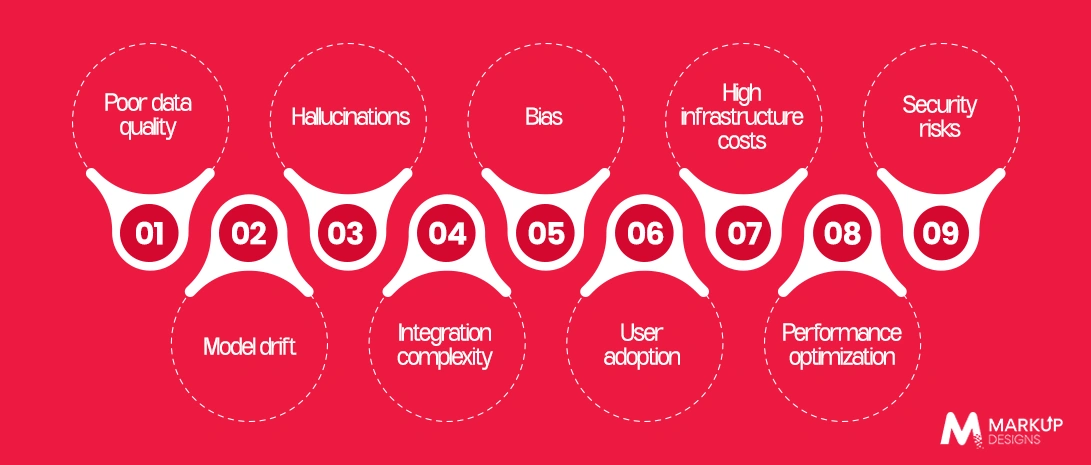
Enterprise AI initiatives often encounter technical and organizational challenges. Identifying these risks early helps improve project success rates.
| Challenge | Mitigation Strategy |
| Poor data quality | Implement rigorous data cleaning and governance processes |
| Hallucinations | Use RAG, human review, and continuous evaluation |
| Bias | Diversify datasets and regularly audit model outputs |
| High infrastructure costs | Optimize inference, use scalable cloud resources, and select the appropriate model size |
| Security risks | Apply encryption, RBAC, audit logging, and vulnerability assessments |
| Model drift | Continuously monitor performance and retrain when necessary |
| Integration complexity | Use APIs, middleware, and modular architecture |
| User adoption | Provide training, documentation, and change management initiatives |
| Performance optimization | Monitor latency, optimize prompts, and leverage GPU acceleration |
Starting Your AI Journey and Achieving Success with LLMs
Companies have to go beyond the development of LLMs; they need to implement the best practices that have been proven to provide long-term value.
- When starting with a new AI initiative, it is important to start with a high-value use case that delivers measurable ROI.
- Consider using retrieval-augmented generation in place of fine-tuning when possible to reduce costs and simplify the process of updating the model.
- Establish a human-in-the-loop workflow for all sensitive decisions and quality assurance of the outputs generated by the model.
- Monitored performance of the model is essential—monitor the performance, latency, accuracy, and satisfaction of the user with the model continuously.
- Establish an AI governance framework that includes compliance, ethics, and risk management.
- Evaluate outputs regularly through both automated testing and through human review.
- Maximize the efficiency of your inference costs through proper infrastructure, caching, and workload management.
- Continue to iterate and improve upon models using user-provided feedback based upon an evolving set of enterprise data.
Future Trends Impacting the Development of Enterprise LLMs
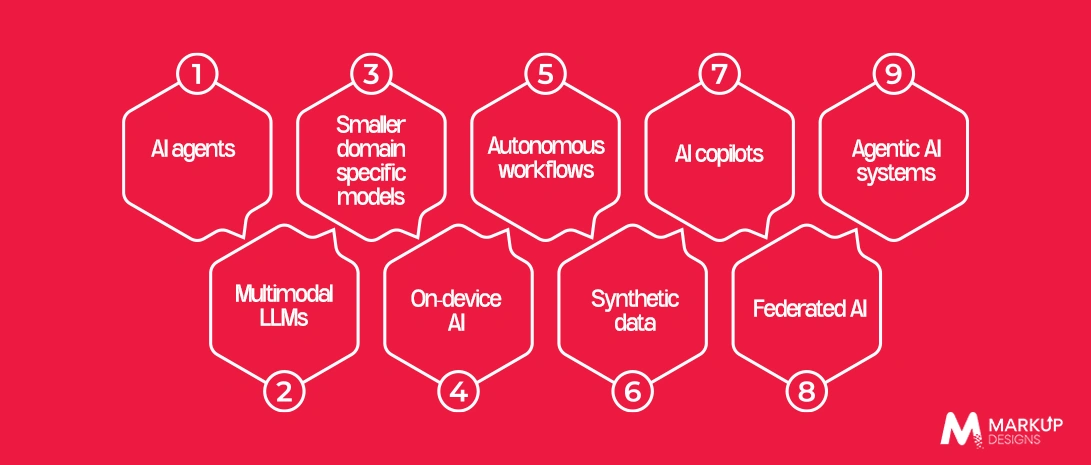
As enterprise AI matures, LLMs continue to become smarter, faster and more flexible in their ability to meet the needs of the enterprise.
AI agents that are able to automate complex workflows; multimodal LLMs that can process text, photos, audio, and video; smaller domain-specific models that provide faster performance and lower infrastructure costs; on-device AI to enhance privacy and reduce latency; AI copilot capabilities, and autonomous workflows that enhance the employee’s productivity and improve operational efficiencies.
AI Agents
AI agents can independently execute multi-step tasks, automate workflows, and make decisions with minimal human intervention.
Multimodal LLMs
These models understand and process text, images, audio, and video, enabling richer and more versatile AI applications.
Smaller Domain-Specific Models
Compact, specialized models deliver faster performance, lower costs, and improved accuracy for industry-specific use cases.
On-Device AI
Running AI directly on devices enhances data privacy, reduces latency, and minimizes dependence on cloud infrastructure.
Autonomous Workflows
LLMs are increasingly automating end-to-end business processes, improving operational efficiency and reducing manual effort.
AI Copilots
AI copilots assist employees with tasks such as content creation, coding, research, and data analysis to boost productivity.
Federated AI
Federated AI enables organizations to train models collaboratively while keeping sensitive data within their own environments.
Agentic AI Systems
These advanced AI systems combine reasoning, planning, and tool usage to complete complex business tasks autonomously.
Partner with Markup Designs
Markup Designs has a team of experts who work to create successful AI applications for enterprises by transforming AI strategy into production-ready solutions. Combining technical knowledge with business concepts is our strength. We can provide secure, efficient, and enhanced-performing custom LLM applications using our solution offerings:
- Complete custom LLM from end to end
- Develop an AI Strategic Plan and AI Consulting
- Implementation of RAG (Retrieval-Augmented Generation) technology
- Larger language model fine-tuning
- Private secure LLM development
- Deployed in Cloud, Hybrid and On-Premise environments
- Implementing enterprise-level MLOps and Monitoring
- Design AI Architecture for scalability
- Continuous Optimization and Support for your LLMs
Our team of professionals can help with the acceleration of AI transformation through the development of an AI-powered Knowledge Assistant, automate enterprise operational workflow processes, and implement your custom LLM(s).
Build Secure Enterprise AI Solutions
Transform your business with custom LLM development tailored to your industry, workflows, and security requirements. From AI strategy and model customization to deployment and ongoing optimization, our experts deliver scalable enterprise AI solutions that drive measurable business outcomes.
Conclusion
Custom LLM development is transforming how enterprises leverage artificial intelligence to improve efficiency, automate workflows, and deliver intelligent customer experiences. Rather than relying solely on public AI models, organizations are increasingly investing in secure, domain-specific AI solutions tailored to their business needs.
Whether through prompt engineering, Retrieval-Augmented Generation, fine-tuning, or more advanced customization strategies, enterprises can build AI systems that understand proprietary knowledge, reduce hallucinations, strengthen compliance, and integrate seamlessly with existing business processes.
The most successful enterprise AI initiatives begin with clear business objectives, high-quality data, strong governance, and an iterative implementation strategy. As AI technologies continue to evolve, organizations that invest in scalable, secure, and well-managed custom LLM solutions will be better positioned to drive innovation, improve operational performance, and maintain a competitive edge in an increasingly AI-powered marketplace.
FAQs
1. What is custom LLM development?
Custom LLM development involves adapting, fine-tuning, or building large language models using proprietary enterprise data to deliver domain-specific, secure, and context-aware AI applications.
2. How much does custom LLM development cost?
Costs vary based on project complexity. Proof-of-concept projects typically range from $20,000–$50,000, MVPs from $50,000–$150,000, and enterprise platforms can exceed $500,000.
3. How long does it take to build a custom LLM?
Most enterprise implementations require between two and eight months, depending on data preparation, customization, integrations, and deployment requirements.
4. Should I fine-tune or use RAG?
For most enterprises, RAG is the preferred starting point because it provides faster deployment, lower costs, and easier updates. Fine-tuning is recommended when deep domain expertise or specialized language understanding is required.
5. Can enterprises deploy LLMs on-premises?
Yes. Many organizations choose on-premise or private cloud deployments to meet strict security, privacy, and regulatory requirements.
6. Which industries benefit most from custom LLMs?
Healthcare, finance, manufacturing, retail, legal, insurance, telecommunications, education, and human resources are among the industries seeing significant value from enterprise LLM adoption.
7. How secure are enterprise LLMs?
When implemented correctly with encryption, role-based access controls, audit logging, private deployments, and governance frameworks, enterprise LLMs can meet stringent security and compliance requirements.
8. Which foundation model is best for enterprise AI?
The best choice depends on business requirements, licensing, deployment flexibility, performance expectations, and infrastructure. GPT, Llama, Claude, Mistral, Gemma, DeepSeek, and Qwen all offer distinct advantages.
9. How do you reduce hallucinations in LLMs?
Organizations can reduce hallucinations through Retrieval-Augmented Generation, high-quality training data, continuous evaluation, human review, and prompt optimization.
10. Why choose a custom LLM over public AI models?
Custom LLMs provide greater security, domain expertise, regulatory compliance, brand consistency, enterprise integrations, and improved accuracy compared to generic public AI systems.
Author's Perspective
Many organizations assume that building a custom LLM means training a model from scratch. In reality, this approach is rarely the most practical or cost-effective. For most enterprises, customizing an existing foundation model through Retrieval-Augmented Generation, selective fine-tuning, and robust prompt engineering delivers significantly faster time-to-value while minimizing infrastructure costs.
Another common mistake is treating AI as a standalone technology project rather than a business transformation initiative. Organizations that invest in high-quality data, establish clear governance policies, involve business stakeholders early, and adopt an iterative deployment strategy consistently achieve better outcomes than those pursuing large-scale implementations without measurable objectives. The long-term success of enterprise AI depends not only on choosing the right model but also on aligning AI initiatives with business goals, continuously monitoring performance, and adapting solutions as organizational needs evolve.
Discuss your Project NowAjit Kumar Jha
VP - Business Operations
Related Posts

AI Diet Assistant App Development: Everything Businesses Need...
How to Choose the Right AI Chatbot Development...
How eCommerce AI Chatbots Turn Customer Conversations Into...
Insights Are Valuable & Execution is Priceless
You’ve read about the digital future. Now, let’s build the infrastructure to take you there. Move your strategy from the page to the product.
Design Your Solution Now
Contact Us
Schedule The Appointment At Your Convenience Date And Time.
30 Min
Web Conference
Time Zone
Indian standard time (08:30pm)

Thanks For Getting In Touch!
You’ve Taken The First Step Toward Transforming Your Digital Presence. Our Experts Will Reach Out Shortly To Take It Forward.
Launch Your Dream Project
Provide a brief overview of your project, and our specialists will evaluate your requirements. We will connect with you to explore how the right digital solutions can help you launch faster.