

In Brief
- Learn the average cost of developing a travel app in Dubai, as well as what affects the pricing of the app.
- Find out what basic and advanced features will be included in the app and how they will impact both timeframes for development as well as projections for the app’s budget.
- Find out how technologies such as AI, GPS capabilities, cloud infrastructure, and various third-party integrations shape the overall cost of developing a travel app.
- Examine how the requirements to develop a basic travel app differ from the requirements to build an average travel app, as compared to the requirements for developing a high-end travel app.
- Review real-world ways to reduce the cost of developing a travel app and increase ROI(short-term return on investment) over time.
Dubai has become an international leader in travel and tourism, attracting millions of tourists every year with its world-famous attractions, luxury products and services, cultural offerings, and business prospects. The travel industry is experiencing technological changes through digital transformation, so that more and more people rely on mobile applications to plan their trip, book accommodations, find tourist spots and attractions, manage travel plans, and get real-time information regarding their travel itineraries. This increased reliance on mobile devices has created great opportunities for start-ups, travel agencies, tour operators, and hospitality companies to invest in innovative travel applications that improve the way customers experience travelling and grow their business.
However, one of the most frequently asked questions that companies have prior to launching their platform is “How much does it cost to develop a travel app in Dubai?”
Many factors influence the price of developing a travel app, including: different levels of complexity of an app; feature sets; how it looks and functions; what technology is being used; whether other technologies (such as software libraries) are incorporated; and how the app is built and delivered (i.e., native, hybrid).
In this article, we’ll take a look at some of the factors that will affect the cost of building a travel app in the Dubai market, including the current trends in future, technology, and general strategies for getting the highest value from your investment.
Introduction To The Dubai Travel App Market
Travel technology, through the use of AI-driven technology, has been changing dramatically in recent years and continues to grow at a rapid pace by facilitating personalized recommendations, chatbots, predictive pricing, and intelligent itinerary planning. This presents huge opportunities for startups, travel agencies, hospitality providers, and tourism companies to build travel apps targeting various segments of a diverse and ever-changing traveller population.
Tourism Success in Dubai
Dubai is one of the top three countries that have the highest number of visitors per year (after London and Paris), and attracts millions of visitors for business, pleasure, shopping, nightlife, and luxury travel. The large and thriving tourism industry supports strong demand for digital services to help visitors plan, organize, and enjoy their travels.
Expansion of The Digital Tourism Industry
More and more travellers choose to use mobile or tablet-based solutions for their travel needs, including booking flights, hotels, ground transportation, and activities. This has resulted in significant growth in the need for comprehensive travel apps, which provide users with convenience, up-to-date information, and a high level of personalized service.
Supporting Smart Tourism Initiatives by the Government
The innovative government initiatives supporting smart cities and digitization continue to reinforce the development of new products and services in tourism and travel systems that will enhance the overall visitor experience through the implementation of digital services. These programs have helped to accelerate the use of technological solutions in travel by promoting digital services.
Increased Adoption of AI in Travel Applications
The increasing use of AI in the travel industry provides businesses with a new way to differentiate themselves from competitors. Features such as AI-based travel recommendation engines, AI-based chatbots, automated customer service tools, dynamic pricing analysis, and personalized itinerary building are creating more engaging experiences for users.
Startup and Travel Agency Market Opportunities
The increased demand for digital travel-related services has resulted in significant growth opportunities for startups, travel agencies, tour operators, and other hospitality-related businesses. By investing in the development of highly featured travel apps, organizations will have improved customer engagement, enhanced efficiency in the delivery of service, new sources of revenue, and gain a competitive edge in Dubai’s fast-growing tourism marketplace.
Important Features for a Travel App in Dubai
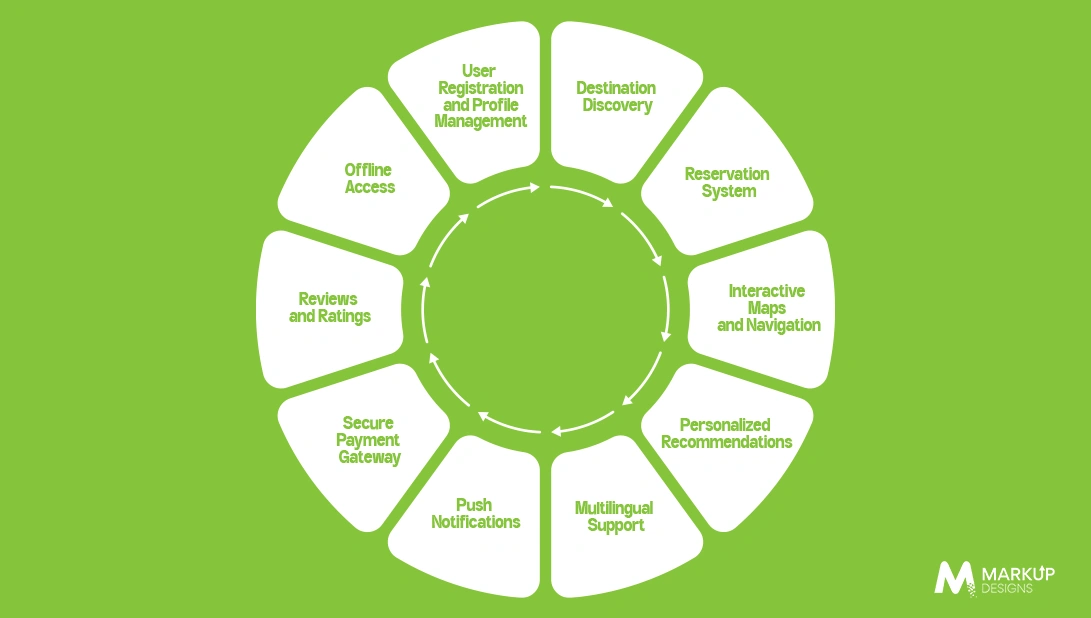
Whether you’re building a travel app for tourists visiting Dubai or creating a platform for local travel businesses, incorporating the right features is crucial for user engagement and long-term success. Here are the must-have features every modern travel app should include.
User Registration and Profile Management
A seamless registration and profile management system allows users to sign up using email or social media accounts, save their travel preferences, manage personal information, and access booking history for a more personalized travel experience.
Destination Discovery
The destination discovery feature helps travelers explore popular attractions, hotels, restaurants, events, and activities in Dubai, making trip planning more convenient and engaging.
Booking and Reservation System
An integrated booking system enables users to reserve flights, hotels, transportation, and tours directly within the app, creating a streamlined end-to-end travel experience.
Interactive Maps and Navigation
Interactive maps powered by GPS help travelers navigate unfamiliar locations, discover nearby attractions, plan routes efficiently, and access real-time location information.
Personalized Recommendations
Using AI and user behavior analysis, the app can deliver personalized recommendations for destinations, activities, accommodations, and dining options based on individual preferences and travel patterns.
Multilingual Support
Since Dubai attracts visitors from around the world, multilingual support allows users to access the app in English, Arabic, and other international languages, improving accessibility and user satisfaction.
Push Notifications
Push notifications keep travelers informed about booking confirmations, flight updates, special offers, travel alerts, and important reminders throughout their journey.
Secure Payment Gateway
A secure payment gateway enables users to make transactions safely using multiple payment methods while ensuring data protection and compliance with industry security standards.
Reviews and Ratings
Reviews and ratings allow travelers to share experiences, provide feedback, and make informed decisions based on recommendations from other users.
Offline Access
Offline functionality gives users access to downloaded maps, travel guides, booking details, and saved itineraries even when internet connectivity is limited or unavailable.
Cost to Build a Travel App in Dubai
The cost of developing a travel app in Dubai can vary significantly depending on the application’s complexity, feature set, design requirements, integrations, and technology stack. A simple travel booking platform requires considerably less development effort than an advanced travel ecosystem powered by artificial intelligence, real-time analytics, and immersive technologies. Understanding the different levels of app complexity can help businesses estimate budgets more accurately and choose the right development approach based on their goals.
Cost Based on App Complexity
Travel App Development Cost Comparison
| App Complexity | Key Features | Development Timeline | Estimated Cost |
| Basic Travel App | User registration, destination listings, basic booking functionality | 3–5 Months | $15,000 – $30,000 |
| Mid-Level Travel App | Advanced search, payment integration, personalization, notifications | 5–8 Months | $30,000 – $70,000 |
| Advanced Travel App | AI recommendations, AR experiences, real-time tracking, multi-vendor ecosystem | 8–12+ Months | $70,000 – $150,000+ |
Travel App Development Cost Breakdown by Development Stage
Establishing a travel app requires multiple steps, which contribute to the overall development cost. From initial planning and design to deployment and ongoing maintenance, each phase requires particular expertise, resources, and time. A good overview of how development cost distributes itself throughout the life cycle will serve to help businesses put effective budget allocations into place to avoid surprises later on in the project.
Market Research and Planning
All successful travel applications emerge following intense market analysis and strategizing. This phase traverses the analysis of competitors, seeking out market opportunities, understanding user expectations, and collecting exhaustive business requirements. The clearer the direction of the project plan, the fewer risks there are throughout the development, ensuring that the end product comes close to addressing the wishes of the business.
UI/UX Design
The design phase is all about creating a navigation system that is easy to use and, of course, aesthetically pleasing. Pretty much every designer uses wireframes, interactive prototypes, and user journey maps for tracing travelers’ pathways through the application. Because user experience is vital for app adoption and retention.
Frontend Development
The frontend development involves building user-facing components for the application. Depending on business requirements, developers can create native Android and iOS applications or use cross-platform frameworks such as Flutter or React Native, which can save development time and costs.
Backend Development
The backend forms the basis of travel applications. It manages data, user accounts, bookings, APIs, databases, and cloud services. A backend must be secure and scalable (able to handle vast numbers of users) for the app to work well as it grows.
Third-Party Integrations
A lot of the functionality of modern travel apps comes from their reliance on third-party services. Third-party integrations, like mapping services, payment gateways, hotel and flight booking APIs, and services that provide local weather, allow travel companies to provide end-to-end travel experiences within one app.
Testing and Quality Assurance
Before an app goes live, it must be thoroughly tested to verify that the app can be relied upon, secure, and operate as designed. Quality assurance (QA) teams perform functional testing, performance testing, usability testing, and security testing to identify any issues or problems that would affect users.
Deployment and Launch
Once the app has been developed and tested, it will be launched to the public and made available for download from the Apple App Store and Google Play Store. This includes the final optimizations being made; the app will go through store compliance checks and publishing approvals before it can be launched.
Ongoing Maintenance
Development of a travel app does not stop after it has been launched. Travel apps require constant maintenance to fix bugs, enhance performance, make necessary security updates, and add new features based on user feedback and emerging market trends.
Regular updates help keep the application competitive and ensure a smooth user experience.
Travel App Development Cost Distribution
| Development Stage | Cost Allocation (%) | Estimated Timeline |
| Market Research and Planning | 5% – 10% | 2 – 4 Weeks |
| UI/UX Design | 10% – 15% | 3 – 6 Weeks |
| Frontend Development | 20% – 25% | 6 – 12 Weeks |
| Backend Development | 25% – 30% | 8 – 16 Weeks |
| Third-Party Integrations | 10% – 15% | 2 – 6 Weeks |
| Testing and Quality Assurance | 10% – 15% | 3 – 6 Weeks |
| Deployment and Launch | 2% – 5% | 1 – 2 Weeks |
| Ongoing Maintenance | 15% – 20% Annually | Continuous |
Key Factors Affecting Travel App Development Cost

The cost of building a travel app in Dubai is influenced by the number of features you want to include. Several technical, operational, and business-related factors play a significant role in determining the final development budget. Understanding these cost drivers can help businesses make informed decisions, prioritize investments, and develop a travel application that aligns with both user expectations and business objectives.
App Design Complexity
The complexity of your app’s design directly impacts development costs. While a basic interface with standard layouts can be developed quickly, custom designs require additional effort in user research, wireframing, prototyping, and visual design.
Read Also: Understanding App Development Pricing Based on Features and Complexity
Feature Set
The number of features are the biggest cost determinants. Basic travel apps may only include destination browsing and booking capabilities, while advanced applications often incorporate AI-powered recommendations, itinerary management, real-time tracking, multilingual support, and intelligent travel assistants.
Platform Selection
Choosing the platforms on which your app will be available can substantially affect the budget. Developing separate native applications for Android and iOS generally requires more resources than building a single cross-platform solution.
Technology Stack
Frontend technologies determine the user experience, while backend technologies support data management, APIs, security, and system performance. Selecting modern, scalable technologies may require a larger initial investment but often results in improved reliability, flexibility, and future scalability.
Third-Party Integrations
Travel applications rely heavily on external services to deliver a seamless user experience. Integrations with flight booking systems, hotel reservation platforms, payment gateways, maps, weather services, and location-based tools add functionality but also increase development complexity.
Cloud Infrastructure
A reliable cloud infrastructure is essential for ensuring application performance, availability, and scalability. Costs vary depending on factors such as hosting requirements, storage needs, user traffic, and data processing demands. As the user base grows, businesses may need to invest in additional cloud resources to maintain optimal performance and reliability.
Security and Compliance
As a result, robust security measures and regulatory compliance are critical. Compliance with international standards such as GDPR, adherence to UAE data protection regulations, and secure payment processing requirements can increase development costs but are necessary for protecting users and maintaining trust.
Development Team Location
The location of your development team can significantly influence project costs. Hiring developers based in UAE typically involves higher hourly rates due to local market conditions and expertise. Offshore development teams may offer cost advantages, while hybrid models combine local project management with offshore development resources to balance quality, communication, and budget considerations.
Hidden Costs of Travel App Development
While the initial development budget covers design, coding, and deployment, several ongoing expenses can significantly impact the total cost of running a travel app. Businesses should account for these hidden costs early to avoid budget overruns and ensure long-term sustainability.
App Store Fees
Publishing an app requires developer accounts on both Apple and Google platforms. These recurring fees are necessary to maintain app availability and release updates.
API Licensing Costs
Travel apps often rely on third-party APIs for flight bookings, hotel reservations, maps, weather updates, and travel information. Many providers charge based on usage, making API costs an ongoing expense.
Cloud Hosting Expenses
Cloud infrastructure supports data storage, transactions, and real-time services. Hosting costs vary depending on user traffic, storage requirements, and application scalability.
Security Updates
Regular security updates are essential to protect user data, maintain compliance, and defend against emerging cyber threats.
Customer Support
Providing chat support, ticket management, and issue resolution helps improve user satisfaction but also requires dedicated resources and operational costs.
Marketing and User Acquisition
Launching a travel app is only the beginning. Businesses must invest in ASO, paid advertising, social media marketing, and promotional campaigns to attract and retain users.
How to Reduce Travel App Development Costs Without Compromising Quality
Developing a new mobile application provides an opportunity to create revenue and value for both users and developers. Planning is essential to managing expenses while also ensuring that the app delivers quality performance as well as a user experience.
Begin with An MVP (Minimum Viable Product)
You can validate your app’s concept and enter the market more quickly if you launch your product with just the basic core functions.
Place Priority On Must-Have Functions
Start by implementing only those functions that are necessary at first; additional functions can be added later during development in future updates.
Use Cross-Platform Development
Utilizing cross-platform mobile application development frameworks such as Flutter and React Native will allow you to develop both iOS and Android applications from one code base and thus will reduce the time it takes to develop each product.
Leverage Pre-Built APIs
Using pre-built APIs for maps, payments, booking services, etc., will speed up your development process and lower the overall costs associated with developing your product.
Partner With An Experienced Development Team
An experienced development team can help you avoid project delays, minimize risk, and ensure a successful delivery of your project.
Revenue Models for Travel Apps
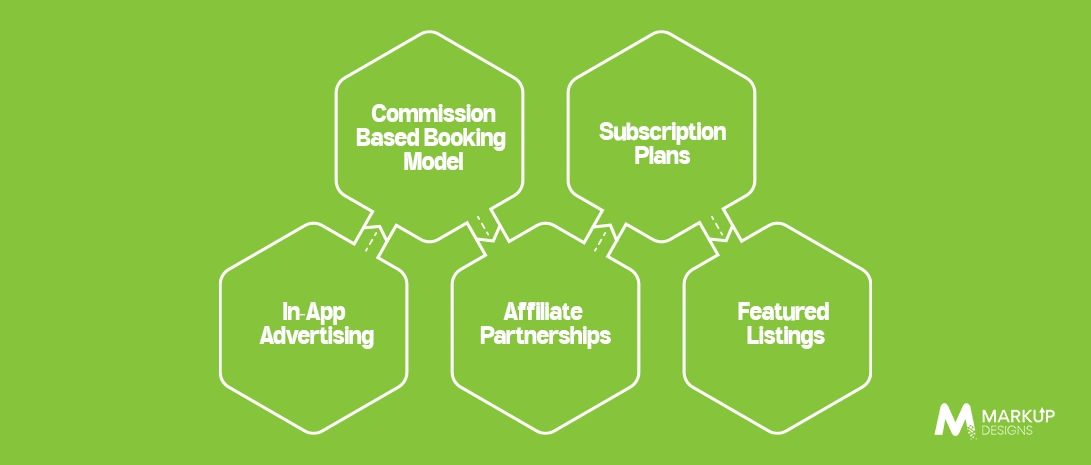
Having a well-defined monetization strategy for travel apps allows for a steady source of revenue while providing value to the end user as well as your business partners.
Commission-Based Booking Model
Earn a percentage from every hotel, flight, or travel service booked through your app.
Subscription Plans
Provide customers with additional value by offering them subscription options that provide additional features such as personalized itineraries, exclusive deals, and enhanced travel assistance.
In-App Advertising
Focus on in-app advertisements using sponsored listings, banner advertisements, or promotion of brands or businesses in your app that are related to travel.
Affiliate Programs
Partnering with hotels, airlines, tour operators, and tourism providers can generate additional revenue by providing them with referrals of customers who are interested in purchasing from those companies.
Featured Listings
Allow businesses to pay for priority placement and increased visibility within search results and recommendations.
Choosing the right combination of revenue models can maximize profitability while creating a sustainable travel app business.
Emerging Technologies Shaping the Future of Travel Apps
Emerging technologies are transforming travel apps, making journeys more personalized, efficient, and engaging.
AI-Powered Travel Planning
AI helps create smart itineraries and personalized travel recommendations based on user preferences.
Generative AI Travel Assistants
AI-powered assistants enable conversational trip planning and instant travel support.
Augmented Reality Experiences
AR enhances exploration through interactive destination guides and immersive travel experiences.
Real-Time Translation
Translation tools help travelers communicate seamlessly across different languages.
Predictive Pricing Analytics
Advanced analytics help users identify the best time to book flights, hotels, and travel services.
IoT and Smart Tourism Integration
Connected devices and smart tourism solutions create more convenient and personalized travel experiences.
Businesses that adopt these technologies can deliver enhanced user experiences and gain a competitive advantage in the evolving travel industry.
Step-by-Step Process to Develop a Travel App in Dubai
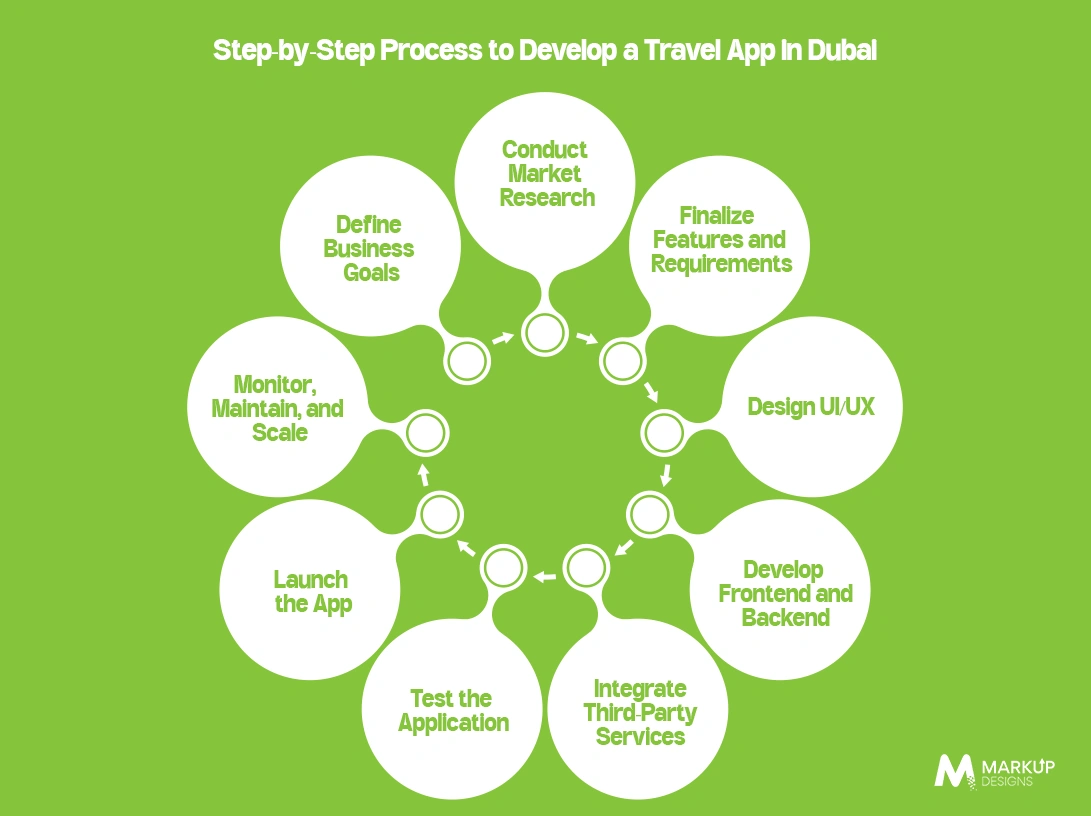
Developing a successful travel app requires a structured approach, from planning and design to deployment and continuous improvement.
Step 1: Define Business Goals
Identify your target audience, business objectives, and revenue model.
Step 2: Conduct Market Research
Analyze competitors, market trends, and user expectations.
Step 3: Finalize Features and Requirements
Determine the core features, integrations, and technical requirements for the app.
Step 4: Design UI/UX
Create an intuitive and engaging user experience through wireframes and prototypes.
Step 5: Develop Frontend and Backend
Build the user-facing interface and the backend infrastructure that powers the application.
Step 6: Integrate Third-Party Services
Connect APIs for payments, maps, bookings, and other essential travel services.
Step 7: Test the Application
Perform functional, performance, and security testing to ensure a smooth user experience.
Step 8: Launch and Market the App
Publish the app and promote it through strategic marketing campaigns.
Step 9: Monitor, Maintain, and Scale
Continuously improve performance, release updates, and scale the platform as user demand grows.
Why Choose Markup Designs for Travel App Development in Dubai?
Markup Designs provides mobile app development services that leverage industry experience and innovative technologies combined with deep-seated knowledge of the UAE, to create successful travel applications that enhance user experience while providing significant returns on investment for our clients.
We use an open development process enabling us to keep clients aware of progress and deliverables at all times during the development process, while providing a high degree of quality, security, and performance on all applications built.
Markup Designs provides ongoing travel application development support, ongoing application and technology optimization, and ongoing application support (after the application has launched) to allow the traveling public as well as travel companies to adapt to changing consumer needs and continue to be successful over the long term.
Are you Ready to Create Your Travel Application in Dubai?
Collaborate with Markup Designs to make your Travel Application idea into a full-feature, scalable digital platform. We will work with you through Strategy, UI/UX Design, Development, AI Integration to Post-Launch Support to create an amazing travel experience for your customers.

Conclusion
The cost of developing Travel Applications in Dubai vary depending on several factors such as application complexity, features, Technology Stack, Third Party Integrations and how much ongoing maintenance you are willing to provide .While a basic travel app can be developed with a modest budget, advanced platforms powered by AI, real-time services, and personalized experiences require a larger investment. By understanding the key cost drivers, planning strategically, and partnering with an experienced development company, businesses can build a scalable travel app that meets user expectations, drives engagement, and delivers long-term value in Dubai’s rapidly growing tourism market.
FAQs
1. How much does it cost to build a travel app in Dubai?
The cost of travel app development in Dubai typically ranges from $15,000 to $150,000+, depending on factors such as app complexity, features, design requirements, integrations, and technology stack.
2. How long does travel app development take?
A travel app can take anywhere from 3 to 12 months to develop. Basic apps generally require 3–5 months, while advanced travel platforms with AI and custom features may take 8–12 months or longer.
3. What technologies are used for travel app development?
Travel apps are commonly built using technologies such as Flutter, React Native, Swift, Kotlin, Node.js, Python, AWS, Google Maps APIs, and secure payment gateway integrations.
4. Can AI be integrated into a travel app?
Yes. AI can be used to provide personalized recommendations, smart itinerary planning, travel chatbots, predictive pricing insights, and enhanced customer support, improving both user experience and engagement.
5. How can a travel app generate revenue?
Travel apps can generate revenue through booking commissions, subscription plans, in-app advertising, affiliate partnerships, and featured listings, depending on the business model and target audience.
Author's Perspective
In my experience, the success of a travel app depends on much more than simply launching a booking platform. Today’s travelers expect personalized recommendations, seamless booking experiences, real-time assistance, and intuitive navigation, making technology a key differentiator in a highly competitive market. Businesses that strategically invest in the right features, scalable architecture, and emerging technologies such as AI are better positioned to deliver exceptional user experiences and achieve long-term growth. While development costs can vary significantly, a well-planned travel app should be viewed as a long-term investment that can drive customer engagement, operational efficiency, and sustainable revenue generation.
Discuss Your Project NowJupinder Singh Arora
Founder and CEO
Related Posts

How to Build an App Like Yuka: Features,...

10 Key Factors to Choose the Right Mobile...
Mobile App Development in Kuwait: Cost, Process, Features...
Insights Are Valuable & Execution is Priceless
You’ve read about the digital future. Now, let’s build the infrastructure to take you there. Move your strategy from the page to the product.
Design Your Solution Now
Contact Us
Schedule The Appointment At Your Convenience Date And Time.
30 Min
Web Conference
Time Zone
Indian standard time (08:30pm)

Thanks For Getting In Touch!
You’ve Taken The First Step Toward Transforming Your Digital Presence. Our Experts Will Reach Out Shortly To Take It Forward.
Launch Your Dream Project
Provide a brief overview of your project, and our specialists will evaluate your requirements. We will connect with you to explore how the right digital solutions can help you launch faster.