

In Brief
- Immersive technologies are now being implemented across all business sectors to streamline processes, increase operational productivity, provide employee training opportunities, and enhance customer service and decision-making.
- The foundation for AR & VR innovation is being laid through programs such as the Dubai Metaverse Strategy and various smart city initiatives.
- The tangible returns on investments being experienced by businesses that implement these technologies include lower operational costs, improved employee training, and enhanced speed of sales cycles, as well as enhancement of customer experiences.
- There is also a clear indication that AR & VR have moved away from traditional uses within entertainment into other industries, i.e., real estate, healthcare, retail, education & training, manufacturing, tourism, and logistics.
- By adopting immersive technologies today, organizations will be well-positioned to lead the next generation of digital transformation.
Ten years ago, Augmented Reality and Virtual Reality were primarily thought of in relation to gaming and entertainment. Today, they have developed into very powerful business tools that can be used to fundamentally change the way organizations provide employee training, engage customers, visualize data, manage assets, and deliver services to their end users. Dubai has become one of the most ambitious digital economies in the world, leading to an environment where immersive technology can flourish. With the support of the government, smart city programs, and an emphasis on innovation, companies located throughout Dubai are beginning to utilize AR & VR as solutions for significant business issues.
In 2026, the discussion around Augmented Reality (AR) and Virtual Reality (VR) is no longer centered on whether or not there is value for businesses within the space; they have since transitioned towards focusing on how they can see it through to implementation, scalability, and, furthermore, have tangible Return on Investment (ROI).
A Key Driver of the Digital Economy Using AR and VR

The way Dubai has digitally transformed has been key to accelerating the momentum of immersive technologies.
Dubai is positioning itself as a global leader in the world of virtual innovations through Government initiatives such as the Dubai Metaverse Strategy. Investments in AI, Digital Twins, Smart Infrastructure, and Advanced Connectivity have created lots of new possibilities for businesses to embed AR and VR technologies into their operations.
The AR & VR Ecosystem in Dubai is encouraging organisations to stop experimenting with these technologies for two specific areas and start implementing them as an overall strategy of digital transformation within their business.
Read: Also: How AI Is Transforming UAE Businesses in 2026
What UAE Governments and Businesses Are Using AR and VR
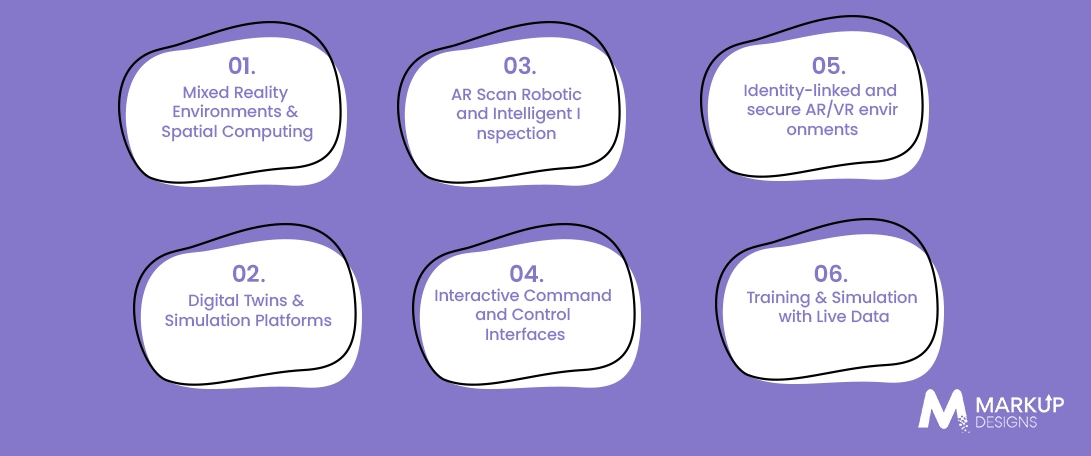
The adoption of AR and VR technologies in Dubai goes far beyond just providing customers with a better user experience. There is a great deal of enterprise-grade AR and VR technology being developed to enhance efficiency, visibility, collaboration, and decision-making within businesses.
Mixed Reality Environments & Spatial Computing
One of the most promising advancements in the field of immersive technology is Spatial Computing.
Many businesses are creating extremely interactive workspaces by integrating both physical and digital environments to allow employees to visualize data, collaborate remotely, and engage with digital assets in a real-life context. This is particularly useful in industries where accurate visualisation and collaboration are essential, such as engineering, architecture, construction, and urban planning.
Digital Twins & Simulation Platforms at the City Scale
Dubai has invested substantially in creating digital twin (DT) technologies to provide virtual representations of physical (infrastructure, facilities, urban environment) assets and operations.
Digital twins allow organisations to monitor their assets in 3D real-time; simulate whether the projected outcome was achieved; evaluate how the asset performed relative to its intended purpose; and determine how best to implement their changes before they are made at the physical level. The level of active participation from the public in utilising transport, utilities, infrastructure management, and smart city initiatives will become more reliant on seeing every action or decision (both planned and unplanned) as a ‘virtual object’ through digital twins.
AR Scan Robotic and Intelligent Inspection
AR Scanning robots and intelligent inspection systems are helping Industrial organisations by using augmented reality (AR) based inspection systems and robotic technologies to increase operational efficiency and improve the quality of maintenance.
Through the use of AR technologies, technicians can readily see physical objects as if they were overlaid with a digital representation. This enables technicians to identify problems more quickly, obtain immediate access to maintenance procedures, and perform inspections with greater accuracy/consistency, thereby reducing downtime.
Interactive Command and Control Interfaces
Dashboards are being transformed from traditional formats into more immersive operational environments.
Companies are now implementing command centers powered by AR and VR that enable organizations to collect and visualize large data sets into interactive visual environments. These command centers can assist organizations in developing better situational awareness, allowing decisions to be made more quickly, and providing team members with greater capabilities in managing complex activities.
Identity-linked and secure AR/VR environments
The security of immersive technologies has become paramount in business settings, as they are becoming increasingly embedded in enterprise operations and procedures. As a result, businesses are investing in AR and VR environments that maintain data security through identity management, user authentication, access control, compliance, etc. This allows businesses to utilize immersive technology to achieve their core work functions without sacrificing the security of their respective business.
Training & Simulation with Live Data
One of the most significant ways in which companies are utilizing AR & VR in the enterprise is through employee training. Many organizations are developing realistic simulation-based training systems that replicate their real-world operating environment, allowing employees to safely and effectively develop the skills they need to perform their jobs. When combined with real-time or live data, these training and simulation systems become even more effective, giving organizations the ability to train their teams using actual events and conditions.
Real-World Case Studies for AR & VR in Dubai
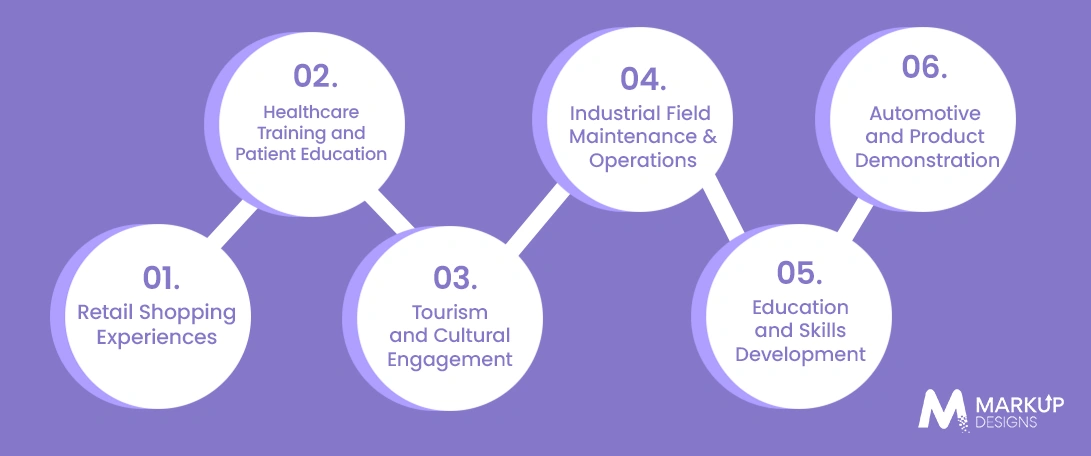
The increased adoption of immersive technology has been driven by businesses across multiple verticals that have begun using their respective industries’ business applications. In the case of AR & VR, organizations in Dubai are starting to realize the value in utilizing these technologies, particularly in the real estate and property app development.
Virtual tours allow potential buyers to view new developments remotely and explore floor plan options before construction is complete. This is highly beneficial for international investors and purchasing property “off plan.”
Retail Shopping Experiences
AR technology is being used to provide customers with more interactive experiences when shopping.
Shoppers can view products in their own environment, try out different product configurations, and gain additional product information before making a purchase. Customers feel more confident about their decision and, as a result, have a higher conversion rate.
Healthcare Training and Patient Education
Healthcare providers are using AR/VR technologies to enhance both provider training and patient education.
Providers can use VR simulations to rehearse medical procedures and use AR applications to better educate patients about their diagnosis and/or treatment options by providing a visual representation through the use of AR.
Tourism and Cultural Engagement
The tourism industry in Dubai is continuing to explore new and innovative ways to enhance the visitor experience.
With the help of AR technology, the tourism industry can build a more interactive narrative when sharing stories, provide insights into the history of attractions or museums, and deliver more personalized content to visitors at various attractions, museums, and cultural sites. As a result, visitors will have a more immersive and memorable experience.
Industrial Field Maintenance & Operations
More industrial businesses are utilizing AR to assist field service technicians and maintenance personnel.
Augmented Reality (AR) applications enable companies to use technology for real-time directions and advice, access to the equipment they are trying to use, and a way to see the equipment they are trying to use in action, thus reducing human error and improving productivity.
Education and Skills Development
In addition, companies are utilizing immersive technologies to enhance educational settings for their students. By providing engaging and interactive learning experiences, students will better understand complex subject matters through simulation or virtual interaction with the subject.
Automotive and Product Demonstration
Automotive companies have also begun to use AR/VR technologies as a means of changing how they introduce their products. Through AR/VR, automotive companies allow potential customers to view their vehicles and customize the vehicle configurations, as well as engage in virtual integration with the product before purchasing.
To Implement AR/VR in the UAE: A Practical Approach
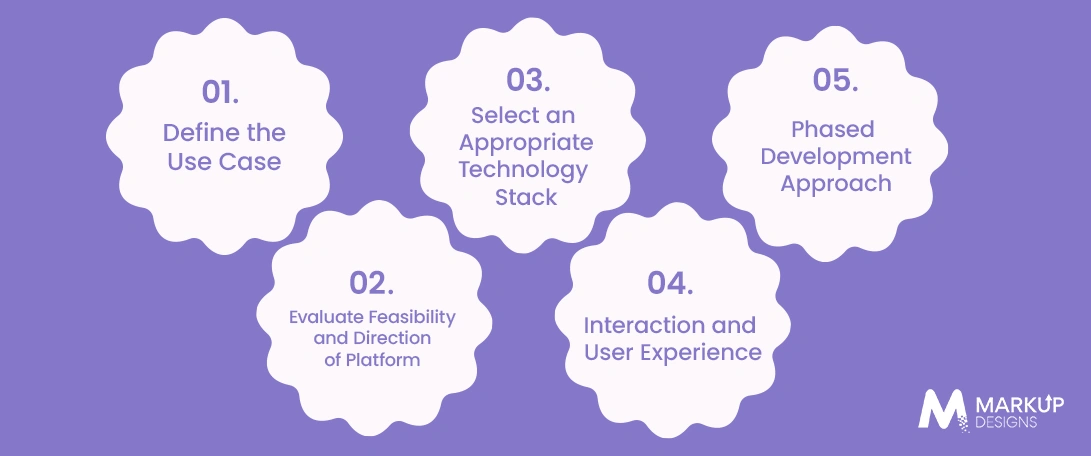
It is essential to create an organized strategic plan when using AR/VR technology; merely implementing technology for the sake of innovation alone will not meet your objectives.
Define the Use Case and Desired Outcome
When implementing AR/VR, organizations must first define the problem they wish to solve and the measurable outcome they are trying to achieve.
Evaluate Feasibility and Direction of Platform
Before developing any application, organizations need to evaluate their technical needs, user needs, their infrastructure, and determine what platform will be used.
Select an Appropriate Technology Stack
Your technology choice must support the future scalability of the application into an integrated service and meet the organization’s long-term business objectives.
Interaction and User Experience Flows in Design
Intuitive and engaging experiences that correspond with the operational needs of a health app will be the foundation for effective AR and VR applications.
Phased Development Approach
Starting with core functionality will allow the organization to validate its assumptions before expanding its capabilities through feedback.
Cost of AR and VR Development in Dubai
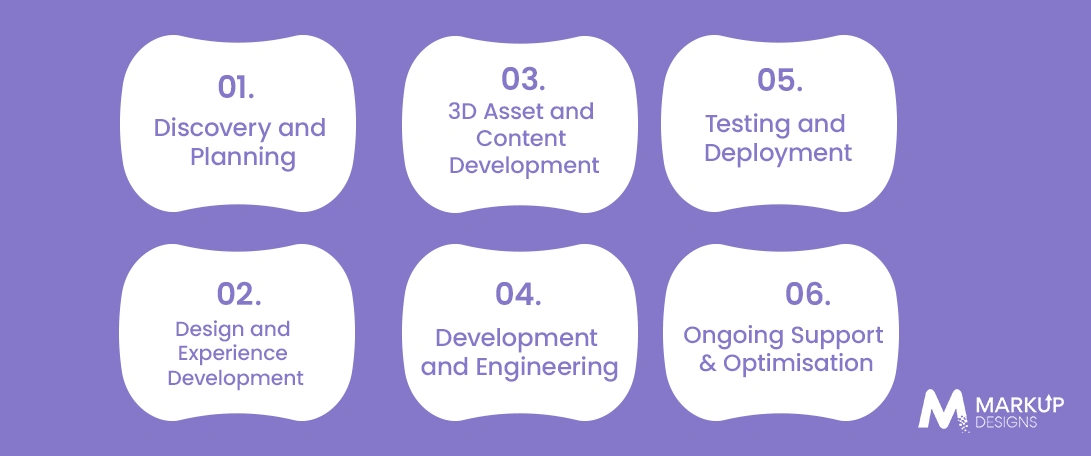
When determining investment requirements for an AR or VR development project, there are many factors that must be taken into consideration, including the complexity of the project, air pressure to control the pressure, and platform compatibility for use.
Discovery and Planning
Defining the objectives and gathering the requirements, discovering if technology is feasible, and determining the scope of the project.
Design and Experience Development
Developing User Experience Designs, Interface Designs, Wireframes, Prototypes, and Immersive Interaction Designs.
3D Asset and Content Development
Creating Custom Environments, Interactive Elements, Animations, and high-quality 3D Models are the majority of the work needed for most AR/VR Projects.
Development and Engineering
The total project cost is generally the cost of developing the application, integrating it into the platform that it will be running on, and implementing functionality.
Testing and Deployment
Testing all project components assumes that all project components have been tested to ensure that they have the expected performance, usability, compatibility, and security before they can be launched.
Ongoing Support & Optimisation
After the launch of the application, ongoing support and monitoring its overall performance to ensure the long-term viability of the application through post-launch updates and/or inclusion of new features.
Cost-Related Factors Impacting AR/VR Development in Dubai
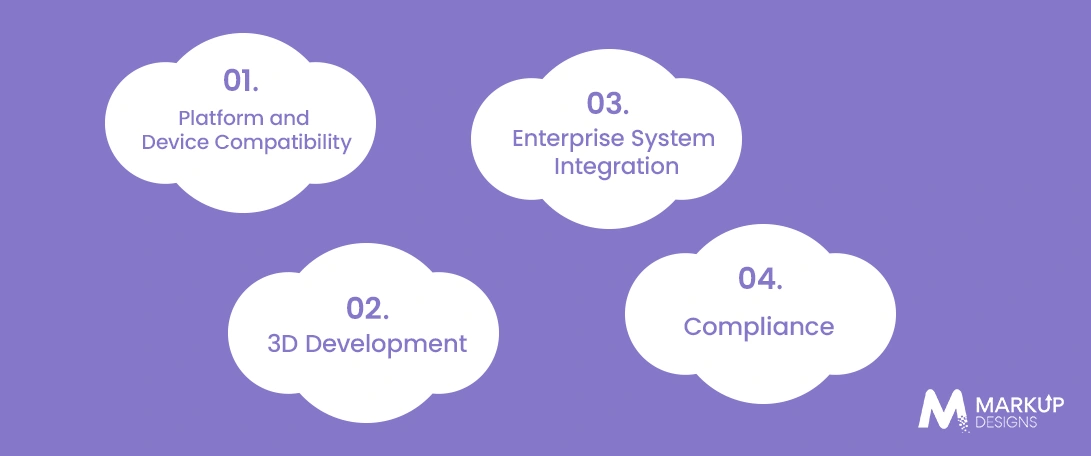
The overall complexity of the application in terms of the depth of the feature set.
The cost of developing an application based on advanced interaction technologies, including real-time simulation and multi-user environments.
Integration of Artificial Intelligence technologies in applications that require advanced development support.
Platform and Device Compatibility
Most of the time, an increase in complexity can be attributed to having to support different types of devices, different operating systems, and different types of platform/device hardware when developing a project.
3D Development
The overall cost of your project will be greatly influenced by how many 3D assets you create and how good those 3D assets are.
Enterprise System Integration
Integrating immersive applications with ERP (Enterprise Resource Planning) platforms, CRM (Customer Relationship Management), IoT (Internet of Things) devices, analytics platforms, and internal databases will require additional experience/expertise and development work.
Compliance
Security controls, how much budget needs to be spent on compliance measures, as well as implementing good, defensible governance frameworks; these initiatives are very likely going to require additional development efforts depending on the industry that your business operates within.
Why Dubai-Based Businesses Are Targeting AR/VR For Investment In 2026:
Through experience, organisations have begun to view immersive technologies as a strategic business tool instead of as an experimental innovation through which they can improve employee productivity within their businesses and create better customer experiences whilst reducing operational inefficiencies, improving training outcomes, enabling better teamwork among employees, and assisting with the use of data to make decisions about their current business operations.
As AR & VR technologies continue to grow, companies that started adopting these technologies early will have a competitive advantage over their competition and will also be able to meet their current operational requirements as well as enhance customer engagement through the use of immersive technology solutions.
How Markup Designs would help you modernize your AR & VR Technologies
At Markup Designs, we partner with organizations to bring creative concepts to life through interactive and immersive digital solutions that produce measurable value for their business.
Our team focuses on creating high-quality AR/VR solutions for businesses, enabling them to support employees through workforce training, enhance collaboration among team members digitally, and further engage with customers by visually representing products and optimizing operations.
From strategy, design, development, and deployment through ongoing support, we partner with businesses to help them confidently leverage these emerging technologies.
Are You Ready To Create The Future Of Digital Experiences?
By using immersive AR/VR solutions, organizations will be able to unlock new ways to enhance engagement, increase efficiency, and encourage innovation. By working with Markup Designs as a partner, businesses can create scalable AR/VR experiences that meet business objectives for today and prepare for the future.

Conclusion
Enterprises continue to see AR/VR technology as a critical component of successful enterprise innovation strategies in Dubai. As organizations implement their digital transformation initiatives, these technologies have created new ways for companies to engage their customers, train their employees, optimize their operations, and make data-driven business decisions.
Companies that strategically invest in AR/VR technologies now will be positioned to benefit as they compete in an increasingly digital economy that demands experiential engagement.
FAQ
1. Why are enterprises in Dubai investing in AR/VR technologies?
Enterprises in Dubai are investing in AR/VR to foster operational efficiency, improve customer experiences, enhance workforce training, and support digital transformation.
Government-backed programs such as the Dubai Metaverse Strategy and smart city initiatives have further accelerated adoption by encouraging businesses to explore immersive technologies as practical business tools rather than experimental innovations.
2. Which industries are adopting AR and VR the fastest?
Several industries are leading AR and VR adoption in Dubai. Real estate companies use virtual property tours and immersive project visualization, while retailers leverage AR for interactive shopping experiences. Healthcare organizations utilize VR for medical training and patient education, and industrial sectors deploy AR for maintenance, inspections, and workforce training. Education, tourism, automotive, logistics, and construction are also experiencing significant growth in AR and VR implementation.
3. How much does AR and VR development cost in Dubai?
The cost of AR and VR development varies based on project complexity, platform requirements, integrations, and feature sets. Basic AR applications may start from AED 80,000 to AED 150,000, while more advanced enterprise-grade solutions involving custom 3D environments, AI integration, digital twins, or multi-user functionality can exceed AED 500,000. Factors such as asset creation, hardware compatibility, and security requirements also influence the overall investment.
4. What are the biggest benefits of enterprise AR and VR solutions?
Enterprise AR and VR solutions provide numerous benefits, including improved employee training, enhanced customer engagement, faster decision-making, reduced operational errors, and increased productivity. They also help organizations visualize complex data, accelerate product demonstrations, improve collaboration across teams, and create more immersive customer experiences that drive business growth.
5. How long does it take to develop an AR or VR application?
Development timelines depend on the complexity of the solution. A basic AR or VR application may take three to four months to develop, while more advanced enterprise solutions involving custom integrations, digital twins, multiplayer functionality, or complex simulations can require six to twelve months or longer. Proper planning and phased development approaches can help streamline implementation.
6. Are AR and VR suitable for small and medium-sized businesses?
Yes. AR and VR technologies are becoming increasingly accessible for small and medium-sized businesses. Many organizations start with focused use cases such as virtual product demonstrations, employee training modules, interactive marketing experiences, or customer engagement applications. As technology becomes more affordable and scalable, SMEs can adopt AR and VR without the large investments that were previously required.
7. What technologies are commonly integrated with AR and VR platforms?
Modern AR and VR solutions are frequently integrated with technologies such as Artificial Intelligence (AI), Internet of Things (IoT) devices, cloud computing platforms, digital twins, enterprise resource planning (ERP) systems, customer relationship management (CRM) platforms, analytics tools, and machine learning models. These integrations help create more intelligent, connected, and data-driven immersive experiences.
8. How can businesses measure the ROI of AR and VR investments?
Organizations typically measure ROI through improvements in training efficiency, employee productivity, customer engagement, conversion rates, operational accuracy, and cost savings. Metrics such as reduced training time, lower maintenance costs, faster sales cycles, increased customer satisfaction, and improved workforce performance often provide clear indicators of the business value generated by AR and VR initiatives.
Author's Perspective
The way people discuss AR/VR has changed a lot in recent times. It’s gone from being a new technology to one that can be utilized in business for innovation, efficiency, and response time.
Dubai is invested in digital transformation; the government supports it, and there is a high enterprise demand for digital innovation. This makes it possible for immersive tech to go from being tested in pilot programs to being used broadly by businesses.
Those businesses that plan strategically for AR/VR, using them as tools of business transformation rather than standalone technologies, will be in the best position to achieve growth.
Discuss Your Project NowGaurav Goyal
Global Sales- VP
Insights Are Valuable & Execution is Priceless
You’ve read about the digital future. Now, let’s build the infrastructure to take you there. Move your strategy from the page to the product.
Design Your Solution Now
Contact Us
Schedule The Appointment At Your Convenience Date And Time.
30 Min
Web Conference
Time Zone
Indian standard time (08:30pm)

Thanks For Getting In Touch!
You’ve Taken The First Step Toward Transforming Your Digital Presence. Our Experts Will Reach Out Shortly To Take It Forward.
Launch Your Dream Project
Provide a brief overview of your project, and our specialists will evaluate your requirements. We will connect with you to explore how the right digital solutions can help you launch faster.