
Real Estate App Development in Dubai: Features, Cost & Trends
In Brief
- Dubai’s real estate market is rapidly expanding, driven by global investors and population growth
- Market value is projected to reach around $697.94B by 2026, with strong transaction activity
- Growing demand for mobile-first solutions is accelerating real estate app development
- Real estate apps enable buying, selling, renting, and property management on a single platform
- Cost ranges from $8,000 to $150,000+, depending on app complexity and features
- Key trends include AI, AR/VR, blockchain, IoT, big data analytics, and voice search
Dubai’s real estate landscape is changing at a faster rate, positioning the city as one of the most dynamic property markets in the world. It is known for its luxury residential developments and high-yield commercial assets, while continuing to attract global investors seeking strong returns and long-term value. Backed by ambitious urban expansion plans and government-led smart city initiatives, the sector is advancing at a remarkable pace. This rapid transformation has significantly increased the demand for real estate app development in Dubai, enabling businesses to streamline property discovery, evaluation, and transactions in a more transparent and highly efficient manner
The Dubai real estate market continues to demonstrate strong support in early 2026, driven by rapid population growth, sustained foreign investment, and its reputation as a global haven for investors. Property transactions have reached record-breaking levels, with the overall market value projected to touch US$697.94 billion by 2026.
Key Trends Shaping the Real Estate Market in Dubai
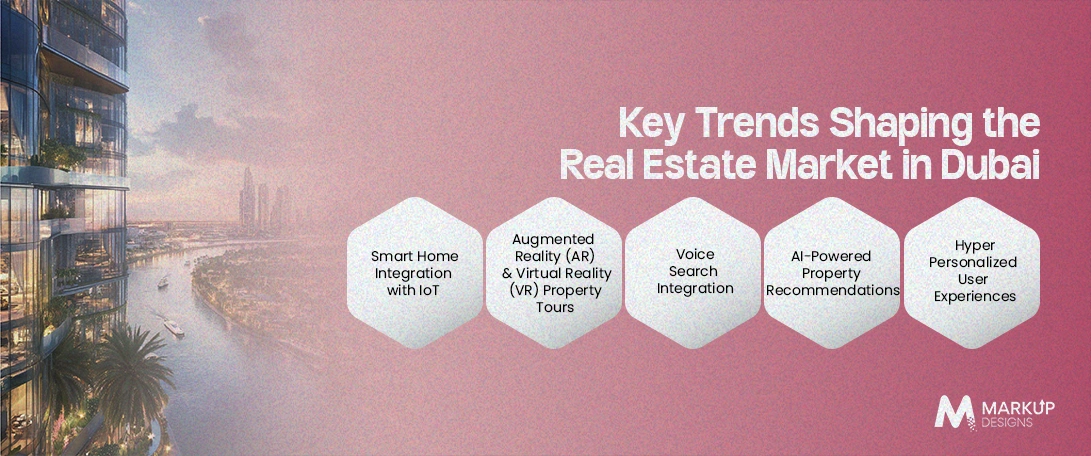
1. Smart Home Integration with IoT
IoT is transforming real estate applications by enabling seamless connectivity between apps and smart home devices. Users can monitor and control lighting, temperature, security systems, and energy usage directly through the application, offering greater convenience and control.
Key Features
- Live data integration from smart meters
- Remote control of lighting and appliances
- Smart home compatibility display for properties
2. Augmented Reality (AR) & Virtual Reality (VR) Property Tours
AR and VR technologies are revolutionizing property viewing experiences by allowing users to explore homes virtually through immersive 3D walkthroughs. This reduces the need for physical visits and enhances decision-making for buyers, especially remote investors.
Key Features
- 3D virtual walkthroughs of properties
- VR headset-supported immersive tours
- Virtual staging for unfurnished properties
3. Voice Search Integration
Voice-enabled search is becoming a key feature in modern real estate apps, allowing users to find properties quickly using natural speech commands. It improves accessibility, speed, and convenience for users on the go.
Key Features
Voice-enabled property search functionality
- Natural language processing for accurate results
- Multi-language voice support for wider reach
4. AI-Powered Property Recommendations
Artificial Intelligence is reshaping property discovery by delivering personalized listings based on user behavior, preferences, and search history. This improves engagement and helps users find relevant properties faster while supporting agents with better lead targeting.
Key Features
- Smart filtering and dynamic sorting
- AI-driven investment insights and recommendations
- Personalized property suggestions
5. Hyper-Personalized User Experiences
Modern real estate apps are leveraging machine learning to create highly personalized user journeys. From tailored listings to customized interfaces, apps are becoming more intuitive and user-focused than ever before.
Key Features
- Personalized home screen and dashboards
- AI-based content and property recommendations
- Smart search history and behavior-based alerts
Types of Real Estate Applications
The real estate app development ecosystem is diverse and continues to evolve with changing user needs. These applications empower users to buy, sell, rent, and manage properties more efficiently while enabling businesses to streamline real estate operations through advanced digital solutions.
1. Property Listing Apps
Property listing apps allow users to browse available properties through advanced filters. Users can explore detailed listings that include property images, pricing information, location details, and other essential specifications, making property discovery simple and efficient.
2. Property Finder Apps
Property finder apps enable users to perform advanced and map-based property searches. With smart filtering options, these apps help users find highly relevant property matches based on their preferences, location, and budget.
Read Also: Cost of Building a Real Estate App Like Property Finder?
3. Real Estate Agent Finder Apps
These applications connect buyers and sellers with verified real estate agents. Users can view agent profiles, ratings, reviews, and communicate directly through messaging features to facilitate smooth and transparent transactions.
4. Property Management Apps
Property management apps assist landlords and property managers in efficiently handling rental operations. They support rent collection, maintenance tracking, tenant communication, and document management through a centralized platform.
5. Rental & On-Demand Booking Apps
These apps enable users to book properties for short-term or long-term stays with ease. They offer secure booking systems, digital contracts, and safe payment gateways to ensure a seamless rental experience.
6. Real Estate Investment Apps
Investment-focused real estate apps provide users with valuable market insights, ROI analysis tools, and portfolio management features. Many of these platforms also leverage AI-driven analytics to improve investment decisions and market forecasting.
Features of Real Estate Application Development for Modern Businesses
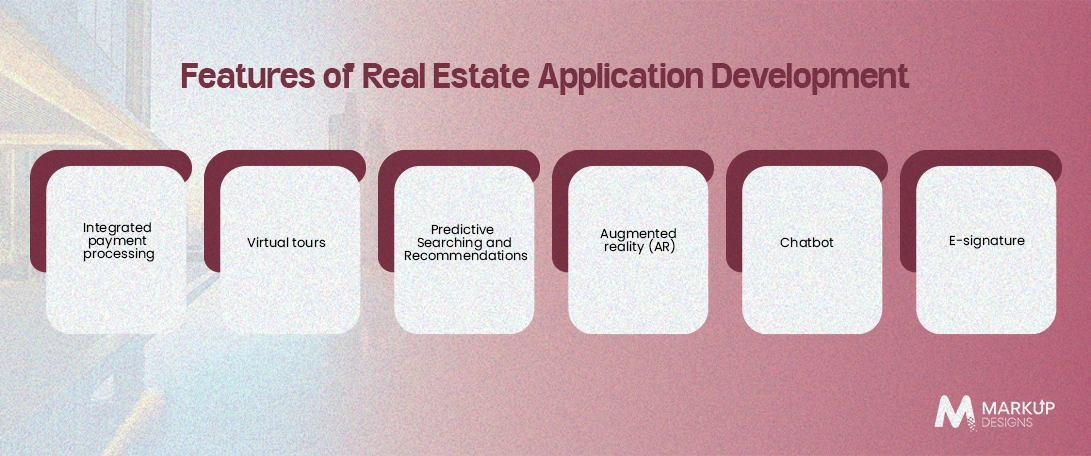
The real estate application is expected to go far beyond the simple property listing while delivering a highly personalized experience to the investors or buyers. As the complete user experience is evolving, businesses must integrate highly upgraded features that allow buyers to explore and invest in the desired property. Some of the core features of the application in real estate are
- Integrated payment processing
Payment processing allow users to pay all their expenses for renting, making deposits, and other payments through your app. With such a convenient feature, users can pay any amount quickly and securely, saving themselves from the trouble of making payments elsewhere.
- Virtual tours
This feature in the application allow users to discover properties in real time, and that too in a 360-degree format. It offers a comprehensive overview of the online viewing experience. These modern features allow buyers to visualize the space prior to actually investing in it.
- Predictive Searching and Recommendations
The application of real estate can benefit users a lot with a machine learning algorithm. It analyzes the user’s behavior and then proactively suggests the relevant properties as per their choice, which suits best. Users can also access detailed neighborhood insights along with data-driven information about various local areas to make more informed decisions.
- Augmented reality
The inclusion of augmented reality AR and VR technology makes it possible for users to virtually place furniture and other items inside the property model that is created. This allows users to see how the particular property is going to look when they purchase or rent it. It would help them finalise their decision without necessarily visiting the property.
- Chatbot
Now there are real estate businesses developing real estate AI chatbots. Anyone could use this approach to assist users through chatbots. The use of this conversational AI agent interface makes it possible for users to receive helpful information on the property while searching and looking to rent it.
- E-signature
This feature allows the user to sign all the required documents and contracts in a timely manner by avoiding delays and keeping all the information safe and verified.
Read Also: The Future of AI in Digital Transformation
Real Estate App Development Process
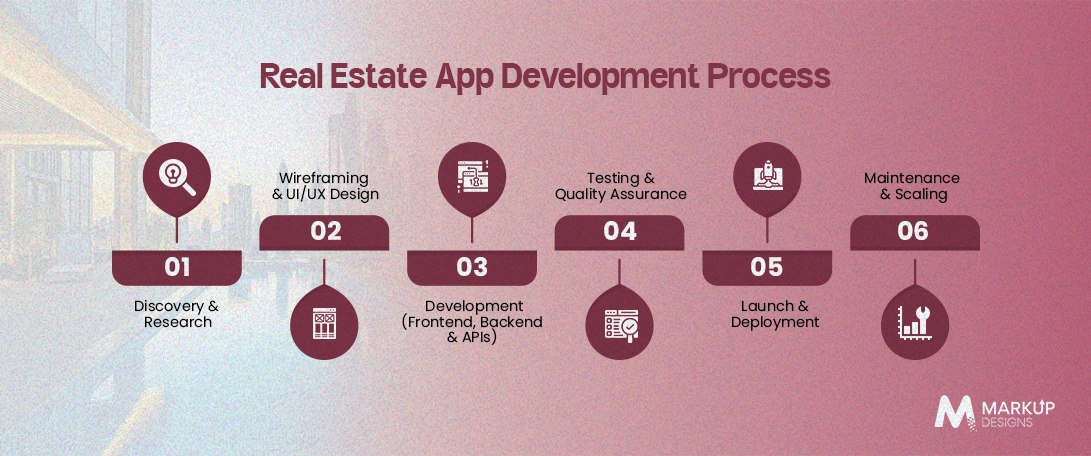
Creating a successful real estate app requires a well-structured approach, which is similar to guiding buyers from their first inquiry to the final property decision. Each phase brings clarity, reduces risks, and ensures a smooth launch. Below is a streamlined breakdown of the real estate app development Agenda, Outcomes, and Deliverables process:
1. Discovery & Research
This foundational stage converts your idea into a clear strategy.
- Conduct market research to understand user needs, trends, and regulations
- Analyze competitors to identify gaps and opportunities
- Define user personas to align with target audience’s expectations
- Prioritize features based on business goals and insights
Outcome: A detailed product roadmap, feature list, and project scope.
2. Wireframing & UI/UX Design
This phase transforms concepts into visual experiences and user flows.
- Create low-fidelity wireframes to structure layouts
- Design user journeys for search, listings, bookings, and profiles
- Develop high-fidelity UI designs with intuitive interfaces
- Build a consistent design system (colors, typography, components)
Outcome: Interactive prototypes ready for validation and development.
3. Development (Frontend, Backend & APIs)
This is where real estate app development takes technical shape.
- Build responsive frontend interfaces for web and mobile platforms
- Develop backend systems for business logic, databases, and authentication
- Create APIs to enable seamless communication across systems
- Integrate essential features like maps, payments, CRM, messaging, and analytics
Outcome: A fully functional app with integrated features and scalable architecture.
4. Testing & Quality Assurance
Rigorous testing ensures reliability, security, and performance.
- Unit testing for individual components
- Integration testing for system workflows
- End-to-end testing for real user scenarios
- Security, performance, and load testing
- User Acceptance Testing (UAT) for final validation
Outcome: A stable, secure, and bug-free app ready for deployment.
5. Launch & Deployment
This stage brings your app to the market.
- Optimize App Store and Play Store listings
- Set up cloud hosting, CI/CD pipelines, and domain configurations
- Conduct soft launches or phased rollouts
- Monitor performance, crashes, and user behavior
Outcome: A live application ready for real-world users and feedback.
6. Maintenance & Scaling
Post-launch, continuous improvement is key to long-term success.
- Monitor app performance and user engagement
- Release updates, bug fixes, and security patches
- Scale infrastructure as traffic grows
- Introduce new features based on feedback and market trends
Outcome: A scalable, high-performing app that evolves with your business.
Read Also: A Step-by-Step Guide to Develop a Mobile App
Cost of Developing a Real Estate Application in Dubai
| App Type | Key Features | Estimated Cost (USD) | Estimated Timeline | Ideal For |
| Basic App (MVP) | Property listings, basic search filters, user registration, contact forms | $8,000 – $15,000 | 2 – 3 months | Startups, small companies |
| Standard App | Advanced filters, user profiles, saved listings, push notifications, and map integration | $15,000 – $40,000 | 3 – 5 months | Growing real estate businesses |
| Advanced App | In-app chat, CRM integration, payment gateway, analytics dashboard, and admin panel | $40,000 – $80,000 | 5 – 7 months | Mid-size companies |
| Enterprise-Level App | AI recommendations, AR/VR tours, blockchain integration, automation, multi-language support | $80,000 – $150,000+ | 7 – 12+ months | Large enterprises & property platforms |
Note: This is the general costing. It may change depending on the project requirements.
Choosing the Right App Development Partner in the Real Estate Industry
Choosing the right development partner is crucial when creating an effective real estate application for a highly competitive environment like Dubai. Apart from technical abilities, the developer must be knowledgeable about your business objectives and long-term requirements, and understand the user needs.
- PropTech Expertise: Hire a development partner who has expertise in developing real estate applications precisely.
- Portfolio: Check their previous projects to know the quality of design and functionality of the product.
- Industry Knowledge: A development partner who knows the ins and outs of the Dubai real estate market and legislative framework is essential.
- Technical Competence: Make sure that your development partner is proficient in using contemporary software and technologies.
- Maintenance and Further Development: A team that can support you after the release of your application will help you maintain its performance level.
Choose Markup Designs as a Trusted Partner for Real Estate App Development in Dubai
Choosing the right development partner can make a significant difference in the success of your real estate app. Markup Designs positions itself as a trusted technology partner, delivering tailored solutions that align with your business goals and market demands.
- Proven Industry Expertise: We have expertise in Real Estate App Development, which allows us to understand the dynamic environment.
- Custom-Built Solutions: We design and develop apps that meet specific business needs, ensuring scalability, flexibility, and long-term growth.
- UI/UX Excellence: Our team focuses on creating intuitive, engaging, and user-centric designs that drive higher engagement and conversions.
- Advanced Technology Stack: We leverage modern technologies such as AI, AR/VR, and advanced integrations to build future-ready applications.
- End-to-End Development: From ideation and design to deployment and ongoing maintenance, we provide complete development support under one roof.
- Post-Launch Support: We ensure continuous updates, performance optimization, and scalability so your app remains competitive in Dubai’s fast-evolving real estate market.
FAQs
1. How much does real estate app development in Dubai cost?
The cost typically ranges from $8,000 to $150,000+, depending on the app’s complexity, features, and integrations.
2. How long does it take to develop a real estate app?
Development timelines can vary from 2 to 12+ months, based on the scope, design complexity, and technology stack.
3. What features are essential in a real estate app?
Key features include property listings, advanced search filters, virtual tours, payment integration, chat functionality, and AI-based recommendations.
4. Is it necessary to include AR/VR in real estate apps?
While not mandatory, AR/VR significantly enhances user experience by offering immersive property tours, which can improve engagement and conversions.
5. Can a real estate app be scaled after launch?
Yes, a well-built app can be easily scaled with additional features, integrations, and infrastructure upgrades based on business growth.
6. Why is Dubai a good market for real estate app development?
Dubai offers a strong real estate market, high investor interest, and rapid digital adoption, making it ideal for launching innovative real estate apps.
Conclusion
The rapid growth of Dubai’s Real Estate sector, combined with increasing digital adoption, has made real estate apps a necessity rather than a luxury. From simplifying property discovery to enabling seamless transactions, these applications are transforming how buyers, sellers, and agents interact in the market.
Investing in real estate app development in Dubai allows businesses to stay competitive, improve customer experiences, and unlock new revenue opportunities. However, the success of your app largely depends on choosing the right features, understanding market trends, and partnering with an experienced development team.
If you’re planning to build a future-ready real estate app, now is the right time to take the next step and turn your vision into a scalable digital solution.

Author's Perspective
From an industry perspective, Real Estate App Development in Dubai has evolved from a digital option to a strategic necessity. With users expecting seamless, mobile-first experiences from property discovery to final transactions—businesses must go beyond basic features and focus on innovation, usability, and scalability. Technologies like AI, AR/VR, and data analytics are no longer optional but essential to stay competitive. Ultimately, success lies not just in building an app, but in creating a solution that truly addresses user needs while aligning with long-term business growth in Dubai’s fast-paced real estate market.
Discuss Your Project NowJupinder Singh Arora
Founder and CEO
Related Posts

How to Build an App Like Yuka: Features,...

10 Key Factors to Choose the Right Mobile...

Mobile App Development in Kuwait: Cost, Process, Features...
Insights Are Valuable & Execution is Priceless
You’ve read about the digital future. Now, let’s build the infrastructure to take you there. Move your strategy from the page to the product.
Design Your Solution Now
Contact Us
Schedule The Appointment At Your Convenience Date And Time.
30 Min
Web Conference
Time Zone
Indian standard time (08:30pm)

Thanks For Getting In Touch!
You’ve Taken The First Step Toward Transforming Your Digital Presence. Our Experts Will Reach Out Shortly To Take It Forward.
Launch Your Dream Project
Provide a brief overview of your project, and our specialists will evaluate your requirements. We will connect with you to explore how the right digital solutions can help you launch faster.