
Blockchain for Business Applications in the Middle East: Use Cases, Benefits & Future Trends
In Brief:
- The Middle East blockchain market is rapidly growing, driven by strong government initiatives and enterprise adoption, especially in the UAE and Saudi Arabia.
- Blockchain has moved beyond experimentation and is now becoming a core part of digital infrastructure across industries.
- Technologies like AI, cloud, and 5G are accelerating blockchain adoption by creating integrated, data-driven ecosystems.
- Blockchain offers key advantages such as transparency, security, immutability, and decentralization, making it valuable for complex business operations.
- Industries like finance, logistics, real estate, healthcare, and government are actively implementing blockchain to improve efficiency and trust.
- Real-world initiatives, particularly in the UAE and Saudi Arabia, highlight large-scale deployment in public services, smart cities, and financial systems.
- Despite growth, challenges such as regulatory gaps, integration issues, high costs, and lack of skilled talent still exist.
- Businesses benefit from reduced costs, faster transactions, improved data security, and stronger stakeholder trust through blockchain adoption.
- Successful implementation requires a clear use case, regulatory alignment, pilot testing, and integration with existing systems.
- The future of blockchain in the region looks strong, with growth in Web3, smart cities, and convergence with AI and IoT driving long-term innovation.
The Middle East blockchain market is expanding rapidly, led by countries such as the UAE, where the market alone is projected to grow from USD 8.9 billion in 2025 to over USD 72.6 billion by 2032. Alongside this, blockchain-driven segments like decentralized finance are also witnessing strong momentum, with the regional DeFi market expected to grow at over 50% CAGR through 2033.
Blockchain technology in the Middle East has moved beyond its experimental phase; rather, it is fast emerging as a foundation for digital systems in the region. The once emerging blockchain technology is now positioning itself as an important component for digital economies in the region. In the field of banking and governmental systems, blockchain technology is moving beyond its concept phase into reality.
According to recent market insights, the Middle East blockchain market appears to be moving towards a period of rapid expansion, which will mostly be fueled by government-led initiatives and enterprise participation.
In fact, the United Arab Emirates and Saudi Arabia are currently leading such efforts by implementing large-scale strategies focused on integrating blockchain into their public sector operations, financial services, and international commerce.
The UAE has already been pursuing an ambitious strategy aimed at shifting a large number of transactions made by the government to distributed ledger technology solutions.
Similarly, Saudi Arabia is consistently trying to align blockchain adoption efforts with its economic diversification goals within the framework of its Vision 2030 program.
The interesting thing about the Middle East region is not only the pace of blockchain implementation, but also the intentions behind it.
In this blog, we’ll explore how blockchain is reshaping business across the Middle East, supported by strong government initiatives, rapid enterprise adoption, and accelerating market growth.
Middle East Technology Market Trends
The current technology market trends in the Middle East clearly highlight a shift toward rapid, large-scale digital transformation.
The Middle East technology landscape is evolving at a pace that is difficult to ignore. What sets the region apart is not just adoption, but the scale and speed at which digital transformation is being executed. Countries like the UAE and Saudi Arabia are no longer following global tech trends-they are actively shaping them through large-scale investments and policy-driven innovation.
One of the most defining trends is the surge in enterprise digital transformation. According to a GSMA report, enterprises across the Middle East are outpacing global peers in adopting advanced technologies such as AI, 5G, and cloud computing, driven by strong national digital agendas and infrastructure investments. This foundation is critical, as it directly fuels blockchain adoption across industries.
Cloud and AI are also dominating technology spending. In 2025 alone, cloud technologies accounted for over 53% of the Middle East’s digital transformation market, while AI and machine learning are projected to grow at a CAGR of over 18% through 2031. These technologies are not operating in isolation-they are increasingly integrated with blockchain to enable smarter, more secure, and automated business ecosystems.
This is where blockchain growth in the Middle East becomes particularly significant. Blockchain is no longer limited to cryptocurrency use cases. It is actively powering decentralized finance, supply chains, and digital identity systems. In fact, blockchain accounted for over 42% share of the decentralized finance technology segment in 2025, highlighting its central role in reshaping financial infrastructure.
At a broader level, the region’s blockchain market is witnessing exponential expansion. Estimates suggest that the market could grow from around $2.7 billion in 2024 to over $131 billion by 2030, reflecting the aggressive pace of adoption led by the UAE and Saudi Arabia.
Taken together, these trends indicate a clear shift: the Middle East is rapidly transitioning from a technology adopter to a global innovation hub, with blockchain positioned at the core of this transformation.
Understanding Blockchain Beyond the Buzzword
Blockchain is often discussed as a revolutionary technology, but in many business conversations, it still remains misunderstood. To understand its real value, it’s important to move beyond the hype and look at what blockchain actually does in a practical, business context.
At its core, blockchain is a distributed digital ledger that records transactions across multiple systems in a way that is secure, transparent, and tamper-resistant. Unlike traditional databases that rely on a central authority, blockchain operates on a decentralized network where every participant has access to the same version of data. This eliminates the need for intermediaries and significantly reduces the risk of manipulation or data inconsistencies.
What makes blockchain particularly powerful for enterprises are its core capabilities:
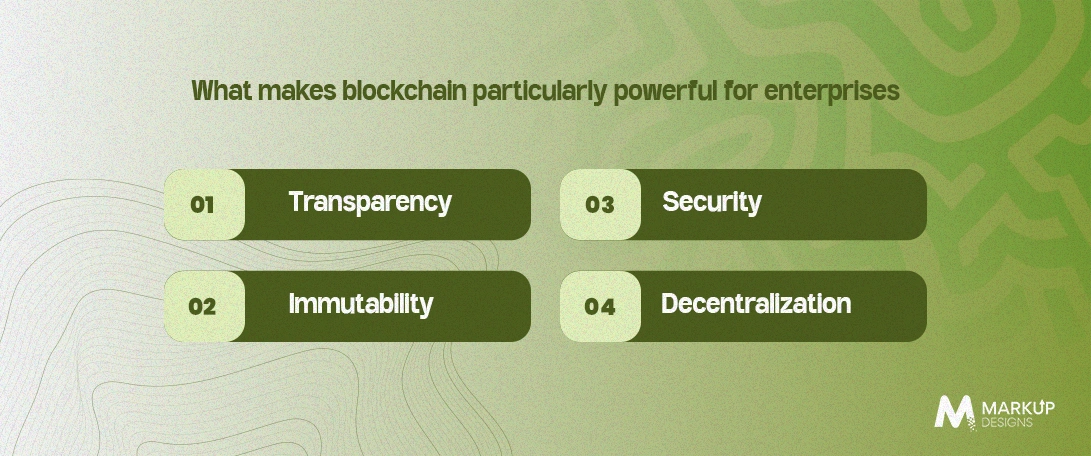
- Transparency: All transactions are visible and traceable, improving accountability across stakeholders
- Immutability: Once recorded, data cannot be altered, ensuring integrity and trust
- Security: Advanced cryptographic mechanisms protect sensitive information
- Decentralization: No single point of control reduces dependency and operational risks
In the Middle East, these capabilities directly address some long-standing business challenges. For example, industries like logistics and trade often involve multiple parties across borders, making transparency and coordination difficult. Blockchain simplifies this by creating a single source of truth that all parties can rely on. For enterprises handling large-scale operations, this often requires scalable cloud infrastructure and modern integration frameworks.
Similarly, in sectors like finance and real estate, where trust and verification are critical, blockchain reduces paperwork, speeds up transactions, and minimizes fraud risks. This is why businesses across the region are increasingly viewing blockchain not as a disruptive experiment, but as a practical solution to improve efficiency and trust in complex ecosystems.
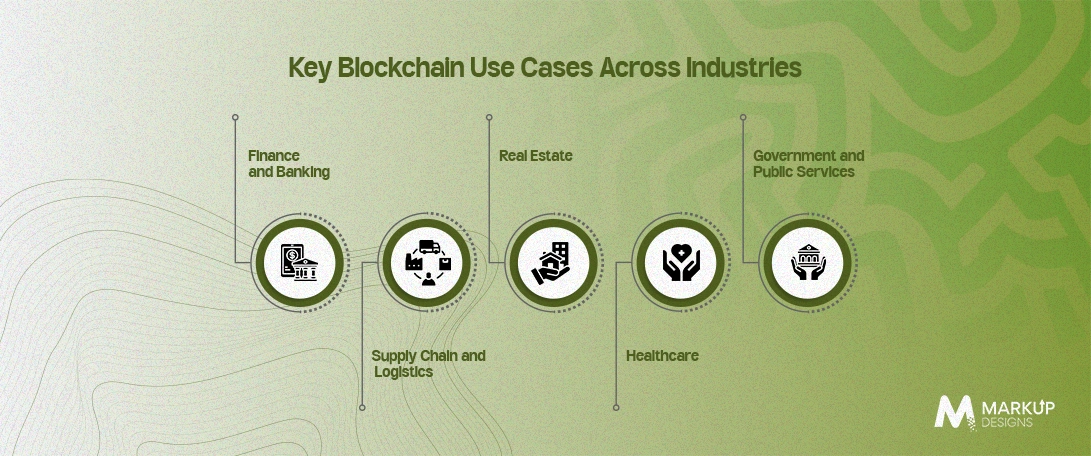
Key Blockchain Use Cases Across Industries
Blockchain adoption in the Middle East has progressed beyond early-stage testing and is now being widely implemented across industries where trust, transparency, and efficiency are essential. What’s interesting is how businesses are not just adopting blockchain for innovation, but to solve long-standing operational challenges. This is where enterprise blockchain solutions are gaining traction, helping organizations build scalable, secure, and interoperable systems tailored to real business needs.
In sectors where multiple stakeholders, regulatory dependencies, and high-value transactions are involved, blockchain is creating measurable impact. From finance to logistics and even public services, organizations are leveraging it to streamline processes, reduce fraud, and improve data accuracy. The evolving blockchain use cases in the Middle East clearly reflect a shift from pilot projects to full-scale deployment.
4.1 Finance & Banking
The financial sector has been one of the earliest adopters of blockchain in the region. With cross-border transactions being a major part of Middle Eastern economies, blockchain is helping reduce delays and transaction costs.
- Faster and more secure cross-border payments
- Smart contracts for automated lending and settlements
- Reduced fraud through transparent transaction records
4.2 Supply Chain & Logistics
Given the Middle East’s position as a global trade hub, supply chain inefficiencies can have significant financial impact. Blockchain is enabling real-time visibility and trust across complex logistics networks.
- End-to-end shipment tracking in real time
- Improved transparency between suppliers, distributors, and retailers
- Reduced delays and counterfeit risks
4.3 Real Estate
Real estate transactions in the region often involve extensive documentation and verification. Blockchain simplifies this by digitizing records and enabling secure ownership transfers.
- Tokenization of property assets
- Faster and paperless transactions
- Enhanced transparency in ownership records
4.4 Healthcare
Healthcare systems are increasingly exploring blockchain to manage sensitive patient data while maintaining privacy and accuracy.
- Secure sharing of patient records across providers
- Improved data integrity and reduced duplication
- Better compliance with data protection standards
4.5 Government & Public Services
Governments in the Middle East are among the most active adopters of blockchain, using it to enhance efficiency and citizen services.
- Digital identity management systems
- Secure record-keeping for public data
- Smart city initiatives powered by blockchain
Across these industries, the common thread is clear-blockchain is not just enhancing processes, it is redefining how trust is built and maintained in business ecosystems.
Real-World Blockchain Initiatives in the Middle East
The Middle East’s blockchain narrative is not built on theory-it is backed by real, large-scale implementations that demonstrate how the technology is being embedded into everyday operations. Governments, in particular, are playing a leading role in turning blockchain strategies into measurable outcomes.
In the UAE, initiatives under Emirates Blockchain Strategy 2021 have focused on shifting government processes onto blockchain frameworks to improve efficiency and reduce administrative costs. This strong push has significantly accelerated blockchain adoption in UAE, with projects in areas like digital identity, licensing, and document verification already streamlining interactions between citizens, businesses, and public entities.
Dubai has taken this further through smart city initiatives, where blockchain is being integrated into sectors such as real estate and transportation. For instance, property transactions are being digitized to reduce paperwork and enhance transparency, making the entire process faster and more secure.
Saudi Arabia is also actively investing in blockchain as part of Saudi Vision 2030. The focus here is on financial services, supply chain optimization, and government infrastructure, with pilot projects gradually scaling into enterprise-level deployments.
What stands out across these initiatives is their practical orientation. These are not isolated experiments-they are structured efforts aimed at improving efficiency, reducing costs, and building trust at scale.
Challenges in Blockchain Adoption
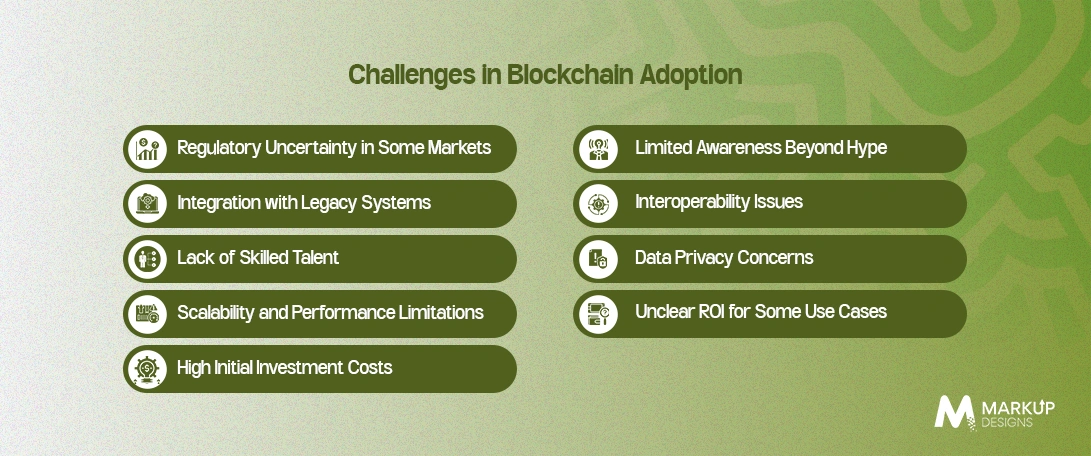
Despite strong momentum, several practical challenges continue to slow blockchain adoption, requiring businesses to address technical, regulatory, and strategic barriers effectively.
- Regulatory Uncertainty in Some Markets
While countries like the UAE are progressive, other regions still lack clear frameworks, slowing wider adoption across the Middle East blockchain market. - Integration with Legacy Systems
Many businesses operate on outdated infrastructure, making blockchain integration complex, time-consuming, and costly. This is why enterprises are increasingly prioritizing legacy system modernization before adopting advanced digital technologies like blockchain. - Lack of Skilled Talent
There is a growing demand for blockchain developers and architects, but the talent pool in the region is still developing. - Scalability and Performance Limitations
Some blockchain networks struggle with high transaction volumes, creating challenges for enterprise-level deployment. - High Initial Investment Costs
Implementing blockchain solutions requires upfront investment in technology, training, and infrastructure. - Limited Awareness Beyond Hype
Many organizations still associate blockchain only with cryptocurrency, missing its broader business applications. - Interoperability Issues
Different blockchain platforms often lack standardization, making it difficult for systems to communicate seamlessly. - Data Privacy Concerns
While blockchain is secure, managing sensitive data on shared ledgers raises compliance and privacy challenges. - Unclear ROI for Some Use Cases
Without a clear business case, companies hesitate to invest, especially when benefits are long-term rather than immediate.
Benefits of Blockchain Adoption
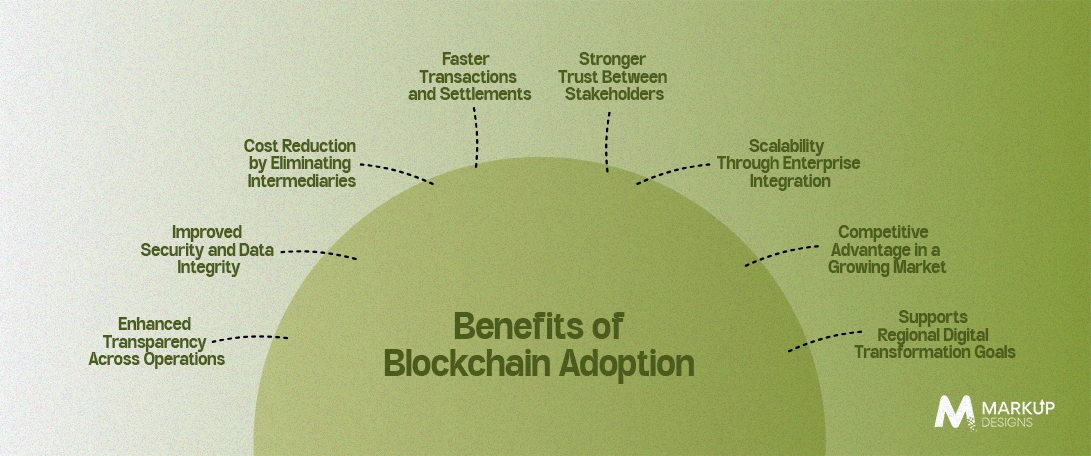
Blockchain adoption is delivering measurable business value across the Middle East, helping organizations improve efficiency, security, transparency, and long-term competitiveness.
- Enhanced Transparency Across Operations
Blockchain creates a shared, immutable ledger, allowing all stakeholders to access real-time data and reducing disputes in multi-party business environments. - Improved Security and Data Integrity
Advanced cryptographic encryption ensures that data cannot be altered once recorded, making blockchain highly reliable for sensitive business transactions. - Cost Reduction by Eliminating Intermediaries
Businesses can significantly cut operational costs by removing third-party involvement in processes like payments, contracts, and verification. - Faster Transactions and Settlements
Blockchain enables near real-time processing, especially beneficial in cross-border payments and trade finance. - Stronger Trust Between Stakeholders
With transparent and verifiable data, businesses can build stronger relationships with partners, customers, and regulators. - Scalability Through Enterprise Integration
Modern enterprise systems are increasingly integrating blockchain, supporting large-scale operations and digital transformation goals. - Competitive Advantage in a Growing Market
Early adopters are gaining an edge, particularly in the UAE blockchain market, where innovation and government support are accelerating adoption. - Supports Regional Digital Transformation Goals
Blockchain aligns with national strategies, contributing directly to the ongoing blockchain growth in the Middle East and enabling future-ready business ecosystems.
How Businesses Can Successfully Implement Blockchain
Adopting blockchain is not about jumping on a trend, it requires a clear and problem-first approach. In the Middle East, successful implementations are those aligned with business goals, regulatory frameworks, and long-term digital strategies. Organizations see the most value when they use blockchain as part of their overall transformation journey, rather than as an isolated solution-especially with scalable and secure enterprise blockchain solutions now available.
To ensure effective implementation, businesses should focus on the following:
- Start with a Defined Use Case
Identify specific problems (e.g., fraud, delays, lack of transparency) where blockchain can create measurable impact. - Choose the Right Blockchain Model
Decide between public, private, or hybrid blockchain based on data sensitivity, scalability, and control requirements. - Ensure Regulatory Compliance
Align with local laws and frameworks, especially in markets like the UAE and Saudi Arabia where regulations are evolving rapidly. - Partner with Experienced Technology Providers
Collaborate with firms that understand both blockchain technology and regional business environments. - Run Pilot Projects Before Scaling
Test feasibility through controlled deployments to validate ROI and performance. - Focus on Integration, Not Replacement
Seamlessly integrate blockchain with existing systems instead of overhauling entire infrastructures.
Read Also: Custom Blockchain Architecture Explained: Build Secure & Scalable Solutions
Cost of Implementing Blockchain Solutions in the Middle East
Let’s address the practical question every business eventually asks-what does it actually cost to implement blockchain? The answer isn’t fixed, because it depends heavily on the use case, complexity, and scale of deployment. That said, there are some clear cost components you should plan for.
One important thing to understand-blockchain is not a “cheap” solution upfront, but it often delivers long-term cost savings by reducing intermediaries, automating processes, and minimizing errors. For businesses in the Middle East, the focus should be less on initial cost and more on ROI and operational efficiency over time.
From Code to Cost: Blockchain Breakdown
| Cost Component | Description | Estimated Cost Range |
| Development & Architecture | Core blockchain setup, smart contracts, and backend infrastructure | $15,000 – $60,000+ |
| UI/UX & Frontend Development | Building user-friendly dashboards and interfaces for business use | $5,000 – $25,000 |
| Integration with Existing Systems | Connecting blockchain with ERP, CRM, or legacy platforms | $10,000 – $40,000 |
| Security & Compliance | Audits, encryption, and adherence to regional regulations | $8,000 – $30,000 |
| Testing & Deployment | Ensuring performance, scalability, and reliability before launch | $5,000 – $20,000 |
| Ongoing Maintenance | Updates, monitoring, and system optimization post-deployment | $2,000 – $10,000/month |
The Future of Blockchain in the Middle East
The future of blockchain in the Middle East is closely tied to the region’s broader vision of becoming a global digital innovation hub. As governments continue to invest in advanced technologies, blockchain is expected to play a central role in shaping next-generation business ecosystems.
We are already seeing blockchain converge with technologies like AI, IoT, and smart city infrastructure, creating more intelligent and automated systems. This convergence is becoming a major driver of AI-driven digital transformation across industries.
Key trends that will define the future:
- Integration with Emerging Technologies
Blockchain combined with AI and IoT will enable smarter, data-driven ecosystems. - Growth of Web3 and Digital Assets
The region is becoming a hotspot for decentralized platforms, tokenization, and digital finance. - Increased Enterprise Adoption
More businesses will move from pilot projects to full-scale implementation. - Government-Driven Expansion
Continued policy support will fast-track adoption across public and private sectors. - Rise of Smart Cities
Blockchain will power secure, efficient, and connected urban infrastructures.
The Road Ahead for Blockchain in the Middle East
Blockchain in the Middle East has clearly moved beyond the exploration phase. What we are witnessing now is a shift toward practical, results-driven implementation, where businesses and governments are leveraging the technology to solve real operational challenges. This is especially evident in the growing blockchain adoption in UAE, where strong policy support and innovation ecosystems are accelerating real-world deployments.
The region’s strong regulatory support, investment momentum, and digital-first mindset create a unique environment where blockchain can thrive at scale. However, success will depend on how strategically organizations approach adoption-focusing on clear use cases, measurable outcomes, and long-term integration.
Hence, the message is straightforward: Blockchain is no longer optional for innovation-led growth. Those who act early and align it with their digital transformation goals will be better positioned to compete in an increasingly connected and transparent global economy.
FAQs
1. What are the key business applications of blockchain in the Middle East?
Blockchain is widely used across industries such as finance, supply chain, real estate, and government services. Common applications include cross-border payments, smart contracts, digital identity systems, and transparent logistics tracking.
2. Why is blockchain adoption growing rapidly in the Middle East?
The growth is driven by strong government initiatives, supportive regulations, and large-scale digital transformation programs. Countries like the UAE and Saudi Arabia are actively investing in blockchain to diversify their economies and improve efficiency, with the UAE blockchain market leading regional momentum.
3. Which industries benefit the most from blockchain in the region?
Industries such as banking, logistics, healthcare, and real estate benefit significantly. Blockchain helps reduce fraud, improve data security, streamline processes, and enhance transparency across these sectors.
4. Is blockchain only used for cryptocurrencies in the Middle East?
No, blockchain use goes far beyond cryptocurrencies. Businesses are leveraging it for operational efficiency, secure data sharing, supply chain visibility, and automating agreements through smart contracts.
5. What challenges do businesses face when implementing blockchain?
Some common challenges include integration with existing systems, lack of skilled professionals, evolving regulations, and scalability concerns. However, these are gradually being addressed as the ecosystem matures.
Author's Perspective
From my experience working with digital transformation and blockchain projects, one thing is clear: success depends on strategy, not just technology. Many organizations rush into adoption without clear use cases, leading to limited results. In the Middle East, where innovation is accelerating, businesses that focus on scalability, compliance, and long-term value creation see the most meaningful impact from blockchain investments.
Discuss your Project NowAjit Kumar Jha
VP - Business Operations
Related Posts

Crypto Trading Bot Development: Architecture, Features & Cost...
Cost to Develop a Cryptocurrency Exchange App Like...
How to Build a Secure Crypto Payment Gateway...
Insights Are Valuable & Execution is Priceless
You’ve read about the digital future. Now, let’s build the infrastructure to take you there. Move your strategy from the page to the product.
Design Your Solution Now
Contact Us
Schedule The Appointment At Your Convenience Date And Time.
30 Min
Web Conference
Time Zone
Indian standard time (08:30pm)

Thanks For Getting In Touch!
You’ve Taken The First Step Toward Transforming Your Digital Presence. Our Experts Will Reach Out Shortly To Take It Forward.
Launch Your Dream Project
Provide a brief overview of your project, and our specialists will evaluate your requirements. We will connect with you to explore how the right digital solutions can help you launch faster.