
In Brief
- Centralize digital resources: Gather images, videos, documents, product files, and branding elements in a single organized repository that can be searched easily.
- Automate the workflow: Decrease the need for manual approvals, versioning, and publishing procedures to streamline the movement of teams from content creation to content distribution.
- Enhance enterprise governance: Regulate access to files, trace the way they are used, control the rights to digital materials, and preserve branding consistency.
- Combine with current systems: Link Content Management System, Product Information Management, e-commerce solutions, CRMs, and other industry systems.
- Provide for long-term effectiveness: Pick the technology that will ensure factors such as scalability, safety, AI capability, and measurable efficiency.
As businesses expand, it becomes increasingly challenging to manage digital assets across multiple locations, storage systems, and media channels. Marketing divisions require pre-approved brand elements, sales teams ask for appropriate presentations, and product departments rely on proper images and information. With no centralized system in place, companies may waste time looking for files or duplicating information and struggle to keep a unified style in multiple customer contacts. In Australia, Digital Asset Management (DAM) software development exists to help solve those issues, providing a solution that is balanced with the company’s business processes, its needs for governance, and its technology environment.
However, creating a custom DAM solution is more complex than building a file repository that simply has a search function in place. A successful enterprise solution makes provision for content organization, permission management, version tracking, workflow automation, integration, and reliable content delivery. Moreover, it should serve as a ground for developing new technologies like AI-based metadata management and intelligent search capabilities.
What Is Digital Asset Management Software and Why Do Australian Enterprises Need It?
Companies manage a growing amount of digital content such as product images, videos, presentations, documents, branding materials, ads, and technical files. However, if all these files are stored across different shared drives, cloud folders, email exchanges, and separate systems, it will be hard to find the necessary content to manage. The digital asset management (DAM) software offers businesses a centralised space to save, manage, organise, look for, approve, control and release content from a single platform.
What Is Digital Asset Management Software?
A DAM platform does much more than simply replace cloud storage. It links organisational processes with metadata, permissions, versions, workflows, rights management and unification with other enterprise software. Since many industries in Australia require specific workflows and integrations in a range of practices and operations, the DAM for them is more than just a way to store a bigger amount of files, but rather an opportunity to better manage digital content.
Digital asset management software refers to a set of tools designed for controlling the process of using digital content during its life cycle in any organisation. It allows staff to upload files, organize them, create metadata, define access restrictions, control versions, approve content, and distribute effective data using various communication channels.
Unlike basic file storage, DAM software provides greater control over how assets are used. Marketing teams can find approved campaign creatives, sales teams can access current presentations, and product teams can manage product imagery without relying on disconnected folders or manual communication.
How Does an Enterprise DAM System Work?
An enterprise DAM typically follows a structured asset lifecycle. Files are uploaded to a central repository, classified using metadata and taxonomy, reviewed according to defined workflows, and made available to authorised users or connected systems.
For example, a marketing team could upload a new product campaign, assign relevant metadata, send it for approval, and publish the approved assets to connected websites or e-commerce platforms. Permissions determine who can edit or download the files, while version history and audit records provide visibility into changes and usage.
Why Traditional File Storage Is Not Enough for Growing Businesses
Cloud storage is useful for keeping files accessible, but it is not designed to manage complex enterprise content operations. As asset libraries grow, teams can encounter duplicate files, unclear naming conventions, outdated versions, limited search capabilities, and difficulty determining which assets are approved for use.
These problems become more significant when multiple departments, locations, agencies, and publishing channels are involved. A DAM platform adds the organisation, governance, automation, and workflow controls needed to manage content at scale.
The Business Case for Custom DAM Development in Australia
Custom DAM development becomes relevant when an enterprise has requirements that cannot be efficiently addressed through a standard platform. These may include specialised approval workflows, complex user permissions, industry-specific governance, large-scale asset migration, or integration with existing enterprise applications.
The business case should therefore be based on operational requirements rather than the assumption that custom software is always superior. If an off-the-shelf platform already provides the required functionality, custom development may add unnecessary cost and complexity. Where standard tools create workflow limitations or integration gaps, however, a custom DAM can provide greater control and a platform designed around the organisation’s long-term content operations.
What Challenges Does Custom DAM Software Development Solve?
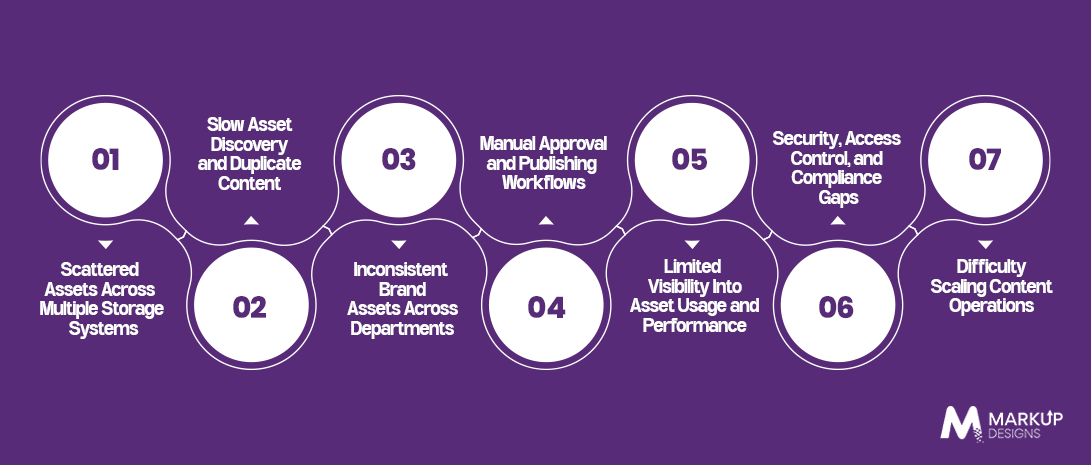
As digital content grows across departments and channels, enterprises often face problems that basic storage solutions cannot resolve. Custom DAM development addresses these operational gaps by creating a structured environment for managing assets, workflows, access, and distribution.
Scattered Assets Across Multiple Storage Systems
Assets stored across shared drives, cloud platforms, personal folders, and departmental systems are difficult to manage consistently. A centralised DAM creates a single source of truth and reduces dependence on disconnected storage locations.
Slow Asset Discovery and Duplicate Content
Teams can spend considerable time searching for the correct file when assets lack consistent metadata and naming structures. Poor discovery can also result in employees recreating assets that already exist. Structured classification and advanced search help reduce both problems.
Inconsistent Brand Assets Across Departments
Using outdated logos, product images, presentations, or campaign materials can create inconsistencies across customer touchpoints. A DAM can provide teams with access to approved and current assets while controlling which versions are available for use.
Manual Approval and Publishing Workflows
When asset reviews depend on emails, spreadsheets, or separate communication tools, approvals can become difficult to track. DAM workflows can introduce defined review stages, notifications, approvals, and publishing controls.
Limited Visibility Into Asset Usage and Performance
Without usage data, enterprises may struggle to identify which assets are actively used and which are no longer relevant. DAM analytics can provide insights into downloads, usage, and asset activity to support better content management decisions.
Security, Access Control, and Compliance Gaps
Different assets may require different levels of access. Role-based permissions, audit trails, and rights management allow enterprises to control who can access, modify, download, or distribute content.
Difficulty Scaling Content Operations
More products, markets, users, and digital channels inevitably create more content. A scalable DAM can support increasing asset volumes and users without forcing teams to rely on increasingly complex manual processes.
What Features Should an Enterprise DAM Platform Include?
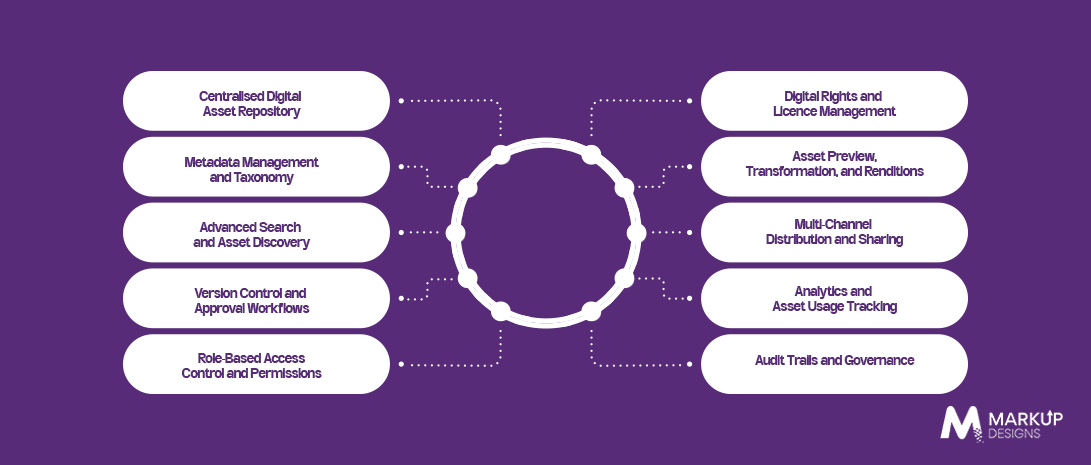
An enterprise DAM should combine content storage with tools for organisation, discovery, governance, and distribution. The exact feature set should reflect the organisation’s workflows rather than simply copying every capability available in competing platforms.
Centralised Digital Asset Repository
A central repository provides one controlled location for images, videos, documents, audio files, product assets, and other digital content. It establishes a reliable source of truth for teams across the organisation.
Metadata Management and Taxonomy
Metadata describes an asset through information such as type, category, product, campaign, location, or usage rights. A structured taxonomy makes large asset libraries easier to organise, filter, and maintain.
Advanced Search and Asset Discovery
Search functionality should allow users to find assets through keywords, metadata, categories, filters, and other attributes. Better discovery reduces the time employees spend navigating folders and searching through multiple systems.
Version Control and Approval Workflows
Version control helps users identify the latest approved version of an asset, while approval workflows provide a structured process for reviewing and publishing content.
Role Based Access Control and Permissions
Permissions can restrict asset access according to roles, departments, locations, or other business requirements. This helps prevent unauthorised changes or distribution.
Digital Rights and Licence Management
Rights management allows organisations to track licensing conditions, usage restrictions, ownership information, and expiry dates associated with digital assets.
Asset Preview, Transformation, and Renditions
Users can preview assets without downloading them, while automated transformations can create suitable formats or sizes for different channels and publishing requirements.
Multi Channel Distribution and Sharing
Approved assets can be shared with internal teams, agencies, partners, websites, e-commerce platforms, and other channels without requiring users to manually distribute files across separate systems.
Analytics and Asset Usage Tracking
Analytics can provide visibility into downloads, asset activity, and usage patterns. This helps organisations understand how their content is being used and where asset libraries can be improved.
Audit Trails and Governance
Audit trails record important actions such as uploads, edits, approvals, and downloads. Combined with governance policies, they help enterprises maintain accountability and control over their digital content.
Read Also: Digital Transformation for Australian Enterprises: Strategy, Technology & ROI
Advanced Technologies Shaping DAM Software Development in Australia
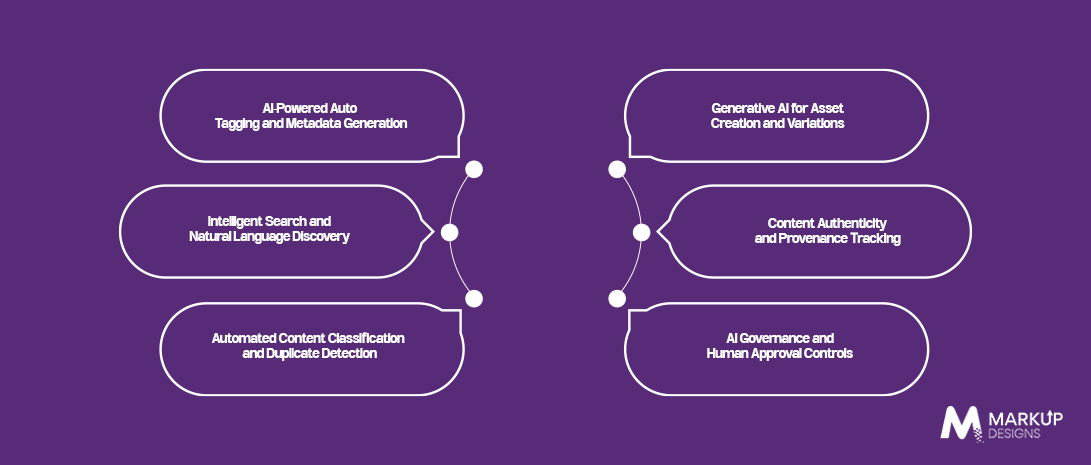
AI is changing how enterprises organise and discover digital content, but it should be applied to specific operational problems rather than added simply because it is technically possible. Its effectiveness depends heavily on the quality of the underlying assets, metadata, workflows, and governance framework.
AI-Powered Auto Tagging and Metadata Generation
AI can analyse images, videos, and documents to suggest tags and metadata. This can reduce repetitive manual classification, particularly when organisations manage large and frequently changing asset libraries.
Intelligent Search and Natural Language Discovery
Natural language search allows users to describe what they need rather than relying entirely on exact keywords. For example, a user could search for a specific type of product image or campaign asset using descriptive language.
Automated Content Classification and Duplicate Detection
AI can help classify assets according to predefined categories and identify files that may be duplicates or near duplicates. Human review may still be necessary where classification decisions have compliance or business implications.
Generative AI for Asset Creation and Variations
Generative AI can assist with creating content variations, adapting assets for different formats, or producing initial creative concepts. Enterprises should still establish approval controls before AI-generated content reaches customer-facing channels.
Content Authenticity and Provenance Tracking
Provenance capabilities help organisations understand an asset’s origin, modification history, and usage. This becomes increasingly important as content passes through multiple systems and AI-assisted creation becomes more common.
AI Governance and Human Approval Controls
AI outputs should not automatically be treated as accurate or approved. Human oversight can help validate generated metadata, classifications, and content before they become part of an organisation’s official asset library.
Custom DAM vs Off-the-Shelf Software: Which Is Right for Your Enterprise?
Choosing between custom and off-the-shelf DAM software should start with business requirements rather than technology preference. A standard platform may be sufficient for organisations with straightforward asset management needs, while enterprises with complex processes may require deeper customisation.
When an Off-the-Shelf DAM Is the Better Choice
An off-the-shelf DAM can be appropriate when standard asset management, search, permissions, and workflow capabilities meet the organisation’s requirements. It can also provide faster deployment and predictable subscription costs.
When Custom DAM Development Makes Business Sense
Custom development becomes more compelling when the business requires specialised workflows, unique permissions, complex integrations, specific governance controls, or functionality that existing products cannot provide without extensive workarounds.
Customisation, Integration, and Scalability Considerations
The decision should consider more than the initial implementation cost. Enterprises should evaluate how easily the platform can integrate with existing systems, adapt to changing workflows, support increasing asset volumes, and accommodate future requirements.
Questions to Ask Before Choosing a DAM Development Approach
Before selecting an approach, enterprises should assess:
- What asset management problems need to be solved?
- How many users and assets will the system support?
- Which existing systems need integration?
- What security and governance requirements apply?
- Can an existing DAM meet these requirements without excessive customisation?
- What will implementation, migration, maintenance, and scaling cost?
- How will the organisation measure the platform’s business impact?
The right choice is ultimately the one that solves the organisation’s actual content management problems without introducing unnecessary complexity.
Security and Compliance Considerations for Enterprise DAM
Security should be built into the DAM architecture from the beginning rather than added after development. Enterprise platforms often contain commercially sensitive, proprietary, or licensed content, making controlled access and reliable data protection essential.
Role-Based Access and Permission Management
Role-based access ensures users only access the assets and functions relevant to their responsibilities. Permissions can be configured for viewing, editing, downloading, sharing, and approving content.
Encryption and Secure Asset Storage
Digital assets and associated data should be protected through encryption during transmission and storage. Secure infrastructure and appropriate key management further reduce the risk of unauthorised access.
Audit Logs and Activity Monitoring
Audit logs record activities such as uploads, downloads, edits, approvals, and permission changes. These records provide visibility into how assets are being managed and can support internal investigations and compliance requirements.
Data Residency and Enterprise Governance
Australian enterprises should consider where their asset data is stored and how it is governed. Data residency requirements, retention policies, access controls, and organisational governance should be addressed during architecture planning.
Backup, Disaster Recovery, and Business Continuity
A DAM platform should include reliable backup and recovery mechanisms so critical assets remain available after accidental deletion, system failures, or other disruptions. Disaster recovery planning should also define how quickly services and data can be restored.
Secure Integrations and API Management
DAM platforms often connect with CMS, PIM, e-commerce, CRM, and other systems. APIs should therefore be secured through appropriate authentication, authorisation, monitoring, and access controls to prevent connected systems from becoming security weaknesses.
Here’s a professionally structured version of the section, keeping the development process practical and aligned with enterprise DAM requirements.
How to Develop Custom Digital Asset Management Software in Australia
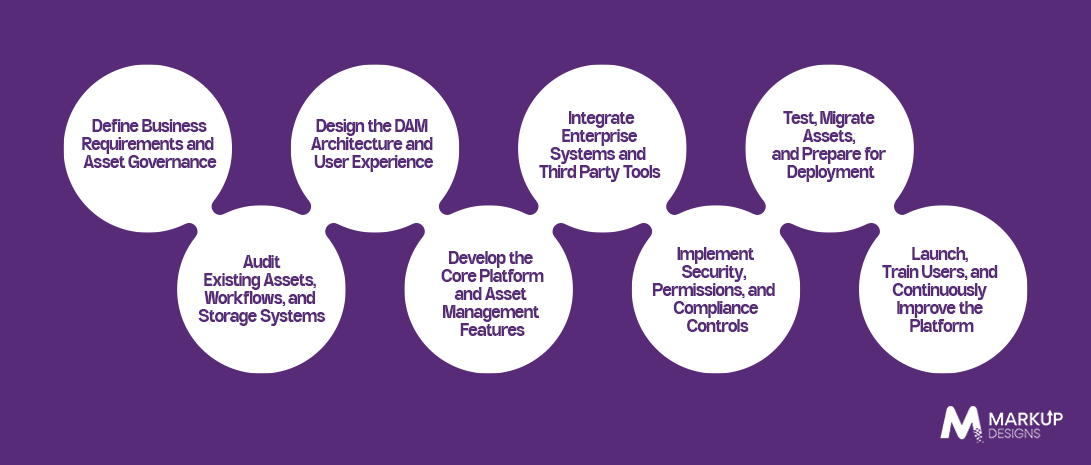
Developing a custom Digital Asset Management (DAM) platform requires more than building a central repository for files. The software should reflect how an organisation creates, stores, manages, approves, distributes, and retires digital assets. A structured development approach helps ensure the platform supports operational workflows while maintaining security, scalability, and compliance.
Define Business Requirements and Asset Governance
Start by identifying the types of digital assets the organisation manages, who uses them, and how they move through different stages of their lifecycle. Define requirements for asset ownership, metadata, version control, approval workflows, retention, archival, and deletion.
Establish governance policies alongside these requirements so the DAM platform has clear rules for how assets should be created, accessed, reviewed, distributed, and retired.
Audit Existing Assets, Workflows, and Storage Systems
Review existing asset libraries, file formats, storage locations, naming conventions, metadata structures, and approval processes. Identify duplicate assets, outdated files, fragmented repositories, and workflow bottlenecks that a new DAM platform should address.
This audit also helps determine migration requirements and prevents the new system from simply reproducing inefficient legacy processes.
Design the DAM Architecture and User Experience
Design an architecture that can support the expected asset volume, number of users, integrations, and future growth. Define the database, storage layer, APIs, search infrastructure, authentication mechanisms, and processing services.
At the same time, design an intuitive interface that makes it easy for users to upload, organise, search, preview, edit, approve, and share assets without unnecessary complexity.
Develop the Core Platform and Asset Management Features
Build the essential DAM functionality around the organisation’s workflows. Core features may include centralised asset storage, metadata management, advanced search, tagging, version control, asset previews, bulk uploads, collections, approval workflows, and automated file processing.
Features should be developed around actual user requirements rather than adding unnecessary functionality that increases system complexity.
Integrate Enterprise Systems and Third Party Tools
Connect the DAM platform with the systems users already rely on. Depending on the organisation, integrations may include CMS platforms, CRM systems, marketing automation tools, cloud storage, productivity platforms, eCommerce systems, and creative applications.
Well designed APIs and integration layers allow assets and metadata to move between systems without creating additional manual processes.
Implement Security, Permissions, and Compliance Controls
Protect digital assets through role based access controls, authentication, encryption, audit logs, secure APIs, and granular permissions. Access should be based on user roles, teams, asset types, projects, or organisational requirements.
For Australian organisations, compliance requirements should also be considered during architecture and implementation rather than being added after development.
Test, Migrate Assets, and Prepare for Deployment
Test the platform across functionality, performance, security, integrations, usability, and different asset formats. Migration should then be handled systematically, including asset validation, metadata mapping, duplicate identification, permissions, and data integrity checks.
Before deployment, conduct user acceptance testing and resolve critical issues to ensure the platform is ready for production use.
Launch, Train Users, and Continuously Improve the Platform
Deploy the DAM platform in a controlled manner and provide training based on different user roles. Establish documentation, support processes, monitoring, and performance tracking to identify issues after launch.
A custom DAM should evolve as asset volumes, workflows, integrations, and business requirements change. Regular optimisation, security updates, feature enhancements, and user feedback can keep the platform efficient and scalable over time.
How to Choose the Right DAM Development Company in Australia
It is important to keep certain factors in mind while selecting the software development company in Australia for digital asset management. The chosen partner must know about various aspects of content operations, threat management, and integration, apart from dealing with challenges associated with implementation.
Assess Industry Experience and Technical Expertise
Search for a company having experience creating enterprise software, along with expertise that is relevant to your specific needs. The team should also be knowledgeable about your industry so that they can pinpoint the issues regarding workflow and governance.
Review Relevant DAM Development Projects
Look for past experiences where the chosen partner has been involved in content platforms, asset management, or any similar type of software development process. Do not judge only based on what you see in their pictures, but examine how effective the software has been regarding features, integration, and performance.
Evaluate Integration and Architecture Capabilities
A DAM rarely operates independently. Confirm that the development partner can design an architecture capable of connecting with your CMS, PIM, e-commerce, CRM, identity, and other business systems.
Check Security and Compliance Practices
Ask how the company approaches authentication, permissions, encryption, API security, testing, monitoring, backups, and compliance. Security should be part of the development methodology rather than a final project stage.
Understand the Development and Support Process
Clarify how requirements are gathered, prototypes are validated, development is managed, testing is conducted, and feedback is incorporated. Also establish what support, maintenance, and optimisation services are available after launch.
Compare Proposals, Timelines, and Long Term Costs
Do not select a provider solely because it offers the lowest initial quote. Compare scope, technology choices, integration requirements, development timelines, maintenance arrangements, and potential future costs to understand the overall investment.
Why Choose Markup Designs for Custom DAM Software Development?
Markup Designs focuses on DAM development as a wide-ranging digital platform rather than building another dated system. The idea is to develop a secure and scalable solution integrated into existing workflows.
Enterprise Software Development Expertise
Markup Designs employs experts in enterprise software development and digital engineering to aid businesses in building scalable applications and connected digital solutions.
Custom DAM Architecture and Development
The team designs and develops a DAM system based on the particular requirements of the business and the type of assets, data flow, and permissions, rather than confining operations within a standard model.
AI and Automation Integration
When justified by business purposes, AI and automation can be used for the creation of metadata, asset classification, search, and workflow management.
Secure Enterprise Integrations
Contemporary DAM systems can be connected to the existing corporate systems via secure connections and form an interconnected content ecosystem instead of merely a new isolated system.
Testing, Deployment, and Ongoing Support
The development of a DAM system does not end with its launch. The testing and launching stages, as well as maintenance, monitoring, and development lead to the success of the solution.
Turn Your Digital Assets Into a Better Managed Enterprise Resource
Build a secure, scalable DAM platform designed around your workflows, integrations, and content management requirements.

Conclusion
Digital asset management software is ultimately about more than bringing files into a single repository. For growing enterprises, the real value lies in creating a structured content ecosystem where assets can be found quickly, accessed securely, approved efficiently, and distributed across the right channels. Custom development becomes valuable when standard platforms cannot adequately support an organisation’s workflows, integrations, governance requirements, or scale.
For Australian enterprises considering DAM development, the priority should be to define the operational problems first and then select the architecture, features, technologies, and development approach around those requirements. With appropriate security controls, integrations, automation, and ongoing governance, a well-designed DAM platform can become an important part of the organisation’s broader digital infrastructure.
FAQs
1. What do we mean when we say digital asset management software development?
Digital asset management software development is the process of building software for a centralized platform that allows companies to tabulate their digital material by providing a means of retrieval and resource utilization. Such software development can be customized to meet enterprise needs in terms of workflows, integration, and protocol specifications.
2. How much does it cost to create a custom DAM software solution in Australia?
The cost of such a solution depends on many variables such as complexity, features, integrations, and security criteria.
3. When shall we expect the launch of the DAM enterprise solution?
The time it takes to develop a solution depends on its complexity and features. The design and implementation of the system involves a number of stages, such as specification clarification, system architecture development, integration, migration, testing, and release.
4. What features must be inherent in the DAM software package?
The main features of such systems are centralized storage, metadata management, advanced search, versioning, approvals, role management, rights management, asset transformations, and accounting.
5. What is meant by Custom DAM Software and Ready-Made DAM software?
Ready-Made DAM software has pre-installed features and can be set up quickly, while custom DAM software is tailored as per the company’s needs. Custom solutions are flexible; they allow the user to manage workflows effectively and provide the option to execute integrations in a secure way.
Author's Perspective
From a corporate point of view, it should be remembered that DAM is much more than a simple storage solution. It should be understood as a connection point of people, content, processes, and systems that are part of a managed digital asset ecosystem. It is more reasonable to detect the shortcomings in the operation of content in the processes and then create a platform that solves the particular issues detected. From the Australian company’s point of view, there is a need to consider such factors as security, governance, integration, scalability, and low maintenance at an architectural stage rather than adding them later.
Discuss Your Project NowJupinder Singh Arora
Founder and CEO
Related Posts

How to Build an Insurance Portal with CRM,...

Custom Software Development Services in Abu Dhabi for...

Custom Software Development Cost in Bahrain: Factors, Benefits,...
Insights Are Valuable & Execution is Priceless
You’ve read about the digital future. Now, let’s build the infrastructure to take you there. Move your strategy from the page to the product.
Design Your Solution Now
Contact Us
Schedule The Appointment At Your Convenience Date And Time.
30 Min
Web Conference
Time Zone
Indian standard time (08:30pm)

Thanks For Getting In Touch!
You’ve Taken The First Step Toward Transforming Your Digital Presence. Our Experts Will Reach Out Shortly To Take It Forward.
Launch Your Dream Project
Provide a brief overview of your project, and our specialists will evaluate your requirements. We will connect with you to explore how the right digital solutions can help you launch faster.