

In Brief
- Community platforms like Qatar Living are becoming important digital growth channels due to increasing digital adoption and evolving user behavior.
- The cost of building a community platform depends on complexity, features, infrastructure, scalability, and long-term business objectives.
- Development investment can range from QAR 109,200 for an MVP to QAR 2,184,000+ for enterprise-grade platforms with advanced capabilities.
- Core features such as user profiles, discussion forums, content management, search, and notifications play a major role in driving user engagement and retention.
- Hidden costs, including maintenance, content moderation, marketing infrastructure, and ongoing feature updates, should be planned from the beginning.
- Long-term success comes from solving real user needs, creating sustainable monetization models, and continuously improving the platform experience.
The Middle East is not only developing its physical structures. It is developing its digital communities. In Qatar, a digitally connected community, a mobile-first approach, and government-led digital transformation are revolutionizing the way people discover houses, jobs, services, and events. For leaders in various sectors, digital channels are no longer just additional tools but growth channels. That is why online community platform development is becoming a topic in boardroom meetings and not just in IT departments.
When discussions turn to community platforms in Qatar, one name consistently stands out: Qatar Living. Its success was not accidental, it earned its place by becoming part of people’s everyday lives. From finding homes and job opportunities to discovering local events, seeking advice, and staying updated with community news, users return to the platform repeatedly. Over time, Qatar Living has evolved beyond being just a website and has become a core part of Qatar’s digital community infrastructure.
In addition to community platforms, real estate companies in Qatar have also taken initiatives to create an ideal real estate platform for the future in Qatar, based on Qatar’s National Vision 2030 digital vision.
Such success has led to a great deal of curiosity from entrepreneurs and businesses wondering if they should develop an app like Qatar Living for their own audience. But such real estate firms, media houses, local marketplace companies, and even lifestyle businesses all get stuck at the same stage, how much would it cost to develop an online community platform like Qatar Living?
This blog analyzes that expenses aids the process of decision-making. Here, you will understand the key factors that influence the cost of building an online community platform like Qatar Living and how making cost-driven decisions without proper planning can often lead to higher expenses in the long run. You will understand the ways through which the budget is managed without compromising on any of the important aspects.
Understanding Qatar Living’s Success: A Quick Overview
The success of Qatar Living came from its transformation from a simple classifieds platform into a complete community-driven ecosystem. The amalgamation of all its features, like property, employment opportunities, online marketplaces, and discussion forums, made it a one-stop solution for both the residents and companies of Qatar.
Another key factor behind its success is its strong relevance to users’ everyday needs and the convenience it consistently delivers. The site caters to the daily needs of users through its simple navigation system, localized content, and continuous addition of features based on user interaction.
The Strategic Playbook Behind Qatar Living and How You Can Apply It
To be able to comprehend the investment, it is important first to comprehend the value created. For example, it is important to note that the success of platforms like Qatar Living does not just happen; they are successful because of the powerful combination of first-mover advantage, localization, and an impressive feature offering.
Success Criteria:
First mover advantage – Early mover in the digital market in Qatar since 2005
Highly localized offering – Developed specially to cater to the specific requirements of Qatar’s diverse expat and local communities
Complete ecosystem – Full service digital platform for housing, transportation, jobs, services, and classifieds
People-Focused Approach – Customer-focused rather than feature-driven
Its success comes from building a complete digital ecosystem rather than relying on a single standout feature. This approach helped attract a larger user base, generate significant revenue through classifieds and advertising, and establish a strong presence within Qatar’s digital economy. From its foundation in 2005 until today, when Qatar Living became Qatar’s largest digital company, it has evolved from a simple forum into the largest digital community in the country that solves the daily issues of local residents and tourists. Currently, Qatar Living has over 400k+ active users since October 2025.
The broader lesson for business leaders is clear. Successful community platforms are those that provide solutions regularly rather than just following trend. The success of Qatar Living was not driven by a single standout feature but by its ability to become an essential part of people’s daily lives.
Read Also: Cost of Building a Real Estate App Like Property Finder
Understanding the Complete Cost to Build an Online Community Platform like Qatar Living
Budgeting for this type of project does not entail a set number; rather, it is a range based on its complexity and features, among other factors. In order to understand the cost associated with developing a platform like Qatar Living, it becomes important to consider the different levels of complexity and stages of development.
Investment Tiers by Platform Complexity
Minimum Viable Product (MVP): Build a streamlined version of the platform with core features that solve specific user problems. Launch early to gather real user feedback and validate market demand. Use those insights to guide future enhancements and product decisions. Stay cost-conscious while ensuring the concept proves its value.
Costs: QAR 109,200 – QAR 254,800 ($30,000 – $70,000)
Mid-Level Complexity Platform: Implement payment gateway and communication systems. Have full-fledged user profiles and an improved navigation system. Make your simple platform earn you money. High user growth signifies acceptance in the market.
Investment Cost: Up to QAR 1,092,000 (Up to $300,000)
Enterprise-Level Platform: Implement an AI-based recommendation system and microservices architecture. Integrate several third-party services and reporting tools. Develop software that can manage million users. This will be considered an enterprise-level community platform development.
Investment Amount: QAR 2,184,000+ ($600,000+)
Development Stage Breakdown
Planning Stage: If one is about to create an application similar to Qatar Living, know that the development time frame will help in budgeting effectively. Research and planning are common initial stages for most projects, and their cost ranges from QAR 18,200 to QAR 36,400. In the first weeks of the project, the team conducts market research, competitor analysis, and feature prioritization.
Designing Stage: After the completion of the planning process, it’s time for the designers to step in. With the design process of an app, you get an addition to your costs ranging from QAR 27,300 to QAR 54,600. Your final total costs range from QAR 45,500 to QAR 91,000.
Development Stage: The development stage is where the expenses soar. The development of the platform in general, including backend technologies, databases, API, and UI, is estimated at QAR 91,000 and QAR 163,800. In total, you would be spending between QAR 136,500 and QAR 254,800.
Testing Stage: Testing happens at all stages of development and accounts for an extra 15-20% of total expenses. The developers look for bugs, check compatibility of the system on various devices, and ensure security before release. The last expenditure on your MVP falls within the range of QAR 136,500 – QAR 254,800.
Read Also: How AI Is Transforming the Retail Industry in the Middle East
Factors That Influence the Cost to Build an Online Community Platform Like Qatar Living
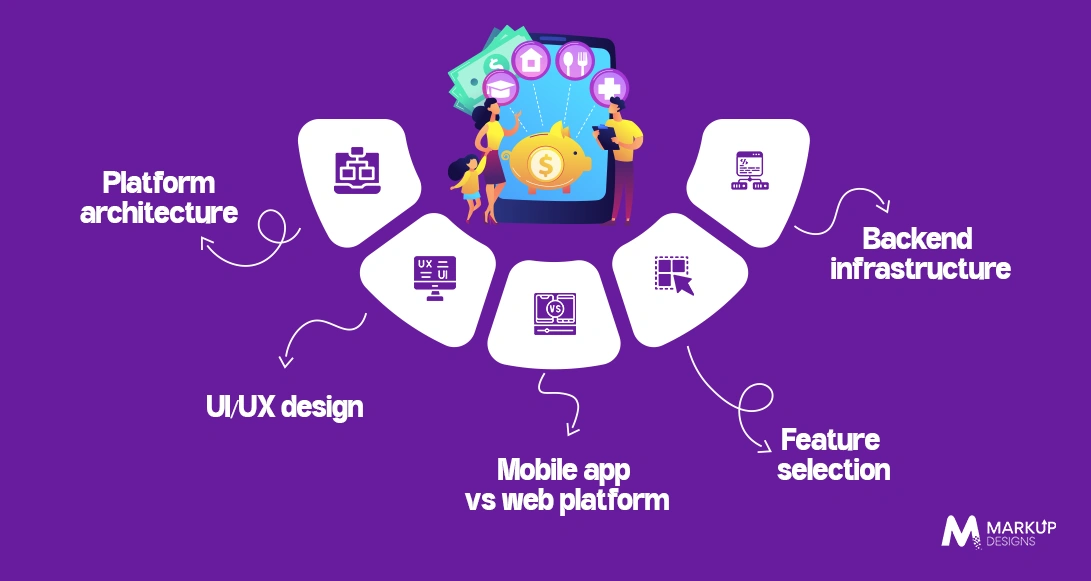
When it comes to budgeting, companies should remember that the cost of a platform will not depend only on screens but will be determined by architectural choices, scalability requirements, and the responsibilities of a platform in the users’ lives. This means that if you are going to develop community portals for Qatar or the Middle East region, these factors will determine the total cost.
Platform architecture and technical complexity
The architecture of a community platform plays a significant role in determining overall development costs, as it directly influences how the platform is designed, integrated, scaled, and maintained. A more advanced architecture often requires greater investment in backend infrastructure, custom features, security layers, and system integrations. However, the goal is not complexity for its own sake but building an architecture that supports performance, scalability, and long-term business growth.
UI/UX design requirements
User experience plays a major role in determining the development cost of community and social networking platforms. Elements such as custom UI design, interactive features, intuitive navigation, personalized user journeys, and responsive interfaces require additional time for research, design, prototyping, and usability testing. The more sophisticated and tailored the design requirements are, the higher the development investment becomes.
Mobile app vs web platform development
Choosing between a mobile app, a web platform, or both significantly affects the overall project cost. Web platforms generally have lower initial development costs, while mobile applications require platform-specific development and optimization. Developing app for both iOS and Android requires additional effort in design, testing, and ongoing maintenance. Cross-platform strategies can help balance cost and performance requirements.
Feature selection and scalability needs
Features and their complexity have a direct impact on the cost of developing the platform, like Qatar Living. Basic functionalities such as user profiles, messaging, listings, notifications, and search need different types of development work. Further, additional functionalities like artificial intelligence suggestions, analysis, or a multilingual version would incur extra cost.
Backend infrastructure and cloud services
Backend infrastructure and cloud technologies directly impact community platform development costs by influencing hosting, database management, storage, traffic handling, and scalability requirements. More advanced infrastructure requires a higher initial investment but delivers better performance, security, and flexibility. Effective cloud infrastructure planning also reduces long-term maintenance and operational costs.
Hidden Cost Drivers Businesses Often Miss in Community Platform Projects
Many businesses focus only on development costs and overlook expenses that may appear after launch. As user activity grows, costs related to scaling, maintenance, moderation, support, and ongoing improvements become essential. These hidden expenses are rarely reflected in initial pricing but can significantly impact long-term platform success.
Continuous Maintenance and Updates
Launching a platform is only the beginning. Ongoing bug fixes, feature enhancements, system upgrades, and performance improvements require continuous engineering effort. Without proper planning, maintenance can become a significant recurring cost over time.
Content Seeding and Moderation Effort
An empty platform quickly loses user interest. Many businesses underestimate the effort needed to build engagement before a community becomes self-sustaining. Content seeding, discussion management, and moderation require ongoing human involvement beyond launch.
Marketing Infrastructure, Not Just Marketing Spend
Engagement can’t be achieved through traffic alone. Referral programs, workflows for emails, notifications and in-app messaging involve product development. Growth that is not backed up will result in spending money but not in retaining users.
Feature Driven by User Behavior
Once users start engaging with the platform, new requirements naturally emerge. Requests for additional filters, enhanced visibility controls, payment features, and other improvements often become priorities. These evolving needs are rarely included in the original project scope.
Internal Admin Complexity
As platform operations grow, administrative needs increase as well. Analytics, moderation, and automation capabilities must evolve to support scale. Stronger governance and operational control often lead to higher ongoing maintenance and management costs.
Key Features Every Successful Community Platform Needs
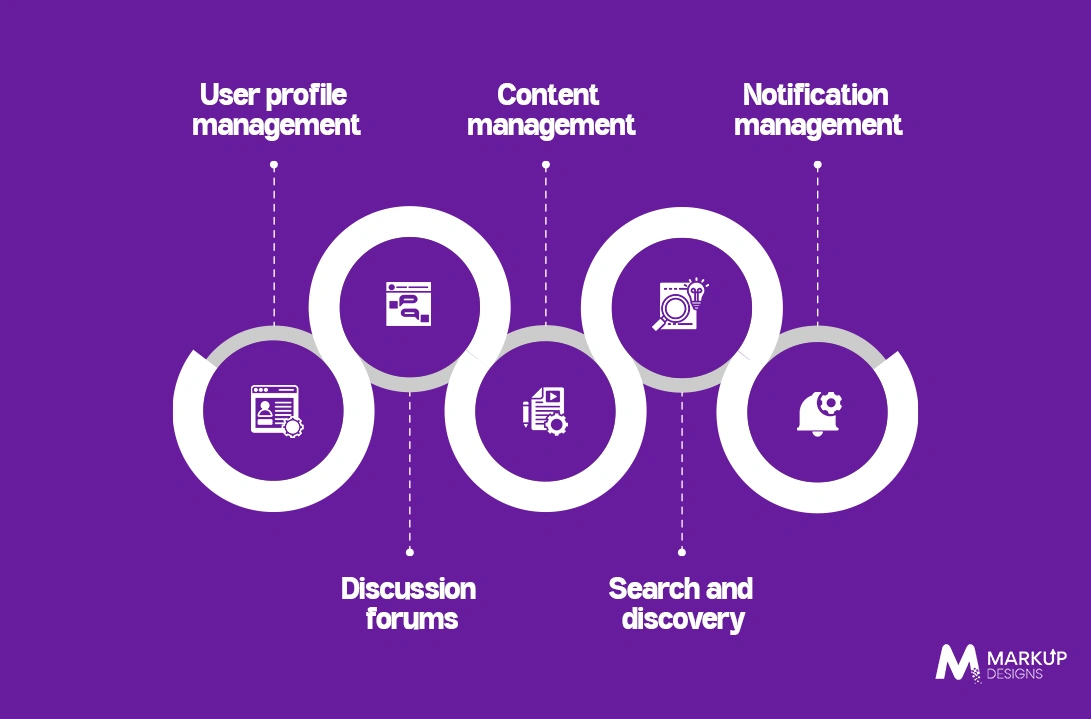
A community platform succeeds when users choose to return consistently. Creating a sense of value, familiarity, and trust encourages long-term engagement and participation. User retention is not an optional feature, it is a core factor that directly influences the platform’s growth and success.
User profile management
The platform facilitates users in creating and maintaining their profiles, preferences, and activity history. It enables the delivery of a customized experience and drives engagement in the community for a long time. Users will be able to change their account settings and privacy settings conveniently.
Discussion forums and community feeds
Allowing users to share their thoughts, post questions, and engage in discussions. The feed keeps the content fresh, up-to-date, and accessible. This will promote increased user involvement and community engagement.
Content management
It helps in supporting efficient content creation, organization, editing, and moderation across the platform. It ensures information remains structured, relevant, and up to date while improving overall platform efficiency and user experience.
Search and discovery
It enables users to quickly discover relevant discussions, listings, people, and content across the platform. Strong search and discovery features improve usability, increase engagement, and make navigation more intuitive through filters and personalized recommendations.
Notification management
It keeps users updated with the use of alerts, updates, notifications, and messages. This feature enhances retention through the promptness of interactions and responses. Notifications also ensure that users stay updated about community events.
Estimate the Cost of Your Community Platform
Get a tailored cost breakdown for building a community platform like Qatar Living based on your features, user base, and business goals. Understand development timelines, technology requirements, and scalability considerations before you begin.

Advanced Features That Help Your Community Platform Stand Out
Once you build up your platform foundation well, you can grow the platform through features that make your platform more usable, faster, and harder to leave behind. These are the features that differentiate existing platforms from dominant platforms.
Intelligent Recommendation Engine
Users stay engaged with personalized content. Recommended listings, jobs, or posts keep users on the platform longer. AI-driven recommendation systems analyze user behavior, preferences, and interaction patterns to deliver highly relevant content. This improves user retention, increases session duration, and encourages repeated platform visits.
Paid Listings and Promotion Options
A revenue model should be designed from the start. Featured ads, posts, and visibility become sources of income. Businesses and users can pay for premium placement to gain greater exposure and reach targeted audiences faster. Built-in monetization capabilities create sustainable revenue opportunities as the community grows.
Live Chat and Direct Messaging
Conversations build communities. Live interactions create user retention that cannot be created by content only. Real time communication encourages stronger engagement and helps users connect instantly without leaving the platform. Messaging features also support networking, inquiries, transactions, and long-term community participation.
Advanced Analytics and Reporting
Data drives strategy. User behavior trends, listing performance, and engagement stats inform better strategies. Detailed analytics provide visibility into platform growth, content effectiveness, and user activity. These insights help businesses make informed decisions and continuously optimize user experiences.
Support for Multilingualism and Localization
A platform serving diverse users should deliver experiences that align with their language, preferences, and local expectations. Localization extends beyond translation by adapting content, formats, and interactions for different regions. This creates a more personalized experience and expands market reach across broader audiences.
AI-Based Moderation and Searching
With growth comes automation to ensure quality. Filtering and searching speed help in lowering manual effort.AI moderation helps identify spam, inappropriate content, and policy violations at scale while improving search relevance. Automated content management creates safer and more efficient community experiences.
Role-Based User Management
Different roles, such as admins, contributors, advertisers, and moderators, require varied access controls. Role-based permissions strengthen security and streamline operations by giving users access only to relevant functions. This structure supports governance while simplifying platform administration.
Event and Marketplace Integration
The platform evolves into an ecosystem as users transact, book services, and actively engage within a single connected environment. Integrated marketplaces and event capabilities increase platform utility and reduce dependency on external services. Users benefit from a seamless experience that supports discovery, interaction, and transactions in one place.
How to Develop a Platform Like Qatar Living: Step-by-Step Process
The creation of a big community platform is not a development endeavor. This is a business transformation undertaking. The most frequent cause of failure of platforms is not technical, but the lack of execution discipline. The online community platform development process succeeds where the connection between strategy, engineering, design, and operations forms a unified process flow.
Step 1: Market Strategy and Platform Positioning
The process begins by identifying why users would choose your platform over existing alternatives. This includes market research, competitive analysis, and validation exercises to uncover unmet needs. At this stage, businesses decide whether to build a broad community platform or focus on a niche industry segment.
Step 2: User Research and Behavioral Insights
The team studies user intent, engagement habits, and pain points beyond basic demographics. Through interviews, surveys, and behavioral analysis, they understand how users discover, interact with, and return to digital platforms. These insights guide feature priorities and user journeys.
Step 3: Product Planning and Feature Architecture
Once user expectations are clear, the platform structure and feature roadmap are defined. The team prioritizes what belongs in the initial launch and what can be introduced later. This approach keeps development focused while allowing room for future growth.
Step 4: System Architecture and Technical Planning
This phase establishes the technical foundation of the platform. Decisions around infrastructure, database design, scalability, cloud services, and system modularity directly impact long-term performance and cost efficiency.
Step 5: Experience Design and Usability Optimization
Design goes beyond visual appeal to create intuitive and frictionless user experiences. Navigation, workflows, layouts, and interactions are refined to improve usability and build trust. The focus is on creating a platform that feels simple, reliable, and consistent.
Step 6: Platform Development and Integration
Development begins with core functionality and gradually expands to user flows, backend systems, APIs, payment capabilities, and analytics. Continuous testing throughout development ensures seamless integration and platform stability.
Step 7: Security and Compliance Implementation
Security controls are introduced to protect users and platform operations. Authentication systems, encryption standards, access management, monitoring, and compliance measures help reduce risk and maintain trust.
Step 8: Performance Testing and Scalability Validation
Before launch, the platform undergoes performance and load testing to simulate real-world traffic conditions. Engineering teams optimize speed, reliability, and resource usage to ensure the system performs consistently under growth.
Step 9: Launch Preparation and Controlled Deployment
Deployment starts with controlled rollouts instead of full-scale release. Early user feedback is collected, improvements are implemented, and operational risks are addressed before expanding to a wider audience.
Step 10: Operational Readiness and Growth Enablement
As adoption increases, support systems, moderation workflows, reporting tools, and governance processes become essential. These operational foundations help maintain quality and ensure sustainable growth.
Step 11: Continuous Maintenance and Platform Evolution
After launch, ongoing improvements become a core part of success. Performance optimization, bug resolution, security updates, and feature enhancements are driven by user behavior and evolving business needs. Long-term platform success depends on continuous refinement.
How Community Platforms Like Qatar Living Make Money: Revenue Models Demystified
When users need their listings to get more visibility, community portals earn their money. In general, most portals earn up to 60-70% of their income from featuring. In Qatar, the fee for featuring ranges from 50 to 200 Qatari rials ($14-$55), providing a stable monthly income.
Advanced Monetization Models:
Premium Business Subscriptions – Packages that include unlimited listings, customer service, and analytical tools, costing between QAR 500-2,000 per month
Smart Display Ads – Programmatic ads that earn QAR 2-8 per thousand impressions, especially useful considering Qatar’s high purchasing power
Transaction Fees – Fees charged as a percentage of transaction value, ranging from 2-5%, useful in real estate and vehicle listings
Data Insights – Business insights and analytics packages for those looking for data on consumer behavior
Emerging Sources of Income:
Modern development of online community platforms opens up new opportunities to monetize via API access licensing, white-label products for other markets, and high-end verification services. Using escrow services for costly operations will bring extra money from commissions and will help establish user confidence.
There are difficulties in developing an online community platform, but the absence of efficient income generation is not supposed to be among them. The majority of successful platforms get profit margins of 25-35% in 18-24 months after their launch due to various sources of income.
Innovate Beyond Qatar Living: How to Create a Platform That Outshines
To compete in an existing market like one dominated by an established player, such as Qatar Living, is not a matter of matching features. It is a question of business positioning. Organizations that have been successful in such a niche do not pose themselves the question of “How can we compete with them?” but rather “In what way can we beat them?” This is what makes a community portal work.
Use Technology to Get Rid of Friction Rather Than Create Complexity
Technology is supposed to make the lives of users easier and also make the operations smoother. The better you search, the easier you will be able to navigate and have your platform perform smoothly, and that will earn your brand more trust than any marketing campaign ever can.
Entering the Market Through Focus, Not Size
When you try to cater to all, you end up not catering to anyone properly. Platforms that target an audience first grow their authority faster. It could be exclusive properties, authenticated service providers, or job-related networks, focusing helps establish credibility much quicker. If you wish to launch an app like Qatar Living, then the wiser approach would be to master.
Why Choose Markup Designs for Developing a Community Platform in Qatar?
We create community platforms that have been designed to scale, involve users, and help achieve long-term digital growth in the dynamic market of Qatar. We create our solutions through strategic thinking, use of technologies, and user-friendly designs to provide you with secure and feature-packed platforms that meet your business objectives. From community feeds, content management, integration, scalability, and more – we deliver performance and flexibility.
Build a High-Impact Community Platform
Launch a feature-rich community platform designed to drive engagement, simplify content management, and support long-term growth. Work with experienced developers to create a scalable solution that delivers seamless user experiences.

Conclusion
Developing a community platform like Qatar Living involves more than just development; it is a sustained effort to invest in digital technology, user interaction, scalability, and business strategy. It all comes down to an overall cost, which will be determined by various factors, including the complexity of the platform. Companies that understand how to solve user problems, create proper engagement loops, and build sustainable monetization strategies have a higher chance of succeeding.
FAQs
1. How much does it cost to build a community platform like Qatar Living?
The development cost can range from approximately QAR 109,200 to QAR 2,184,000+ ($30,000–$600,000+), depending on the platform’s complexity, features, infrastructure, and scalability requirements.
2. How long does it take to develop a community platform?
Development timelines typically range between 3–12 months or more, depending on project scope, custom features, testing requirements, and integration complexity.
3. What are the essential features of a successful community platform?
Core features include user profile management, discussion forums, content management, search and discovery, notifications, messaging, and admin controls.
4. Should businesses build a web platform or a mobile app first?
This depends on business goals and target users. Many businesses begin with a web platform or MVP and later expand into mobile applications for wider engagement.
5. How do community platforms generate revenue?
Common revenue streams include paid listings, featured promotions, subscriptions, advertisements, transaction fees, and premium business services.
6. Can a community platform be scaled after launch?
Yes. A modular architecture and cloud-based infrastructure make it easier to add features, support higher traffic, and expand platform capabilities over time.
Author's Perspective
Community platforms are now becoming an integral part of the digital revolution in Qatar because they provide sustained engagement as opposed to just one-off engagements. The best platforms may not be those which offer all the features but are those which keep solving users’ problems and become part of their daily behavior. Companies which are planning to launch a platform such as Qatar Living need to start with clear vision, scalability and user experience in mind. This will work much better than replicating other platforms.
Discuss Your Project NowGaurav Goyal
Global Sales- VP
Related Posts

How Much Does Inventory Management Software Cost in...

Enterprise AI Outsourcing: How to Choose the Right...

How to Hire the Best Mobile App Developers...
Insights Are Valuable & Execution is Priceless
You’ve read about the digital future. Now, let’s build the infrastructure to take you there. Move your strategy from the page to the product.
Design Your Solution Now
Contact Us
Schedule The Appointment At Your Convenience Date And Time.
30 Min
Web Conference
Time Zone
Indian standard time (08:30pm)

Thanks For Getting In Touch!
You’ve Taken The First Step Toward Transforming Your Digital Presence. Our Experts Will Reach Out Shortly To Take It Forward.
Launch Your Dream Project
Provide a brief overview of your project, and our specialists will evaluate your requirements. We will connect with you to explore how the right digital solutions can help you launch faster.