

In Brief
- Consider wireframes: Complete wireframe design and user flows at the planning stage to minimize potential design rework and modifications.
- Launch MVP initially: Focus on necessary functions and create an MVP version of the application to verify the idea and proceed further.
- Implement Agile methodologies: Apply short development cycles and frequent reviews to spot problems timely and facilitate progress.
- Opt for automation: Introduce automated tests and CI/CD processes to ensure prompt releases and codebase quality.
- Hire a professional development team: Collaborate with experienced specialists that will use reusable components, proper workflow, and continuous quality assurance.
Mobile app development time impacts the speed of business product launch, responsiveness to customer needs, and ability to stay ahead of the competition. In 2026, changing user requirements, complicated integrations, and continuous technological innovations make efficient planning of the development process indispensable. A delay in mobile application launch means additional expenses and postponement of the possibility to reach the target audience and earn money.
Businesses can accelerate mobile app development by making the right decisions before and during the development process. Starting from applying low-fidelity wireframes and building an MVP, to employing Agile methodologies and implementing tests automation, the correct approaches will help avoid rework and increase delivery speed. This guide explores 10 practical ways to shorten the mobile app development timeline while maintaining app quality, usability, and long-term scalability.
Why Is Speed Important in Mobile App Development?
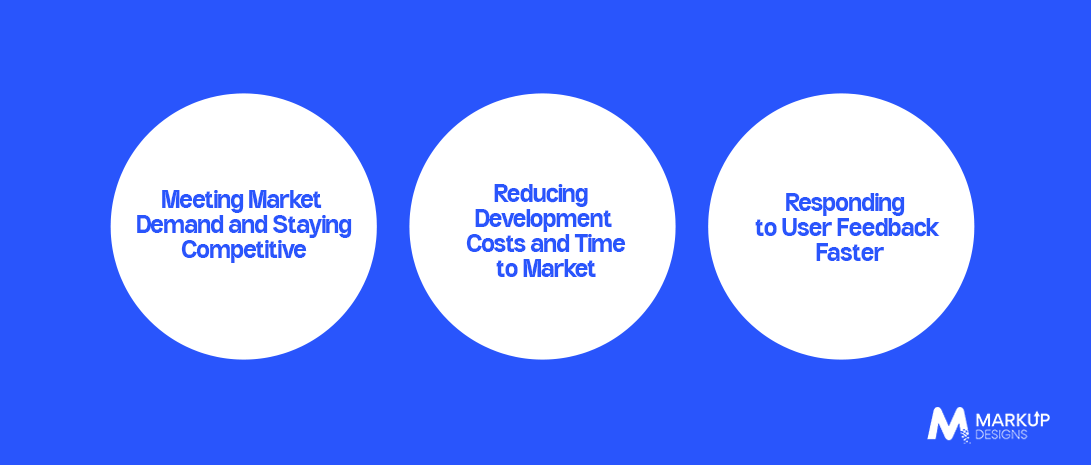
The benefits that come with reducing the time it takes to develop a mobile application include giving the business better opportunities to take advantage of changes in the market, manage budgets, and deliver value to customers in a short while.
Meeting Market Demand and Staying Competitive
As markets change due to various factors like technology and changing preferences, businesses must be ready to respond in good time. It is thus advisable for businesses to cut development time so that they can introduce their applications and remain competitive.
Reducing Development Costs and Time to Market
It is important for any business to save on the amount of money and time spent on developing its application since long development times mean increased costs for many reasons, like revisions and reallocations. It becomes easier to save costs when one develops their applications using a structured development process.
Responding to User Feedback Faster
It becomes possible for businesses to receive feedback from users much quicker when the app is released much earlier. They can use these insights to prioritise updates, refine features, and make product decisions based on actual user behaviour rather than assumptions.
Read Also: Complete Guide to Android App Development Cost in 2026
What Are the 10 Ways to Speed Up Mobile App Development in 2026?
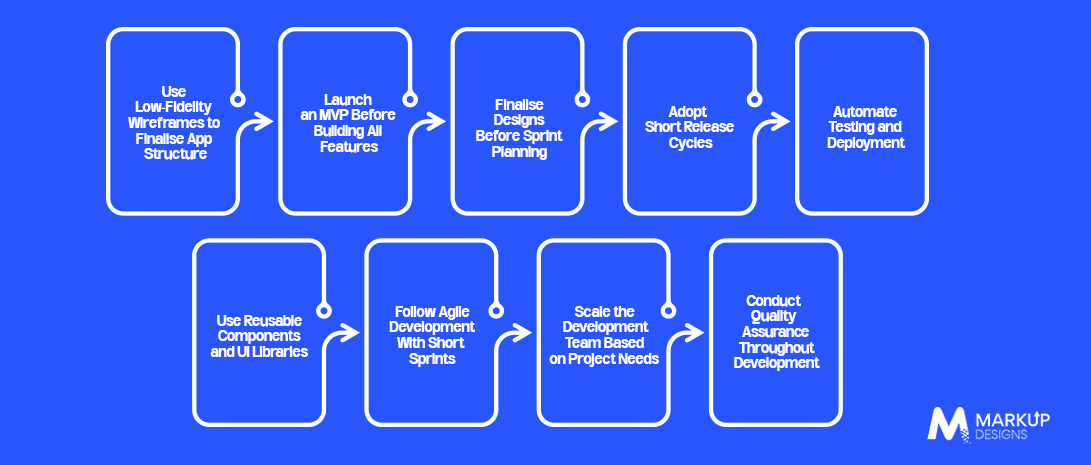
There are different ways in which companies can decrease mobile app development time through better planning, prioritization of important features, and efficient development practices. They include the following methods.
1. Use Low-Fidelity Wireframes to Get the App Structure Right
Low-fidelity wireframes enable teams to lay out all of the app screens and their navigation paths. At this stage, it is easier to spot any usability flaws and correct structural mistakes before investing effort into making changes during the development process.
2. Launch MVP Instead of Full-Featured App
An MVP is an application that contains only the necessary features to solve the users’ problem. By focusing on these features, companies are able to shorten the initial development process, launch an app earlier, and prove their ideas before adding any extra functionality.
3. Finish All Design Decisions Before Sprint Planning
Finalizing all important design decisions before sprint planning allows developers to know exactly what they should create and implement. It helps to avoid any uncertainties, mid-sprint changes, and ensures that the work will be done on time.
4. Adopt Short Release Cycles
A short release cycle strategy helps to deliver working features periodically rather than at once after the completion of an app’s development. This method is beneficial because it helps to detect technical problems, get regular feedback, and adjust the app without interrupting the whole process of development.
5. Automate Testing and Deployment
Automated testing helps to save time on manual testing of the same functionality each time; in addition, the application of a CI/CD pipeline helps to streamline the process of integration, testing, and deployment. These strategies help to detect bugs earlier, eliminate release delays, and release software more frequently.
6. Use Reusable Components and UI Libraries
The use of reusable UI elements and proven UI components is very helpful because it prevents developers from developing typical user interface elements every time. The use of tested components for implementing buttons, forms, navigation, input fields, etc., helps to increase the speed of implementation.
7. Follow Agile Development With Short Sprints
An Agile development strategy breaks down a task into short sprints and makes it possible to implement small tasks in short sprints. Regular planning, daily coordination, and sprint reviews help teams identify blockers early, adjust priorities, and maintain progress as requirements evolve. Clear sprint goals also make it easier to track delivery against the project timeline.
8. Scale the Development Team Based on Project Needs
The development team should consist of people who possess skills that are necessary for the creation of an app. If some kind of specialism such as backend, integration, UI/UX, testing, and others is required, then adding more specialists to your team will help you avoid bottlenecks. However, adding more people without assigning them tasks may cause difficulties in coordination and communication and will not necessarily speed up the delivery of your project.
9. Conduct Quality Assurance Throughout Development
Testing should be performed throughout the entire software development lifecycle instead of waiting for it till the end. It will help teams detect any possible defects during the earlier stages of their existence, thus saving time on the fixing and correction processes.
10. Reduce Rework Through Clear Requirements and Feedback
Functional requirements and acceptance criteria, as well as constant feedback, help developers understand the product better. Moreover, documenting all decisions and checking progress on a regular basis may prevent mistakes and misunderstandings.
What Factors Can Delay a Mobile App Development Timeline?
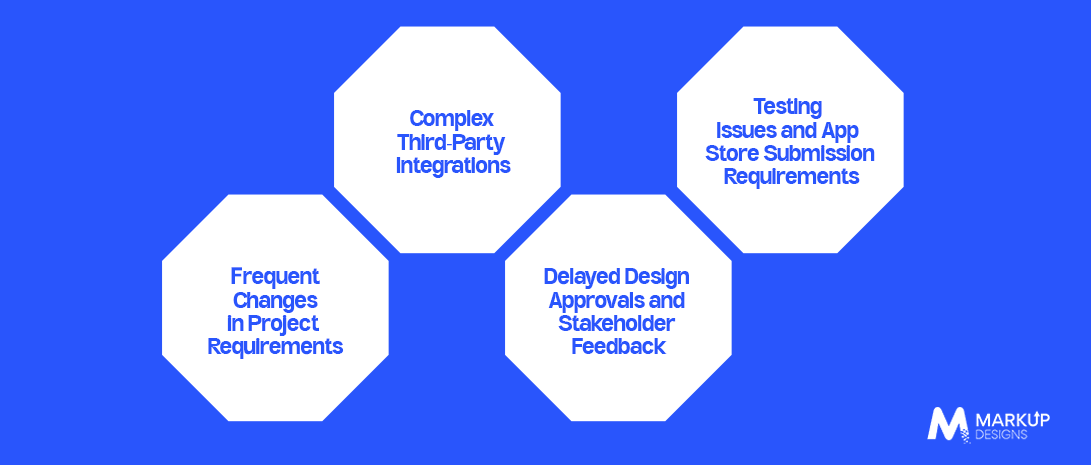
Nevertheless, there are certain problems that will influence delivery schedules despite a structured process of product development. Knowing the causes of these delays will help businesses to manage resources effectively, foresee possible risks, and take steps to avoid problems in advance.
Frequent Changes in Project Requirements
Multiple changes in the project related to features, workflow, or objectives may affect the sprint schedule and cause developers to rework on completed modules. It is important to define the project scope, prioritize requirements, and use a change management process to evaluate the effect of every request.
Complex Third-Party Integrations
Integration with the payment gateway, CRM system, analytical solutions, or an API might require further development and testing. Problems with compatibility, lack of documentation, and possible limitations of the third-party service will slow down development. Proper evaluation of integration requirements and testing critical dependencies can solve these issues.
Delayed Design Approvals and Stakeholder Feedback
When teams have to wait for approval of a design or feedback, the development process gets slowed. In turn, it may cause further delays in release. Allocating decision-makers, setting deadlines for reviews, and gathering feedback will help.
Testing Issues and App Store Submission Requirements
Unresolved defects, performance problems, security gaps, and platform-specific requirements can delay launch. App Store and Google Play reviews may also require additional changes before an app is approved. Testing on target devices, reviewing current submission guidelines, and preparing release assets early can help minimise avoidable delays.
How Can Businesses Choose the Right Mobile App Development Partner to Speed Up Delivery?
The right development partner can help businesses set realistic timelines, choose appropriate technologies, and manage the process from its initiation to implementation. Apart from coding expertise, businesses must analyze how the partner manages communication, quality control, resource allocation, and other project changes.
Evaluate Technical Expertise and Industry Experience
Consider the company’s previous experience in using the needed platforms, frameworks, backends, and integrations. Industry expertise will be helpful in recognizing possible technical problems, making proper architecture decisions, and avoiding time losses due to the wrong choice of technology.
Review Development Processes and Testing Practices
Learn how the company manages requirements management, sprint planning, code review, automation testing, and deployment. A clear development process with well-structured milestones and continuous quality assurance will make it easy to track the project progress and recognize possible delays.
Assess Team Structure and Communication
A trustworthy company will be able to outline responsibilities and give regular progress reports, with communication between developers, designers, testers, and other parties involved in the project. The right specialist and an effective escalation process may help to eliminate blockers in a timely manner.
Check Previous Projects and Delivery Records
Review relevant case studies, client feedback, and examples of apps the provider has delivered. Discuss how the team handled complex requirements, managed setbacks, and maintained quality under tight timelines. This provides a clearer picture of its ability to deliver a similar project successfully.
How Can Markup Designs Assist Businesses With Speeding Up Mobile App Development?
Markup Designs assists companies in accelerating the development process by creating a structure, using professional developers, and employing effective strategies during the process. Planning, selecting the appropriate technology stack, working with reusable components, and continuous testing help eliminate unnecessary delays in the mobile app development process.
Speed Up Your Mobile App Development With the Right Team
Bring your app idea to market faster with a development approach built around your business goals, project scope, and user needs.

Conclusion
To speed up the mobile app development process, it is important to consider multiple elements, including requirements gathering, MVP-first strategy, agile workflow, reusable components, and continuous testing, as well as choosing the right development partner.
FAQ
1. How long does it take to create a mobile application in 2026?
Developing a mobile application can take a few weeks to create a basic MVP or several months to develop an advanced one with all its features. Development time will depend on a variety of elements, including scope of the project, platforms used, design elements, and testing.
2. What are the factors that influence development time the most?
These factors may include the level of complexity of the mobile app, required features, UI/UX design, technologies used, additional third-party integrations, and testing needs. Also, frequent scope changes and delays with approval can influence development time.
3. Can MVP decrease the development time of mobile apps?
Indeed, it does because MVP is a way of focusing only on the features that allow for the validation of an app’s core value. Thus, MVP allows reducing the time of initial development and launching an app earlier. Moreover, businesses can plan their further development with the use of feedback from users.
4. Does Agile development increase the speed of mobile app delivery?
Agile development may accelerate the process of delivery since it breaks down the development process into small sprints and helps find any blockers. However, the efficiency of Agile depends on priorities, participation of all stakeholders, and coordination within the development team.
5. What measures could businesses take to reduce the cost of mobile app development without slowing down its launch?
Businesses can manage costs by choosing priority features and specifying requirements, choosing reusable components, automating testing and deployment processes, conducting an MVP analysis, and evaluating progress. All of these measures will reduce the risk of rework and align development with the budget.
Author's Perspective
In my opinion, fast development of mobile apps lies in the correct decision-making at the beginning of the project. Companies that know their
Businesses that define their priorities, validate core features, and maintain clear communication with their development teams are better positioned to avoid rework and launch on schedule. The goal is not simply to build an app faster, but to deliver a reliable product that can evolve with user expectations and business needs.
Discuss Your Project NowAjit Kumar Jha
VP - Business Operations
Related Posts

Native App vs PWA: Choosing the Right Mobile...

How to Develop a Messaging App Like Telegram...

How to Build a Secure Money Transfer App:...
Insights Are Valuable & Execution is Priceless
You’ve read about the digital future. Now, let’s build the infrastructure to take you there. Move your strategy from the page to the product.
Design Your Solution Now
Contact Us
Schedule The Appointment At Your Convenience Date And Time.
30 Min
Web Conference
Time Zone
Indian standard time (08:30pm)

Thanks For Getting In Touch!
You’ve Taken The First Step Toward Transforming Your Digital Presence. Our Experts Will Reach Out Shortly To Take It Forward.
Launch Your Dream Project
Provide a brief overview of your project, and our specialists will evaluate your requirements. We will connect with you to explore how the right digital solutions can help you launch faster.