

In Brief
- An Electronic Medical Record (EMR) is a software solution that allows healthcare organizations to digitally store, update, retrieve, and manage patients’ health information such as their medical history, diagnoses, prescribed medications, treatment plans, and lab/test results. Popular variants of EMR include cloud-based, on-premises, specialty-specific, enterprise, modular, and hybrid EMR systems.
- Key features of EMRs are patient registration, clinical documentation, appointment scheduling, electronic prescriptions, laboratory/diagnostics integration, and reporting/analytics. These features make clinical workflows more efficient and simplify patient records management.
- The process of EMR development includes analysis of healthcare needs, selection of the proper architecture, UI design, core functionality development, system integrations via HL7/FHIR and other standards, and finally security testing and deployment.
- The cost estimation of EMR development varies from $40,000 to $4,000,000+ and includes a basic EMR ($40,000-$120,000), a mid-range EMR ($120,000-$400,000), and an enterprise EMR ($400,000-$4,000,000+). Development time required varies from 4 to 18+ months.
- Common challenges can be related to complexity in clinical workflows, data migration issues, interoperability problems, security issues, end-user adoption problems, and scalability problems. The advantage of developing a custom EMR system is that it will solve such problems by implementing various customization options, storing all information in one place, securing data, and increasing efficiency.
Healthcare institutions are becoming more and more focused on digital solutions when it comes to the storage and management of patients’ data. Paper-based medical records make it complicated to have easy access to the patient’s history and treatments, and it is hard to provide information between healthcare professionals. Here comes the Electronic Medical Record (EMR) system.
The development of an EMR system demands not only the creation of a digital medical records management system. It requires an understanding of the healthcare workflows, technology stack selection, cost estimation of the development, etc.
In this blog post, we are going to speak about the development process of an EMR system, its key features, the step-by-step process of development, cost estimation, problems that appear while creating an EMR system, and the advantages of creating a custom solution for healthcare organizations.
What is an EMR System and How Does It Work?
An Electronic Medical Record (EMR) system is an electronic system used for the creation, maintenance, management, and updating of patients’ health records. It involves the replacement of the conventional paper-based record systems with electronic records accessible to authorized healthcare professionals in a medical practice or healthcare institution.
The EMR system keeps track of patient information, such as medical history, diagnoses, medications, allergic reactions, treatment plans, laboratory tests, and clinical notes. This enables doctors and healthcare professionals to make well-informed decisions without having to rely on physical records.
How Does an EMR System Work?
An EMR system operates on the principle of capturing and organizing patient data throughout the process of delivering medical services. The workflow for such a system includes:
- Patient registration: This is where patients’ data and medical history are recorded in the system.
- Clinical documentation: Where doctors document the patients’ symptoms, diagnosis, physical examination, and treatment.
- Digital prescription management: The generation and management of digital prescriptions for the patients.
- Test and report management: The recording of laboratory reports for the patients.
- Retrieval of records: Authorized personnel have access to patient data at any time.
- Updating of records: The updating of medical records in the course of follow-up care and treatment.
This is how an EMR system can be used to streamline the work of clinicians.
Types of EMR Systems
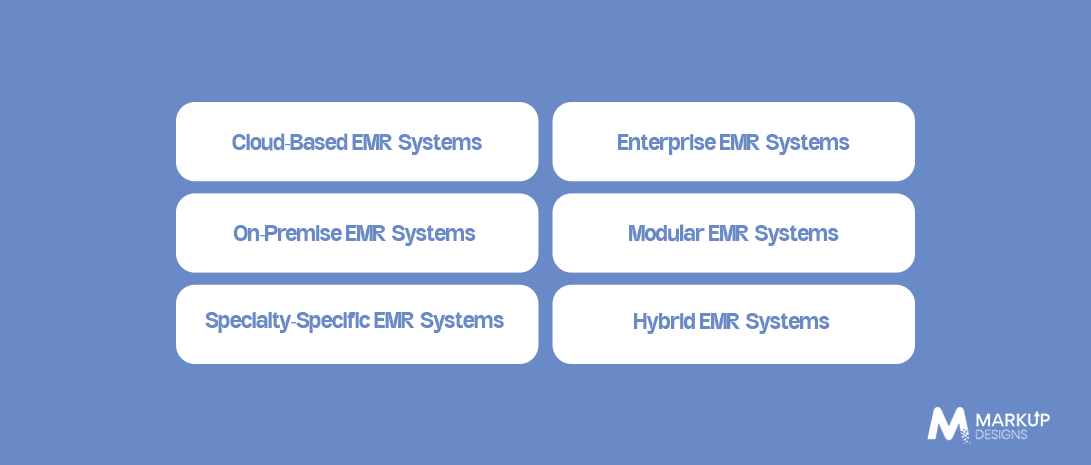
Different kinds of EMR software depend on various aspects of healthcare facilities, including ways of handling patient data, operational needs, and preferences concerning the facility’s infrastructure. It is essential to consider the proper kind of EMR because it influences the availability, scalability, maintenance, and general cost of development of the system.
Here are the six most popular types of EMR software:
1. Cloud-Based EMR Systems
This kind of EMR stores patient data on the cloud infrastructure. The advantage of this kind is that it allows healthcare specialists to access patient data via the Internet.
2. On-Premise EMR Systems
This kind of EMR operates on the servers of the organization where it is used. On-premise EMR gives users more freedom in regard to data storage, system configuration, and internal security issues.
3. Specialty-Specific EMR Systems
It is a kind of EMR software that is designed specifically for some medical specialty, for example, cardiology, dermatology, dentistry, or oncology.
4. Enterprise EMR Systems
Enterprise EMR software is used by hospitals and healthcare organizations that cover several departments or locations. It helps consolidate patient information and streamline clinical processes.
5. Modular EMR Systems
Modular EMR systems provide healthcare organizations the flexibility to choose particular features according to their requirements. These may include patient care, billing, scheduling, and more.
6. Hybrid EMR Systems
Hybrid EMR software is a combination of cloud and on-premises infrastructure. It provides health care organizations with the option to choose the best from both sides.
Key Features to Include in an EMR System
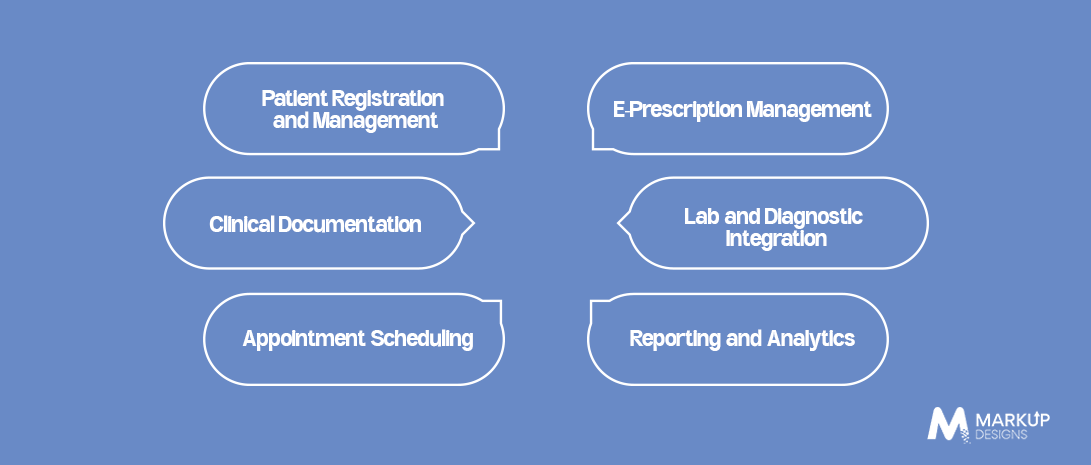
An ideal EMR system should ensure that patient data is easily manageable while meeting the day-to-day clinical and administrative requirements. In addition, some key features ensure healthcare professionals become more efficient, reduce manual effort, and ensure medical records remain accurate. Some of the key features that should be considered during EMR software development include the following:
1. Patient Registration and Management
The tool provides a means of registering a patient as well as storing his/her personal details, contact details, medical history, allergies, and previous treatments in one place.
2. Clinical Documentation
It ensures doctors can document the patient’s symptoms, diagnosis, examination results, treatment plan, and clinical notes to ensure they have access to well-managed medical records.
3. Appointment Scheduling
The appointment management module enables patients and administrators to schedule and manage appointments and send reminders for upcoming appointments.
4. E-Prescription Management
It enables doctors to create, edit, and share electronic prescriptions. This will ensure medications are managed and reduce errors associated with handwritten prescriptions.
5. Lab and Diagnostic Integration
EMR software can be linked to laboratory and diagnostic systems for receiving results of tests and scans, among other pieces of medical data.
6. Reporting and Analytics
Reporting capabilities provide healthcare facilities with the ability to track the number of patients’ visits, treatment trends, clinical outcomes, and operational activity.
How to Develop an EMR System: Step-by-Step Process
Developing an EMR system is a task that needs proper planning, a technical approach, and workflow knowledge. Because an EMR system involves sensitive patient information and clinical processes, each step in the process should be focused on usability, security, and reliability.
The following are five key steps in developing an EMR system.
Step 1: Analyze Healthcare Needs and Workflow
The first step in developing an EMR system is analyzing the requirements of the healthcare institution. Here, you identify the users of the EMR system, which can include doctors, nurses, administrators, and patients. This helps you analyze their clinical workflows and documentation procedures.
Step 2: Select the Appropriate System Architecture
An appropriate architecture should be selected according to the infrastructure and security needs of the healthcare institution and its future expansion plan. The healthcare provider may opt for cloud-based, on-premises, or hybrid systems.
Consider factors such as:
- Data storage and accessibility.
- Scalability and system performance.
- Integration with existing healthcare platforms.
- Backup and disaster recovery requirements.
Step 3: Design a User-Friendly Interface
The EMR system must have an intuitive design, since healthcare specialists use the system for hours per day. Create dashboards separately for physicians, nurses, administration specialists, etc.
Ensure navigation, patient record structuring, availability of clinical data, and responsiveness.
Step 4: Implement Main Features and Integrations
When the architecture and interface have been created, implement the necessary modules of EMR. They can be patient registration, clinical notes, scheduling, electronic prescriptions, reports, etc.
Connect the system with external healthcare platforms via the HL7 and FHIR standards.
Step 5: Conduct Testing, Security Analysis, and Deployment
Perform the system’s functional, performance, usability, and security testing before deploying it. Ensure that patient records are saved correctly, integrations work correctly, access control works well, etc.
After validating the system’s quality, deploy it, train healthcare specialists to use the system, and maintain it further.
How Much Does It Cost to Develop an EMR System?
The amount that goes into creating an EMR depends on the degree of sophistication of the EMR, its features, integration capabilities, security needs, and the development period required. The development of a basic EMR system for a clinic will definitely incur lower costs than that of an EMR system developed for enterprises.
The cost involved in the creation of an EMR may range between $40,000 and $4,000,000 or even more.
Estimated EMR Development Cost by Complexity | ||
|---|---|---|
| EMR System Type | Estimated Cost | Development Timeline |
| Basic EMR / MVP | $40,000–$120,000 | 4–6 months |
| Mid-Level EMR | $120,000–$400,000 | 6–9 months |
| Enterprise EMR | $400,000–$4,000,000+ | 9–18+ months |
Factors That Affect EMR Development Costs
Several factors influence the overall investment required to build an EMR system.
- Complexity of Features: Simple patient management features take up less development effort than advanced capabilities of clinical documentation, analysis, and AI technology.
- Integration with Other Software Products: Integration of laboratory systems, pharmacies, billing software, and diagnostics tools is a significant development complexity.
- Migration of Data: Large amounts of patient data that need to be migrated add to development complexity.
- Security and Compliance Issues: Encryption and other security measures will also increase development costs.
- Customization: Custom workflows, multiple user roles, and departmental modules may lead to additional development efforts.
- Technical Support and Maintenance: Cloud-based hosting and maintenance add to the cost of software products.
EMR Development Budget Breakdown
Development costs are also distributed across different project phases. A typical budget allocation may look like this:
| Development Phase | Estimated Budget |
| Discovery and Planning | 10–15% |
| UI/UX Design | 10–15% |
| Core Development | 35–45% |
| Compliance and Security | 10–15% |
| Testing and Validation | 10–15% |
| Deployment and Training | 5–10% |
How to Manage EMR Development Costs
Healthcare organizations may control the costs of developing their applications through the inclusion of critical functions, focusing on the most impactful workflows, and adding advanced capabilities in subsequent stages. Scalability from the very beginning will also help avoid costly modifications to the system during its further development.
At the same time, it is vital to plan not only the initial costs but also the ongoing costs of hosting, maintenance, and cybersecurity monitoring.
Common Challenges in EMR Development and Their Solutions
EMR software development faces some difficulties that should be discussed. These include technical and operational problems. It is necessary to know about them, since this way it is possible to develop better software.
The following list includes the six most common EMR development difficulties and solutions for them.
1. Complicated Healthcare Workflow
Various healthcare providers have various procedures. It is hard to make a system that will take into account all of them.
Solution: It is possible to perform a workflow analysis and involve doctors, nurses, and administrative employees in the process.
2. Data Migration Problems
Migration from paper documents and other sources may result in data loss, duplication, and other problems.
Solution: It is necessary to have a structured data migration and validation process and several tests.
3. Interoperability Challenges
Healthcare institutions have their own labs, pharmacies, billing, and diagnostic tools that need to be integrated, causing interoperability challenges.
Solution: Stick to healthcare data exchange standards, including HL7 and FHIR, to ensure seamless interaction between different healthcare apps.
4. Data Security and Privacy Risks
EMR software stores confidential patient health information, which may attract hackers to gain access to it.
Solution: Implement encryption, multi-factor authentication, access controls, audit logins, and other necessary security measures.
5. Low Acceptance Rate
It may be difficult for healthcare professionals to adjust to new EMR software due to complex design and process disruptions.
Solution: Create a user-friendly interface and tailor specific training programs for different roles.
6. Scalability and Performance Problems
With an increasing number of patients, users, and healthcare facilities, EMR software will face performance problems.
Solution: Select appropriate software architecture and optimize databases.
Addressing these challenges during development helps healthcare organizations build EMR systems that are secure, reliable, and easier to use. It also reduces the risk of costly changes after deployment.
Benefits of Developing a Custom EMR System
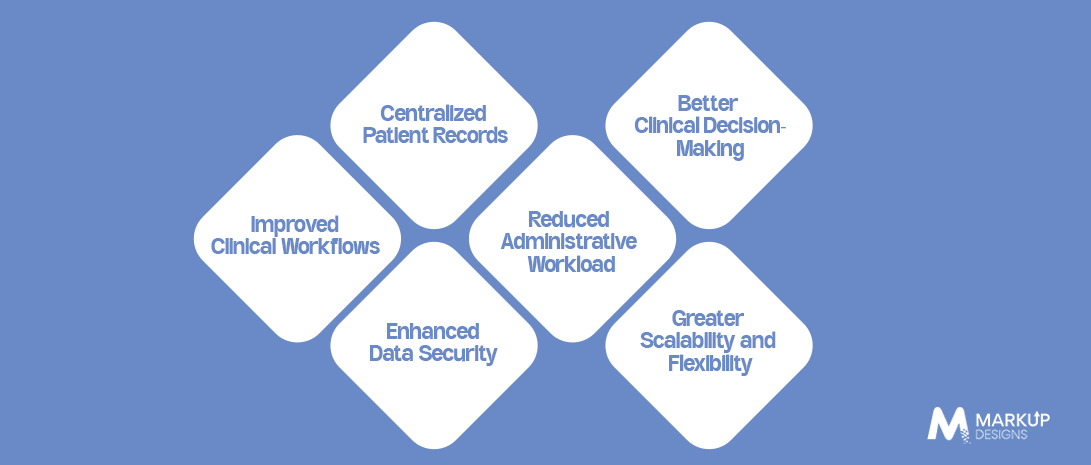
Developing a custom EMR system gives healthcare companies an opportunity to create a platform based on their own clinical workflow, operational requirements, and needs for managing patients. Custom solutions give more opportunities in terms of features, integrations, and future developments compared to generic software.
Here are six advantages that developing a custom EMR system provides.
1. Improved Clinical Workflows
Custom EMR platforms enable healthcare providers to automate the process of patient registration, clinical documentation, and appointment scheduling. This eliminates routine work and saves time for doctors and other health workers.
2. Centralized Patient Records
Custom EMR systems allow consolidating all patients’ history, diagnoses, prescriptions, and test results in one platform.
3. Enhanced Data Security
Healthcare companies have an opportunity to create specific security measures such as role-based access, encryption, authentication, and audit trails.
4. Reduced Administrative Workload
The automation of administrative functions like scheduling, record-keeping, and documentation can be useful in reducing paperwork and other efforts.
5. Better Clinical Decision-Making
Clinical decision-making will be aided by the patient records, reports, and analysis provided by an EMR system.
6. Greater Scalability and Flexibility
A customized EMR system can be made to add further functionalities and integrate more as per the needs of the healthcare organization.
How to Choose the Right EMR Software Development Company
Selection of the appropriate software development partner is one of the main keys to success while creating an efficient EMR system. EMR software development requires not only technical skills but also knowledge of the clinical processes, data security issues, and legislation.
These are six factors you have to pay attention to when selecting an EMR software development company.
1. Healthcare Domain Experience
A partner should have experience in creating healthcare software solutions and an understanding of the processes in the field of medicine. Such experience will help to solve the tasks that arise during development.
2. Understanding of Healthcare Legislation
A development company should have knowledge about healthcare regulations and legislation (HIPAA, GDPR, etc.) and know how to protect security and privacy during development.
3. Technical Skills
It is necessary to evaluate the experience of the company in using such technologies as Java, Python, React, cloud technologies, and healthcare integration standards (HL7, FHIR).
4. Integration Capabilities
Find out whether it is possible for the company to integrate EMR software with existing hospital management software, laboratory software, pharmacy software, billing software, and other third-party applications.
5. Look for Scalability and Customizability
Find the development company that is able to provide you with a solution that will be suited to your needs now and in the future.
6. Post-Launching Help and Support
It is necessary to maintain EMR systems, update them, improve their security, etc. Therefore, find out whether the development company will offer you some help after launching the EMR software.
Choosing the right technology partner will help healthcare providers to simplify development, make proper decisions, and create a successful EMR platform.
Ready to Build a Custom EMR System?
Work with an experienced software development team to create an EMR solution that simplifies clinical workflows, protects patient information, and supports your organization’s growth. From initial planning to deployment and ongoing support, get the expertise needed to build a reliable healthcare platform.

Conclusion
Developing an EMR platform presupposes knowledge of all the aspects, such as healthcare workflows, technical specifications, costs of development, and compliance standards. From the choice of system architecture to the implementation of necessary features and security measures, each decision is crucial for the successful creation of a reliable platform.
EMR platforms allow healthcare institutions to manage information about patients, decrease administrative burden, facilitate clinical collaboration, and utilize medical information more effectively. Nevertheless, to be successful, an EMR system needs to be designed and developed in a proper way that will help it to keep up with changes in the healthcare sector.
No matter whether you need a simple EMR solution for a clinic or a complex platform for hospital networks, it might pay off to invest in the development of such a system. You can do it with the help of a dedicated team of professionals from a healthcare software development company.
FAQs
1. How much does it cost to develop an EMR system?
The cost of developing an EMR system generally ranges from $40,000 to $4,000,000 or more. A basic EMR solution may cost $40,000–$120,000, while mid-level and enterprise systems require higher investments depending on features, integrations, security requirements, and complexity.
2. How long does it take to develop an EMR system?
EMR development can take anywhere from 4 to 18 months or longer. A basic system may take 4–6 months, a mid-level solution around 6–9 months, and an enterprise-level platform 9–18 months or more.
3. What technologies are used to develop an EMR system?
Common technologies include Java, Python, .NET Core, and Node.js for backend development; React, Angular, and Vue.js for frontend development; and PostgreSQL, MySQL, and MongoDB for databases. AWS, Azure, and Google Cloud are also used for infrastructure.
4. Is HIPAA compliance mandatory for EMR software?
HIPAA compliance applies to covered entities and business associates handling protected health information in the United States. EMR developers and healthcare organizations must implement appropriate administrative, physical, and technical safeguards when HIPAA applies.
5. What is the difference between EMR and EHR software?
EMR software primarily manages patient records within a particular healthcare practice or organization. EHR software is designed to support a broader view of patient health information and facilitate sharing across different healthcare providers and organizations.
Author's Perspective
Developing an EMR system requires a balanced approach to technology, usability, and security. The focus should be on creating a platform that simplifies clinical workflows, keeps patient information organized, and supports efficient healthcare delivery. Choosing the right features, technology stack, and compliance measures is equally important. As healthcare technology continues to evolve, AI, automation, and interoperability will further improve EMR capabilities, making scalable and secure solutions essential for meeting future healthcare requirements.
Discuss Your Project NowJupinder Singh Arora
Founder and CEO
Related Posts

How to Secure Healthcare Data: Essential Strategies for...

Custom eCOA Software Development: Process, Technology Stack, and...

How Much Does It Cost to Develop DICOM...
Insights Are Valuable & Execution is Priceless
You’ve read about the digital future. Now, let’s build the infrastructure to take you there. Move your strategy from the page to the product.
Design Your Solution Now
Contact Us
Schedule The Appointment At Your Convenience Date And Time.
30 Min
Web Conference
Time Zone
Indian standard time (08:30pm)

Thanks For Getting In Touch!
You’ve Taken The First Step Toward Transforming Your Digital Presence. Our Experts Will Reach Out Shortly To Take It Forward.
Launch Your Dream Project
Provide a brief overview of your project, and our specialists will evaluate your requirements. We will connect with you to explore how the right digital solutions can help you launch faster.