
In Brief
- The security of healthcare data implies the protection of sensitive information about patients, such as their personal information, medical data, payment information, diagnostic results, and data from medical devices.
- Effective data security ensures that patients’ privacy is maintained, their trust in healthcare organizations is maintained, financial losses are prevented, operational continuity is ensured, regulations are adhered to, and correct medical records are maintained.
- The typical challenges include ransomware attacks, malicious software, phishing, insiders, vulnerable medical devices, cloud security issues, vulnerabilities related to vendors, and outdated infrastructure.
- The 10 best ways to secure healthcare data can be outlined, which include encryption, role-based access management, multi-factor authentication, security assessment, protecting EHR, secure cloud system, education of employees, security of vendors, data backup, and continuous monitoring.
- Good security practices, combined with new trends like artificial intelligence, blockchain, Zero Trust architecture, and differential privacy, will decrease the number of risks._markup Designs helps healthcare companies implement secure application development, integrations, solutions compliant with all rules, security testing, and maintenance services.
The healthcare industry is responsible for the management of a significant amount of sensitive data. This includes medical records, the history of the patients, results of the diagnosis, medical reports, and health insurance records. The rise in the adoption of electronic healthcare applications like EHRs, telemedicine applications, and connected medical devices poses new challenges to the management and protection of the data.
A single breach of security could result in exposing sensitive patient data, disrupting healthcare service delivery, and tarnishing the reputation of an organization. Cyberattacks, theft, and lack of security measures have made healthcare data vulnerable to attack. Therefore, it is important for healthcare organizations to adopt the proper security measures to protect their sensitive data.
This blog highlights the definition of healthcare data security, its importance, common threats, and the top ten strategies that should be adopted to keep the data secure. We will also discuss some emerging technologies and how a good technology partner could assist you in improving the security of your healthcare organization.
What is Healthcare Data Security?
Data security in health care involves processes, software, and protocols for securing sensitive health information from any form of misuse, theft, damage, and unauthorized access. Healthcare data security ensures that patient information in hospitals’ databases and other sources is secure and confidential. Data security in health care also applies to other information in EHRs, telemedicine services, cloud services, and connected medical devices.
The various types of sensitive information include:
- Personal information: Such as name, address, identification numbers, and contact information of patients.
- Medical records: These include medical history, diagnoses, treatment, and prescription details.
- Financial information: Includes insurance, billing information, and payment information.
- Diagnostic data: This includes laboratory reports, medical imaging, and test results.
- Connected device data: Collected via wearable technology and remote patient monitoring systems.
Effective security measures help healthcare organizations protect this information throughout its lifecycle, from collection and storage to sharing and disposal.
Why is Healthcare Data Security Important for Healthcare Organizations?
Patient information constitutes an essential part of the daily activities of healthcare organizations. It becomes necessary to ensure data safety not only to protect patients’ privacy, but also to operate effectively and build trust. Adequate healthcare data security enables organizations to control electronic information safely while lowering associated risks of cyberattacks. Some of the main advantages of healthcare data security are listed below.
- Patient Privacy Protection: It safeguards private information about patients, their medical history, and treatment information.
- Building Patient Confidence: It allows us to reassure patients of adequate protection of their information.
- Minimizing Financial Risks: It decreases the risk of losses because of data breaches, ransomware, litigation, and recovery costs.
- Operational Continuity: It ensures the safety of essential systems of healthcare organizations from interruptions.
- Meeting Required Standards: It assists organizations in complying with the relevant requirements of data security and the healthcare industry.
- Preservation of Accuracy: It prevents any alterations to medical records and allows healthcare professionals to make informed decisions.
Common Healthcare Data Security Threats and Challenges
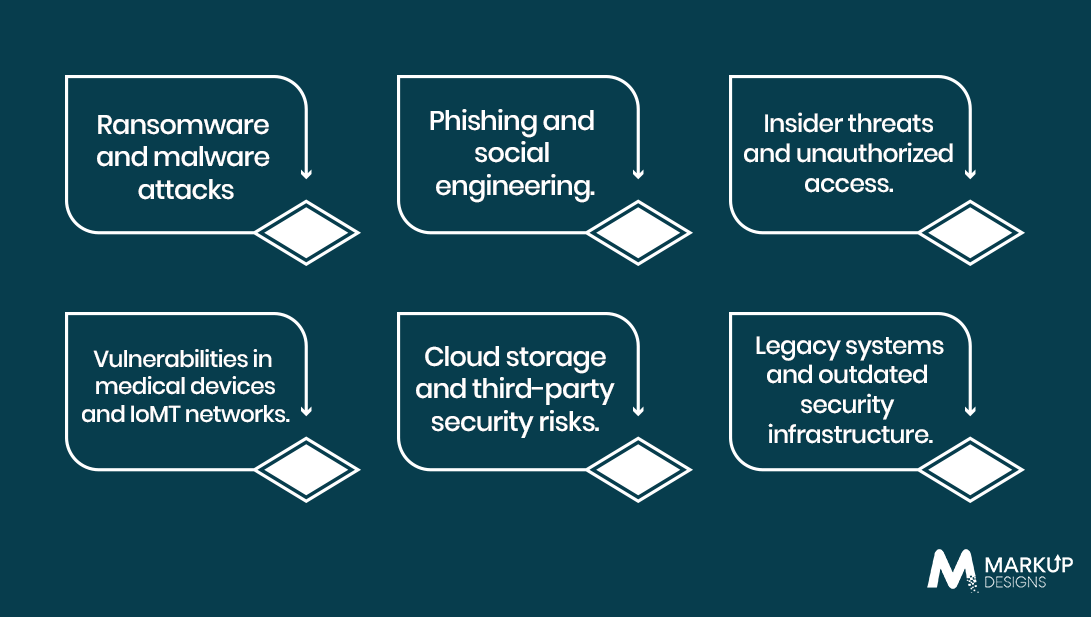
As healthcare organizations adopt more digital solutions, their exposure to cybersecurity threats also increases. From phishing attacks to vulnerabilities in connected medical devices, several risks can compromise sensitive patient information. Understanding these challenges helps organizations identify security gaps and take preventive action.
1. Ransomware and malware attacks.
The use of malware by hackers to hold medical facilities hostage for extortion or theft of personal patient data.
2. Phishing and social engineering.
Cybercriminals manipulate employees into giving out passwords or clicking on malicious websites.
3. Insider threats and unauthorized access.
Insiders and other authorized users may unintentionally or intentionally expose patient data.
4. Vulnerabilities in medical devices and IoMT networks.
The vulnerabilities of connected devices with insufficient authentication, out-of-date firmware, and network insecurity.
5. Cloud storage and third-party security risks.
Insecure cloud storage, integration flaws, and inadequate third-party vendor security procedures.
6. Legacy systems and outdated security infrastructure.
Outdated software and legacy infrastructure pose risks because of their inherent security vulnerabilities.
10 Essential Strategies to Secure Healthcare Data
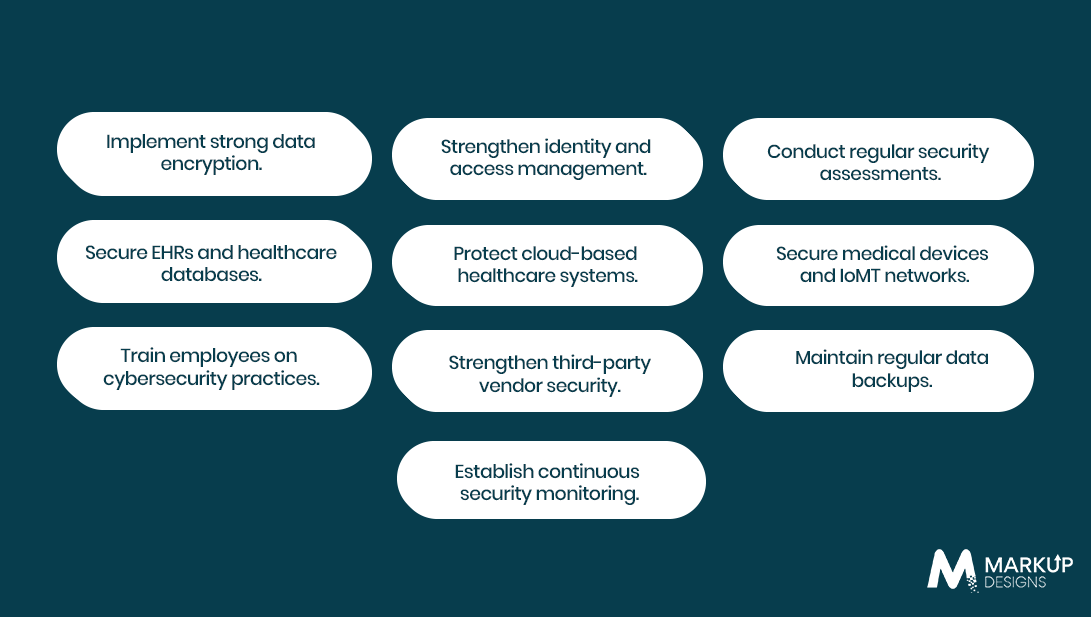
The healthcare sector requires both technology, security policies, and employee awareness of the employees for protecting sensitive information. Proper security measures can minimize the risk of data breaches and improve the reliability of healthcare systems. These are 10 key security measures that the organization can take:
1. Implement strong data encryption.
It is important to use encryption in order to ensure that the data is protected while it is stored in databases and transferred between healthcare systems. This way, sensitive data cannot be accessed by an unauthorized person.
2. Strengthen identity and access management.
It is possible to use role-based access control (RBAC) to ensure that employees have access to necessary information. It is also possible to utilize multi-factor authentication (MFA).
3. Conduct regular security assessments.
It is important to perform these tests regularly in order to identify vulnerabilities in the healthcare system and eliminate these threats.
4. Secure EHRs and healthcare databases.
This can be done through restricting access, encryption, regular updates, and monitoring. The logs should be kept in order to track the actions related to accessing patient records.
5. Protect cloud-based healthcare systems.
Employ safe cloud computing architecture with appropriate security measures such as access control, encryption, and constant configuration monitoring. Health facilities should also have safe backup systems that will prevent any loss of data from any form of cyberattacks or accidents.
6. Secure medical devices and IoMT networks.
Protect connected medical devices with device authentication, secure communication protocols, and constant updates to the devices’ firmware. Connected medical devices should be kept in a network that is appropriately segmented.
7. Train employees on cybersecurity practices.
Have regular training programs to educate health care employees on how to detect phishing emails, insecure websites, and poor data handling practices. Also, employees should learn how to report security threats.
8. Strengthen third-party vendor security.
Perform an assessment of third-party vendors’ cybersecurity standards before sending any patient information to the vendors. Have the responsibility for security well articulated between you and the vendor.
9. Maintain regular data backups.
Automate the backup of all critical health information data and save it securely. Frequently conduct recovery tests to ensure that critical patient data can be recovered when required.
10 Establish continuous security monitoring.
Monitor health care systems, network applications, and databases to detect any unusual activity. The security monitoring tools may help detect any unauthorized login attempts or access.
How Can Healthcare Organizations Build a Strong Data Security Framework?
Implementation of individual security measures is crucial; however, healthcare institutions require a proper framework for managing their data security needs. A proper framework will help set responsibilities and identify risks, and will ensure protection effectiveness as systems continue to change.
The following measures can be considered while creating a framework:
- Identification of critical data and systems: Identification of patient information, applications, databases, and connected systems holding confidential information;
- Risk assessment: Identification of all potential risks related to the existing systems, network, and data exchange;
- Implementation of security policies: Establishment of policies concerning access, storage, sharing, retention of information, and reporting of incidents;
- Implementation of security controls: Deployment of encryption, MFA, access management, network security, and other controls;
- Review and Improve Regularly: Definition of the process of identification, containment, and recovery from the incident.
How Emerging Technologies Are Improving Healthcare Data Security
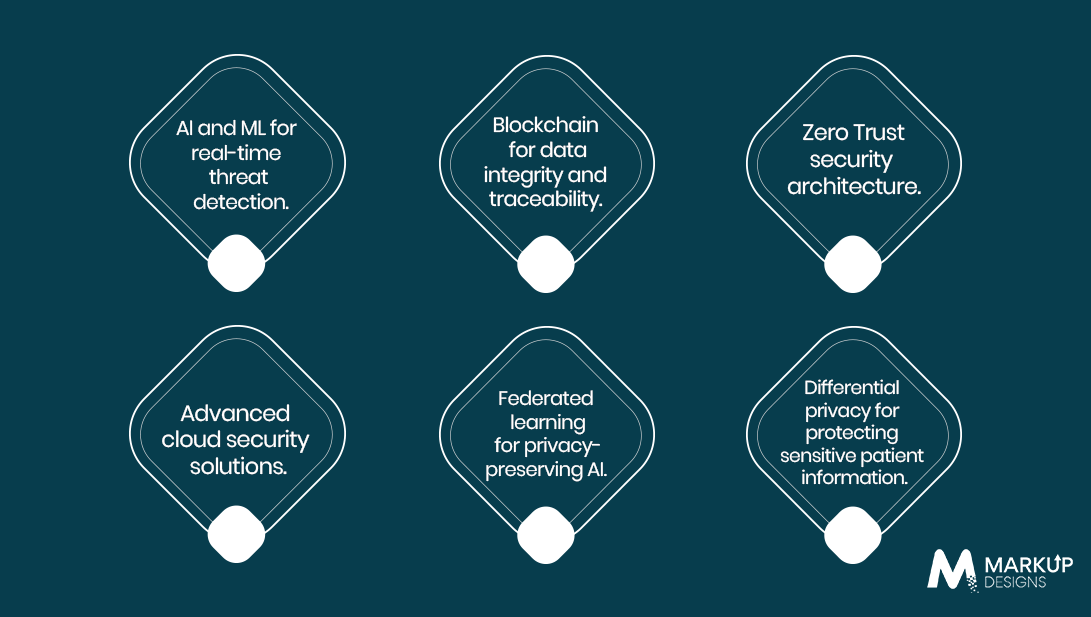
Emerging technologies are assisting organizations in the healthcare sector to better monitor and secure their data and identify any potential threats.
1. AI and ML for real-time threat detection.
AI-driven solutions can be used by the healthcare industry to monitor its network activity and detect any threats.
2. Blockchain for data integrity and traceability.
Blockchain technology can be used to provide an immutable trail of data transactions to help organizations trace and detect any unauthorized changes to their data.
3. Zero Trust security architecture.
The zero trust security model works in a way that verifies users and devices before they are allowed access, whether they are internal or external to the organization’s network.
4. Advanced cloud security solutions.
Cloud security solutions can assist organizations in monitoring configurations, managing permissions, detecting threats, and securing sensitive data stored on cloud computing platforms.
5. Federated learning for privacy-preserving AI.
Federated learning solutions allow for learning AI models from distributed data in different locations without the need to collect patient data on one centralized server.
6. Differential privacy for protecting sensitive patient information.
The technique of adding statistical noise to data sets helps organizations to analyze the information while ensuring patient privacy.
These technologies can strengthen healthcare data security when implemented with appropriate access controls, governance policies, and regular security assessments. However, organizations should select solutions based on their infrastructure, data sensitivity, and operational requirements.
How the Right Healthcare Technology Partner Can Help Secure Patient Data
Protecting healthcare data needs more than just putting in place security technologies for each case. Companies require technologies capable of securing patients’ information in all stages of its use, including collecting, storing, processing, and transferring it. A good healthcare technology partner can assist in developing secure healthcare applications and introducing the proper security measures to the company’s infrastructure.
Here’s what a technology partner can do for you:
- Design Secure Healthcare Applications: Develop healthcare applications that will have built-in security features like encryption, authentication, and access controls.
- Implement Compliance-Ready Solutions: Develop software that complies with the necessary requirements for healthcare data protection, like HIPAA and GDPR, depending on the organization’s location and its activity.
- Integrate Systems Securely: Use secure API and authentication protocols to integrate EHRs, hospital management systems, telemedicine platforms, healthcare applications, and others.
- Perform Security Tests: Conduct security assessments, penetration tests, and regular security checks.
- Optimize Data Access and Monitoring: Implement role-based access permissions and data monitoring in order to track access to patients’ data.
- Provide Ongoing Maintenance and Support: Maintain healthcare applications with security patches, updates, and performance monitoring.
Markup Designs appreciates the significance of constructing trusted and secure digital health systems. This is why our team works towards implementing security procedures during healthcare software development to help our clients achieve their digital health objectives.
Develop Healthcare Solutions with Security at Their Core
Looking to develop or upgrade a healthcare application? Partner with Markup Designs to build secure, scalable, and reliable healthcare solutions that support patient data protection and evolving business needs.
Conclusion
Data security in healthcare is very important for patient data protection, maintenance of trust, and continuous delivery of healthcare services. With the increasing reliance on electronic health records, cloud computing, telemedicine apps, and interconnected medical devices by organizations, it is imperative that they take a proactive approach to managing their security risks.
The adoption of encryption, access control measures, security assessments, employee education, and monitoring can help lower risks. There is also a need for healthcare organizations to adopt new technologies and create security frameworks to counter emerging threats.
However, data security is an ongoing process and not just a one-off effort. With the use of the right technologies, security policies, and support, data security in healthcare organizations can be improved.
FAQs
1. What are the best ways to secure healthcare data?
The best ways include implementing data encryption, multi-factor authentication, role-based access control, regular security assessments, secure backups, and continuous monitoring.
2. What are the biggest threats to healthcare data security?
Common threats include ransomware, phishing, insider threats, unauthorized access, insecure medical devices, cloud vulnerabilities, and third-party security risks.
3. How does encryption protect patient information?
Encryption converts readable information into an encoded format that can only be accessed using the appropriate decryption key. It helps protect patient data during storage and transmission.
4. How can healthcare organizations prevent data breaches?
Organizations can reduce data breach risks by conducting regular security audits, updating software, training employees, restricting access, monitoring systems, and maintaining incident response plans.
5. What role does AI play in healthcare data security?
AI helps identify unusual network activities, detect potential threats, analyze security patterns, and support faster incident responses.
Author's Perspective
Healthcare data security should be considered a fundamental part of digital healthcare development, not an additional feature added after a system is built. As healthcare organizations adopt connected technologies and digital platforms, protecting patient information requires continuous attention. Strong security practices, responsible data management, and the right technology infrastructure can help organizations reduce risks while delivering reliable healthcare services. Investing in secure systems today can also help create a stronger foundation for future digital healthcare growth.
Discuss Your Project Now
Related Posts
Custom eCOA Software Development: Process, Technology Stack, and...
How Much Does It Cost to Develop DICOM...
How Healthcare ERP Software is Transforming Hospital Management...
Insights Are Valuable & Execution is Priceless
You’ve read about the digital future. Now, let’s build the infrastructure to take you there. Move your strategy from the page to the product.
Design Your Solution Now
Contact Us
Schedule The Appointment At Your Convenience Date And Time.
30 Min
Web Conference
Time Zone
Indian standard time (08:30pm)

Thanks For Getting In Touch!
You’ve Taken The First Step Toward Transforming Your Digital Presence. Our Experts Will Reach Out Shortly To Take It Forward.
Launch Your Dream Project
Provide a brief overview of your project, and our specialists will evaluate your requirements. We will connect with you to explore how the right digital solutions can help you launch faster.