

In Brief
- The application of Artificial Intelligence in the field of asset management is achieved through the use of Machine Learning, NLP, predictive analytics, and Generative AI technologies for analysis of financial information, identification of trends, forecasting, and decision-making.
- The advantages of AI in asset management are better decision-making, increased efficiency, improved risk management, real-time market analysis, personalization, cost reduction, and scalability.
- Main application areas of AI in asset management are optimization of portfolios, automated trading, prediction of risks, detection of fraud, market sentiment analysis, and automated compliance and reporting. BlackRock, JPMorgan Chase, Goldman Sachs, and MSCI have already applied AI to their financial activities.
- Main difficulties in implementing AI include high costs, poor quality of data, legacy systems integration, regulatory issues, lack of skilled personnel, and concerns about data security. Businesses may overcome these problems by gradual implementation, good data management, explainable AI, training of employees, and security measures.
- The successful adoption of AI technologies involves understanding the business requirements, data preparation, choosing appropriate technology, creating and implementing solutions, performing tests, and optimizing. Markup Designs assists businesses in developing custom AI-driven asset management solutions through AI development, machine learning, intelligent automation, predictive analytics, and scalable architecture.
Asset management is getting more complicated with increasing volumes of data, changing market conditions, and increased demands for investments by businesses and financial institutions. In many cases, traditional approaches based on manual processes and historical data limit the ability to react in a timely manner to market changes and discover new risks. Here, AI makes an impact on helping asset managers with analyzing large datasets, automating routine operations, predict market dynamics, and making informed investment decisions.
By applying AI, businesses can increase portfolio management efficiency, reduce operational costs, enhance risk assessment, and improve client experience. Besides, AI in asset management allows asset managers to spend more time on strategic decision-making instead of performing routine operations.
This blog will be focused on explaining what AI in asset management is, its benefits, use cases, real-life examples, and implementation challenges.
What is AI in Asset Management?
AI in asset management involves the application of artificial intelligence solutions in processing financial data, portfolio management, operations automation, and decision-making. AI technologies help asset managers to analyze large volumes of structured and unstructured data and provide valuable insights that cannot be easily achieved otherwise.
There are multiple AI technologies that are combined to improve asset management processes:
- Machine Learning (ML): Analyzes historical and current data to detect patterns and trends and make investment decisions based on them.
- Natural Language Processing (NLP): Allows processing of such types of data as financial news, market reports, research papers, and others to determine market sentiment.
- Predictive Analytics: Predicts potential changes in the market, asset performance, and risks based on historical data using statistical models.
- Generative AI: Helps to summarize financial reports and generate investment research papers to help asset managers with information analysis.
Unlike traditional asset management when there is a need for human labor and predefined strategy implementation, AI tools allow continuous information processing and insights generation. However, the role of human expertise is still essential when it comes to validating suggestions and making investment decisions.
Key Benefits of AI in Asset Management
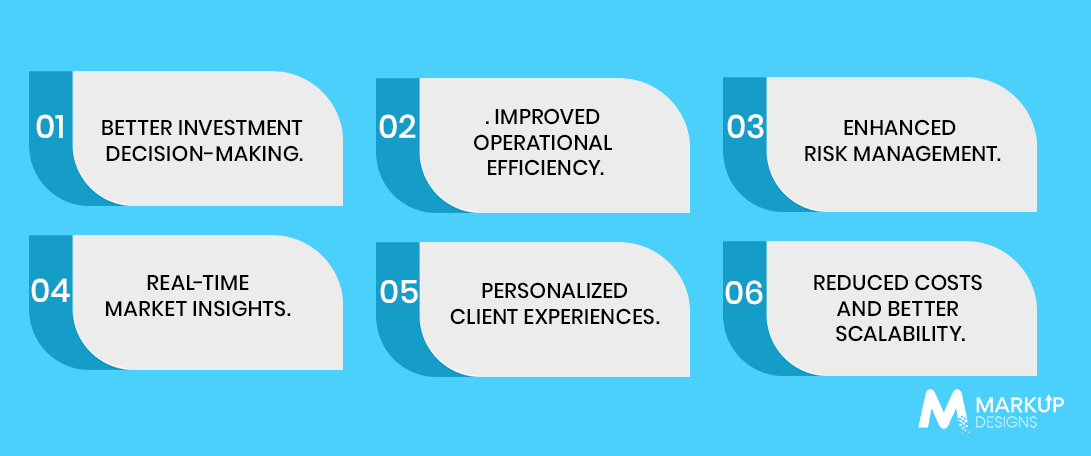
The integration of AI into asset management helps companies enhance the process of analyzing information, managing investments, and handling business operations. With the help of data analysis, automation, and prediction abilities, companies can make more informed decisions without much effort. The following are some of the main advantages that can be gained by using AI in asset management.
1. Better investment decision-making.
Using AI, companies can analyze historical data, market trends, and financial indicators, gaining useful insights. Asset managers can use such insights when comparing various investment opportunities and understanding market trends.
2. Improved operational efficiency.
AI can automate routine processes such as data input, report generation, portfolio tracking, and other business-related activities. Thus, with the help of AI, the workload of asset managers will decrease significantly.
3. Enhanced risk management.
AI models can detect unusual patterns, analyze the market environment, and find out any existing risks. This will help asset managers know what threats they may face and prevent them from making wrong decisions.
4. Real-time market insights.
The process of AI consists of analyzing a large amount of financial data, information about the market, and the latest news. The information obtained in this way allows the asset manager to make an appropriate decision according to the current market situation.
6. Personalized client experiences.
AI enables asset management companies to learn more about the interests of clients, their objectives, and their attitude towards risk. In this case, the company is able to give the most relevant recommendations and support for the client.
7. Reduced costs and better scalability.
Automation of the process allows saving costs, as well as optimizing the use of resources. AI technologies also allow processing increasing amounts of data and investments with minimal additional effort from the company.
Top Use Cases of AI in Asset Management
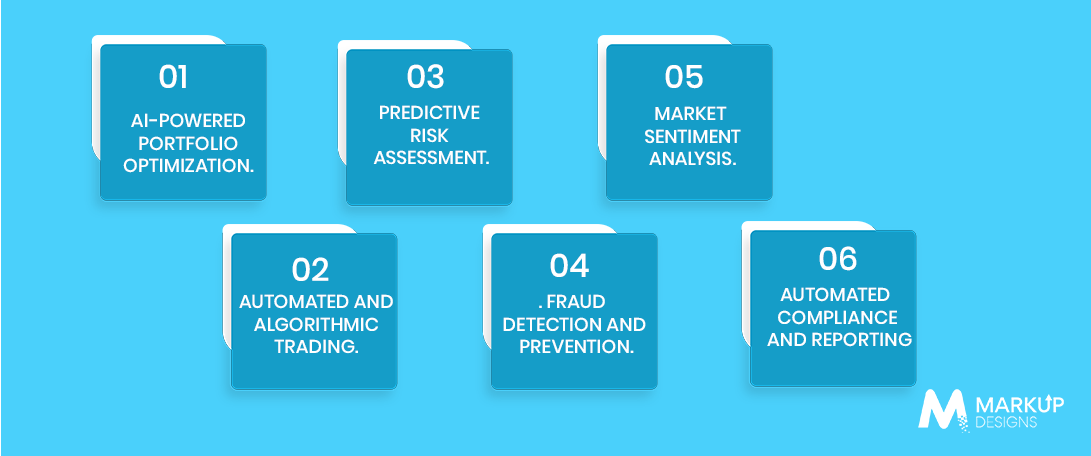
The technology is applied to a range of asset management activities aimed at increasing efficiency, automating processes, and developing investment strategies. In portfolio optimization, fraud detection, and other areas, it assists financial institutions in dealing with complicated situations and getting more value out of their data. The following list describes six significant applications of AI in asset management.
AI-powered portfolio optimization.
AI evaluates asset performance, trends in the market, past returns, and risk factors in order to help asset managers develop investment portfolios and manage them. It is able to reveal opportunities for potential allocation.
Automated and algorithmic trading.
An AI-based trading system analyzes market data, price movements, and trading signals to discover potential opportunities. The system is able to implement predetermined trading strategies automatically.
Predictive risk assessment.
By analyzing financial data, volatility in the market, and past patterns, AI is able to reveal potential risks in investments. The information may be useful for assessing the portfolio exposure and planning the strategy.
Fraud detection and prevention.
AI is capable of scrutinizing transactions and activities in accounts and highlighting irregular patterns that are usually associated with fraud. The machine learning algorithms will help alert to any suspicious activities to be analyzed by the institutions.
Market sentiment analysis.
Natural Language Processing (NLP) makes it possible for AI to analyze financial news, company news, research reports, and market discussions. AI helps asset managers determine investor sentiment and detect anything that may affect the markets.
Automated compliance and reporting.
AI helps automate the process of complying with financial regulations and reporting. It is capable of analyzing vast amounts of financial documents, detecting compliance issues, and organizing information.
Read Also: Integrating AI into ERP Systems: A Complete Business Guide
Real-World Examples of AI in Asset Management
Some major financial companies have already implemented AI and advanced analytics technologies into their businesses to enhance investment research, portfolio management, and finance operations. These implementations are good examples of the way AI technologies can be used in various fields of asset management.
- BlackRock: Implements AI and data analytics technologies in its investment technology ecosystem for portfolio analysis, risk management, and investment research purposes.
- JPMorgan Chase: Uses AI and machine learning technologies across financial services, including investment research, data analysis, and risk activities.
- Goldman Sachs: Employs AI technologies for financial analysis, automation of workflows, and productivity enhancement within its business operations.
- MSCI: Utilizes advanced analytics and AI-related technologies in investment research, portfolio analysis, and ESG data evaluation to assist investors in the evaluation of different market factors.
These examples clearly show that AI is becoming one of the key elements of modern financial services. Nevertheless, its effectiveness will greatly depend on the ability to integrate AI solutions with quality data, business knowledge, and human supervision.
Challenges of Implementing AI in Asset Management and How to Overcome Them
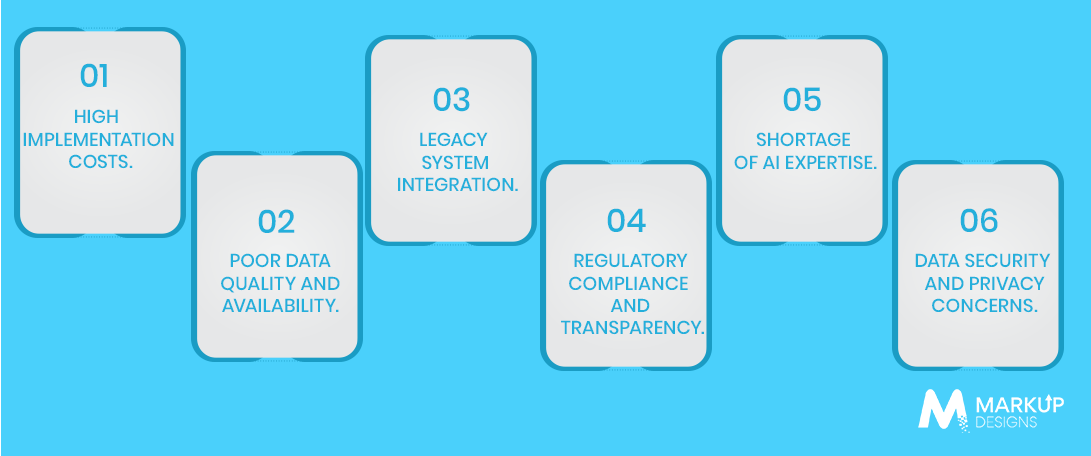
Although AI provides numerous advantages in asset management, there are certain challenges associated with its implementation. Companies have to take into account various aspects such as cost of infrastructure, data quality, security, and compliance while introducing AI solutions. Knowing these challenges can make the implementation process easier for organizations.
1. High implementation costs.
The implementation of AI solutions presupposes expenditure on infrastructure, data systems, professionals, and maintenance. Such costs may prove difficult for many companies, especially small asset management companies.
How to overcome it: Begin with important AI applications that solve particular business challenges. This approach can facilitate managing costs at the initial stage of introduction.
2. Poor data quality and availability.
Data is one of the key elements when it comes to the successful application of AI models. Badly structured or not up-to-date financial data will negatively impact their efficiency.
How to overcome it: Ensure effective data management by performing data cleaning, validation, standardization, and updating.
3. Legacy system integration.
A number of asset managers continue using traditional platforms and old-fashioned systems. The integration of advanced artificial intelligence into such systems may cause various problems connected with compatibility, technical problems, and disruptions.
How to overcome it: Apply approaches of utilizing APIs, middleware, and proper system architecture for connecting AI-based applications to the infrastructure of an organization. Moreover, gradual integration can minimize possible disruptions in daily activities.
4. Regulatory compliance and transparency.
Financial organizations need to meet certain standards and regulations concerning investment data and decisions on financial matters. There are AI models that are hard to explain; therefore, it is difficult to know what recommendations they make and why.
How to overcome it: Use the strategy of explainable AI and ensure having appropriate audit trails and document decisions. Human participation in decision-making is also important.
5. Shortage of AI expertise.
In order to deploy AI solutions, one should possess knowledge of machine learning, financial data analysis, programming skills, and model management. It is not always easy to find experts in all these spheres.
How to overcome it: Educate employees and collaborate with qualified AI development partners. In this way, companies will have access to the necessary technical expertise.
6. Data security and privacy concerns.
Asset management applications work with confidential financial data and client information. The implementation of AI may raise security concerns if proper care is not taken with data access and processing.
How to overcome it: Encryption, access control mechanisms, API security, and periodic testing can help in overcoming this issue. Organizations need to have good data governance practices in place as well.
How to Implement AI in Asset Management
Implementing AI in the process of asset management is not enough by choosing the best technology. Companies need to have a strategic approach to match AI opportunities with their needs and objectives. Using a proper approach will simplify the implementation process and ensure good results.
- Determination of Business Needs: Describe the problem that AI should solve – portfolio analysis, risk estimation, reporting, or process optimization.
- Collection and Preparation of Data: Collect appropriate financial and operational data, clean it of any errors, and establish data management procedures.
- Selection of Appropriate Technologies: Choose an AI technology according to your business needs – Machine Learning, NLP, predictive analytics, or generative AI.
- Integration and Development of the Solution: Implement AI models and integrate them with the current systems for asset management, databases, and business operations.
- Testing and Validation of the Model: Evaluate the accuracy, reliability, security, and performance of the implemented AI model.
- Deployment, Monitoring, and Optimization: Implement the solution and optimize it based on performance monitoring and feedback.
How Markup Designs Helps Businesses Build AI-Powered Asset Management Solutions
Designing an asset management system based on artificial intelligence will require financial technologies, artificial intelligence capabilities, and efficient software development services. Markup Designs provides companies with an opportunity to convert their AI concepts into real-life business-oriented solutions, which will meet their needs and goals of an operational and financial nature. These services include custom AI development to create applications according to your particular asset management process, AI & ML integration to provide predictive analytics and investment insights, and intelligent automation to facilitate document processing and management.
Moreover, Markup Designs creates solutions for predictive analytics based on historical and real-time data analysis to make strategic decisions in a more informed manner. The company focuses on the security and scalability of the architecture of the solutions it creates for its clients. From requirement analysis and solution designing through development, integration, testing, deployment, and maintenance services, it offers the whole spectrum of services, which will help your company to improve its operational performance and make the right decisions.
Have an idea for an AI-powered financial solution?
Connect with Markup Designs to discuss your requirements and explore the right development approach for your business.

Conclusion
Artificial Intelligence is reshaping the way asset management companies conduct investment analysis, portfolio management, risk assessment, and operations.
However, the successful implementation of artificial intelligence depends not only on advanced technologies but also on other factors such as quality data, security infrastructure, proper models of AI, and the implementation strategy. Combining AI-powered analysis with the knowledge of professionals is necessary for making the correct financial decisions.
The constantly growing abilities of artificial intelligence give a chance to asset management companies to create better and more sophisticated operational strategies. Collaboration with an experienced technology company such as Markup Designs can help your business to build a custom AI system.
FAQs
1. How is AI used in asset management?
AI is used in asset management to analyze financial data, optimize investment portfolios, assess risks, automate trading activities, detect fraud, and streamline compliance reporting. It helps asset managers gain insights and improve operational efficiency.
2. What are the biggest benefits of AI in asset management?
The major benefits include better investment decision-making, improved operational efficiency, enhanced risk management, real-time market insights, personalized client experiences, and reduced operational costs.
3. Can AI help reduce investment risks?
Yes, AI can help identify potential risks by analyzing historical data, market trends, and financial indicators. Predictive models can highlight unusual patterns and possible risk factors. However, AI cannot eliminate investment risks or guarantee accurate predictions.
4. What are the most common AI use cases in asset management?
Common use cases include portfolio optimization, automated trading, predictive risk assessment, fraud detection, market sentiment analysis, and automated compliance reporting.
5. How much does it cost to implement AI in asset management?
The cost depends on factors such as solution complexity, data infrastructure, AI model requirements, system integration, security measures, and ongoing maintenance. A basic automation solution may require less investment than a customized AI-powered asset management platform.
Author's Perspective
AI is transforming asset management by helping firms improve efficiency, analyze complex data, and make more informed decisions. However, adopting AI alone does not guarantee better results. Its effectiveness depends on how well businesses use automation, predictive analytics, and intelligent data processing to address real operational challenges.
The future of asset management will rely on a balanced approach that combines AI capabilities with human expertise. While AI can process information quickly and identify patterns, strategic decisions still require human judgment, experience, and accountability.
A successful AI adoption strategy starts with clear business objectives, reliable data, and scalable technology solutions. By focusing on these factors, asset management firms can use AI more effectively, improve their operations, and prepare for changing industry demands.
Discuss Your Project NowGaurav Goyal
Global Sales- VP
Related Posts

How AI Is Transforming Bahrain Businesses: 10 Industry...

Enterprise AI Integration in the Middle East: A...

How to Implement Responsible AI in Australia: A...
Insights Are Valuable & Execution is Priceless
You’ve read about the digital future. Now, let’s build the infrastructure to take you there. Move your strategy from the page to the product.
Design Your Solution Now
Contact Us
Schedule The Appointment At Your Convenience Date And Time.
30 Min
Web Conference
Time Zone
Indian standard time (08:30pm)

Thanks For Getting In Touch!
You’ve Taken The First Step Toward Transforming Your Digital Presence. Our Experts Will Reach Out Shortly To Take It Forward.
Launch Your Dream Project
Provide a brief overview of your project, and our specialists will evaluate your requirements. We will connect with you to explore how the right digital solutions can help you launch faster.