

In Brief
- Study how DevOps outsourcing drives enterprise digital transformation through automation, fast software releases, and efficient teamwork.
- Learn about critical DevOps services such as automation of CI/CD, cloud infrastructure management, DevSecOps, and continuous monitoring.
- Find out about the advantages of DevOps outsourcing, ranging from cost reduction to enhanced scalability and time-to-market speed.
- Find out what issues companies may face when outsourcing DevOps services – security threats, system integration problems, lack of communication, and dependence on the third-party provider.
- Learn how companies can select a proper DevOps service provider and assess the results of outsourcing DevOps.
It takes more than implementing new solutions for an enterprise to undergo digital transformation. Enterprises should upgrade their technology infrastructure, deliver software efficiently, and be able to react fast to the changes in the market. However, handling all of these processes on their own is difficult and time-consuming for many companies.
DevOps outsourcing allows businesses to manage their challenges and gain specialized expertise in automation, cloud operations, continuous integration, and deployment.
How Does DevOps Outsourcing Support Enterprise Digital Transformation?
Through DevOps outsourcing, companies will be able to leverage specialized skills and technologies, automate software development and delivery processes, and use established best practices to achieve greater agility. Such collaboration may result in better connections between development and operations teams, as well as better software delivery and improved infrastructure management.
What DevOps Services Can Enterprises Outsource to Accelerate Digital Transformation?
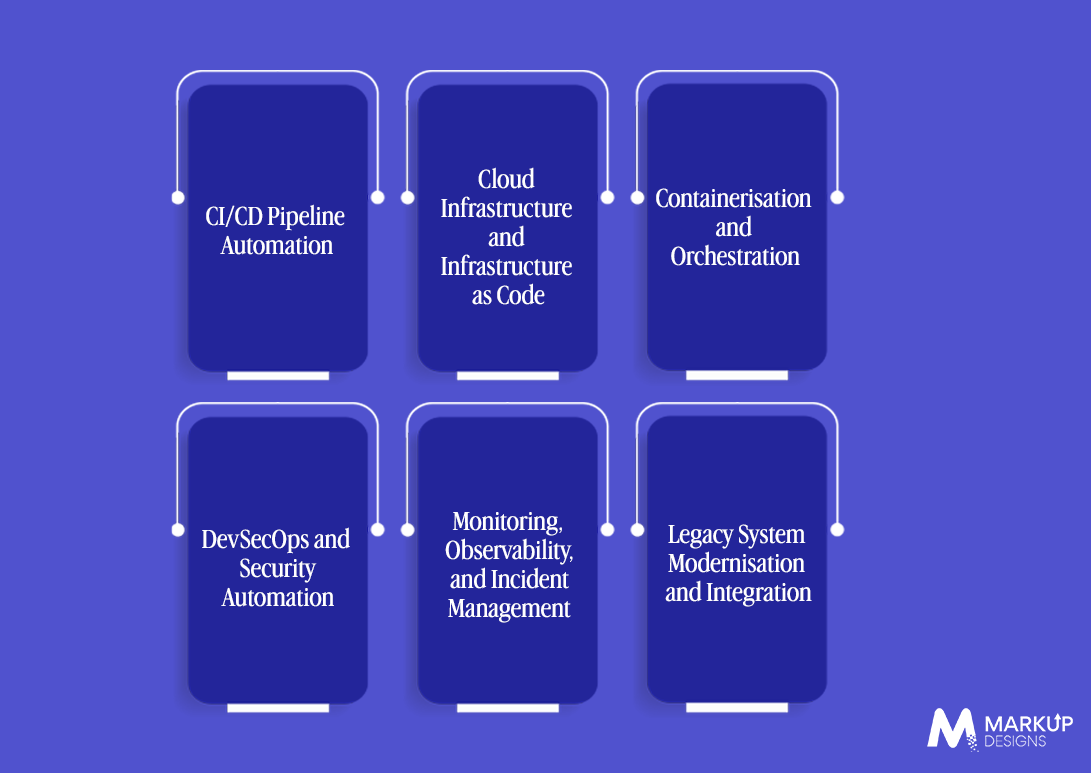
Businesses can outsource a number of DevOps services to automate software development and delivery, modernize IT infrastructure, and improve system reliability. Such services will help organizations optimize workflows, boost their security, and facilitate digital transformation according to changing business needs.
CI/CD Pipeline Automation
Outsourcing CI/CD pipeline automation allows businesses to integrate and test code automatically and deploy software. Automatic workflows will minimize manual intervention in the process, will prevent release delays and will allow teams to deliver new updates frequently. The automation of such workflows becomes a consistent basis for successful software delivery.
Cloud Infrastructure and Infrastructure as Code
DevOps partners will assist enterprises in managing cloud infrastructure and automate its provisioning using Infrastructure as Code (IaC).
These practices improve consistency across development, testing, and production environments while reducing configuration errors. They also make it easier to scale infrastructure as business requirements change.
Containerisation and Orchestration
Containerization entails packaging applications and their dependencies in portable containers that run uniformly regardless of the environment. DevOps teams outsourcing their services can use tools such as Docker and Kubernetes to simplify application deployment and resource management, among others. Such solutions allow companies to modernize their application delivery systems.
DevSecOps and Security Automation
Unlike conventional DevOps, where security is done towards the end of the application delivery process, DevSecOps seeks to ensure that security processes are carried out at different points in the software development lifecycle. Outsourcing providers can automate the processes of vulnerability scans, dependency checks, and security tests, among others.
Monitoring, Observability, and Incident Management
Outsourced DevOps professionals ensure that companies have monitoring and observability solutions in place to track the performance of applications and infrastructure, system availability, among other issues. Through automation, they are able to alert the teams of anomalies that may occur and manage the incident effectively.
Legacy System Modernisation and Integration
Many organizations depend on legacy applications that are difficult to maintain or integrate with the latest platforms. It is possible for DevOps professionals to help with the process of modernization using automated testing and deployment, among others.
What Are the Key Benefits of DevOps Outsourcing for Enterprises?
With DevOps outsourcing, companies will be able to achieve faster software delivery, optimize costs of operations, and obtain specialized technical skills. The ability to scale effectively and deploy reliably, as well as improve the collaboration of developers and operators, is also possible.
Faster Software Delivery and Time to Market
DevOps outsourcing offers automation of workflows and release procedures, which helps to get rid of bottlenecks in the development process. This will enable organizations to progress from code development to deployment and release faster and implement new features faster. Rapid delivery will assist organizations in addressing customer feedback and needs.
Reduced Infrastructure and Operational Costs
The use of DevOps outsourcing services might lead to a reduction in the need to maintain a large in-house DevOps team. Automation and management of cloud resources will assist in minimizing manual workload and unnecessary spending on infrastructure. However, specific benefits will depend on the engagement model and services provided.
Improved Scalability and Infrastructure Flexibility
DevOps teams will assist organizations in adjusting the infrastructure to meet workload and business needs. Automated infrastructure provisioning and cloud management will enable them to increase or decrease resources quickly without much manual effort.
Better Software Quality and Deployment Reliability
Automated testing, standardized deployment pipelines, and continuous monitoring enable the detection of software defects prior to moving to production. Such processes minimize release mistakes, making software delivery more reliable for enterprise software and reducing interruptions to its current services.
Stronger Security and Compliance Practices
Skilled DevOps outsourcing providers can help implement security testing, access control, vulnerability management, and audits as part of the development process. Such processes will assist enterprises in identifying potential security flaws early on and monitoring their systems in a more efficient manner. However, enterprises should make sure that all security obligations and compliance requirements are stated in the outsourcing agreement.
Access to Specialised DevOps Expertise
Through DevOps outsourcing, enterprises gain access to experts who are proficient in working with cloud environments, automation, containerization, and infrastructure operations. In this way, enterprises will not have to rely on their own recruitment process in order to find professionals. Also, outside specialists will help fill any skill gaps that might be present in-house.
Improved Collaboration Between Development and Operations Teams
DevOps outsourcing will enable establishing common workflows, roles, and metrics for both development and operations teams. When external specialists work closely with internal stakeholders, enterprises can improve delivery consistency and operational accountability.
How Does DevOps Outsourcing Accelerate Enterprise Digital Transformation?
Outsourcing DevOps allows companies to transform digitally through automating workflows, modernising legacy systems and adopting the cloud. Through DevOps, companies can be able to develop and release software faster, improve system reliability and adapt to changes in market demands without creating extra stress for internal teams.
Automating Manual Development and Deployment Workflows
Manual testing, manual configuration, and manual deployment processes can hinder digital transformation and increase human errors in a company. When using DevOps services, there is automation in all these processes, making software releases more reliable and predictable. Teams will have enough time to innovate as opposed to engaging in repetitive processes.
Modernising Legacy Applications and Infrastructure
Through DevOps partnerships, companies are assisted in modernizing their systems and infrastructures by updating their old deployment processes. Methods of automation such as automated testing, containerization, and infrastructure automation will assist enterprises in improving legacy systems without having to replace them completely. This helps in minimizing technical constraints while protecting important operations.
Enabling Cloud Adoption and Hybrid Cloud Operations
Companies wishing to migrate to the cloud need proper planning, infrastructure management, and optimization services. Outsourced DevOps teams can support cloud migration, automated provisioning, and integration across on-premises and cloud environments. This helps enterprises build flexible infrastructure that supports evolving digital requirements.
Supporting Agile Development and Continuous Innovation
By providing frequent releases, feedback, and improvement opportunities, DevOps processes are helpful in facilitating agile development. The involvement of outsourcing partners enables companies to implement automation tools and workflows that will help them shorten the development process. Companies will be able to conduct tests, address feedback, and apply improvements without being stuck with long release schedules.
Improving System Reliability and Business Continuity
Continuous monitoring, automation and standardization of the recovery and deployment processes help enterprises keep the availability of their applications. DevOps specialists can detect and address any problems, handle incidents, plan disaster recovery, and reduce disruptions in operations.
What Challenges Do Enterprises Face When Outsourcing DevOps?
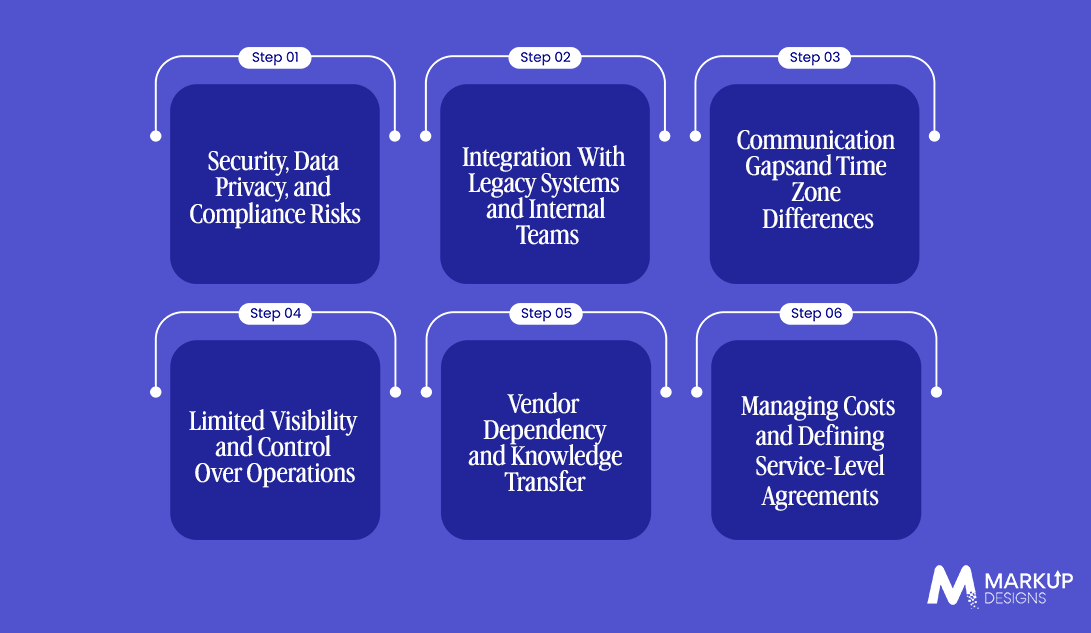
The process of DevOps outsourcing is useful as it provides access to specialized skills for companies but involves a number of security, integration, communication, and management-related challenges. Identification of possible problems and responsibility allocation enable the maintenance of necessary control of the process.
Security, Data Privacy, and Compliance Risks
Granting access to infrastructure, source code, and company data to an external party can lead to security issues. Access control policies, security protocols and responsibility allocation in regard to incident handling should be developed and implemented.
Integration With Legacy Systems and Internal Teams
The current enterprise systems may have old technology that is not compatible with the current DevOps. Also, internal teams may work with different workflows and deployment practices. Conducting an evaluation and planning phased implementation can help to reduce disruptions.
Communication Gaps and Time Zone Differences
Collaboration between an outsourced team from a number of different locations can lead to decision-making problems and problem resolution complications. Ambiguities regarding responsibilities and updates can negatively affect delivery deadlines. Communication schedules, documentation sharing, and escalation procedures help to align internal and external teams.
Limited Visibility and Control Over Operations
Enterprise companies may face challenges when trying to monitor the activities of the outsourced team because reporting and performance expectations were not clearly defined. Lack of visibility can make it harder to track delivery delays and other operational problems. Dashboards, regular reviews, and SLAs help to increase visibility and control.
Vendor Dependency and Knowledge Transfer
Vendor dependency can be problematic for the enterprise company once the engagement is over and the company needs to take back ownership of its critical systems. Enterprises should establish documentation standards, transition plans, and clear ownership of code and infrastructure.
Managing Costs and Defining Service-Level Agreements
Unclear project scope, additional tooling, and changing infrastructure requirements can increase outsourcing costs. Enterprises should define deliverables, pricing structures, support coverage, and service-level agreements before work begins. Regular cost reviews and performance tracking help ensure the engagement remains aligned with business objectives.
Read Also: DevOps Automation: Transforming Software Delivery with Smarter Workflows
How Can Enterprises Choose the Right DevOps Outsourcing Partner?
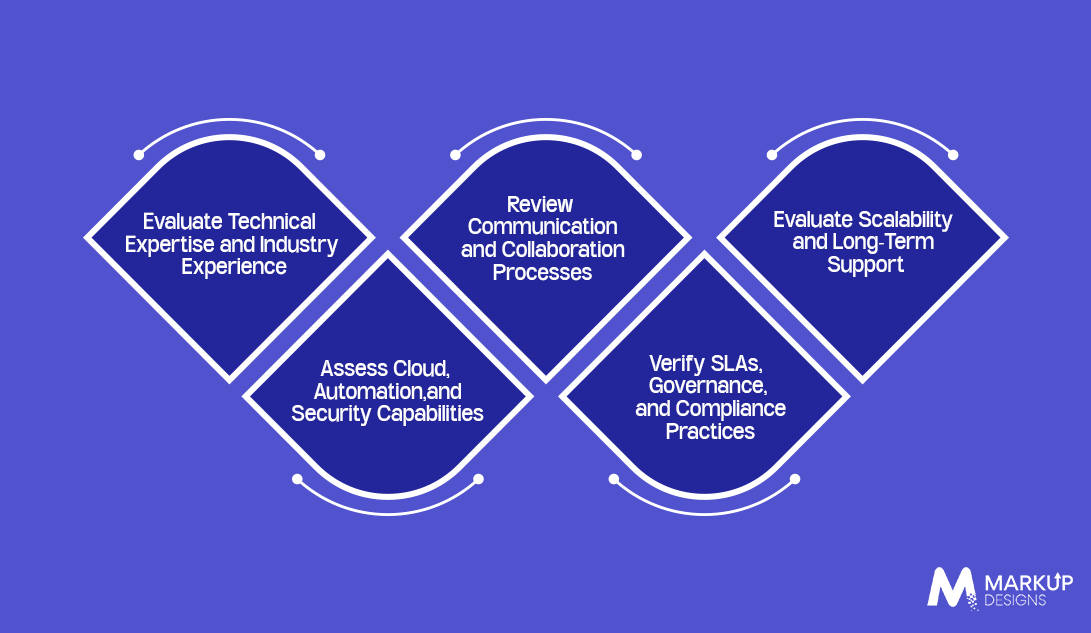
Selecting the right DevOps outsourcing partner involves assessing technical capabilities, security practices, communication, and support capabilities. An organization should choose the vendor that understands its infrastructure and business objectives and offers scalability for services in the course of digital transformation.
Evaluate Technical Expertise and Industry Experience
Organizations should check the vendor’s experience in implementing CI/CD processes, working with cloud platforms, automating infrastructure, and deploying applications at an enterprise level. Industry experience is also needed in case the projects have some complexity or regulatory requirements.
Assess Cloud, Automation, and Security Capabilities
The right outsourcing partner should be able to demonstrate real-life competencies in working with cloud platforms, automation solutions, and security practices used by the company. It allows an understanding of how the infrastructure is managed, how deployments are tested and monitored, and how vulnerabilities are addressed.
Review Communication and Collaboration Processes
An effective outsourcing partnership implies a good level of communication between external experts and employees. The organization should carefully consider how reporting, project management, escalation, and collaboration processes will be conducted.
Verify SLAs, Governance, and Compliance Practices
Service-level agreements should specify performance targets, incident response expectations, support availability, and escalation procedures. Enterprises should also review the provider’s security controls, access management, documentation, and relevant compliance practices. Clear governance establishes accountability and helps businesses manage operational and contractual risks.
Evaluate Scalability and Long-Term Support
A DevOps partner should be able to adapt services as enterprise workloads, applications, and infrastructure requirements grow. Assess the provider’s capacity to support future migrations, ongoing optimisation, incident management, and knowledge transfer. Long-term support arrangements help enterprises maintain operational continuity and evolve their digital capabilities beyond the initial implementation.
How Can Enterprises Measure the Success of DevOps Outsourcing?
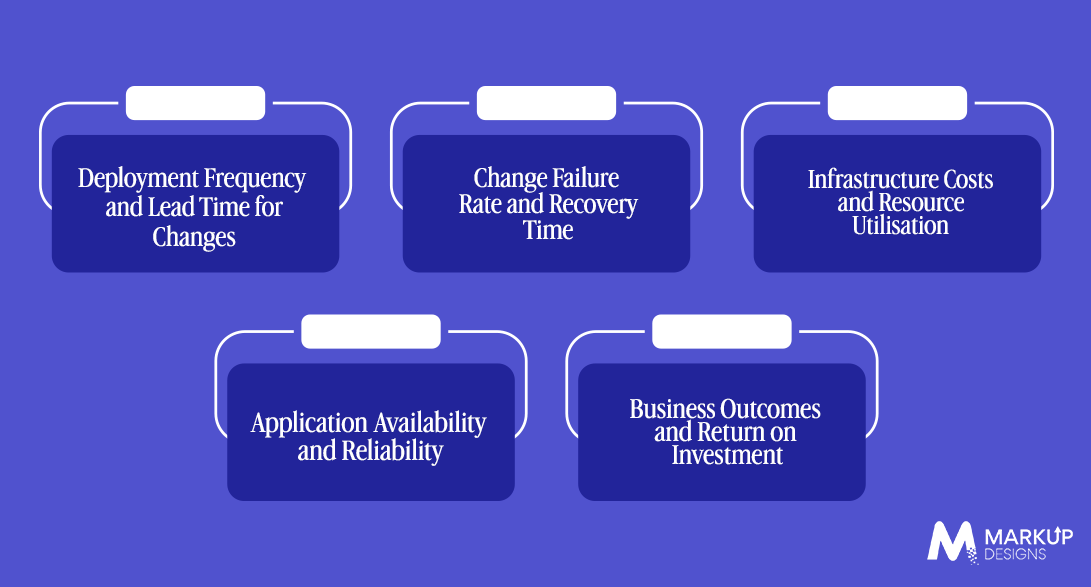
Businesses may assess DevOps outsourcing by analyzing changes in software deployment speed, system stability, infrastructure efficiency, and business performance. This allows determining the degree to which the collaboration meets operational objectives and yields desired results.
Deployment Frequency and Lead Time for Changes
Deployment frequency is the number of deployments made within the specified period, whereas lead time is the time taken to move a unit of code through the entire delivery process. High deployment frequency and low lead time mean that the pipeline is effective and that changes to the applications are implemented quickly.
Change Failure Rate and Recovery Time
Change failure rate refers to the percentage of deployments causing problems and requiring rollbacks, while recovery time is the amount of time required to restore services to the initial state. Both measures allow evaluating the quality of releases and processes involved in them.
Infrastructure Costs and Resource Utilisation
Cloud expenditures, infrastructure costs, and resource utilisation should be evaluated by businesses to spot ways to improve the efficiency of infrastructure and optimize its use and costs.
Application Availability and Reliability
Availability of applications is their ability to remain available for users, while reliability is their ability to perform well. Monitoring uptime, incident frequency, and service-level agreement (SLA) compliance helps enterprises assess whether their DevOps partner maintains stable and dependable systems.
Business Outcomes and Return on Investment
DevOps outsourcing should contribute to broader business objectives, including faster product launches, lower operational costs, and improved customer experiences. Comparing these outcomes with outsourcing expenses helps enterprises assess ROI and determine whether the partnership supports long-term digital transformation.
What Are the Best Practices for Successful DevOps Outsourcing?
A successful approach to DevOps outsourcing depends on having clear business goals, responsibilities, and collaboration processes. Enterprises need to set realistic expectations, prioritize important projects, and assess the performance of the outsourcing to ensure they get consistent value from the services.
Define Transformation Goals and Success Metrics
It is important for enterprises to understand why they need to outsource DevOps processes and how they plan to benefit from outsourcing – faster releases, increased reliability, reduced costs, or enhanced scalability. By setting KPIs at the start, enterprises will be able to assess the success of the process.
Start With a Clear Scope and Prioritised Workloads
Outsourcing all DevOps functions right away may complicate the process excessively. Enterprises should start by scoping out the most impactful tasks, for example, CI/CD pipeline automation, cloud infrastructure management, or application monitoring.
Establish Shared Workflows and Accountability
It is essential that there is a set of roles, processes, and communication mechanisms for both internal teams and outsourcing partners to collaborate effectively. Shared workflows, regular reviews, and documented responsibilities help reduce delays, resolve issues efficiently, and maintain alignment across development and operations.
Integrate Security Across the DevOps Lifecycle
Security should be part of every stage, from code development and testing to deployment and monitoring. Enterprises should establish access controls, automate vulnerability scanning, manage secrets securely, and conduct regular audits to reduce risks across outsourced environments.
Monitor Performance and Optimise Continuously
DevOps practices and business requirements evolve over time, making regular performance reviews essential. Enterprises should analyse KPIs, identify workflow bottlenecks, gather team feedback, and refine automation and infrastructure strategies to improve delivery efficiency and system reliability.
How Can Markup Designs Assist Enterprises With Accelerating Digital Transformation Through DevOps?
Markup Designs assists enterprises in integrating DevOps into the processes of digital transformation by providing software development, cloud solutions, automation, and systems integration services. Our team concentrates on the optimization of deployment processes, creating reliable infrastructure, and developing a scalable technological environment.
Accelerate Enterprise Digital Transformation With DevOps
Move towards faster software delivery, more reliable systems, and scalable digital operations with the right DevOps strategy.

Conclusion
Thus, DevOps outsourcing allows enterprises to enhance the process of digital transformation by improving software delivery, optimizing infrastructure, and enhancing operational reliability. Setting success criteria, defining the roles of parties involved, and choosing a suitable outsourcing provider will help businesses cope with the implementation risks.
FAQ
1. What is DevOps outsourcing, and how does it enable digital transformation?
DevOps outsourcing means collaborating with external experts in managing or improving development and operations processes. DevOps outsourcing helps enterprises in enabling digital transformation through automation, cloud adoption, faster release of software, and improved infrastructure.
2. Why do enterprises outsource DevOps services?
There are several reasons why enterprises outsource DevOps services. They include accessing special expertise, reducing the burden of operational management, automating work processes, scaling the infrastructure, etc.
3. How expensive is it for enterprises to outsource DevOps services?
DevOps outsourcing services’ prices may vary depending on several factors such as project complexity, team size, cloud infrastructure, service scope, and maintenance. Enterprises need to consider not only implementation but also recurrent costs of using the service in order to calculate the total cost.
4. What DevOps services are the first to be outsourced by enterprises?
There are several types of DevOps services that enterprises can start with when planning to outsource DevOps services. They include CI/CD automation, cloud infrastructure, infrastructure as code, and application monitoring.
5. How Does DevOps Outsourcing Contribute to Software Delivery Speed?
DevOps outsourcing contributes to increasing software delivery speed through the automation of build, testing, and deployment processes, as well as decreasing manual transitions. Skilled professionals can optimize pipelines, detect bottlenecks, and create a release procedure that will allow teams to provide more frequent updates.
Author's Perspective
DevOps outsourcing will bring maximum benefit for enterprises if companies perceive DevOps outsourcing as a strategic collaboration, not just the delegation of tasks. Having set goals, outcomes and collaborating with an outsourced team, enterprises will be able to create robust systems and undergo digital transformation.
Discuss Your Project NowGaurav Goyal
Global Sales- VP
Related Posts
How is DevOps Charting a New Model for...

Why DevOps Matters in Mobile Application Development
Insights Are Valuable & Execution is Priceless
You’ve read about the digital future. Now, let’s build the infrastructure to take you there. Move your strategy from the page to the product.
Design Your Solution Now
Contact Us
Schedule The Appointment At Your Convenience Date And Time.
30 Min
Web Conference
Time Zone
Indian standard time (08:30pm)

Thanks For Getting In Touch!
You’ve Taken The First Step Toward Transforming Your Digital Presence. Our Experts Will Reach Out Shortly To Take It Forward.
Launch Your Dream Project
Provide a brief overview of your project, and our specialists will evaluate your requirements. We will connect with you to explore how the right digital solutions can help you launch faster.