

In Brief
- DevOps fosters a more collaborative atmosphere among developers and the operations teams by making the overall process of developing the mobile application faster and more effective.
- This helps in developing more robust mobile applications for various organizations.
- DevOps eliminates some of the major problems associated with mobile app development, such as bottlenecks and inefficiencies in the development cycle.
- Integration of DevOps and Agile facilitates enhanced software quality and customer satisfaction.
- DevOps streamlines processes using automation and minimizes operational risks.
- Although implementing DevOps needs an initial investment of time and money, it ultimately proves beneficial to the organization.
The number of people who own smartphones globally has reached 3 billion, and there are going to be an additional hundred million users in the future. The rise in numbers is obvious proof that the mobile app industry continues to grow and shows no signs of stopping any time soon.
Today, businesses operate in a digitally driven world where transformation happens continuously. However, when companies first started adopting digital technologies, the approach toward mobile application development was very different. In those days, businesses had the goal of gaining a foothold in the mobile industry in order to satisfy the demands for smartphone apps.
As the mobile app market matured, businesses shifted their focus toward sustainability and delivering better user experiences. Businesses began looking for development approaches that could improve collaboration, reduce costs, accelerate delivery, and maintain high-quality standards.
This shift is what made DevOps an essential part of modern mobile application development. DevOps is an innovative method that combines the efforts of both developers and operators to deliver applications efficiently by streamlining delivery. Transitioning from conventional development approaches to agile processes, DevOps helps organizations to develop secure and highly performant mobile apps.
Key Aspects That You Must Know About DevOps

What is DevOps?
DevOps is a modern software development approach in which development and operations teams collaborate to build, test, and release software faster and more efficiently. The word DevOps consists of two smaller words – Development (Dev) and Operations (Ops).
The core objective of DevOps is to improve communication, automate workflows, and enhance software delivery, security, and performance. Unlike other approaches to software engineering, DevOps allows companies to deliver their application products much quicker but without compromising on quality and reliability.
Simply put, DevOps enables different teams to collaborate more efficiently throughout the software development lifecycle.
DevOps is an approach that enables businesses to enhance their development and maintenance processes for software and mobile apps. The main aspects of this concept include:
- More efficient software deployment and development process
- Enhanced collaboration among teams
- Continuous testing and monitoring
- Increased software quality and reliability
- Rapid solution identification and update
- Automation of recurring operations
Implementing DevOps approaches allows companies to speed up their work, as compared to traditional software development.
How DevOps Works in Mobile App Development
DevOps takes up a collaborative and continuous methodology towards software development. Instead of working separately, the development and operations teams collaborate throughout the entire application lifecycle.
The process includes:
- Application planning and development
- Continuous testing of new features
- Deployment through automation
- Feedback through real-time monitoring
- Continuous improvement and updating
This process helps businesses reduce delays, avoid costly mistakes, and deliver a better user experience.
Relevance of DevOps for Modern Businesses
Modern businesses require AI-powered applications that are fast, scalable, secure, and efficient. DevOps assists a company in realizing this aim by developing a corporate culture of cooperation and constant improvement.
Unlike traditional development models, where departments work separately, DevOps encourages teams to collaborate toward shared business goals.
This approach ensures an increase in productivity, reduced expenses on application development, rapid releases, and competitiveness.
The Key Difference Between DevOps and Agile App Development Process
There are several methodologies that are popular for modern mobile application development. At the moment, many organizations tend to use one or both methodologies to enhance development, cooperation, and the general quality of their products.
Though Agile and DevOps methodologies are frequently combined, these are entirely different concepts with different aims and goals. Both frameworks concentrate on various aspects of the software development process.
How Agile Differs from DevOps?
DevOps is an approach to software development where the emphasis is placed on increasing the level of cooperation between developers and system administrators. The primary goal of DevOps is to automate and streamline software development, deployment, and operational processes.
On the other hand, agile is a development approach based on the principles of continuous improvement using small development cycles. Unlike traditional development methods, Agile focuses on building products incrementally through smaller and continuous development cycles.
| Aspect | Agile | DevOps |
| Main Focus | Faster software development and continuous improvement | Faster software delivery, deployment, and operations management |
| Purpose | Improve collaboration between developers and customers | Improve collaboration between development and operations teams |
| Approach | Breaks projects into smaller development cycles | Automates and streamlines the entire delivery process |
| Goal | Deliver better features through regular feedback | Deliver stable, secure, and reliable applications faster |
| Working Style | Iterative and incremental development | Continuous integration, testing, deployment, and monitoring |
| End Result | Better product development process | Faster and smoother product delivery and maintenance |
Key Advantages of Choosing DevOps in Application Development
DevOps has changed the software development process by removing the barrier between development and operations departments. Before the introduction of DevOps, developers would code an entire application and hand it over to the operations team to deploy and maintain. However, this approach often created communication gaps between teams.
In DevOps, both teams collaborate at every stage of the development process. This creates a more streamlined and coordinated application development process.
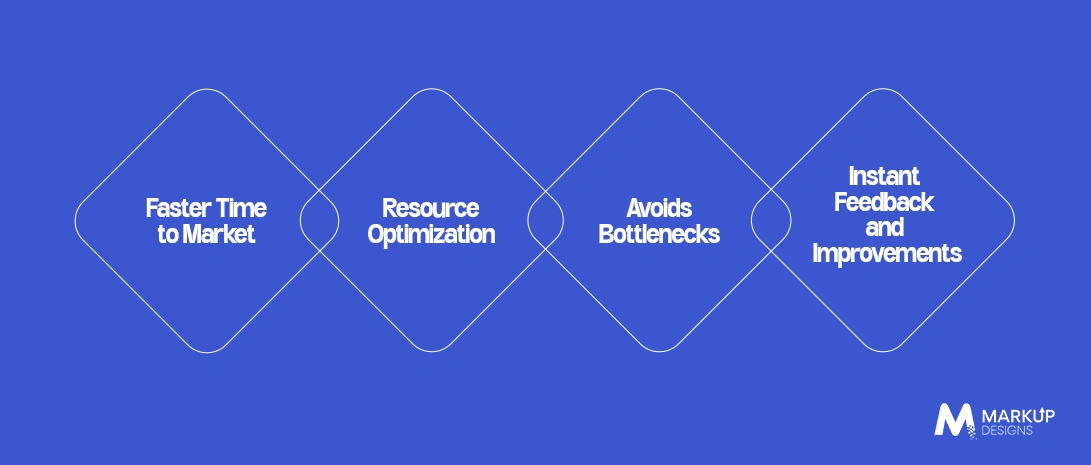
Another advantage of DevOps is that tasks are divided among different teams. By doing so, developers and other stakeholders remain on the same page regarding the application’s performance, deployment, stability, and security. As a result, businesses can deliver high-quality applications faster. Some of the advantages are:
1. Faster Time to Market
One of the biggest advantages of DevOps in mobile app development is faster application delivery. By collaborating in real-time, teams involved in the development, including development, operations, and testing, make the development process efficient.
Continuous development and testing allow businesses to release updates, features, and improvements more quickly. This approach allows for identifying problems easily and fixing them before they can slow down the process.
2. Resource Optimization
DevOps helps businesses optimize resources and simplify the application development process. As collaboration between development and operations improves, tasks like launching new builds, features, and updates become much easier.
Resource optimization is possible because of the automation aspect of DevOps. Automation reduces repetitive manual tasks, allowing developers to focus on more critical development activities.
3. Avoids Bottlenecks and Issues in Development Processes
DevOps helps eliminate bottlenecks and operational inefficiencies during development. It improves communication between teams and keeps the development workflow aligned.
Some of the common development problems resolved with the implementation of DevOps include:
- Repetitive development tasks and procedures
- Differences in development environments
- Workflow problems and instability
- Lack of visibility during operations
- Issues with communication and ownership among various development teams
Through addressing these problems, DevOps ensures efficiency and reliability of the development process.
4. Instant Feedback and Improvements
Another benefit provided by DevOps is that development teams get instant feedback throughout the development process. Developers can get feedback on their work through the stakeholders who have been tracking project progress.
This allows teams to identify and resolve issues early, resulting in better user experiences and higher application quality.
The C’s of DevOps That Every Business Must Understand
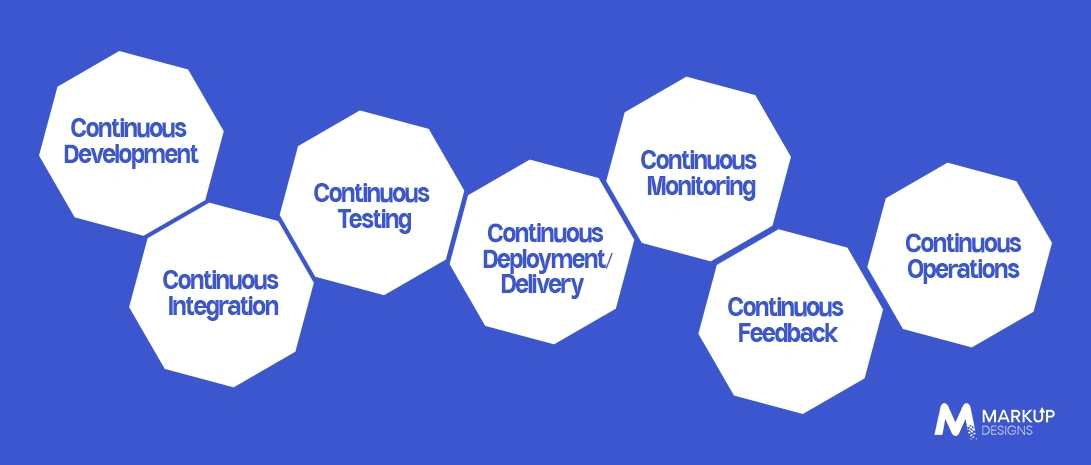
Continuous Development
In DevOps, applications are developed through smaller and more manageable updates instead of building the entire product at once. Teams continuously plan, write, and improve code while using tools like Git to manage and track changes efficiently.
Continuous Integration
Developers regularly merge their code into a shared repository where the system automatically builds and tests the application. It enables early detection of any problems with coding and helps keep the development process neat and orderly.
Continuous Testing
Testing of the application is automated to detect any bugs, vulnerabilities, and performance problems in the code. The application moves to the next stage only after it successfully passes all the required tests of the development process.
Continuous Deployment/Delivery
Once the application passes testing, DevOps automatically prepares it for release or directly deploys it to live servers. This helps businesses launch updates and new features faster with minimal manual effort.
Continuous Monitoring
In DevOps, the performance of applications, the health of servers, and the activities of users are monitored continuously. This helps in the timely identification of problems and maintaining smooth operations.
Continuous Feedback
Feedback received from users, logs generated by the application, and other relevant information provided by the system are monitored constantly. This helps developers to improve and update the application accordingly.
Continuous Operations
DevOps also makes sure that there are no interruptions in the operations of the system used for running an application. The automation process supports smooth operations at all times.
The Right Way to Implement DevOps
Businesses planning to adopt DevOps in mobile application development should understand the key implementation steps involved.
Continuous Integration and Continuous Delivery
In case a company is looking forward to applying mobile DevOps, the most important thing is Continuous Integration and Continuous Delivery. Both practices play a crucial role in improving development efficiency and delivery speed.
Code should be written in an organized manner so that it allows other developers’ code to merge without any problems. Developers must ensure that their code integrates smoothly within the DevOps workflow.
There is also a need for proper management of all the development resources, which include source codes, scripts, documentation, configuration files, and others.
Testing and Monitoring
There are several aspects that contribute to the success of a mobile application, including its efficiency on different devices and platforms. Applications must perform efficiently across different screen resolutions, hardware configurations, operating systems, and device capabilities.
That is why testing cannot be restricted solely to simulation or emulation tests. Therefore, businesses must ensure consistent application performance across multiple devices and platforms.
Automation testing helps address several challenges in this situation. It can assist in coping with frequent application updates, finding bugs, and eliminating them quickly without impeding development processes.
Quality Control
Quality control plays an essential role within the DevOps approach for mobile application development. It consists of testing every phase of the application, starting from the programming phase until the end when the product is released. Every modification made during development should be validated to prevent errors and maintain application quality.
Further, companies must always monitor their user feedback, scores, and comments at the app store level. This feedback helps developers understand user expectations, identify issues, and improve the application experience.
Four Major Phases Of Devops That You Should Know
Phase 1: Bring Your Own DevOps
During the early stages of DevOps adoption, teams often relied on their own preferred tools and technologies. Although it was beneficial at first since each team was familiar with its own system, it also led to poor collaboration, as there were communication problems due to the lack of knowledge about other teams’ technology stacks.
With increasing project complexity, businesses realized the necessity of finding a better way of working together and improving project management.
Phase 2: BICDevOps
To find an effective solution to the problem, businesses chose to have a standardized DevOps configuration. In the BICDevOps configuration, each company opts to use one of the best DevOps technologies for each step of the development process.
Although this model improved collaboration and workflows, managing integrations between multiple tools became increasingly difficult.
Phase 3: Do-It-Yourself DevOps
As a means to resolve problems with integration, many firms build their own connections among various tools for DevOps. The Do-It-Yourself or DIY DevOps entailed developing specific platforms to help the various tools perform better.
While this was able to address issues with the workflow, the maintenance of the DIY system was costly both in terms of time and effort. In many cases, developers would spend most of their time managing and troubleshooting tool integrations rather than working on the product itself.
Phase 4: DevOps Platform
The latest version of DevOps involves the adoption of a DevOps platform. Rather than utilizing several disconnected tools, the DevOps platform provides a platform that manages all aspects of the software development lifecycle.
A DevOps platform increases transparency, makes processes easier, and helps the team to gain greater control over planning, development, testing, security, deployment, and monitoring.
Organizations can boost collaboration and efficiency, eliminate operational complexity, and achieve their full potential through DevOps by working with all of these departments within the same platform.
Mobile DevOps Delivers Long-Term ROI To Businesses
While implementing Mobile DevOps may require additional time and investment initially, the long-term business benefits make it a valuable strategy for enterprises. DevOps enables businesses to improve their apps’ quality, speed up the development process, and offer better user experiences, which is why it is a good investment for companies for the future.
Improved Customer Experience
All businesses aspire to offer their clients high-quality goods and services as well as convenient digital experiences. DevOps assists in achieving this aim by providing companies with an opportunity to continuously test and improve their applications during the development process.
Continuous testing allows for the timely detection of potential problems and bugs in the app, increasing the stability and efficiency of mobile apps and providing users with better experiences when using the application.
Enhancement of Innovations
For any company to succeed, businesses have to quickly adjust to the changes in market conditions and customer requirements. This can be achieved through DevOps, whereby developers can create innovative features, updates, and applications without many hassles.
Through DevOps’ emphasis on continuous feedback, testing, and cooperation, businesses can continuously improve the application to meet customers’ requirements in a better way. Hence, innovation becomes easier and faster under DevOps.
Higher Software Quality
Another major benefit of DevOps is higher software quality. With DevOps, there is continuous testing of applications alongside updates and performance monitoring.
Agile methodologies combined with DevOps will ensure that developers are able to work cooperatively towards problem-solving in the process. DevOps stresses greatly on the monitoring of critical aspects such as security and performance.
Create High-Performing Mobile Applications with DevOps
Are you looking for an approach that simplifies your mobile application development process much easier? Let our DevOps team at Markup Designs take care of all that. We provide business organizations with the assistance needed for building high-performing mobile apps using contemporary DevOps techniques.

Conclusion
DevOps is an important aspect of mobile app development because it assists organizations in developing, testing, deploying, and maintaining applications. In the rapidly changing digital environment, there is a need for companies to have mobile applications that are secure, scalable, perform well, and provide users with a great experience.
DevOps improves collaboration between teams, accelerates software delivery, and increases overall development efficiency.
FAQs
1. What is DevOps in mobile app development?
DevOps is a modern development approach that combines development and operations teams to improve collaboration, automate workflows, and speed up mobile application delivery while maintaining quality and security.
2. Why is DevOps important for mobile applications?
DevOps helps businesses release applications faster, improve software quality, reduce bugs, automate testing and deployment, and provide a better user experience across multiple devices and platforms.
3. How does DevOps improve mobile app quality?
DevOps uses continuous testing, automated monitoring, and regular updates to identify and fix issues early in the development process. As a result, businesses can deliver more stable, secure, and reliable mobile applications.
4. What is the difference between Agile and DevOps?
Agile focuses mainly on improving the software development process through iterative development and customer feedback, while DevOps focuses on automating deployment, testing, operations, and collaboration between development and operations teams.
5. What are the key benefits of Mobile DevOps?
Some major benefits of Mobile DevOps include:
- Faster app development and deployment
- Better collaboration between teams
- Automated testing and monitoring
- Improved software quality and stability
- Faster bug fixing and updates
- Reduced operational risks
- Enhanced customer experience
6. Is DevOps suitable for startups?
Yes, DevOps is highly beneficial for startups because it helps reduce development delays, automate repetitive tasks, improve scalability, and speed up product launches while optimizing resources and costs.
7. What tools are commonly used in DevOps?
Popular DevOps tools include Git, Jenkins, Docker, Kubernetes, GitLab CI/CD, Selenium, Nagios, and AWS DevOps services for automation, testing, deployment, and monitoring.
8. Can DevOps reduce mobile app development costs?
Yes, DevOps helps reduce long-term development and operational costs by automating repetitive processes, minimizing manual errors, improving team productivity, and reducing downtime and maintenance issues.
Author's Perspective
Mobile application development has changed a lot over time. Businesses no longer compete only on faster app development. Today, success depends on better performance, stronger security, scalability, and continuous innovation. That is why DevOps has become so important in mobile application development. It is not only an effective technique in itself, but it is also the approach to developing mobile applications and fostering a culture of constant improvement.
Discuss Your Project NowJupinder Singh Arora
Founder and CEO
Related Posts

Cost to Build a Mobile App in Qatar...

How Much Does It Cost to Build an...

How to Build a Car Wash App: Development...
Insights Are Valuable & Execution is Priceless
You’ve read about the digital future. Now, let’s build the infrastructure to take you there. Move your strategy from the page to the product.
Design Your Solution Now
Contact Us
Schedule The Appointment At Your Convenience Date And Time.
30 Min
Web Conference
Time Zone
Indian standard time (08:30pm)

Thanks For Getting In Touch!
You’ve Taken The First Step Toward Transforming Your Digital Presence. Our Experts Will Reach Out Shortly To Take It Forward.
Launch Your Dream Project
Provide a brief overview of your project, and our specialists will evaluate your requirements. We will connect with you to explore how the right digital solutions can help you launch faster.