

In Brief
- Modern communication platforms are shifting from simple text messengers to high-performance, multi-modal digital ecosystems centered around community hubs.
- Building an application comparable to Discord requires a meticulous, layered architecture that handles instant messaging, real-time audio streaming, and structural server organizations.
- Scaling a community-focused chat platform demands a deep investment in decentralized WebSocket connections, low-latency audio processing, and resilient data architectures.
- Engineering teams are moving away from traditional monolithic backends and prioritizing containerized microservices to guarantee continuous application uptime under heavy peak loads.
- Cross-platform framework strategies, cloud-native storage infrastructure, and granular permission systems are reshaping how modern communications platforms are scaled.
- Custom UI/UX state management, hardware-level encryption protocols, and localized
- communication ecosystems are becoming critical competitive differentiators in a saturated app market.
- Engineering organizations that invest early in predictable data caching, optimized media pipelines, and scalable database routing are positioned to lead the next generation of social platforms.
Modern businesses and product engineering teams no longer treat community chat applications as niche, single-purpose software tools. Real-time communication platforms now influence how enterprises coordinate distributed workforces, how creators engage with their audiences, how digital commerce customer support is delivered, and how massive global communities interact in real time.
Across the digital landscape, consumer and enterprise behavior has shifted heavily toward persistent, space-centric digital ecosystems. Chatting, screen sharing, voice streaming, file management, and third-party bot integrations are increasingly consolidated into unified workspaces. This shift is forcing developers to rethink how real-time communication software is architected, developed, and scaled from day one.
The process of building a chat application like Discord is no longer just about establishing a basic database connection and pushing text lines back and forth. It requires creating an intelligent, highly concurrent, and deeply connected digital infrastructure capable of supporting sub-second message delivery, crystal-clear voice communication, granular access controls, and cross-platform flexibility. As digital ecosystems continue to expand, mastering these real-time development strategies is becoming vital for building long-term digital growth platforms.
Why Discord-Like Apps Are Growing Rapidly
The biggest reason why people are switching to Discord or other similar apps is because of its ability to create a server with Voice and Text at no extra cost. This has been a big deal, especially for the Gaming community, since TeamSpeak and other services required renting a server, and also text support was not quite great on it. Other services did not have an option for multiple voice channels as they were restricted to creating a “group chat”.
Discord solved these two problems for the community, at no cost to the user. It might seem too good to be true, but it is quite real and continues to be the norm in the Discord alternatives out there.
The fast increase in the popularity of applications similar to Discord happens due to a dramatic change in preferences when it comes to Internet communication. Users require a platform that will allow building their own community and communicating, collaborate, and exchange content within it.
Discord is up to offer the gamers community multiple voice channels, organized text channels, role management, moderation tools and seamless real-time communication. Users can now actually create large structured communities without paying for hosting or technical setup.
The Shift Toward Community-Centric Communication Platforms
Let’s be realistic about what it takes to run a high-performance communication platform. Users aren’t looking for another basic chat application that simply mimics standard SMS texting; they expect fully immersive digital spaces where text, audio, and media live together in a single workspace. If you look at how modern online communities interact, they expect their software platforms to handle continuous, multi-threaded conversations without lag or frequent server disconnects.
This massive architectural shift boils down to a few major drivers:
- Massive volume requirements for concurrent user sessions across global regions
- High user demand for instantaneous, unbuffered text and media syncs
- The transition from fragmented point-to-point chats to persistent server-and-channel frameworks
- Rapid integration of custom automation bots directly into communication channels
- Growth of remote collaboration spaces requires continuous, open-mic audio options
- Modern engineering focuses on low-bandwidth, high-fidelity media pipelines
- Rising demand for granular, role-based security configurations across huge user populations
- High product reliance on rich text formatting, inline embeds, and custom reactions
If your engineering design treats real-time messaging like a standard request-response database cycle, your app will fail under any real load. Modern app development teams aren’t just writing simple API routes anymore; they are configuring distributed data layers, building custom pub/sub mechanics, and optimizing audio protocols to function over unstable consumer networks.
When technical product teams evaluate a real-time messaging architecture, they look for:
- Communication channels that don’t choke during high-volume notifications
- Smart caching layers that display previous messages instantly upon app launch
- Data infrastructure that guarantees message order delivery across distributed servers
- Edge processing that minimizes audio packet delivery lag
- Flexible integration layers that allow users to connect external webhooks effortlessly
- Scalable front-end state management that updates the UI cleanly without lagging the user’s device
- Audio nodes that adapt dynamically to poor bandwidth drops without crashing the room
- Predictable data storage costs when archiving billions of historical text messages
If a chat architecture fails on any of these points, user retention plummets immediately. That is exactly why software teams are moving past simple, off-the-shelf tutorials and pouring their efforts into building highly optimized, concurrent messaging backends engineered for real-world scale.
Structural Planning and Core Architecture Blueprints
You cannot begin writing code for a complex system like Discord without mapping out the structural layout first. A platform of this caliber runs on a hierarchical data pattern that shapes how data moves through your system and defines how your database models link to one another.
Look at the standard architectural blueprint that defines this system:
- The Server Layer: The top-level community bucket containing all nested operational data
- The Channel Layer: Categorized streams (Text or Voice) that separate distinct conversation lines
- The Message Layer: Individual rich data payloads tied directly to user profiles within a channel
- The User Profile Layer: Central identity management handling status flags, friend lists, and cross-device states
- The Permission Engine: Hierarchical bitwise matrices managing role hierarchies across servers
These layers aren’t just separate folders in your codebase—they dictate your entire database indexing strategy and query paths.
This foundational division creates structural clearings for specialized data pipelines across your infrastructure:
- Persistent WebSocket connections managing live user presence and text delivery
- Isolated WebRTC pipelines routing media streams directly through dedicated audio servers
- High-speed memory spaces managing active user session flags and typing triggers
- Object-storage routing handling immediate file uploads and image thumbnailing
- Distributed message archiving engines managing infinite historical scrollbacks
- Automated webhooks routing server notifications to external engineering platforms
- Relational configuration mappings defining who owns what channel space
- High-volume background job workers processing global user search indexes
Because your platform’s front-end applications will depend directly on this underlying division, mapping out a clean relational model is vital. Teams that start coding without a clear separation of these operational boundaries will inevitably find themselves trapped in a web of unmaintainable, heavily tangled code.
Intelligent Real-Time Features Are Becoming the New Standard
The era of hitting a refresh button to see new text data is long gone. Real-time synchronicity has moved into every part of the modern application workspace. An enterprise-grade chat hub is expected to handle millions of simultaneous socket events every single second, delivering updates across multiple device types instantly without melting your server infrastructure.
Real-time feature sets change your application from a static website into a live, interactive environment by managing:
- Simultaneous presence states indicate exactly who is online, idle, or in a game
- Live, low-overhead typing status triggers are sent to everyone viewing a channel
- Instant message reactions that sync globally across all connected clients within milliseconds
- Live update events that instantly sync edited or deleted messages across the channel
- Automated server-side moderation systems detect spam or harmful links
- Real-time read receipt updates across complex multi-user channels
- Adaptive interface layouts that update member lists without forcing a redraw
- Live notification badges that dynamically count unread threads across multiple servers
Think about how this functions behind the scenes. When a user posts a message in a high-activity server channel, your system cannot afford to write to a heavy disk database before notifying the other thousands of active users in that space. Instead, an optimization routine grabs the payload, pushes it through an in-memory broadcast engine, and fires it down open socket connections instantly, processing long-term database persistence quietly in the background.
The success of a community application rests on this level of responsive immediacy. By using highly lightweight event broadcasting mechanics, your code can completely eliminate artificial UI delays, giving users the snappy, conversational interface they expect.
Cost of Building a Real Estate App Like Property Finder?
Explore the cost, features, AI integrations, technology stack, development process, and monetization strategies behind building a Property Finder-like real estate app in 2026.

Architecture Evolution: Moving Beyond Single-Purpose Platforms
One of the biggest frustrations for product developers is trying to adapt a traditional backend design to handle modern, multi-layered real-time demands. Standard web servers are built around short-lived connections that close as soon as a webpage finishes loading. A chat ecosystem, however, requires thousands of permanent, unbroken connection lines that sit open all day long.
Instead of trying to handle all these patterns inside a single application folder containing:
- Core user authentication data
- Massive historical text storage
- Live audio and video streams
- File asset uploads and hosting
- User search optimization pipelines
- Notification dispatchers
Modern engineering patterns demand a clean microservices separation. This model ensures that if your file upload service gets bogged down by users sharing huge media files, your core text chat service keeps running perfectly without dropping a single packet.
An enterprise-grade chat platform infrastructure separates its systems into isolated services:
- A lightweight Gateway service dedicated purely to maintaining open WebSockets
- An HTTP REST API service handling slow configurations like profile updates and payments
- A distributed Cache service managing active rooms, typing events, and session states
- A media streaming engine routing real-time WebRTC audio packets through edge locations
- An asynchronous queue engine handling heavy out-of-band email or push notification runs
- A search infrastructure indexing message databases continuously for instant lookup
- An asset management service converting and optimizing user image uploads on the fly
- A dedicated analytics data pipeline tracking overall server health and retention numbers
By breaking your application down into these specialized operational blocks, you protect your system from catastrophic failures. You gain the freedom to scale individual components based on what your community is actually doing, avoiding the overhead of duplicating your entire application stack just to handle a spike in user activity.
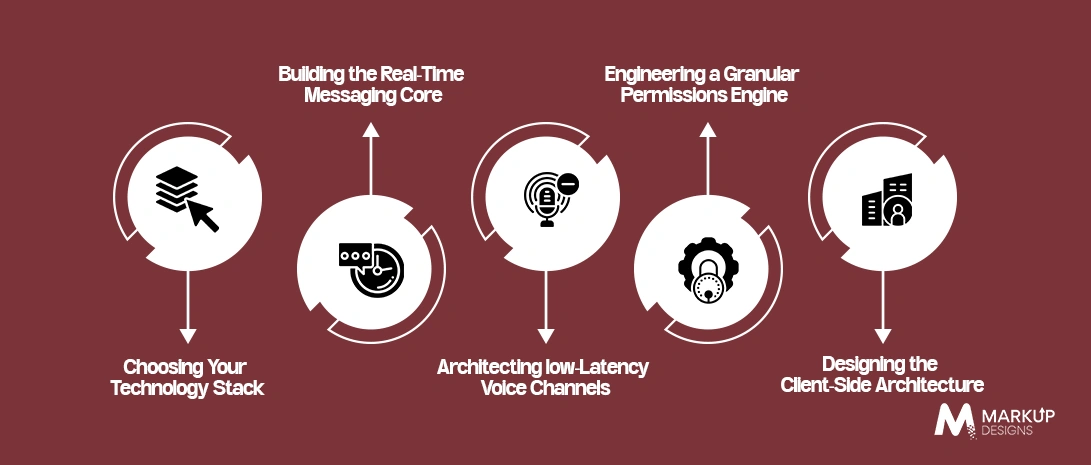
Step 1: Choosing Your Technology Stack
Before you open an editor to build, your team needs to lock down a robust set of tools optimized for high concurrency, low latency, and cross-platform flexibility. Selecting the wrong foundation here will severely limit your app’s performance down the line.
The Backend and Real-Time Layer
For the core platform backend, you need languages and runtimes that excel at handling thousands of simultaneous connections with low memory footprints. Elixir (running on the Erlang VM) is an incredible choice here due to its native actor model, which handles millions of isolated processes effortlessly—this is exactly what Discord used to scale their gateway. Alternatively, Node.js with TypeScript or Go provides excellent concurrency libraries and a massive ecosystem support for handling high-volume WebSocket networks.
The Database Architecture
A single database type cannot handle everything a chat platform throws at it. You need a multi-database approach:
- Redis (In-Memory Data Store): Used for fast ephemeral data like user online presence, typing indicators, active session tracking, and temporary socket routing maps.
- Cassandra or MongoDB (NoSQL Database): Ideal for storing the actual message history. These databases excel at handling immense write-heavy workloads and can scale horizontally across multiple database nodes as your user history grows into billions of rows.
- PostgreSQL (Relational Database): Best for handling highly structured, relational core data such as user accounts, server configurations, explicit channel structures, and payment records.
The Frontend Application Strategy
To maintain a high velocity of feature delivery without doubling your team size, frameworks like React Native or Flutter are highly effective for building cross-platform mobile apps. For desktop and web clients, React or Vue.js paired with lightweight wrapper utilities ensures that you can share core business logic and state management across all web browsers and desktop execution environments.
Step 2: Building the Real-Time Messaging Core (WebSockets)
The heart of a text chat system is the real-time gateway. While typical web apps use standard HTTP requests, your platform must establish persistent TCP connections via WebSockets to enable continuous, bidirectional communication.
[Client App] <— Persistent WebSocket Connection —> [Gateway Service] <—> [Redis Pub/Sub]
When a user opens your app, the client initiates a handshake with your gateway cluster. Once that socket connection is established, it stays open indefinitely. The server can push data updates to the client at any time without waiting for the client app to ask for them.
To make this architecture robust, your gateway must manage several key functions:
- Heartbeat Management: The client and server must exchange tiny ping/pong data packets every few seconds to verify that the connection line is still alive. If a client goes into a tunnel and drops their signal, the server drops the socket cleanly, updating the user’s presence state to offline.
- Event Dispatching: Every action on the platform—whether a message is sent, a channel is deleted, or a role color is changed—is turned into a structured JSON event payload. This payload is stamped with an event type tag and sent down the socket connection to be handled by the client application.
- Pub/Sub Layering: Your individual gateway servers need a way to talk to one another. By placing a high-speed Redis Pub/Sub layer behind your web gateways, a message received by Server A can be instantly published to a global channel, allowing Server B to deliver that message to a user connected to a completely different node.
Step 3: Architecting low-Latency Voice Channels (WebRTC & SFU)
Voice communication is arguably the most complex component of building a platform like Discord. Text messages can tolerate a 200-millisecond network delay; real-time human conversation completely falls apart if your audio latency spikes over 100 milliseconds.
Standard browser communication often relies on Peer-to-Peer (P2P) WebRTC connections. However, while P2P works fine for a direct call between two people, it breaks down completely in a community setting. If you have ten users in a voice channel using P2P, each user’s device must upload their audio stream nine times and download nine separate audio streams from the others. This quickly exhausts mobile battery life and chokes consumer internet connections.
To scale past small groups, your architecture must implement a centralized media server acting as a Selective Forwarding Unit (SFU):
- Each user uploads their encrypted audio stream exactly once to your media server cluster.
- The SFU media server receives these incoming packets, analyzes who is actively speaking, and forwards those audio streams out to the other participants in the room.
- Devices only maintain a single upload line and a set of balanced download streams, saving massive bandwidth across all user clients.
For the actual audio encoding, your platform should implement the open-source Opus codec. Opus is incredibly versatile, capable of dynamically adjusting its audio quality and data compression bitrates on the fly to match the changing network conditions of each user’s connection.
Step 4: Engineering a Granular Permissions Engine
As servers grow from small groups into massive public spaces hosting tens of thousands of users, server administrators require powerful, fine-grained control over who can speak, view channels, embed media, or ban problematic accounts.
To build an efficient permissions layer that doesn’t drag down your database speeds, you should implement a bitwise permission system:
- Every distinct capability on the platform is assigned a specific bit flag value .
- A user’s total active capabilities within a specific role are combined into a singular, compact integer value using bitwise OR operations.
- When a user attempts to post a message in a channel, your access service can perform a lightning-fast bitwise AND comparison to grant or deny access instantly.
This approach allows your backend services to check intricate, multi-layered role conditions within microseconds, completely avoiding the overhead of parsing massive, deeply nested loops of text strings during critical API requests.
Why Your Mobile App’s Success Depends on AWS
Wondering why successful mobile apps rely on AWS? Explore how AWS cloud services improve performance, scalability, security, and development speed to support long-term app growth.

Step 5: Designing the Client-Side Architecture and State Optimization
The best backend architecture in the world will still feel clunky to your users if your front-end application layer isn’t optimized to handle real-time data streams efficiently. A busy chat app shouldn’t trigger full UI rerenders every time a background event comes down the WebSocket.
Your client-side architecture must prioritize several key layout patterns:
- Optimistic UI Updates: When a user types a message and hits enter, the client app should instantly render that message into the chat window with a visual “sending” state before your server even acknowledges the write operation. Once the server confirms success, the client updates the message state quietly. This simple trick makes your app feel incredibly fast to the end-user.
- Virtual Windowing: If a community channel contains hundreds of thousands of historical messages, rendering all of those text objects into the device memory will crash the browser or mobile application. Your frontend must use virtual list processing, which renders only the tiny subset of messages currently visible on the screen, dynamically re-using UI elements as the user scrolls up through their chat history.
- Decoupled State Stores: Keep your real-time network listeners completely separated from your visual presentation code. WebSocket events should feed into a clean, centralized client-side data store (like Redux or Zustand) that uses memoized selectors to ensure only the specific UI components tied to that data update when a change occurs.
Data Management and Long-Term Scale Challenges

Managing a scaling communication ecosystem over multiple years means planning for data growth that climbs exponentially. Enterprise infrastructure engineering teams constantly face intense bottlenecks: database sizes grow into tens of terabytes, caching layers consume heavy memory budgets, and the cost of cloud data transfer can spiral out of control if your network layout isn’t continuously optimized.
Data requirements shift dramatically as your platform grows. Systems need regular architectural optimization, structural database partitioning, and clear asset retention schedules to stay reliable and cost-effective over time. Companies that view chat engineering as a basic database table setup will almost always run into a scaling wall within their first major user surge.
To keep your chat platform highly responsive as it scales, engineering focus must stay centered on:
- Horizontal database sharding based on server IDs to split data workloads cleanly
- Aggressive message log truncation and archival rules for ancient, inactive servers
- Custom media compression microservices that optimize user images before long-term storage
- Open-standard caching protocols that handle data lookups inside local memory spaces
- Regional deployment of gateway nodes to terminate socket lines closer to your users
- Regular performance audits tracking message delivery delays across cross-continental channels
Why Technical Architecture Choices Matter
Building a deeply interactive, long-lasting community application takes far more than just connecting a basic UI to an open database channel. Teams need software architectures engineered specifically to handle immense write-heavy loads, high socket concurrency, strict data delivery constraints, and high-frequency network interruptions.
When new communication tools fail to scale, the root causes are almost always found in weak gateway layer choices, un-indexed message database strategies, or un-optimized client state rendering pipelines. Working with a solid architectural foundation helps product teams launch platforms that deliver high frame rates, instant text synchronization, crystal-clear audio streams, and the flexibility to expand seamlessly from small test rooms into massive global networks.
The Future of Real-Time Digital Spaces
The global digital landscape is shifting rapidly as communication platforms grow more automated, deeply embedded into professional workspaces, and functionally self-contained. The future of interactive group software will turn completely on:
- Decentralized, edge-driven event routing that cuts cross-continental latency to zero
- Custom AI assistance workflows baked smoothly into shared conversation spaces
- Fully sovereign, local cloud compliance hosting configurations
- Multi-modal spaces blending voice, video, and whiteboards into unified workspaces
- Dense, distributed gateway processing networks handling massive active user pools
- High-fidelity, low-bandwidth communication protocols optimized for spotty mobile networks
- Advanced, chip-level security architectures guarding private communication keys
- High-performance, cross-platform client code that runs flawlessly across all devices
Community application channels have evolved from basic tech novelties into the core social fabric of modern gaming, open-source development, and global business coordination. Product teams that move early to build well-architected, highly concurrent, and deeply optimized real-time networks unlock enormous advantages in speed, engagement metrics, and operational performance. Conversely, software applications that stick to old, request-heavy legacy architectures will find it increasingly difficult to survive in our modern, instant-sync digital landscape.
Scale Your Real-Time Digital Infrastructure with Confidence
Build highly concurrent, beautifully optimized, and deeply engaging community ecosystems engineered for global scale and rock-solid performance.

Conclusion
Building an enterprise-ready chat application like Discord requires moving past standard web development patterns and stepping directly into the world of highly concurrent distributed engineering. Success requires balancing a tough, low-overhead real-time gateway layer with high-performance audio routing hubs, intelligent database strategies, and snappily responsive front-end state management.
From gaming networks and casual creator spaces to secure enterprise collaboration hubs and global support channels, real-time community tools are redefining how humans interact online. At this point, features like instantaneous socket message updates, zero-lag WebRTC voice channels, and granular bitwise permission handling aren’t cutting-edge additions—they are basic operational requirements for any serious marketplace launch. The software engineering teams that will dominate the digital spaces of tomorrow are those that view their chat platforms not as simple messaging interfaces, but as deep, long-term infrastructure built explicitly to support seamless, high-volume real-time human connection.
FAQs
1. What is the single biggest bottleneck when building a high-scale chat app?
The biggest challenge is handling the massive write workload on your message history database while simultaneously broadcasting those same message payloads out to thousands of open active user socket connections within fractions of a second.
2. Why is standard HTTP architecture a poor fit for community chat systems?
HTTP is fundamentally built on request-response patterns where the client must always ask for data first. Chat platforms need instant, bidirectional updates, which require establishing permanent, open communication channels using WebSockets.
3. Can you use traditional SQL databases to store infinite chat histories?
While relational databases like PostgreSQL excel at handling structured core user configuration data, using them to store billions of raw chat history lines can cause serious indexing bottlenecks. Write-heavy NoSQL databases like Cassandra or MongoDB are far better suited for scaling message archives horizontally.
4. How does an SFU improve performance in multi-user voice channels?
An SFU (Selective Forwarding Unit) media server allows each participant to upload their audio stream exactly once to a central point. The server then forwards those packets to the other room members, preventing the user’s device from having to send separate audio uploads to every single person in the channel.
5. What is the benefit of using bitwise operations for permissions?
Bitwise permission architectures turn complex, nested strings of role settings into a single, compact integer value. This allows your backend to verify advanced authorization rules via high-speed mathematical operations, keeping your API routes lightning-fast under heavy load.
6. How can you prevent a chat client from lagging during fast, high-volume chat streams?
You should implement virtual windowing on your list views so the device only renders the specific messages currently visible on screen, and decouple your incoming socket data streams entirely from your visual component layout to prevent unnecessary UI redraw cycles.
Author's Perspective
Let’s look at the reality of software engineering today: many development teams still approach real-time community platforms as if they were simple extensions of traditional CRUD (Create, Read, Update, Delete) applications. In our view, that approach misses the core technical realities of modern internet architecture. Persistent, multi-threaded communication systems have transformed into massive distributed data management networks that require specialized architectural design from day one.
As global user expectations settle firmly on instant communication and high-fidelity streaming, teams can no longer get away with throwing together basic, unoptimized backend loops or uncached message layers. True competitive advantage belongs to software organizations that treat their real-time platforms as foundational infrastructure, investing heavily in resilient edge gateways, highly optimized media paths, and ultra-fast client rendering logic. Taking the time to properly engineer these underlying core systems is exactly what separates a crashing prototype from a world-class digital ecosystem.
Discuss Your Project NowGaurav Goyal
Global Sales- VP
Related Posts

Cost to Build a Mobile App in Qatar...

How Much Does It Cost to Build an...
How to Build a Car Wash App: Development...
Insights Are Valuable & Execution is Priceless
You’ve read about the digital future. Now, let’s build the infrastructure to take you there. Move your strategy from the page to the product.
Design Your Solution Now
Contact Us
Schedule The Appointment At Your Convenience Date And Time.
30 Min
Web Conference
Time Zone
Indian standard time (08:30pm)

Thanks For Getting In Touch!
You’ve Taken The First Step Toward Transforming Your Digital Presence. Our Experts Will Reach Out Shortly To Take It Forward.
Launch Your Dream Project
Provide a brief overview of your project, and our specialists will evaluate your requirements. We will connect with you to explore how the right digital solutions can help you launch faster.