

In Brief
- A healthcare payment system is a digital platform that helps connect patients, hospitals, clinics, insurance companies, banks, and payment gateways for the purpose of managing billing, payment transactions, insurance claims, refunds, and record-keeping.
- Some of the advantages associated with healthcare payment systems include faster billing and payment processing, patient convenience, streamlined management of insurance claims, reduction in billing errors, and financial management.
- Important components of healthcare payment systems include patient billing and invoicing, multiple payment gateway integrations, insurance claims management, payment history, reminder functionality, refund management, patient portal, and security measures.
- Healthcare payment system development includes understanding business needs, understanding compliance needs, choosing payment infrastructure, interface design, core module development, EHR/EMR systems integration, implementation of security measures, testing, and implementation. Some of the other technologies that can be used to enhance the capability of a healthcare payment system include artificial intelligence/machine learning, blockchain, cloud computing, open banking APIs, and biometrics.
- Healthcare payment system development cost is dependent on factors like features needed, payment gateway and healthcare integration, security, infrastructure, and maintenance needs. Markup Designs offers healthcare payment system development services through customizable solutions, secure integrations, scalable architecture, and end-to-end development services.
Payments are an integral part of the whole patient experience; however, the process of managing them is quite complicated. The generation of invoices, insurance processing, collections, refunds, and numerous other financial transactions are carried out by healthcare organizations on a daily basis. And using the traditional methods of billing and a separate payment system makes the processes long and administratively heavy.
The healthcare payment system allows unifying all the above-listed activities into one system. It allows patients to pay for medical services in the most convenient way possible, whereas healthcare providers gain the possibility of efficient management of their financial operations.
At the same time, the creation of such a system implies certain preliminary planning, implementation of the right set of features, creation of a safe payment infrastructure, and integration of the system with the existing healthcare software.
In the blog post, we will talk about the process of developing the healthcare payment system, its main features, the technologies used, and the cost of development.
What is a Healthcare Payment System?
A healthcare payment system is a digital solution that allows healthcare facilities to organize and execute the processes of managing financial transactions regarding healthcare services. It provides a connection between patients, hospitals, clinics, insurance companies, banks, and payment gateways to facilitate the activities of billing and payments.
Instead of relying on this, one can get rid of manual invoices, paper forms, and payment channels in order to facilitate the processes of billing and payments. Patients will be able to see their medical bills, monitor their balance, make payments online, and view the details about the transactions. Administrators will be able to manage invoices, perform refunds, control payments, and handle insurance transactions.
The healthcare payment system will allow integration with EHR, EMR, and accounting systems in order to provide organized access to the data related to the financials of the organization.
For example, once a patient finishes a consultation, the system will generate an invoice, offer the payment options, complete the payment, and update the payment status automatically.
Why Should Healthcare Organizations Invest in Payment System Development?
Processing of payments in the healthcare sector is not limited to just receiving money from patients. There is also a need for handling insurance claims, billing, refunds, and financial reports. In this respect, digital payment processing unites all these processes into one and makes daily accounting procedures much easier to handle.
There are several important benefits that should be considered:
1. Faster Billing and Payments
With automated billing services and digital payment methods, there will be less manual labor involved, and transactions will be processed faster. Patients will not have to visit billing desks anymore in order to pay for their services.
2. Improved Patient Experience
A variety of payment methods, detailed invoices, and online payment opportunities make this process more convenient for patients.
3. Simplified Insurance Claim Management
Integration with insurance platforms will allow managing claim processing, tracking the status of claims, and avoiding repetitive administrative actions.
4. Reduced Billing Errors
Automated calculation, digital invoices, and a single source of transactional information will help avoid mistakes that occur because of manual input of data.
5. More Efficient Financial Accounting
Healthcare administrators will be able to track payment history, outstanding bills, revenue flow, and generate financial reports.
Overall, investing in healthcare payment system development helps organizations improve financial workflows while making payment experiences simpler for patients.
Essential Features of a Healthcare Payment System
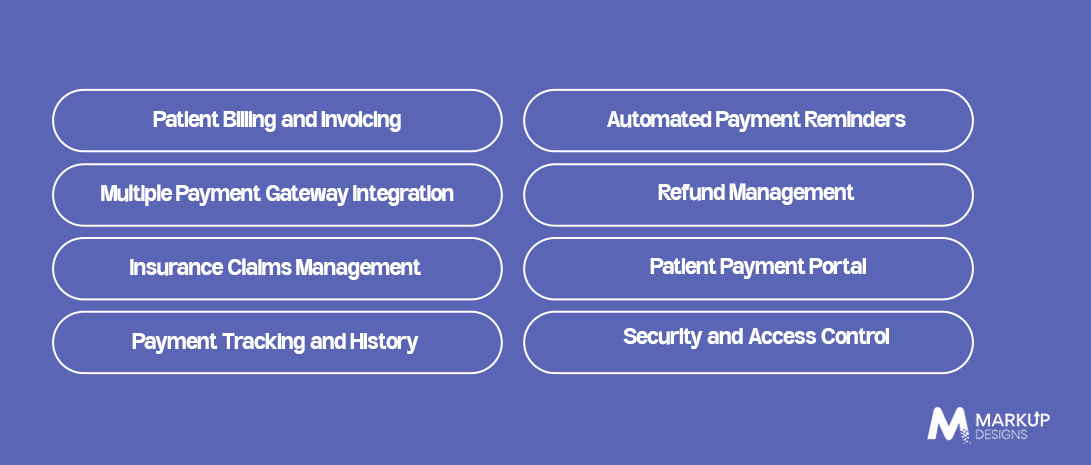
A good payment platform in healthcare should have appropriate attributes that will ensure smooth financial transaction management and a convenient experience for both patients and healthcare providers. The following is a list of attributes that are necessary for a healthcare payment system.
1. Patient Billing and Invoicing
It enables healthcare providers to create electronic invoices, handle medical bills, and share relevant payment details with patients.
2. Multiple Payment Gateway Integration
It supports multiple payment mechanisms like credit card, debit card, bank transfer, UPI, digital wallets, among others.
3. Insurance Claims Management
It helps in handling insurance claim submissions, tracking claim status, and managing relevant data for reimbursements.
4. Payment Tracking and History
It keeps track of transaction history, payment status, pending balance, and payment history of the past.
5. Automated Payment Reminders
It sends notifications about payment reminders, unpaid invoices, and pending balance via email, SMS, and notifications in the application.
6. Refund Management
Facilitates refunds, handles refund request management, and keeps transactional records updated.
7. Patient Payment Portal
Gives patients the opportunity to access their invoices and make payments.
8. Security and Access Control
Encryption, authentication, and role-based access control are provided to ensure the security of financial and medical information.
How to Develop a Healthcare Payment System: A Step-by-Step Process
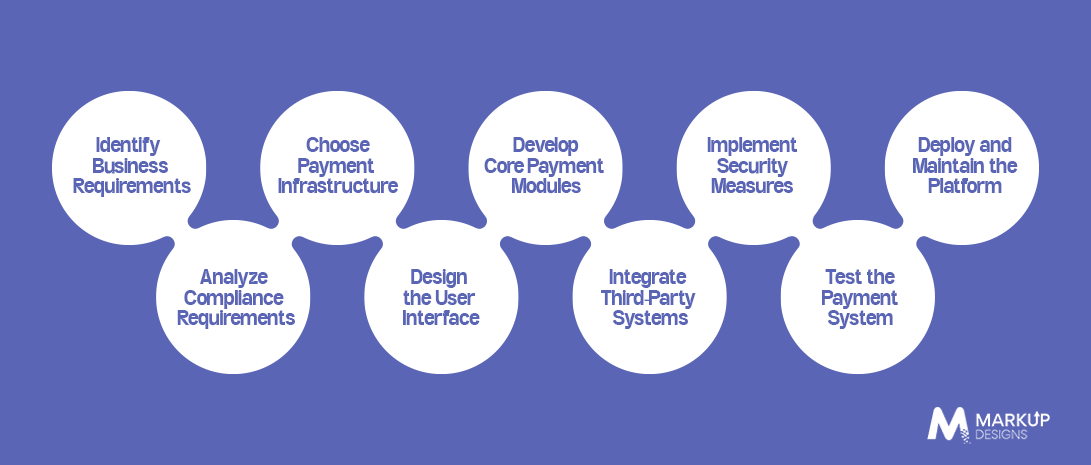
Developing a healthcare payment solution involves careful planning, appropriate technology utilization, and knowledge of financial processes within the healthcare industry. Every step of development is crucial to creating a secure and efficient payment platform for transactions.
These are the main stages of developing a healthcare payment solution:
Step 1. Identify Business Requirements
In order to create a solution, it is vital to identify the business needs, its potential users, and problems in its payment process. Find out what kind of healthcare businesses you want to target – whether hospitals, clinics, insurance providers, or telehealth companies.
Step 2. Analyze Compliance Requirements
Any payment solution for the healthcare industry deals with confidential information. Determine what compliance requirements apply in your target country, e.g., HIPAA, GDPR, PCI DSS.
Step 3. Choose Payment Infrastructure
Identify the right payment infrastructure. Select the right payment gateways and processors. Decide on the payment methods your platform will use – from cards, bank transfers, UPI payments to digital wallets.
Step 4. Design the User Interface
Design an intuitive user interface that will let patients easily see bills, pay bills, and receive receipts without any hassle. Likewise, equip healthcare administration officials with intuitive dashboards for managing bills and invoices. Ensure the platform is easy to use on mobile devices and computers.
Step 5. Develop Core Payment Modules
Develop modules necessary for the platform’s operation, including billing, invoicing, transactions, insurance claims, payment processing, refunds, and automated notifications to inform patients of their payment status.
Step 6. Integrate Third-Party Systems
Integrate the platform with EHR systems, EMR systems, accounting systems, insurance systems, and payment gateways. API integration is useful in facilitating data transfer between different systems.
Step 7. Implement Security Measures
Ensure security through the use of measures such as data encryption, tokenization, multi-factor authentication, and role-based access control. Fraud protection and secure API communication should also be considered.
Step 8. Test the Payment System
Prior to launching, it is important to test the platform to ensure that payments, refunds, invoicing, and insurance processes function properly. Functional, integration, performance, and security testing must be performed to discover any problems and make sure that the system is reliable.
Step 9. Deploy and Maintain the Platform
After testing is done, deploy the system and observe its performance. Gather feedback from users, solve technical issues, and provide updates on a regular basis. The maintenance process will also help your platform cope with increased transaction volume and evolving business needs.
This plan can help you create a payment system that will suit the financial processes in healthcare and will provide a pleasant experience for patients.
Technologies Used in Healthcare Payment System Development
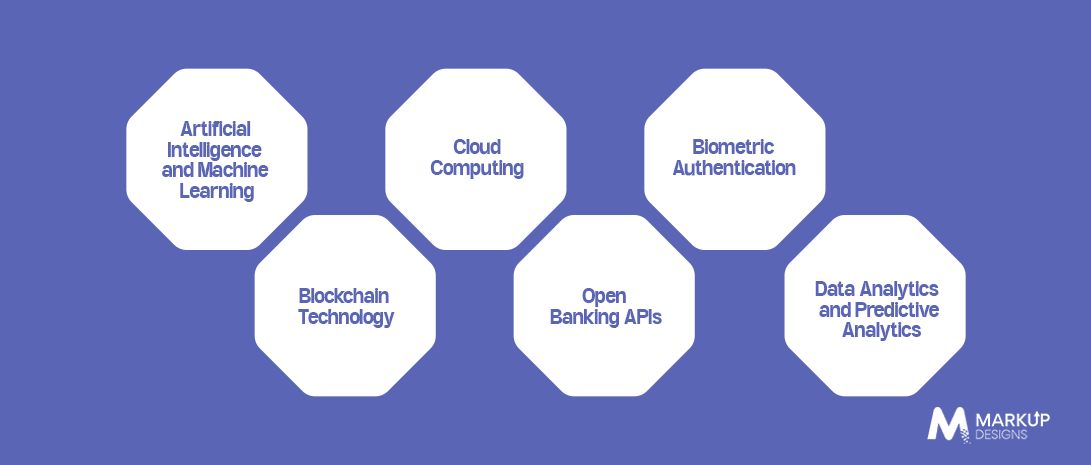
The right technological stack can make a healthcare payment system reliable, scalable, and efficient. Technologies can also make the whole process of payment processing easier, as well as data management. Below is a list of possible technologies that can be used for developing such a system.
1. Artificial Intelligence and Machine Learning
Such technologies can help in identifying abnormal payment transaction patterns, detecting possible fraud in payments, automatically processing invoices, and managing insurance claims.
2. Blockchain Technology
With blockchain technology, one can ensure safe payment transaction records and transparency of the payment transaction workflow. The use of smart contracts can automate specific payment and settlement processes.
3. Cloud Computing
Cloud computing makes it possible to save and manage payment data, support multiple users, and scale the system as the number of transactions grows.
4. Open Banking APIs
Open banking APIs allow secure linkages to be created between payment services and banks. These may be used to facilitate bank payment services, verification of accounts, and more efficient financial data transmission.
5. Biometric Authentication
Technology like fingerprint scanning or facial recognition can offer an additional level of identification, ensuring patient accounts and payments are secure.
6. Data Analytics and Predictive Analytics
Analytics provide information for healthcare service providers about their payment trends, outstanding bills, revenue generation, and possible issues with payment delays.
The selection of the above-mentioned technologies will depend on the requirements of the platform, its users, and integration with third parties.
How Much Does It Cost to Develop a Healthcare Payment System?
The cost of developing a healthcare payment system is influenced by platform functionality, complexity, integrations, requirements for its operation, and the technology. An elementary solution, which provides such components as billing and transaction management, will be created at a different price level compared to an advanced system that offers automated processing of insurance claims, fraud detection, artificial intelligence, and many third-party integrations.
Here is a list of some major factors influencing development costs:
Features and Functionality
The amount and difficulty of implementing the features will influence the efforts necessary for development. Basic billing and payment handling will require less work than advanced features such as insurance handling, refunds, and financial analysis.
Payment Gateway Integrations
Integrating a system with various payment systems, banks, and digital wallets will take more time and money to develop. Also, each payment system may require specific settings.
EHR/EMR Integration
Integration of the system with the already existing medical systems will take extra effort and time to test.
Security and Compliance Requirements
Encryption, authentication, access control, audit trails, and other regulatory requirements will add to the cost of development.
Technology and Infrastructure
Another aspect that impacts the budget is cloud infrastructure, AI, data analysis, and backend architecture selection.
Maintenance and Updates
Maintenance, updates for security and performance issues, and feature improvements are some factors behind ongoing costs.
Hence, it can be concluded that healthcare institutions need to determine their requirements and scope of development to estimate the final budget. This will allow them to evaluate the cost required to develop an effective payment portal.
Why Choose Markup Designs for Healthcare Payment System Development?
Selecting the right technology partner will be critical in ensuring that your healthcare payment system fulfills the business needs and has potential for further development. Markup Designs works with businesses to develop customized software solutions that increase efficiency, enhance user experience, and facilitate digital transformation through software development. The company focuses on comprehending project requirements and creating custom solutions to fit those requirements.
With advanced knowledge of technologies, API integration, and software development, Markup Designs can assist companies in developing payment platforms equipped with features like billing, payment processing, insurance management, and transaction tracking. Additionally, the development strategy pays much attention to such issues as data security, system performance, and seamless integration of systems with the already implemented healthcare applications.
Markup Designs offers full development assistance starting from planning and UI/UX design to the deployment and further support of software products. With 14+ years of experience, 200+ professionals, and services provided to 500+ companies, the company assists companies in implementing their software concepts into reality.
Build Your Healthcare Payment Solution with Markup Designs
Partner with Markup Designs to develop a secure, scalable, and customized healthcare payment system that meets your business needs.

Conclusion
Developing a payment system for the healthcare industry will allow businesses to ease the process of billing, handle transactions, streamline insurance processes, and offer patients various ways of making payments. Nevertheless, creating such a payment solution demands adequate planning, the right features, payment security, and smooth integration with other systems in the industry.
Each stage of the development process, from analyzing the organization’s requirements to selecting technologies, implementing security systems, and maintaining the platform, will ensure the future performance of the solution.
A healthcare company should create a payment system that would meet today’s organizational needs and be scalable enough for further growth. Collaboration with a professional technology company, such as Markup Designs, is what is needed to achieve the goal.
FAQs
1. How long does it take to develop a healthcare payment system?
The development timeline depends on the platform’s complexity, features, integrations, and compliance requirements. A basic solution may take less time than an advanced platform with multiple payment methods and automated insurance workflows.
2. What are the essential features of a healthcare payment system?
Some essential features include patient billing, digital invoicing, payment gateway integration, insurance claims management, transaction tracking, automated reminders, refund processing, and data security.
3. Is HIPAA compliance necessary for healthcare payment systems?
HIPAA applies to covered entities and business associates handling protected health information in the United States. Whether a payment platform needs to comply depends on its role and the information it processes. Other payment and data protection requirements may also apply.
4. Which payment gateways can be integrated into a healthcare payment platform?
Healthcare payment platforms can integrate with suitable payment providers such as Stripe, PayPal, Adyen, or regional payment gateways. The selection depends on the target market, supported payment methods, transaction requirements, and compliance needs.
5. Can a healthcare payment system integrate with EHR and EMR software?
Yes. Healthcare payment systems can integrate with EHR and EMR platforms through APIs and healthcare interoperability standards. These integrations help connect patient billing information with existing healthcare workflows.
Author's Perspective
Healthcare payment systems are becoming an essential part of modern healthcare operations. They go beyond basic transaction processing by simplifying billing, improving payment management, and connecting different stakeholders through integrated digital workflows. A well-developed healthcare payment system focuses on three key areas: operational efficiency, data security, and patient convenience. By combining automation, seamless integrations, and scalable technology, healthcare organizations can create more reliable payment processes and adapt to evolving industry requirements.
Discuss Your Project NowJupinder Singh Arora
Founder and CEO
Related Posts

Green Software Development: A Complete Guide to Sustainable...

Kotlin vs Scala: A Complete Comparison for Modern...
AI Scheduling Assistant for Healthcare: Development Process, Architecture,...
Insights Are Valuable & Execution is Priceless
You’ve read about the digital future. Now, let’s build the infrastructure to take you there. Move your strategy from the page to the product.
Design Your Solution Now
Contact Us
Schedule The Appointment At Your Convenience Date And Time.
30 Min
Web Conference
Time Zone
Indian standard time (08:30pm)

Thanks For Getting In Touch!
You’ve Taken The First Step Toward Transforming Your Digital Presence. Our Experts Will Reach Out Shortly To Take It Forward.
Launch Your Dream Project
Provide a brief overview of your project, and our specialists will evaluate your requirements. We will connect with you to explore how the right digital solutions can help you launch faster.