
In Brief
- The main concept of Green Software Development involves the creation of software that will be able to utilize computing resources effectively, use less energy, and generate fewer carbon emissions throughout its entire lifecycle.
- The key principles of green software include energy-efficient software development, optimized hardware, carbon-aware computing, sustainable architecture, efficient database management, and lifecycle sustainability.
- In order to adopt green software development principles, companies should assess software carbon footprint, choose efficient architectures, optimize the code and the database, select sustainable cloud infrastructure, and monitor resource consumption continuously.
- Benefits include lower operating expenses, decreased carbon emissions, increased efficiency of applications, effective resource consumption, improved brand reputation, and sustainability. Challenges in adopting the approach involve the measurement of emissions, modernization of legacy systems, lack of skills, and the need to balance performance and sustainability.
- In order to evaluate the environmental impact, businesses may make use of tools and frameworks such as SCI, CodeCarbon, Cloud Carbon Footprint, Scaphandre, Kepler, and the GHG Protocol. The selection of an experienced software development company such as Markup Designs will help to create efficient and sustainable software.
Software solutions are now becoming an integral part of any organization, starting from mobile apps and websites through to cloud platforms and artificial intelligence applications. On the other hand, the increased use of digital technology is resulting in higher energy usage in software development, execution, and maintenance of this process. Data centers, cloud technology, and resource-intensive software create an environmental impact; thus, green software development becomes an issue that organizations need to consider nowadays.
That’s why it is important to introduce green software development practices. These involve the development and maintenance of efficient and effective software that utilizes computational resources effectively, requires minimal energy, and minimizes its environmental impact without lowering productivity and quality of software execution.
In 2026, organizations need to consider not only the functionality and scalability of software solutions but also the sustainability of software development.
In this blog post, we will analyze the definition of green software development, its principles, benefits, challenges, ways of measuring green software development, and building sustainable software.
What is Green Software Development?
Green software development refers to creating software solutions that utilize computing resources effectively and minimally harm the environment. This process is oriented toward reducing energy usage, cutting carbon footprint, and optimizing hardware and cloud infrastructure.
This type of software development differs from a regular one as it is not limited only to functional and performance aspects, but also takes into account the energy consumption of the application as well as other resources that it requires for operation.
Thus, developers are encouraged to optimize application code, cut down unnecessary requests to databases, implement effective cloud infrastructure, and not abuse computing resources. Small changes made by developers might lead to significant improvements in terms of the efficiency of applications.
Green software development is focused on taking into account the environmental impact of software development and covers such stages of the software lifecycle as:
- Design: Planning applications with sustainability in mind.
- Development: Writing clean and efficient code.
- Deployment: Using optimized infrastructure and cloud resources.
- Maintenance: Monitoring performance and reducing resource waste.
- Retirement: Managing outdated systems and hardware responsibly.
The main idea behind green software development is the ability to create software with minimal negative impact on the environment.
Why is Green Software Development Important in 2026?
Since companies are embracing cloud computing, artificial intelligence, and other digital software, the need for computer resources is growing. This means that the software needs energy, memory, computing power, and the infrastructure of the data center to function. This has raised concerns regarding the effect of the software on the environment.
The following are some of the reasons why green software development is critical for 2026 and beyond:
- Growing Energy Consumption: The current applications and artificial intelligence systems are consuming a lot of computing resources. Green software development techniques may help reduce unnecessary energy consumption.
- Increased Carbon Emissions: Cloud infrastructure and the use of data centers are causing the emission of carbon into the environment.
- Rising Cost of Cloud Infrastructure: Applications that have not been well optimized end up consuming more computing resources than required. Adopting green software practices is one way to optimize the use of computing resources and control costs.
- Growing Importance of Sustainability: Consumers, shareholders, and partners are increasingly taking into consideration how sustainable a company is when judging it.
- Efficient Business Operations Over Time: Resource-efficient software helps enhance application efficiency and minimize waste in the infrastructure used for digital operations.
- Changing Technology Needs: Companies require applications to provide performance and efficiency, as well as to take into account their environmental implications.
Green software development has thus become an increasingly important aspect of technology planning. This makes it possible for companies to develop digital solutions that help them grow without neglecting the environmental effects of their technology decisions.
Read Also: Green Cloud Computing: Sustainable Cloud Strategies for Modern Enterprises
What are the Core Principles of Green Software Engineering?
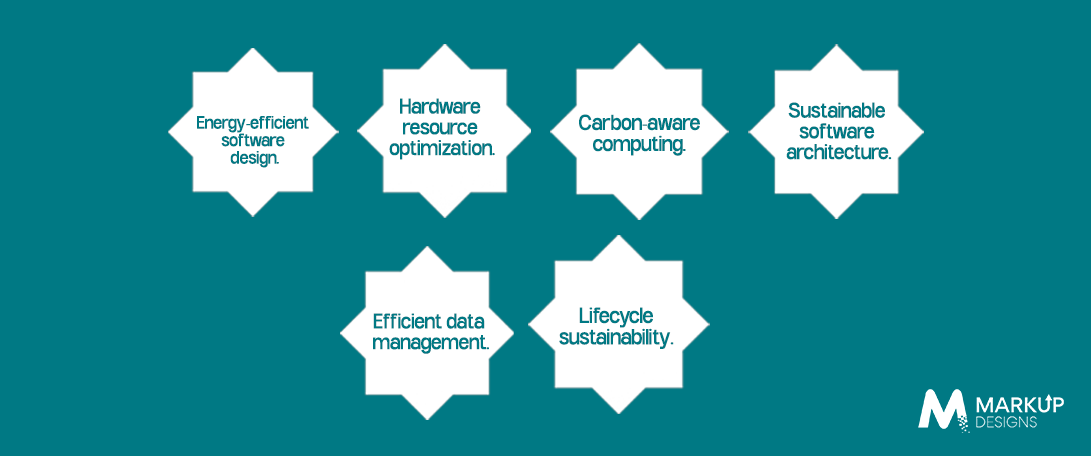
There are some guiding principles for green software engineering that allow developers to develop applications with minimum environmental overhead. These principles involve efficient use of energy, effective utilization of hardware, and environmental awareness during software development.
The following are six principles:
1. Energy-efficient software design.
Applications should be developed in such a way that they accomplish the desired task with minimum energy usage. This can be done through effective coding, reduction in unnecessary processing, and increased efficiency of the application.
2. Hardware resource optimization.
There should be efficient utilization of available hardware resources. This includes avoiding any unnecessary consumption of CPU, memory, and storage space.
3. Carbon-aware computing.
The developers can take into account the carbon emissions associated with the electricity when executing computing workloads. For instance, the less urgent jobs can be executed when the cleaner energy is in higher supply.
4. Sustainable software architecture.
Applying the appropriate architecture is important for avoiding unnecessary infrastructure and computations. Cloud-native, serverless, and distributed architectures can be used effectively for efficient resource management.
5. Efficient data management.
Handling of relevant data can help decrease the amount of energy required. It means using efficient databases, data caching, and data transfers.
6. Lifecycle sustainability.
The sustainability needs to be taken into account throughout the whole lifecycle of the software, starting from planning and development, and including deployment, maintenance, and decommissioning.
How Does Green Software Development Work?
Green software development involves a well-structured methodology where sustainability factors are incorporated at each stage of the software development lifecycle. Apart from ensuring proper functionality of an application, developers also focus on aspects such as energy utilization, infrastructure requirements, and environmental impact.
The following is the green software development approach:
1. Assess the Carbon Footprint of the Software
In this step, developers estimate the amount of energy consumed and the computing resources required for the application. This assessment includes identifying inefficient areas that can be improved.
2. Select the Right Software Architecture
A good software architecture will help reduce the utilization of unnecessary computing resources. The developers identify a suitable architecture based on application requirements.
3. Enhance the Performance of the Code and Application
In this step, developers make the code more efficient by removing redundant operations, optimizing database queries, and optimizing other functions. This helps the applications to perform their tasks with fewer computing resources.
4. Use Cloud Infrastructure Efficiently
Companies can employ cloud-based software that has a mechanism for resource allocation. Right-sizing, autoscaling, and proper choice of cloud regions prevent any over-provisioning of infrastructure.
5. Monitoring and Enhancing Sustainability Performance
In order to develop green software, it is necessary to conduct constant monitoring. Developers monitor power usage, application performance, and resource allocation to discover ways of optimizing their operations.
With the implementation of these recommendations, companies will be able to ensure sustainable software development constantly, not just as an improvement. This strategy will also keep the balance between application performance and sustainability.
Benefits of Green Software Development for Businesses
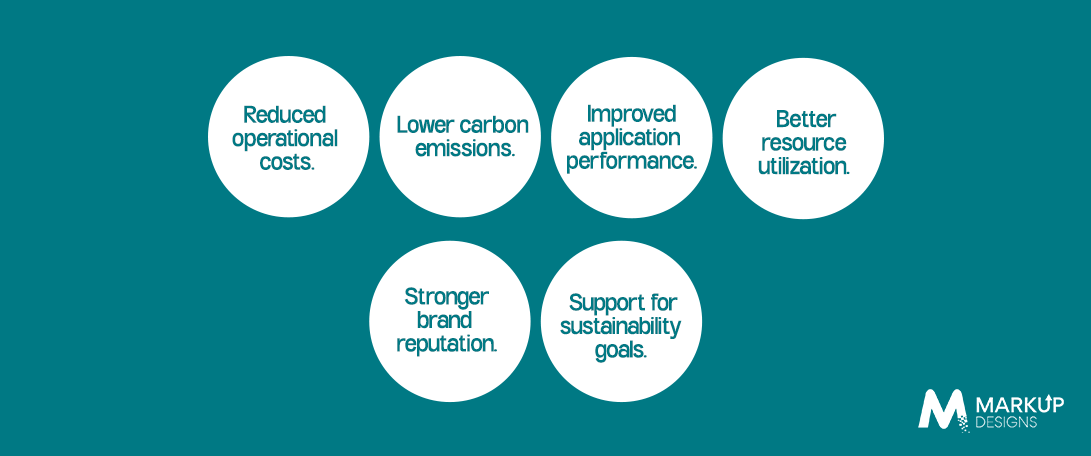
Apart from its ecological importance, green software development brings numerous practical benefits that can be used by any company. Below are the advantages businesses can benefit from green software development.
1. Reduced operational costs.
Green software development implies less usage of computing resources, thus allowing businesses to save money on cloud computing, power consumption, and infrastructure costs.
2. Lower carbon emissions.
Green software development helps to reduce the energy consumption of computing workloads and infrastructure, thus lowering the amount of carbon emissions.
3. Improved application performance.
As a result of optimization of code, infrastructure, and computing workloads, customers will be able to enjoy faster and more reliable applications.
4. Better resource utilization.
Green software development will allow companies to utilize CPU, RAM, storage space, and other infrastructure rather than pay for unused infrastructure services.
5. Stronger brand reputation.
In today’s world, many consumers prefer dealing with environmentally responsible organizations, so green technologies can provide your company with a competitive advantage.
6. Support for sustainability goals.
Green software development will allow businesses to integrate technology operations into sustainability strategies.
By adopting these practices, businesses can build software that supports both operational efficiency and environmental responsibility. It also creates opportunities to make technology investments more effective over the long term.
Challenges in Implementing Green Software Development
Although green software development offers several benefits, integrating this approach into existing systems and development processes can be quite problematic for companies. The following are some of the main challenges that can arise.
Difficult to Measure Software Emissions
One of the problems of quantifying the carbon emissions of software is the nature of the application’s operation via different servers, clouds, and other infrastructures.
Old Applications with High Technical Debt
Many companies have old applications that were created unsustainably, and thus, updating the applications requires additional effort.
Insufficient Awareness About Sustainability Practices
Green software development implies knowledge about many aspects, such as optimization of cloud services, calculation of carbon footprint, and others.
Balancing Performance, Costs, and Sustainability
Sustainability cannot negatively affect the performance and cost-effectiveness of applications, and thus it becomes rather difficult to balance all these elements.
Infrastructure and Cloud Services Problems
The migration of the application to new infrastructure and cloud services can be a complicated process.
To overcome these challenges, businesses should adopt a gradual approach. They can start by assessing existing applications, identifying resource-intensive areas, and implementing improvements based on their technical and business priorities. Working with an experienced software development partner can also help make the transition more manageable.
Green Software Development Tools and Measurement Frameworks
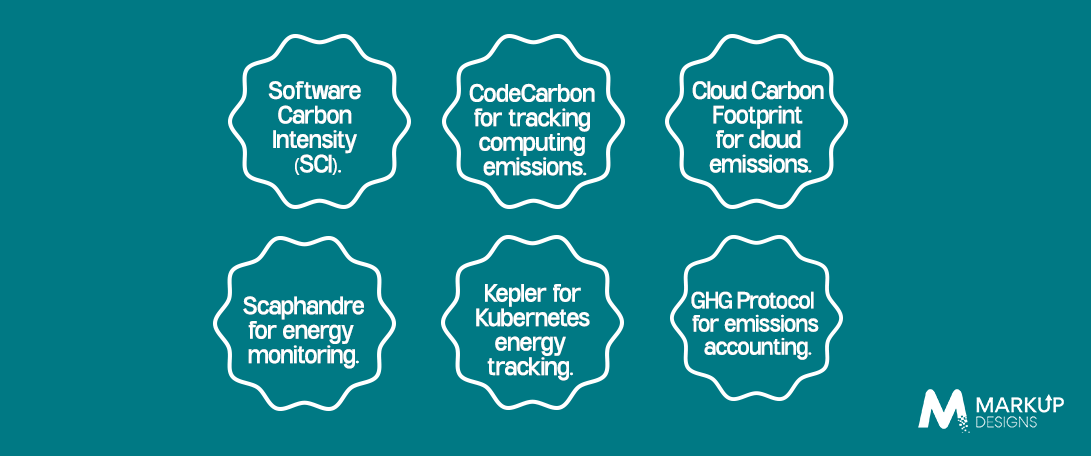
Environmental footprint measurement is another important part of green software development. Companies must have proper tools and frameworks that would enable them to measure the energy consumption and efficiency of their workload.
There is a variety of tools and frameworks to help developers and organizations measure the sustainability of their software.
1. Software Carbon Intensity (SCI).
This measurement framework is aimed at calculating the carbon emissions from the software application. This tool considers operational and embodied emissions of hardware.
2. CodeCarbon for tracking computing emissions.
CodeCarbon is an open-source project for measuring carbon emissions from computing workloads. This tool helps to see the environmental footprint of executing certain code or machine learning models, etc.
3. Cloud Carbon Footprint for cloud emissions.
Cloud Carbon Footprint is a tool to calculate the carbon emissions from cloud infrastructure. This tool has the ability to analyze the cloud resources and discover possible overconsumption.
4. Scaphandre for energy monitoring.
It is a power consumption monitor for the server that collects metrics regarding the server’s power consumption. It informs the technical team about the energy consumed by computing workloads.
5. Kepler for Kubernetes energy tracking.
Kepler (Kubernetes-based Efficient Power Level Exporter) is used to monitor energy consumption in Kubernetes applications. This tool allows understanding how containerized applications consume computing resources.
6. GHG Protocol for emissions accounting.
GHG Protocol is a framework that provides universally accepted standards and guidance that allow measuring and reporting greenhouse gas emissions. Businesses can use this framework for measuring their carbon footprint.
Businesses will be capable of defining their sustainability baseline, measuring resource usage, and evaluating the success of optimization using the frameworks highlighted above. However, one thing needs to be mentioned: some of the frameworks give information on how to measure energy and emissions, while the rest provide information on accounting.
How to Choose the Right Green Software Development Partner
The choice of the right development partner is essential when organizations aim to create sustainable digital products. A reputable development partner is able to recognize resource-heavy processes, choose the appropriate technologies, and develop software in accordance with your business and sustainability needs.
Here are a few factors to consider when selecting a development partner:
- Software Development Expertise
It is necessary to choose a partner who has knowledge of developing scalable software and enterprise software solutions that meet your requirements.
- Knowledge of Sustainable Development Strategies
Your development team must understand what energy-efficient coding, resource optimization, sustainable architecture, and carbon-aware computing mean.
- Cloud Infrastructure Expertise
A good development partner will have knowledge of working with cloud infrastructure, its optimization, autoscaling, and resource management.
- Emphasis on Performance and Efficiency
Consider how the partner develops applications in terms of their performance, database optimization, coding, and efficient use of computing resources.
- Monitoring and Measurement
Choose a development partner who will be capable of measuring application performance, resource utilization, and sustainability changes through the use of proper technologies.
- Maintenance, Monitoring, and Optimization
Sustainable software is always improved, and your development partner must offer you maintenance and optimization services for the further growth of your business.
Ultimately, a right development partner that understands that sustainable software development goes beyond resource optimization is the one you should go for.
Make Your Software More Sustainable with Markup Designs
Build software that supports your business growth while making efficient use of technology resources. Markup Designs helps businesses develop scalable, high-performing, and purpose-built software solutions aligned with their evolving needs.

Conclusion
Green software development has now become an integral component of the technology strategy. With the adoption of cloud computing, artificial intelligence, and digital software among other technological innovations, it has now become increasingly necessary for firms to consider energy consumption and other resource management practices.
Through sustainable software engineering practices, one can make sure that there is less resource wastage and improve software application performance while reducing costs and minimizing the impact on the environment.
From green coding to sustainable architecture, cloud computing, and carbon accounting, all development activities can help in designing sustainable software.
By 2026, businesses should look at sustainability together with performance, security, and scalability when planning for new software development activities. Collaboration with an experienced technology partner can help one identify the areas where improvements can be made.
The practice of green software development is not only good for the environment but also for developing reliable digital applications.
FAQs
1. What is green software development?
Green software development is a process of designing and building software that makes effective use of computing resources and reduces energy usage and impact on the environment.
2. How does green software development lower carbon emissions?
It cuts down the unnecessary use of computing resources, optimizes application code to use hardware efficiently, and promotes the use of eco-friendly cloud infrastructure.
3. What are the key principles of green software engineering?
The key principles are energy efficiency, hardware efficiency, carbon awareness, sustainable architecture, efficient data management, and lifecycle sustainability.
4. What are the tools that can be used for measurement of software carbon emissions?
Some of the popular tools include CodeCarbon, Cloud Carbon Footprint, Scaphandre, Kepler, and Software Carbon Intensity Specification.
5. How can businesses make their existing software sustainable?
Companies can make use of optimized application code, cut down unnecessary database requests, optimize cloud resource usage, remove redundant infrastructure, and measure energy consumption.
Author's Perspective
Green software development represents an important shift in how businesses approach technology. Software solutions should not only meet functional requirements but also use computing resources responsibly. From the initial architecture to ongoing maintenance, sustainability needs to be considered throughout the development lifecycle.
Businesses that prioritize efficient coding, optimized infrastructure, and continuous performance monitoring can build applications that are both scalable and resource-efficient. The focus should be on making smarter technology decisions that deliver long-term business value while reducing unnecessary environmental impact.
As digital adoption continues to grow, sustainable software engineering will play an increasingly important role in shaping the future of software development.
Discuss Your Project NowJupinder Singh Arora
Founder and CEO
Related Posts
Kotlin vs Scala: A Complete Comparison for Modern...
AI Scheduling Assistant for Healthcare: Development Process, Architecture,...
Government Software Development in Australia: How to Choose...
Insights Are Valuable & Execution is Priceless
You’ve read about the digital future. Now, let’s build the infrastructure to take you there. Move your strategy from the page to the product.
Design Your Solution Now
Contact Us
Schedule The Appointment At Your Convenience Date And Time.
30 Min
Web Conference
Time Zone
Indian standard time (08:30pm)

Thanks For Getting In Touch!
You’ve Taken The First Step Toward Transforming Your Digital Presence. Our Experts Will Reach Out Shortly To Take It Forward.
Launch Your Dream Project
Provide a brief overview of your project, and our specialists will evaluate your requirements. We will connect with you to explore how the right digital solutions can help you launch faster.