
In Brief
- Discover geopatriation and its importance in sovereign AI adoption in the Middle East region.
- Learn about the business motives behind localized AI infrastructure and data ownership.
- Determine which industries will benefit most from sovereign AI.
- Study the infrastructure, security, and regulatory needs for enterprise AI implementation.
- Learn about the strategies for implementation to control costs, risks, and scalability.
While businesses in the Middle East are moving forward with their adoption of AI, controlling where the data is stored, processed, and governed becomes increasingly important. The governments and enterprises in the UAE, Saudi Arabia, and the rest of the regional market are creating their localized cloud infrastructure, AI, and digital ecosystems in order to promote data sovereignty and to lessen the dependence on foreign technologies. Thus, geopatriation and sovereign AI have become increasingly important for businesses that process sensitive data in regulated industries.
The implementation of sovereign AI by enterprises is not limited to moving data to local servers. It includes AI workload assessment, choosing the right infrastructure, building governance controls, and meeting the relevant data protection regulations.
Companies will also need to juggle their regulatory compliance needs in relation to AI efficiency, operating costs, and scalability. This guide discusses the place of geopatriation, advantages of sovereign AI, challenges in implementing it, and methods of creating a reliable and sustainable enterprise AI framework in the Middle East.
What Is Geopatriation, and How Does It Relate to Sovereign AI?
Geopatriation is the process of moving computing workloads, applications, and data to IT infrastructures within a particular state or region in order to obtain more control over the management of data and computing processes. In the case of sovereign AI, geopatriation can be helpful for businesses when controlling which AI models process the data and how sensitive it is managed.
Understanding Geopatriation in Enterprise Technology
Geopatriation is the process of transferring workloads from outside into the local IT infrastructure. Enterprises use this method for complying with regulations and minimizing jurisdictional risks, among other reasons.
Sovereign AI vs. Data Residency and Sovereign Cloud
Data residency deals with information storage, whereas sovereign cloud emphasizes the infrastructure, control, and regulatory aspects. The concept of sovereign AI is an extension of these aspects to include AI models, data training, inference, and governance processes.
Why Geopatriation Matters for Middle Eastern Enterprises
Organizations operating in the Middle East have been building local digital infrastructure as part of their national AI aspirations and protection of sensitive information. Geopatriation will assist in matching the requirements of AI operations in the region, as well as ensuring more control over business data.
Why Are Middle Eastern Enterprises Investing in Sovereign AI?
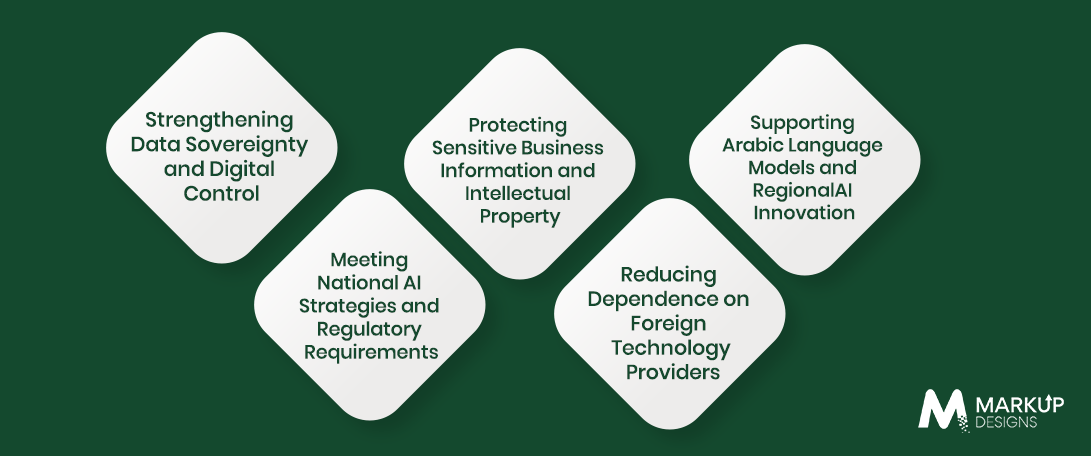
Sovereign AI allows for the deployment of AI systems with more control over data, infrastructure, and governance. Across the Middle East, the increasing adoption of AI and national digital transformation strategies are leading to the necessity for locally governed AI ecosystems.
Strengthening Data Sovereignty and Digital Control
By having local infrastructure in place, organizations can monitor more thoroughly the processing and access of sensitive information. It is especially relevant for companies with confidential customer information or core business processes.
Meeting National AI Strategies and Regulatory Requirements
The governments in the region are paying particular attention to developing AI capabilities and digital infrastructure. Sovereign AI can help enterprises comply with national regulations and policies and industry standards and requirements.
Protecting Sensitive Business Information and Intellectual Property
Locally managed AI infrastructures can decrease the chances of exposing proprietary data, company documents, and business processes. Access control and encryption can additionally contribute to protecting proprietary data from breaches.
Reducing Dependence on Foreign Technology Providers
While Sovereign AI allows for greater freedom in choosing infrastructure, models, and service providers, the dependency reduction can only be achieved through proper planning, considering proprietary platforms, licensing, and technology portability.
Supporting Arabic Language Models and Regional AI Innovation
The regional AI development initiatives can promote models designed specifically for Arabic language variations and specific business environments. This way, regional AI initiatives can enhance the relevance of AI applications in customer service, government services, and other business processes.
Which Industries in the Middle East Need Sovereign AI the Most?

Sectors that deal with sensitive data or critical infrastructure or face high regulatory compliance needs, need Sovereign AI the most. The degree of sovereignty depends on data classification and business needs of enterprises.
Governments and Public Services
Government departments maintain citizen data, data about public services provided, and other sensitive administrative data. Locally governed AI can help in providing AI-based applications related to citizen services, document processing, and internal functioning of the department.
Banking and Financial Services
Banks and other financial institutions use customer data and transaction data. Locally governed AI can help in improving governance of the data and taking control over AI-based fraud detection and risk assessment.
Healthcare and Life Sciences
The healthcare sector maintains patient records, clinical data, and research data. Locally governed AI environments can be used for carrying out work in medical administration and research while maintaining adequate privacy controls.
Energy, Oil, and Gas
Oil and gas companies depend on data about their operations, industrial systems, and commercial data. Locally governed AI can be used for carrying out functions like predictive maintenance and asset monitoring.
Telecommunications and Critical Infrastructure
Telecommunication companies keep network data and data about the communications infrastructure. Locally governed AI can help in network management and anomaly detection.
What Are the Key Components of a Sovereign AI Infrastructure?
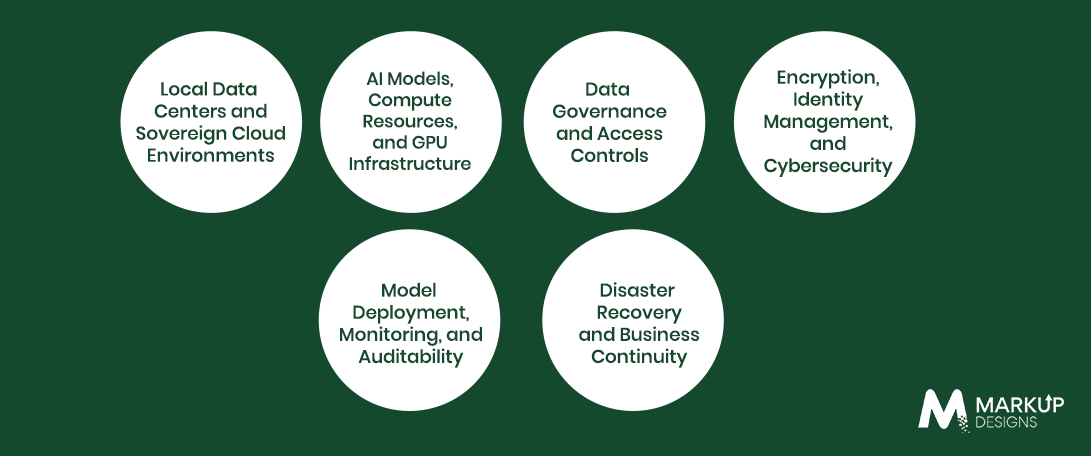
An AI-enabled sovereign environment is the combination of infrastructure, governance, security, and operations that will be used to control AI workloads within certain jurisdictional constraints. All the components need to be analyzed to see if local hosting means effective control.
Local Data Centers and Sovereign Cloud Environments
Locally-hosted infrastructure can be helpful in meeting data residency needs and avoiding cross-border transfers. Enterprises should analyze who controls the infrastructure, who administers the infrastructure, and what additional services are involved.
AI Models, Compute Resources, and GPU Infrastructure
AI workloads demand adequate computing resources and GPU infrastructure. Companies should find the right balance between performance, availability, price, and control when choosing local infrastructure or regional cloud services.
Data Governance and Access Controls
Data governance defines what type of data is kept where, how it is stored, how it is used, and how it is accessed by AI applications. Role-based access control and clear ownership principles can limit the risks associated with data misuse.
Encryption, Identity Management, and Cybersecurity
Encryption, identity management, and privileged-access management can help to secure the data and workloads. Vulnerability management, continuous monitoring, and incident response are also recommended.
Model Deployment, Monitoring, and Auditability
Organizations require visibility into models, versioning, data access, outputs, and performance. Audit logs and monitoring tools assist in incident investigations and risk assessment.
Disaster Recovery and Business Continuity
The local infrastructure needs to be dependable when there is a power outage or an incident. Disaster recovery and business continuity solutions will assist in keeping AI systems operational during disruptions.
How Do UAE and Saudi Arabian Regulations Influence Sovereign AI Adoption?
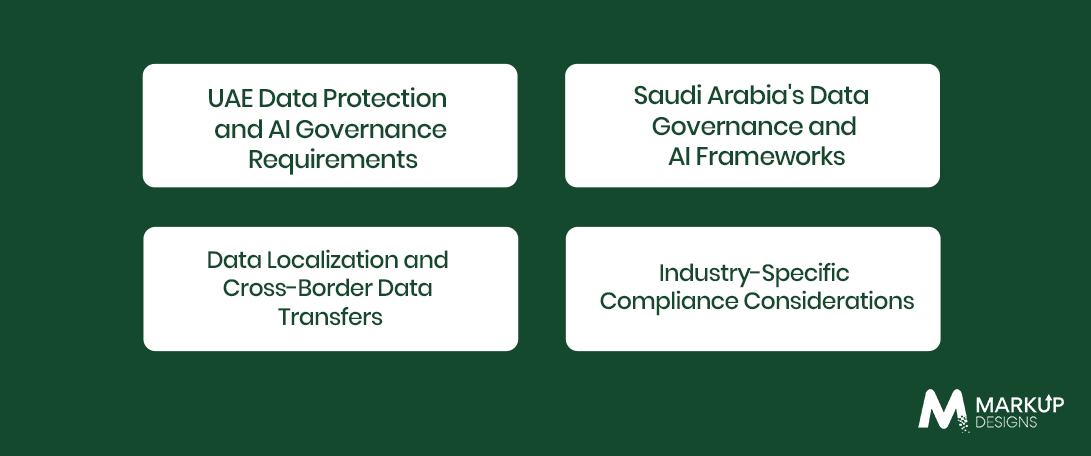
Regulations impact where data is processed, how it must be secured, and what controls need to be in place. Enterprises should take stock of the regulatory requirements relevant to the industry and the business operations instead of assuming that data must always be kept domestically.
UAE Data Protection and AI Governance Requirements
Enterprises in the UAE should assess any data protection obligations under Federal Decree-Law No. 45 of 2021 on Personal Data Protection as well as free zone and sector-specific requirements.
Saudi Arabia’s Data Governance and AI Frameworks
Saudi enterprises should consider the Personal Data Protection Law (PDPL), its implementing regulations, and relevant National Data Management Office and National Cybersecurity Authority requirements. Applicable obligations vary according to the organization, data category, and sector.
Data Localization and Cross-Border Data Transfers
Some data categories and regulated workloads may be subject to localization or specific transfer conditions. Enterprises should classify their data and verify applicable restrictions before deciding where AI processing and storage should occur.
Industry-Specific Compliance Considerations
Banking, healthcare, government, and critical infrastructure may face additional requirements beyond general data protection laws. Compliance teams should review sector-specific rules before approving a sovereign AI architecture.
How Can Enterprises Implement Geopatriation and Sovereign AI?
A phased approach will make it easier to understand workloads, requirements, and obligations. Successful implementation also depends on a proper understanding of the existing environment and priorities.
Assess Existing AI Workloads and Data Sensitivity
Inventory existing AI systems, data sets, and third-party tools. Categorize workloads based on sensitivity, business importance, and regulatory implications to determine which ones need better sovereignty measures.
Identify Requirements for Data Residency and Jurisdiction
Figure out where your data is stored, processed, and accessed by you and third parties. Determine jurisdictional and legal requirements that impact data residency before choosing the deployment approach.
Select the Appropriate Sovereign AI Deployment Approach
Look at the local data centers, sovereign clouds, private infrastructure, or even hybrid options. The appropriate option will depend on control needs, resource availability, budget, and security.
Migrate Data, Models, and Workloads Effectively
Begin with the most important workloads and validate migration procedures. Test data, models, access, and application compatibility when moving to new environments.
Integrate Sovereign AI Environment into Enterprise Systems
Connect sovereign AI environments with existing enterprise software applications, databases, and other platforms. Proper integration of APIs and data will provide functionality without compromising governance.
Establish Governance, Monitoring, and Risk Management
Clarify definitions of ownership, access rights, model approval, and response to incidents. Continual monitoring will allow detection of policy violations and management of emerging risks.
Measure Performance and Optimize Infrastructure
Monitor infrastructure utilization, inference latency, costs, and model performance once deployed. Use the results to optimize resource allocation and decide on whether additional workloads should be migrated.
What Challenges Do Enterprises Face When Adopting Sovereign AI?
Enterprise sovereignty with AI will enhance control over critical workloads; however, there are several financial, technical, and operational trade-offs associated with it. Organizations should analyze them before making unnecessary investments in infrastructure or migrations.
High Infrastructure and Compute Costs
Deployment of the local AI infrastructure will require considerable investments in GPUs, storage, networking, and security. Cloud or hybrid solutions can mitigate these costs depending on the needs of the organization.
Limited Access to Specialized AI Talents
Deploying sovereign AI will require qualified engineers in AI, infrastructure management, cybersecurity, and governance. Organizations may need to invest in training or partner with experienced providers to address skills gaps.
Integration With Existing Enterprise Systems
Old systems might depend on third-party cloud services or proprietary technologies that cannot be easily moved. Compatibility analysis and migration in stages might ease the transition and re-development process.
Finding Balance Between Data Control and AI Performance
On-premises solutions may give better jurisdictional control, but differences might exist in compute power, latency, and model availability. Enterprises should benchmark the workload in order to understand if their selected environment provides required performance.
Vendor Lock-In and Technology Dependence
Dependence on proprietary models, proprietary hardware, and cloud platforms limits future opportunities. Use of open standards, modular architectures, and a clear exit strategy might mitigate migration risks.
Scaling of AI Infrastructure Across Different Markets
Companies operating in the Middle East region might have different legal requirements and infrastructures in each country. A modular approach will allow them to meet local requirements without implementing all systems twice.
How Can Businesses Measure the ROI of Sovereign AI Investments?
Investments in sovereign AI should be measured by both the bottom line and added control over the organization and data. A proper ROI assessment should take into account operating costs, risk reduction, productivity, and flexibility.
Infrastructure Costs and Operational Efficiency
Costs of hosting, utilization rates, maintenance expenses, and operational efficiencies relative to the current environment will help to determine whether the chosen approach is financially feasible.
Regulatory Risk Reduction
Improved coverage by regulations, audits, and enforcement of data handling policies will be a result of sovereignty controls. This improvement may generate business value, but it cannot be considered guaranteed savings.
Data Security and Intellectual Property Protection
Access control efficiency, number of security events, and security of proprietary data and models will help to determine whether sovereignty controls mitigate material risks related to exposure of data.
AI Performance and Business Productivity
Inference latency, accuracy of models, time to process data, and other improvements in productivity that are enabled by sovereign AI will help to determine whether sovereignty controls improve business outcomes.
Long-Term Technology Independence
The ease of workload portability, enterprise’s control over its models, and dependence on a particular vendor for services will determine the level of technology independence enabled by sovereignty controls.
How Can Enterprises Choose the Right Sovereign AI Development Partner in the Middle East?
Selecting an AI development partner involves evaluating more than just technical skills. Companies need to select partners who understand the regional requirements, can provide protection of sensitive workloads, and have the skills to develop maintainable AI services and solutions.
Evaluate AI Engineering and Infrastructure Expertise
The partner should have experience developing AI models, understanding cloud architecture, GPU infrastructure, and deploying solutions within enterprises. The technical skills they have should meet your workload requirements and performance expectations.
Assess Regional Regulatory Knowledge
Your selected partner should have some understanding of data protection laws and other sector-specific regulations in jurisdictions such as the UAE and Saudi Arabia. This will help you to plan architectures and data flow processes according to compliance requirements.
Review Security and Governance Capabilities
Your partner should have experience with encryption, identity management, access controls, model monitoring, and auditing. Good governance is needed to ensure that your sensitive information remains protected and that there is accountability for the AI process.
Check Integration and Migration Experience
The partner must be able to integrate sovereign AI into current systems. A proven track record of successful migrations and workload testing may help to minimize the disruption in operations and avoid redevelopment altogether.
Compare Scalability, Support, and Total Cost of Ownership
It is important to compare the cost of infrastructure, licensing, maintenance, support, and future scalability, rather than focusing exclusively on the price of development. A plan for scaling workloads and limiting dependence on proprietary technologies should be provided by the partner.
How can Markup Designs Assist Enterprises with Sovereign AI Implementation in the Middle East?
Markup Designs assists enterprises in planning and implementing their own AI solutions to meet their needs, taking into account the company’s specific governance needs and technological aspirations. From planning the architecture and integrating AI to software development, the emphasis should be on creating the right solution for the business needs.
Build Your Sovereign AI Strategy With Confidence
Protect sensitive data, strengthen AI governance, and develop scalable AI solutions aligned with your business and regional requirements. Partner with Markup Designs to plan your sovereign AI journey.

Conclusion
Geopatriation and sovereign AI provide businesses operating in the Middle East region with better control over data, AI workloads, and infrastructure technology. Nevertheless, to implement these technologies, businesses need to do much more than just host them locally. They will have to ensure that their architecture complies with existing regulations, build security and governance controls, and analyze performance and total ownership costs. A phased deployment plan can be helpful for that purpose.
FAQ
1. What is geopatriation in AI?
Geopatriation is moving data, applications, and AI workloads to infrastructure that operates in a particular country or jurisdiction. In this way, companies gain control over data handling processes, comply with all relevant regulations, and limit themselves from risks associated with other jurisdictions.
2. What is the difference between sovereign AI and sovereign cloud?
While sovereign cloud deals with infrastructure, data governance, and operational control within specified jurisdictional borders, sovereign AI adds AI models, training data, inference computing, and AI model governance to this list.
3. Why is sovereign AI important for businesses in the Middle East?
With the help of sovereign AI, Middle Eastern businesses can protect sensitive data, follow regulations, and control all operations related to AI.
4. Is it mandatory for sovereign AI to store all data inside the borders of a particular country?
No. It depends on the specific regulations that should be considered. Enterprises have to consider all the rules related to the cross-border transfers of data and all risks associated with the specific workload in question in order to identify which types of data and AI-related activities should be stored locally.
5. How much does the adoption of sovereign AI cost?
The costs differ depending on the choice of infrastructure, GPU demands, complexity of the model, security requirements, etc. The use of the existing sovereign cloud could help to save money on infrastructure, but the operation of the dedicated infrastructure is rather expensive.
Author's Perspective
Sovereign AI needs to be seen as a strategy rather than an infrastructure solution, and enterprises need to find out what workloads require sovereignty in the first place, and only then choose the architecture that would satisfy all the requirements and provide decent AI performance at an affordable cost.
Discuss Your Project NowGaurav Goyal
Global Sales- VP
Related Posts

Build vs Buy RAG Solutions: Choosing the Right...
How AI is Revolutionising Industrial Automation in Australia

How UK Enterprises Can Build an Effective AI...
Insights Are Valuable & Execution is Priceless
You’ve read about the digital future. Now, let’s build the infrastructure to take you there. Move your strategy from the page to the product.
Design Your Solution Now
Contact Us
Schedule The Appointment At Your Convenience Date And Time.
30 Min
Web Conference
Time Zone
Indian standard time (08:30pm)

Thanks For Getting In Touch!
You’ve Taken The First Step Toward Transforming Your Digital Presence. Our Experts Will Reach Out Shortly To Take It Forward.
Launch Your Dream Project
Provide a brief overview of your project, and our specialists will evaluate your requirements. We will connect with you to explore how the right digital solutions can help you launch faster.