

In Brief
- Digital transformation is not just about adopting new technology but, it is about redesigning how a business operates, delivers value, and adapts to change. .
- Many transformation initiatives fail because organizations focus on software implementation instead of solving operational and strategic problems .
- The real challenge lies in the absence of a clear structure that connects business goals with digital execution.
- Without a defined roadmap, companies often experience slow decision-making, inefficiencies, and declining competitive advantage.
- Most transformation efforts fail before they begin due to lack of alignment between strategy, technology, and execution planning.
- Organizations often prioritize buying tools over understanding real business problems, which leads to wasted investments.
- A successful digital transformation roadmap connects business goals, technology investments, people, and execution planning.
- A horizon-based approach helps businesses deliver continuous value instead of waiting for a single large transformation outcome.
Let’s begin with a simple reality.
Digital transformation is no longer optional for enterprises trying to stay competitive. Organizations today are under pressure to make faster decisions, improve operational efficiency, and deliver connected customer experiences all while managing rising complexity across systems, teams, and data .
The difference isn’t always visible in products or pricing. It lies deeper-in the underlying infrastructure. The kind that enables faster decisions, real-time adjustments, and systems that respond without constant manual intervention, all guided by a clear digital transformation roadmap.
When that layer is missing, experience and instinct alone stop being enough. No matter how strong the foundation once was, the gap begins to widen-not suddenly, but steadily.
And that’s the real shift.
In today’s environment, advantage doesn’t just come from what you offer. It comes from how quickly you can adapt, decide, and execute. Without a clear and structured digital transformation strategy, even established systems start falling behind-not because they fail overnight, but because they can’t keep up anymore.
Why Most Transformation Efforts Fail Before They Begin
This situation is more common than many businesses realize. The real issue is usually not the lack of effort or investment, but the absence of a clear structure for making decisions and managing systems effectively.
Many companies invest in new platforms, hire consultants, and launch digital transformation initiatives expecting quick results. However, without proper planning and alignment, they often end up with disconnected tools, increased costs, operational confusion, and frustrated employees after months of implementation.
The numbers are not kind
- 70% of digital transformation initiatives fail to achieve their stated goal, according to research spanning hundreds of enterprise programs
- $2.3 trillion is spent globally on digital transformation annually – with a significant portion delivering no measurable business outcome
- Only 14% of companies report sustain long term performance improvements from digital transformation initiatives, highlighting execution and governance gaps.
- 3 out of 5 transformation efforts stall within the first year due to misalignment between technology deployment and business strategy
These are not failures of technology because digital transformation frameworks and platforms already work, and the tools and talent required can be easily accessed.
The roadmap doesn’t guarantee transformation. But the absence of one almost always guarantees failure. .
Digital Transformation Roadmap
A real digital strategy roadmap is not a Gantt chart. It is not a technology stack list. It is not the IT department’s responsibility to own alone.
It is a living strategic document, one that connects specific business outcomes to specific digital decisions, assigns ownership across the organization, defines the conditions under which priorities shift, and provides the governance infrastructure to keep execution honest.
It answers four questions that most roadmaps never ask – Where are we now? Where do we need to be? What decisions get us there? And who is accountable when we drift?
When it works well, it brings clarity across the organization. Teams are not just reacting to problems as they appear-they start seeing how their actions connect to a larger direction.
But the problem starts when the roadmap is treated like an end goal.
As we’ve seen, the real challenge isn’t reaching a fixed destination. It’s about creating a system that keeps improving, adapting, and responding as things change. When that mindset is missing, the same issues don’t disappear-they just come back in different forms.
“A roadmap without business outcomes attached to every milestone is just a to-do list with better fonts.”
The myth worth killing immediately is not an IT project with a business sponsor. It is a business project that IT enables. The moment technology ownership substitutes for strategic ownership, the roadmap becomes a technical exercise – and technical exercises don’t move market share.
Read Also: Know the Evolution of AI Enterprise Digital Transformationz
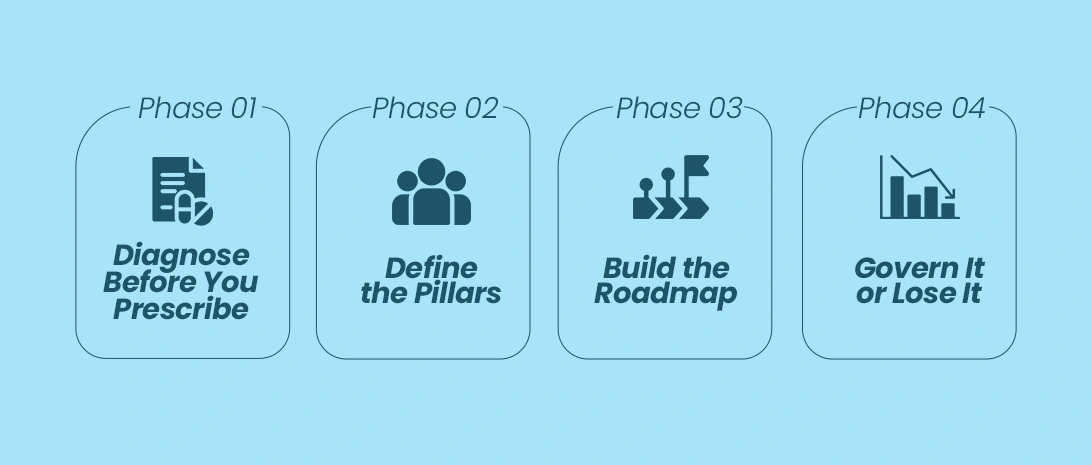
Phase 1 – Diagnose Before You Prescribe
This is exactly where the shift begins in the scenario we just discussed. Instead of focusing on technology, the real question is where is the system actually breaking? Without that clarity, decisions stay reactive-and as we’ve seen, the issue isn’t missing tools, but not understanding what truly needs to be fixed.
The question wasn’t “what technology do we need?” The question was “where are we actually broken?”
The diagnosis covered four domains
People–
Where is decision-making bottlenecked? Where is institutional knowledge held by individuals rather than systems? Where is the organization’s relationship with data still rooted in instinct rather than evidence?
Processes–
Which workflows are manual by legacy rather than design? Where does information change hands without being captured? Which approval chains exist because of org chart politics rather than risk management?
Data maturity-
What data do we have, where does it live, who can access it, and what decisions is it currently informing? Critically – what decisions should it be informing that it isn’t?
Customer experience gaps-
Where are customers absorbing friction that they don’t yet complain about but will eventually leave because of?
Phase 2 – Define the Pillars of Your Digital Strategy Roadmap
Once the diagnosis is complete, the digital strategy roadmap is structured around four interconnected pillars. These are not departmental swim lanes. They are strategic dimensions that must move together.
Customer Experience How digital capability changes the way customers discover, purchase, receive, and advocate for your product or service. This pillar captures everything from interface and personalization to fulfillment and loyalty. It is the pillar most visible to revenue.
Operations How digital tools change the efficiency, accuracy, and adaptability of internal processes – supply chain, logistics, finance, HR, procurement. This is where cost transformation happens.
Data & Intelligence How the organization collects, connects, and activates data across functions. This pillar is the infrastructure beneath the other three. A company can have excellent customer experience initiatives and strong operational tools – and still be flying blind if data is siloed, inconsistent, or inaccessible to decision-makers.
Culture & Talent How the organization builds the human capacity to operate in a digitally mature environment. Technology deployments fail at roughly double the rate when this pillar is ignored. New systems require new behaviors. New behaviors require new skills, new incentives, and new leadership expectations.
“Most companies fail at transformation not because they lacked technology, but because they optimized one pillar and left the other three untouched.”
The roadmap must show how investments in each pillar connect. Where they reinforce each other, and where neglecting one creates drag on the others.
Read Also: How to Select he Right Digital Transformation Framework for Your Organization
Phase 3 – Build the Roadmap in Horizons, Not Just Phases
The linear transformation plan assumes that the business waits for the plan to be completed. The business does not. The market changes, leaders change, and competitors change. Once the plan falls out of step with reality, as often happens within the first six months, the linear transformation plan is outdated.
The Horizon Model replaces sequential phases with parallel, overlapping priorities
Horizon 1 (0–6 months) Stabilize and Digitize
- Eliminate the highest-friction manual processes
- Establish data visibility where it is currently absent
- Deploy foundational tools that reduce operational risk
- Build internal credibility by delivering measurable early wins
Horizon 2 (6–18 months) Integrate and Automate
- Connect systems that currently operate in silos
- Build automation into repeatable, high-volume workflows
- Begin developing predictive capability from clean data
- Align incentive structures to digital performance metrics
Horizon 3 (18–36 months) Innovate and Scale
- Launch capabilities that would not have been possible without Horizon 1 and 2 infrastructure
- Move from operational efficiency to competitive differentiation
- Embed data-driven decision-making at the frontline, not just the executive layer
- Begin monetizing digital assets and capabilities
Read Also Digital Transformation Framework for Enterprise Growth
Phase 4 – Govern It or Lose It
Governance is the most skipped step in enterprise transformation. It is also the step that determines whether a roadmap remains a living strategy or becomes an archived slide deck.
The digital transformation roadmap isn’t owned by one team alone. It can’t sit only with technology or a single function.
As the story reflects, the gaps aren’t isolated-they run across how the entire business operates. Which is why ownership has to be shared. Every function that influences decisions, speed, and execution needs to be aligned and accountable for making it work.
The governance cadence matters as much as the governance structure. Quarterly reviews tied to business outcomes – not technology milestones – keep the roadmap calibrated to reality. The question in each review is not “did we deploy the platform?” It is “did the platform change the metric we deployed it to change?”
Over time, the shift becomes visible-not as a dramatic transformation, but as steady, measurable progress.
The gap may not disappear immediately, but it stops widening. Operational inefficiencies begin to reduce, and processes become more streamlined. With better data visibility, decisions are no longer based on assumptions but on real insights. As a result, areas like cost control and customer retention start to improve in a tangible way.
And with that shift, conversations change too. Decisions are no longer driven by assumptions or intent, but by clarity and data.
Enterprise digital transformation at this stage is no longer a project. It is a management discipline. The roadmap is reviewed, adjusted, and defended in the same room where the business is governed. That proximity is not accidental. That is the point.
The Hidden Cost of Having No Roadmap
Let’s close the loop on what we’ve been seeing throughout.
The gap wasn’t created because of better technology. In most cases, the tools available are similar-cloud systems, automation capabilities, and data platforms. The difference lies in how clearly and consistently those tools are aligned with business outcomes.
What actually changes the trajectory is clarity. When every decision, especially around technology, is tied to a defined direction, progress becomes more intentional. Priorities become clearer, resources are used more effectively, and teams understand not just what they are doing, but why it matters.
That’s what creates speed. Not more tools, not more complexity-but a clearer path that the entire organization can move on together.
The cost of not having a digital transformation roadmap isn’t always obvious at first-but over time, it builds up and can turn into serious problems. They accumulate quietly
- Talent Leaves
Engineers and analysts who have better opportunities often choose organizations where digital growth is backed by clear action. As skilled talent leaves, the company’s ability to innovate and compete also starts weakening. - Customers Migrate
Customers do not leave all at once. They gradually move toward businesses that offer faster, easier, and more transparent experiences – often without even informing the company. - Stakeholder Confidence Weakens
Scattered initiatives often lead to inconsistent results. After repeated missed expectations, discussions slowly shift from long-term strategy to questions around leadership and execution.
“Your competitor’s advantage is not their technology. It is the fact that they know exactly what they’re building, and you’re still deciding.”
The absence of a roadmap is not a neutral condition. It is an active choice to remain reactive while others build the infrastructure to be deliberate.
The Binary That Matters
Right now, one of two things is true about your organization.
Path A You have an active and governed transformation roadmap that is goal-driven. You know the four pillars and what is being built under each one of the three horizons. Your key performance indicators are linked to business goals, not to technology implementation. You know where you are heading, and you are able to back up your decision with the relevant data.
Path B You have good intentions. You have technology vendors. You have a transformation narrative that has been Powerpointed many times. You have scattered initiatives running in parallel with limited coordination and no governing mechanism to course-correct when they diverge. And somewhere, a competitor running months further down the road, compounding the advantage you are still waiting to claim.
If your transformation strategy lives in this deck and nowhere else, you don’t have a strategy. You have a wish.
The roadmap doesn’t guarantee transformation. But the absence of one almost always guarantees failure.
Conclusion
Transformation doesn’t announce itself. It compounds – quietly, relentlessly – in the organizations disciplined enough to plan it and govern it over time. The companies winning today didn’t start with better technology. They started with a clearer picture of where they were going and built the infrastructure to get there systematically. That clarity is available to any organization willing to do the harder work of diagnosis, alignment, and accountability. The question was never whether to transform. The question is whether you’re building toward something deliberate – or waiting for the next quarterly review to show you what you’ve already lost.
FAQs
1. What is a digital transformation roadmap?
It is a structured plan that connects business goals with digital initiatives to ensure organized and measurable transformation.
2. Why do most digital transformation projects fail?
They fail due to unclear strategy, lack of alignment between business and IT, poor execution planning, and weak governance.
3. Is digital transformation only about technology?
No, it includes people, processes, data, culture, and technology working together toward business outcomes.
4. How long does digital transformation take?
It varies, but most enterprises see structured transformation over 12–36 months using phased or horizon-based approaches.
5. What makes a transformation roadmap successful?
Clear business outcomes, strong leadership alignment, continuous governance, and measurable KPIs make it successful.

Author's Perspective
Digital transformation is often seen as just a technology upgrade, but in reality, it is a complete business redesign. Many companies focus on tools while ignoring the structure needed to make them work effectively. Success depends less on how much technology is adopted and more on having clear direction and execution. A roadmap provides that clarity, helping businesses focus on outcomes, accountability, and long-term adaptability, turning transformation into measurable and consistent progress.
Discuss Your Project NowGaurav Goyal
Global Sales- VP
Related Posts

Why Businesses in Oman Need Digital Transformation Services

Digital Transformation in Financial Services: Trends, Benefits &...

IoT in Banking: Transforming Financial Services Through Connected...
Insights Are Valuable & Execution is Priceless
You’ve read about the digital future. Now, let’s build the infrastructure to take you there. Move your strategy from the page to the product.
Design Your Solution Now
Contact Us
Schedule The Appointment At Your Convenience Date And Time.
30 Min
Web Conference
Time Zone
Indian standard time (08:30pm)

Thanks For Getting In Touch!
You’ve Taken The First Step Toward Transforming Your Digital Presence. Our Experts Will Reach Out Shortly To Take It Forward.
Launch Your Dream Project
Provide a brief overview of your project, and our specialists will evaluate your requirements. We will connect with you to explore how the right digital solutions can help you launch faster.