

In Brief
- Startups focusing on AI agents are offering new opportunities by streamlining processes, increasing productivity, and providing personalized services.
- Entrepreneurs can benefit from researching AI agent concepts within the healthcare, finance, marketing, education, e-commerce, real estate, and professional services sectors.
- A good startup concept should solve a particular problem, show the presence of the market need, and provide the clients with measurable value.
- AI agents can generate profits through subscription, pay-as-you-go pricing, company licensing, and integration services.
- When building an AI agent startup, you need to plan every step properly, use appropriate AI algorithms, ensure strong data protection, and continuously improve the solutions.
AI is altering the way companies work by improving existing automation approaches to a situation where systems know what they need to do, can retrieve information, make decisions, and perform tasks. Regardless of what’s being done, be it replying to clients or assisting professionals in finance and healthcare and more, AI agents are creating many new perspectives for future entrepreneurs in 2026.
Nevertheless, a successful AI agent startup entails more than just taking advantage of contemporary technology. Company leaders should look for actual market gaps, determine customer demands, and design solutions that yield tangible business advantages. In this guide, we present more than 30 examples of innovative AI agent startup ideas in different industries, together with potential revenue streams, development costs, and important factors to keep in mind when trying to transform an idea into a business.
What Are AI Agent Startups?
AI agent startups are commercial organizations that create and provide AI-driven systems capable of performing tasks, making decisions, and achieving specified goals under different levels of human supervision. Unlike standard software that follows simple instructions, AI agents can analyze data, plan actions, utilize tools installed at the site, and adjust their statements based on a task and ECO (Environmental Consciousness Indicator).
These startups can help companies automate the processes that have grown repetitive, enhance overall operational effectiveness, and ensure personalized service to customers. Such a business opportunity lies in tackling an explicitly stated issue rather than putting AI in a well-established product or service.
Startups that combine reliable agent capabilities with relevant industry knowledge, secure integrations, and a sustainable pricing model are better positioned to create long-term value.
Why Are AI Agent Startups Gaining Momentum in 2026?
The growing ability of AI agents to carry out increasingly sophisticated activities is giving rise to fresh possibilities for entrepreneurs interested in starting businesses that offer intelligent automation solutions. AI agent startups produce technologies capable of perceiving objectives, interpreting data, making decisions, and completing actions with enough input from human agents.
Such startups can be employed in various industries such as the medical sector, finance, marketing, education, and e-commerce because they offer solutions to industry-specific operational problems. For entrepreneurs, the opportunity is to offer trustworthy and industry-focused technology that will address clients’ real needs, work with current technologies, and provide tangible business benefits.
30+ Innovative AI Agent Startup Ideas for Entrepreneurs in 2026
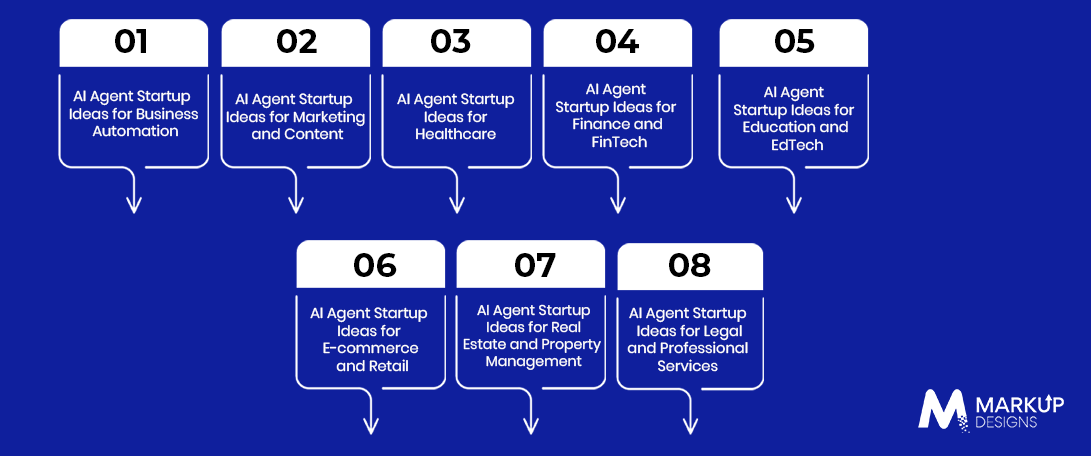
Startups based on AI agents offer entrepreneurs a chance to access different sectors due to the automation of repetitive tasks, enhanced decision-making, and an improved customer experience.
AI Agent Startups for Business Automation
AI business automation suggests new possibilities for creating AI agents aimed at minimizing human work and facilitating the operation of companies.
- AI Customer Support Agent: Resolves common customer queries, answers questions immediately, and defers complex inquiries to a human agent.
- AI Sales Development Agent: Searches for potential customers, tailors communication according to customers’ needs, and organizes appointments with clients.
- AI Lead Generation and Qualification Agent: Detects leads and assesses prospects according to established criteria.
- AI Email Management Agent: Sorts inboxes, prioritizes key communications, develops replies, and monitors follow-ups.
- AI Workflow Automation Agent: Links systems and facilitates repetitive jobs across platforms.
AI Agent Startup Ideas for Marketing and Content
Marketing AI agents can assist enterprises in creating content, interpreting target audiences, and measuring campaign effectiveness without increasing physical burden.
- AI Social Media Management Agent: Prepares content schedules, publishes material, and assesses interaction on social media.
- AI Content Creation and Optimization Agent: Drafts texts and gives advice regarding improvements based on intent and audience requirements.
- AI SEO Research Agent: Detects keyword opportunities and analyzes competitors’ work.
- AI Personalized Email Marketing Agent: Creates specific campaigns and follow-up messages in light of customers’ experiences.
- AI Advertising Campaign Optimization Agent: Monitors ad results and proposes adjustments to targeting, bidding, and budget allocation.
AI Agent Startup Ideas for Healthcare
Healthcare AI agents can deal with admin issues in addition to maintaining communication with patients and allowing clinical decisions to remain supervised by appropriate specialists.
- AI Medical Appointment Scheduling Agent: Responsible for handling appointments, rescheduling, cancellations, and providing reminders.
- AI Patient Engagement Agent: Sends follow-up messages, communicates approved medical instructions, and responds to general administrative questions.
- AI Healthcare Documentation Agent: Translates clinical discussions into structured notes for healthcare professionals’ use.
- AI Mental Wellness Support Agent: Provides relaxation exercises, mood tracking, and general counseling services while keeping necessary precautions.
- AI Healthcare Claims Processing Agent: Checks claims documents for missing elements, highlights discrepancies, and helps with claims processing.
AI Agent Startup Ideas for Finance and FinTech
The financial industry provides suitable grounds for launching AI agents that will collect financial information, accelerate the process of transactions, and indicate any risks.
- AI Personal Finance Management Tool: Monitors expenses, organizes transactions by category, and helps the person with budgeting and saving goals.
- AI Expense Tracking and Reporting Tool: Collects information from receipts, organizes expenditures, and prepares reports for individuals and companies.
- AI Financial Fraud Detection Tool: Detects transactions that do not fit the behavioral framework and alerts about them.
- AI Invoice and Payment Processing Tool: Collects the data from the invoice and monitors deadlines for payments.
- AI Financial Research Agent: Summarizes financial reports, compares company performance, and organizes market information for analysis.
AI Agent Startup Ideas for Education and EdTech
AI agents designed for education can assist educational institutions with customized educational processes, minimizing the amount of administrative workload, and helping students in after-class hours.
- AI Personalized Learning Agent: Recommends the appropriate educational materials and exercises according to the learners’ current level of knowledge and learning achievements.
- AI Virtual Tutor Agent: Gives details about subject issues, answers questions, and suggests practice.
- AI Student Assessment Agent: Can help grade objective tests and find problems the students experience.
- AI Course Development Agent: Can help the teacher prepare lesson plans, test papers, and educational materials.
AI Application Ideas for E-commerce and Retail
Retail businesses exploit AI agents in order to ease product search, automate inventory processes, and assist their clients throughout the shopping process.
- AI Shopping Assistant Agent: Helps clients compare products and choose the best ones according to their needs and budget.
- AI Inventory Management Agent: Monitors the level of stock and looks at demand dynamics, suggesting restocking.
- AI Product Recommendation: Suggests products to customers based on their preferences and history of purchases.
- AI Order Tracking and Returns Agent: Answers questions about delivery and guides clients through the process of returns and exchanges.
AI Agent Startup Ideas for Real Estate and Property Management
AI agents in real estate can assist businesses in managing inquiries, organizing real estate details, and easing communication with buyers, lessees, and property owners.
- AI Real Estate Lead Management Agent: Qualifies property inquiries, replies to prospective buyers, and arranges property tours.
- AI Property Valuation Research Agent: Searches through comparable offerings and neighborhood market information for preliminary property evaluation research purposes.
- AI Property Management Agent: Manages maintenance requests, sends rental reminders, and takes care of regular tenant correspondence.
- AI Virtual Property Tour Assistant: Takes potential customers through the property features, gives responses to inquiries about the amenities included, and organizes repeat visits.
AI Agent Startup Concepts for Legal and Professional Services
Providers of professional services can employ AI agents for information organization, monitoring deadlines, and adjusting organizational processes by a human person.
- AI Legal Document Review Agent: Pinpoints proper sections, inconsistencies, and probable dangers for review by a lawyer in charge.
- AI Contract Management Agent: Watches deadlines for contract revocations, contractual duties, agreement stages, and deadlines of importance.
- AI Compliance Monitoring Agent: Oversees the latest legal updates and points out possible gaps in compliance requirements.
- AI Recruitment and Candidate Evaluation Agent: Organizes applications, compares qualifications against job requirements, and coordinates initial screening.
How to Choose the Right AI Agent Startup Idea
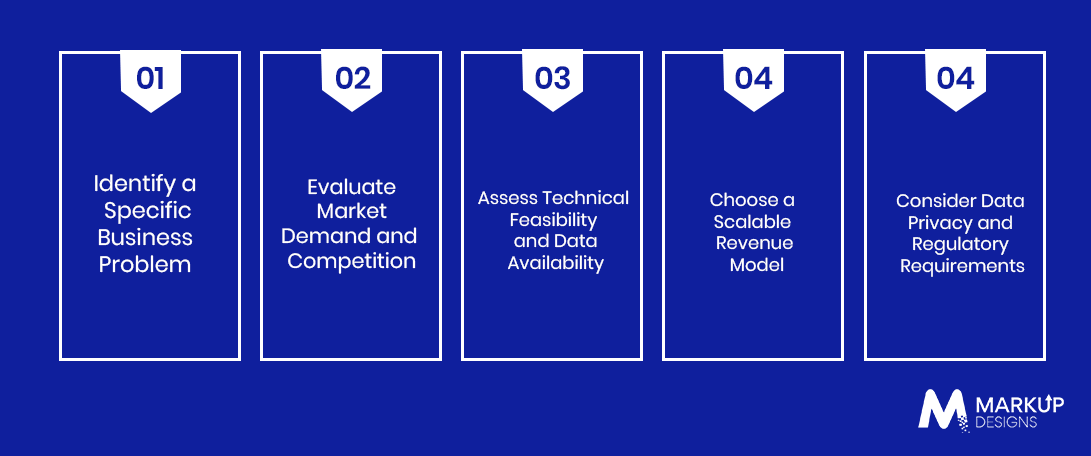
Determining the best AI agent startup idea requires more than recognizing a trending sector. Founders have to do research on the needs of the customers as well as on business chances and development needs.
Identify a Specific Business Problem
To begin with, look for the problem occurring in the business sector and having a chance to pay for solving it. Focus on activities that involve a lot of time, entail repetitive processes, and generate inefficiencies in operations. The clearer the problem definition is, the easier it becomes to create an AI agent that works.
Evaluate Market Demand and Competition
Conduct research on the potential customers of a product, the solutions already used, pricing policy, and consumer reviews. The search should focus on the segments of the market that suffer from the lack of any relevant tools. Carry out interviews, surveys, or small pilots to prove that the demand exists.
Assess Technical Feasibility and Data Availability
Make sure that you get all the necessary Enterprise AI models, data sources, API, and integrations required for building an AI agent. Consider the difficulty of tasks performed by the agent and its access to sensitive or specialized information. Consider the complexity of the tasks the agent must perform and whether it needs access to sensitive or specialized information. Starting with a focused use case can reduce development complexity and make testing easier.
Choose a Scalable Revenue Model
Select a pricing approach that reflects the value your AI agent delivers and the cost of operating it. Subscription plans may suit recurring workflows, while usage-based pricing can work for applications with variable demand. Consider customer acquisition costs, AI model usage, infrastructure expenses, and ongoing support when estimating profitability.
Consider Data Privacy and Regulatory Requirements
Determine what information the agent will collect, process, and store. Depending on the industry and target market, you may need appropriate consent mechanisms, access controls, data encryption, audit logs, and regulatory safeguards. Addressing these requirements early can reduce compliance risks and help build customer confidence.
How Much Does It Cost to Build an AI Agent Startup in 2026?
The price of starting up an AI agent project may vary depending on its complexity, technology, integration, and reliability. Thus, using AI tools to create a prototype is cheaper than creating a unique agent for complicated business workflows.
Factors Affecting AI Agent Development Costs
A number of factors influence the final budget. These are the choice of AI models, backend development, user interface design, data preparation, AI integration with third-party tools, testing, and requirements concerning safety. Besides, the cost structure may vary significantly due to hiring developers, utilizing third-party managed AI services, and creating proprietary infrastructure.
Cost Differences Between Simple and Advanced AI Agents
The cost of creating a simple AI agent that answers questions and automates simple processes is usually lower than that of creating a multi-agent system that carries out complex tasks, processes large amounts of information, and conducts extensive testing. Developing unique models, processing information in real time, and supporting high security may also add to the overall costs of implementing an AI agent.
For planning purposes, entrepreneurs should obtain estimates based on defined features and technical requirements rather than relying on a single generic development price. The initial prototype budget should also be separated from the cost of building a production-ready product.
Ongoing Infrastructure and Maintenance Costs
Development is only the initial investment. Startups must also budget for model API usage, cloud hosting, database services, monitoring, security updates, bug fixes, and technical support. Costs may increase as the number of users, tasks, and integrations grows, making ongoing cost monitoring essential.
How Do AI Agent Startups Make Money?
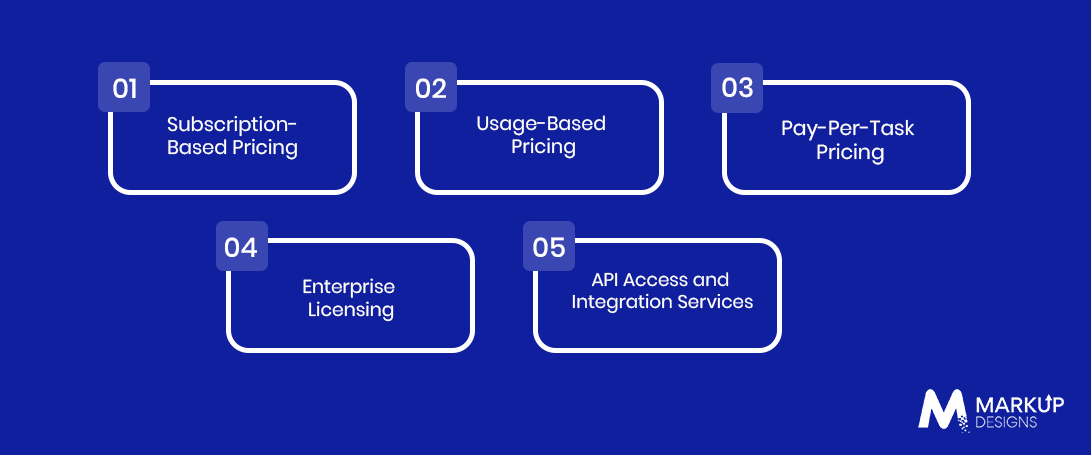
AI startup companies earn money in various ways by offering a variety of prices for the use of their AI tool and the performance of tasks. The best pricing model depends on the people involved and how often the AI tool will be used.
Subscription Pricing
Subscription pricing allows companies to gather regular revenue in the form of monthly or yearly subscriptions. Different levels of added features can be offered depending on the usage, the integrations, and the level of automation of the AI. This can be a great approach where the tool is often used by the customers.
Usage-Based Pricing
In this case, clients pay depending on how many documents were processed, requests made, minutes of connection in real time, etc. This pricing method can be appealing to customers who wish to pay for completed work; however, the company must be careful with expenses in running the AI.
Pay-Per-Task Pricing
The pay-per-task pricing model will charge clients for the successful completion of certain tasks, such as invoice processing, lead qualification, and report generation. It can be suitable when the agent delivers a clearly measurable output and customers want predictable costs per task.
Enterprise Licensing
Enterprise licensing allows startups to sell AI agent solutions to larger organizations under annual or multi-year agreements. Packages may include advanced security, dedicated support, customized workflows, administrative controls, and service-level commitments.
API Access and Integration Services
Startups can provide API access so other businesses can incorporate their AI agent capabilities into existing applications. They can also earn revenue through implementation, customization, and AI integration services, particularly when customers need the agent to work with specialized business systems.
Read Also: How Enterprise AI Agents Drive Business Automation and Operational Efficiency
How to Build and Launch an AI Agent Startup
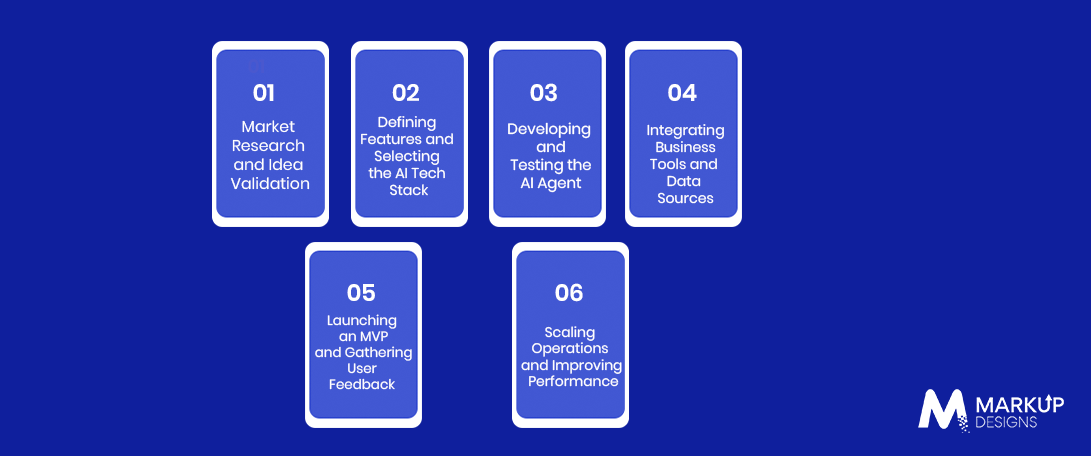
Starting an AI agent enterprise is a step-by-step procedure that verifies an idea, establishes grounds for technological viability, and checks if customers are ready to pay for the solution. A minimum viable product (MVP) is useful for entrepreneurs to check their assumptions prior to making investments in a wider development effort.
Market Research and Idea Validation
Identify the target group, the problem, and existing alternatives. Interview future customers to learn about their processes and expectations. Use the obtained results to determine whether the proposed agent solves a customer problem of significant value.
Identifying Features and Selecting AI Technology Stack
Determine core responsibilities, boundaries, and possible output of the agent. Select appropriate AI models, frameworks, databases, and APIs according to the business case, budget, delay requirements, and confidentiality of the information. Avoid functionality that is not necessary until the key functionality has been checked.
Creating and testing the AI agent
Create the first agent version describing the process. Test its ability to interpret requests, select appropriate actions, use tools correctly, and handle unexpected inputs. Evaluate accuracy, reliability, response time, operating costs, and failure recovery before making it available to customers.
Integrating Business Tools and Data Sources
Connect the agent to relevant applications, databases, or business platforms using appropriate APIs and permissions. Test how information moves between systems and establish safeguards to prevent unauthorized actions, incorrect data updates, or duplicate operations.
Launching an MVP and Gathering User Feedback
Release a limited version to a small group of target users. Track adoption, task completion rates, errors, user satisfaction, and willingness to pay. Use this feedback to prioritize improvements based on actual customer needs rather than assumptions.
Scaling Operations and Improving Performance
Once the product demonstrates demand, expand its capabilities, improve infrastructure, and strengthen monitoring and security. Optimize model usage and automate operational processes where practical. Scale gradually while ensuring that performance and operating costs remain sustainable.
Read Also: How AI Agents Are Transforming Customer Service
Challenges of Starting an AI Agent Business
Although AI agents have significant potential for utilization in the business realm, building a successful business takes considerable effort. Entrepreneurs must find solutions to these challenges during development rather than postpone resolution until after the launch of the product.
Data Privacy and Security
AI agents may have access to customer records or confidential business documents. Problems with access control, excessive data collection, or security issues may expose businesses to considerable risks. It is thus important for startups to create a system that includes all the necessary permissions and policies related to encryption, retention, and compliance.
AI Accuracy and Reliability
AI agents may make mistakes in data provision, misinterpret commands, or take wrong actions. Such failures could have serious consequences when the agent works in fields such as finance, medicine, or law. Proper testing and setting limits on agent operation with proper human supervision could decrease the risk of failures.
Integration with Existing Systems
Integrating the AI agent into obsolete software, databases, or any external application may become a huge challenge from the developmental perspective. Integration difficulties can arise due to the incompatibility of data formats, limited API access, or changes in the platform requirements. Entrepreneurs should assess integration needs before finalizing the product scope.
Customer Trust and Adoption
Businesses may hesitate to delegate important tasks to systems whose decisions or actions are difficult to verify. Startups can address this concern by explaining agent capabilities and limitations, providing activity logs, allowing human approval for sensitive actions, and demonstrating measurable results through pilot projects.
Competition and Differentiation
The AI agent market includes established software providers, specialized startups, and businesses building their own internal solutions. A generic agent may be difficult to differentiate. Entrepreneurs should focus on a specific industry, underserved workflow, strong integrations, or specialized expertise that creates a defensible advantage.
How Can Markup Designs Help You Build an AI Agent Startup?
Turning an AI agent idea into a viable product requires the right combination of technology, business strategy, and development expertise. Markup Designs helps businesses build AI-powered solutions tailored to their operational requirements, target audiences, and growth objectives.
From AI model integration and custom software development to workflow automation and third-party API integration, our team can help you develop an AI agent that addresses specific business challenges. Whether you are validating an MVP or building a scalable AI-powered platform, we focus on creating solutions aligned with your business goals.
Turn Your AI Agent Idea Into a Scalable Business
Build an AI agent solution that addresses real market needs and supports your business goals. Partner with Markup Designs to plan, develop, and scale your AI-powered product.

Conclusion
Startups with AI agents provide pointers to entrepreneurs to tackle business-specific challenges, be it automating complicated processes or making ample money. The potential applications can range from marketing and sales to healthcare, finance, education, and real estate. Ultimately, the commercial prosperity will depend on the right use case, demand for the service, costs spent on the development and maintenance, and the value delivered.
When creating an AI agent, entrepreneurs should not simply follow the trend but address a real problem. With a clear plan for developing the business, a tested technology solution, and a kind of business model to sustain itself over time, an idea about AI agents can be successfully turned into a successful working business.
FAQ
1. What are the most promising AI agent startup ideas in 2026?
Suitable niches to investigate are AI customer service, automation at sales, healthcare management, financial process automation, personalized learning, and the use of AI in overseeing inventory. At the same time, the best use case depends on market needs, demand, and cost.
2. How much does it cost to launch an AI agent startup?
The price is affected by the difficulty of the product, which AI model is chosen, the integrations, security features, and how many people work on it. A simple MVP might require little money if it relies on existing AI APIs. The entrepreneur should contemplate the expenses of hosting, using the model, testing, maintenance, and continuous assistance.
3. Do you have to write code in order to open an AI agent company?
No. An entrepreneur can check his ideas and make a prototype with the help of low-code or no-code tools. Nevertheless, one needs significant technical knowledge in order to be able to create custom integrations, improve reliability, manage security, and scale the product.
4. What industries give the best options for AI agent start-ups?
In the industries of business automation or health care, finance, marketing, education, e-commerce, real estate, or legal services, a start-up is very likely to find opportunities. It is necessary to analyze the specific industry problems, readiness of the customers to pay, regulations, and competition.
5. How do AI agent start-ups make money?
AI agent start-ups can generate income through subscriptions (monthly or yearly), paying for usage, paying per task, enterprise licensing, and API access. Some businesses also earn revenue through implementation, customization, and integration services.
Author's Perspective
AI agent startups have significant potential, but technology alone does not create a sustainable business. The strongest opportunities are likely to come from solving specific, recurring problems that existing tools do not address effectively. Entrepreneurs should validate demand, test a focused MVP, and measure customer value before expanding their products. Prioritizing reliability, data security, and a clear revenue model can help turn an AI agent concept into a viable long-term business.
Discuss Your Project NowJupinder Singh Arora
Founder and CEO
Related Posts

AI Voice Agent for Real Estate: Features, Benefits,...

How Artificial Intelligence Is Changing Mobile Game Development

How to Build Production-Ready Applications with AI Coding...
Insights Are Valuable & Execution is Priceless
You’ve read about the digital future. Now, let’s build the infrastructure to take you there. Move your strategy from the page to the product.
Design Your Solution Now
Contact Us
Schedule The Appointment At Your Convenience Date And Time.
30 Min
Web Conference
Time Zone
Indian standard time (08:30pm)

Thanks For Getting In Touch!
You’ve Taken The First Step Toward Transforming Your Digital Presence. Our Experts Will Reach Out Shortly To Take It Forward.
Launch Your Dream Project
Provide a brief overview of your project, and our specialists will evaluate your requirements. We will connect with you to explore how the right digital solutions can help you launch faster.