

In Brief
- Discover 50+ technologically innovative business concepts related to AI, fintech, the medical field, online shopping, learning, and other developing industries in Australia.
- Identify the technological trends causing business opportunities for startups in 2026.
- Analyse business concepts referring to market demands, income-generating capacity, and scalability.
- Grasp the way of assessing an idea, estimate its expenses, and reveal the interest of potential customers before the start of its creation.
- Realize how a proper technology partner may facilitate the conversion of an idea into a fully operational digital solution.
Digital economy development creates perfect opportunities for entrepreneurs to create companies solving real-world issues by means of technology, whether with artificial intelligence, medical/digital services, environmentally safe energy sources, or specific software-as-a-service products.
Nonetheless, finding an innovative business idea involves more than staying current with technological trends. Entrepreneurs must be aware of local market requirements, see where the existing services are lacking, evaluate the competitors, and select a business model that will ensure the generation of a stable and profitable income. The right blend of technology, client research, and implementation can assist in turning the initial idea into a scalable venture.
The blog presents 50+ innovative business concepts in Australia that make use of technology in the year 2026 and cover the new opportunities in different fields. We also turn to various issues that influence the costs of launching a new business, how to confirm the feasibility of the idea, and the steps associated with creating a technology-oriented business project depending on the right development strategy.
What Are the Top Technology Trends Shaping Business Opportunities in Australia in 2026?
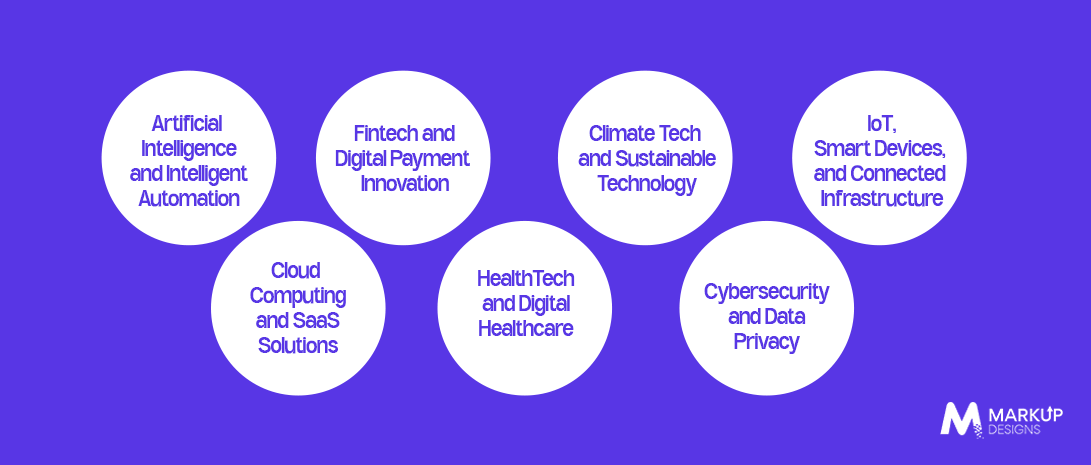
The technological environment of Australia gives birth to businesses capable of solving operational issues, improving customer experience, and providing specific digital services. By understanding these trends, entrepreneurs get valuable information for thinking of business ideas that can be implemented in reality and can be successful in the long term.
Artificial Intelligence and Intelligent Automation
Artificial Intelligence (AI) and Intelligent Automation make it easy for companies to streamline repetitive tasks, process huge volumes of data, and enhance their decision-making ability. AI-enabled applications like customer care solutions, auto-document processing tools, and predictive analysis systems provide firms with solutions across various sectors.
Young businesses can take advantage of lesser-known AI solutions tailored to meet specific business needs, e.g., automating the management of administrative chores in small firms, improving customer engagement, or analysing sales information. The best chance lies in identifying the exact problem instead of just creating an AI tool for the sake of it.
Cloud Computing and SaaS
With the advent of cloud technology, businesses can use applications, storage, and processing capabilities without the need to build huge physical infrastructure. SaaS development services has improved the situation by enabling the delivery of software through subscription.
Australian entrepreneurs can build cloud-based app solutions for project management, CRM, inventory control, accounting, and many other operations. A well-organised SaaS offering can support profitability while reducing the necessity to repeatedly adjust the product for each customer.
Fintech and Digital Payment Innovation
Digital advances, internet banking, and financial tools are helping bring about technological innovations in the financial industry. Opportunities are opening up for e-commerce because companies have a growing demand for easy payment collection options, effortless transaction verification, effective cash flow tracking, and risk assessment.
Emerging opportunities include digital payment app solutions, automated invoice systems, personal finance software, and anti-fraud solutions. However, fintech startups should consider the local regulatory framework, such as Australia’s finance and privacy rules, before launching their products.
HealthTech and Digital Healthcare
The healthcare industry uses more and more advanced technologies for better accessibility, patient information management, clinical workflows, and administration. Opportunities are presented by telehealth, remote patient monitoring, online appointments, and AI-based healthcare tools.
Startups can come up with their solutions for healthcare providers, the aged care service sector, and other segments. The key is solving a concrete healthcare problem while ensuring compliance with Australian laws.
Climate Tech and Sustainable Technology
The energy transformation occurring in Australia and the concerns of sustainable development open doors for creating technological solutions facilitating sustainability.
Potential business models include smart energy management software, carbon accounting platforms, EV charging management systems, and digital waste tracking tools. Solutions that help organisations measure their environmental impact while reducing operating costs can offer a practical commercial proposition.
Cybersecurity and Data Privacy
With the increasing use of cloud options, networked devices, and online business processes by companies, there is a growing concern regarding the safeguarding of private data and systems. In this regard, small and medium enterprises may require simple protection methods they can use while they do not have large cybersecurity teams.
Businesspersons may look for managed security dashboards, identity and access management systems, cloud security monitoring utilities, employee security training websites, etc. The products should solve real security issues and offer effectiveness since businesses cannot afford unconvincing protection statements.
IoT, Intelligent Devices, and Connected Infrastructure
IoT, with its physical devices in connection with online systems, helps businesses to gather data, track assets, and automate some work processes. Applications may vary in agriculture,
transportation, production, property management, healthcare, and energy.
Business possibilities include the creation of applications for equipment tracking, intelligent irrigation, vehicle tracking, connected building operations, etc. The combination of connected devices, cloud computing, and data analysis can help companies discover operational issues sooner and make adequate decisions.
What Are the Best Tech-Based Business Ideas in Australia for 2026?
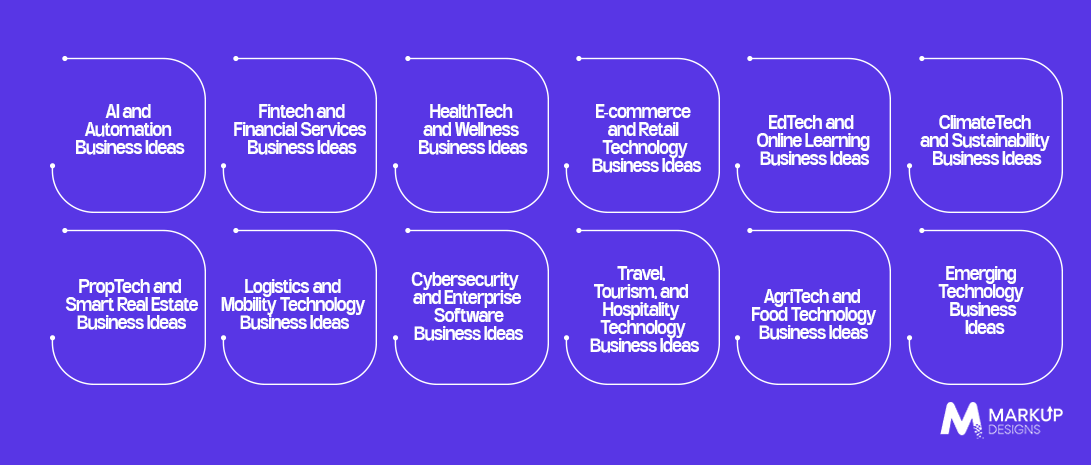
Australia’s booming digital economy offers multiple market options for businesses. There are many options entrepreneurs can pursue, considering critical market elements like needs, investments, and technology.
AI and Automation Business Ideas
AI-enabled devices are beneficial for reducing manual labor, improving the user experience, and rapid decision-making in Australia. The different business opportunities include AI chatbots, workflow automation tools, predictive analytics, and AI marketing tools, among others.
Fintech and Financial Services Business Ideas
Digital financial services do provide a range of opportunities for startups targeting both people and businesses. Some of the ideas are digital payments, personal finance management, fraud detection systems, digital lending solutions, and accounting tools.
HealthTech and Wellness Business Ideas
Digital health services can help gain better access to services and manage medical issues. Potential businesses include telemedicine app development services, remote patient monitoring, online mental health services, and health management software.
E-commerce and Retail Technology Business Ideas
Technology is applied in retail for better personalization of shopping experiences and improved operational efficiency. Business ideas include niche retail marketplaces, AI-powered shopping technology, virtual trial tools, and inventory management tools.
EdTech and Online Learning Business Ideas
Online education opens the door to providing education with enhanced flexibility and accessibility. Entrepreneurs can create AI-powered learning platforms, marketplaces for online courses, corporate training software, and language learning applications.
ClimateTech and Sustainability Business Ideas
Australia is focused on energy efficiency and environmental sustainability in technology and offers a wide range of products to be developed, such as smart energy management systems, EV charging software, carbon footprint monitoring platforms, as well as digital waste management technology.
PropTech and Smart Real Estate Business Ideas
Property tech makes real estate operations easier and includes opportunities like property management apps, AI-based property valuation tools, virtual tours of property, and smart home solutions.
Logistics and Mobility Technology Business Ideas
Technology can help logistics companies operate more efficiently and increase supply chain transparency. Possible solutions may include fleet tracking software, route optimization apps, last-mile delivery tools, and supply chain analytics.
Cybersecurity and Enterprise Software Business Ideas
More and more companies today turn to computerized systems, making it essential for them to have tools for data protection and business operations management. Business opportunities include cybersecurity monitoring, identity management, cloud security solutions, customer relationship management (CRM), and industry-specific enterprise resource planning (ERP) software.
Travel, Tourism, and Hospitality Technology Business Ideas
Technology has the potential to aid in the delivery of personalised offerings and ease the booking experience in terms of travel and hospitality in Australia. Some of the possible startup ideas are artificial intelligence travel planners, tour booking systems, hotel management programs, and digital concierge solutions.
AgriTech and Food Technology Business Ideas
The use of technology can enhance agricultural productivity, resource management, and food chain processes. Possible startup options include precision farming tools, intelligent irrigation systems, direct-to-consumer marketplaces, food waste monitoring solutions, and livestock monitoring mechanisms.
Emerging Technology Business Ideas
Emerging technologies can be used to launch products or services across a variety of industries. For instance, entrepreneurs can explore the possibility of blockchain-enabled supply chain automation software solutions, Internet of Things (IoT) asset monitoring systems, digital reality training platforms, drone management software, and specialized mobile applications for a particular sphere.
How Much Does It Cost to Start a Technology-Based Business in Australia?
How much one needs to invest to start a technology-based company in Australia depends on the intricacy of the product, features that need to be implemented, the development model selected, as well as the enterprise software solution with complex integrations.
Beyond development, entrepreneurs should budget for testing, infrastructure, security, marketing, and maintenance. Estimating these expenses early helps establish a realistic budget and reduces the risk of running out of funds before the business gains traction.
Factors That Influence Technology Startup Costs
Several factors determine the initial investment required to launch a technology business:
- Product complexity: Basic applications cost less to build than platforms with AI capabilities, real-time processing, or multiple user roles.
- Features and integrations: Payment gateways, third-party APIs, analytics, and legacy system integrations can increase development effort.
- UI/UX design: Research, prototyping, accessibility, and user testing influence the design budget.
- Development team: Costs vary depending on whether you hire an in-house team, freelancers, or an external development partner.
- Security and compliance: Industries such as healthcare and financial services may require additional controls, testing, and compliance work.
- Time to market: Tight deadlines may require additional developers or parallel workstreams, increasing costs.
Estimated Development Costs by Business Type
The following figures are indicative planning estimates in Australian dollars (AUD), not fixed market rates. Actual costs depend on the scope, integrations, technical requirements, and development team’s location.
| Business type | Estimated development cost |
| Business website or simple web portal | AUD 5,000–20,000 |
| MVP for a SaaS product | AUD 15,000–60,000 |
| Mobile application | AUD 25,000–100,000+ |
| E-commerce platform | AUD 10,000–50,000+ |
| AI-powered business application | AUD 30,000–150,000+ |
| Complex enterprise software | AUD 80,000–250,000+ |
These ranges are broad estimates for initial development. They may exclude GST, third-party licences, hardware, regulatory assessments, and post-launch operations. A product with complex AI infrastructure or stringent security requirements can exceed the ranges shown.
In-House Development vs Outsourcing
Choosing between in-house development and outsourcing affects both the initial budget and long-term operating costs.
- In-house development: Gives you direct control over priorities, product knowledge, and daily collaboration. However, salaries, recruitment, employee benefits, and team management can make it expensive for early-stage startups.
- Outsourcing: Allows you to access developers, designers, testers, and specialised technical expertise without building a full internal team. The main considerations are communication, project governance, delivery quality, and ownership of the source code.
- Hybrid development: Combines an internal product owner or technical lead with an external development team. This can help startups retain strategic control while limiting fixed staffing costs.
The right choice depends on available funding, the complexity of the product, and whether development will remain a core, ongoing business function.
Ongoing Maintenance, Hosting, and Scaling Costs
Launching the product is only the beginning. Technology businesses must also budget for recurring expenses to keep their platforms secure, reliable, and competitive.
- Hosting and cloud infrastructure: Costs depend on traffic, storage, computing requirements, and architecture.
- Maintenance and updates: Bug fixes, operating system compatibility, dependency updates, and feature improvements require ongoing work.
- Security and monitoring: Access controls, backups, vulnerability assessments, and incident monitoring help protect the product and its users.
- Third-party services: Payment processing, APIs, AI model usage, analytics, and software licences may carry recurring fees.
- Customer acquisition and support: Marketing, onboarding, and customer service expenses become important as the user base grows.
Startups should plan for these costs before launch rather than treating them as unexpected expenses. A scalable architecture and a clearly prioritised development roadmap can help manage spending as demand increases.
How to Choose the Right Technology Business Idea for the Australian Market?
To select a technology business idea, it is necessary to do more than just detect a trending area of business. The opportunity should solve an actual customer requirement, present a feasible business model, and be able to develop according to the resources you have. Thus, the entrepreneurs should check demand before putting much into product creation.
Identify a Specific Market Problem
The first step is to find a problem that customers or companies are facing routinely. For instance, struggling with inventory management may be stressful for small companies, healthcare clinics may be interested in a more convenient system of appointments, or logistics companies might be looking for a more precise system of control over their vehicles.
Having an accurate market problem makes it easier to work on its solution and locate your audience.
Research Competitors and Target Customers
Learn more about existing products, their prices, customers’ reviews, and characteristics. This will enable you to notice shortcomings of the existing products and find ways to position your product as the solution that stands out from competitors. Thus, it is important to use information relevant to doing business in Australia, the requirements of the market, and taking into account the laws.
Evaluate Market Demand and Revenue Potential
Evaluate how many prospective clients experience the problem and if they would pay for a resolution. Research types of revenue models like subscriptions, one-time licenses, transaction costs, usage-based pricing, and service contracts. You should also consider customer acquisition costs, regular operating expenses, as well as time to reach sustainable income. Just having a potentially large market is not enough to produce a successful business.
Assess Technical Feasibility and Required Investment
Understand what technologies, integrations, infrastructure, and technical abilities are needed to create the product. See whether existing platforms can use necessary features or whether custom development is needed. Create an initial budget for design, development, testing, launching, and maintenance. This will help to understand whether the idea is doable with your present resources or requires outside funding and technical ability.
Validate the Idea With a Minimum Viable Product (MVP)
A minimum viable product (MVP) is the first version of a product that has only essential features that can show its value to real customers. Instead of investing in a whole application, launch the simplest version and see what customers say. Use those findings to prioritise improvements and determine whether further investment is justified.
How to Start and Scale a Technology Business in Australia?
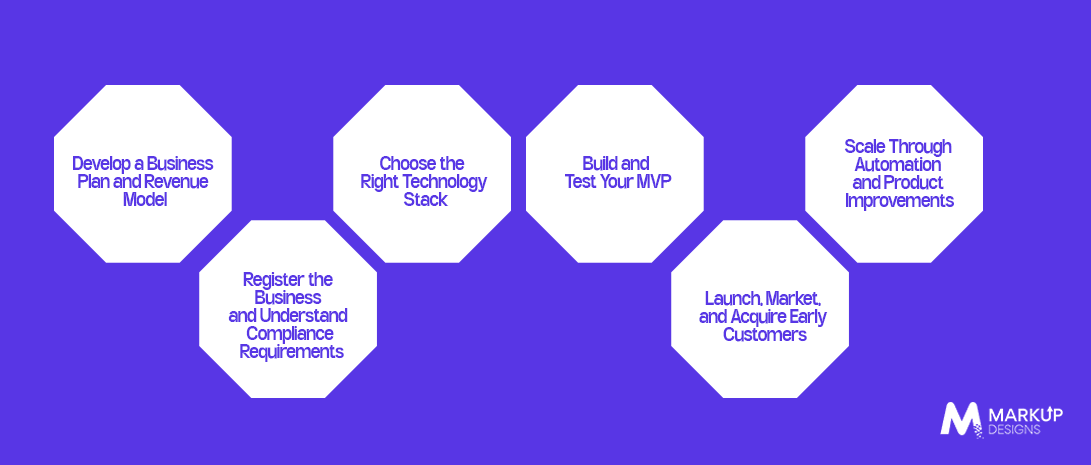
When launching a technology venture, the goal is to convert a well-established opportunity into a product as well as establish maintenance processes around it. A good methodology enables businesspeople to have a grasp of finances and minimize risks during the product development process.
Develop a Business Plan and Revenue Model
Identify the potential customers, major challenges their problems present, the benefits brought by the product, competitors on the market, pricing processes, and methods of reaching the target audience. The business plan should also contain necessary start-up finances, expenditures, expected revenues, and as many indicators as possible.
Identify a revenue model that matches the product and its functions. For example, the model for a SaaS product is based on monthly subscriptions, while companies operating as booking platforms usually charge commissions based on every completed transaction.
Register the Business and Understand Compliance Requirements
Pick the most appropriate business structure and familiarize yourself with the registration processes and taxation throughout Australia. Depending on the business, this may involve obtaining an Australian Business Number (ABN), registering a business name, and registering for applicable taxes.
It is important for technology companies to think about their privacy, consumer protection, intellectual property, cybersecurity, and regulatory obligations. For official recommendations, check the business registration and licensing section on the Australian government website.
Choose the Right Technology Stack
Pick programming languages, frameworks, databases, cloud services, and third-party tools based on the needs of the product, not short-lived trends.
Choose a technology stack that has a high potential for security, maintainability, integration capacity, performance, and growth in the future. For early-stage startups, existing technologies and managed cloud services can facilitate the process of development and remove unnecessary complexity.
Build and Test Your MVP
Convert the validated needs into the finished product. Start with the necessary features, create an interface, implement core functions, and connect the needed services.
Before the launch, you need to undergo functional and usability testing, and run performance tests as well as security tests, which are appropriate to the product type. Testing the product on a small group of audience can help to discover the usability flaws and technical troubles before the launch.
Launch, Market, and Acquire Early Customers
Every product that becomes successful must have a definite way of reaching its consumers. Create an effective launch plan that makes use of search engine optimization, content marketing, PPC campaigns, partner relations, cross-industry networks, and outreach techniques.
Keep track of data that matters, such as costs for customer acquisition, conversion rates, and the number of customers, as well as customer retention and periodic revenue, depending on the type of business you run. This gives good opportunities for you to figure out what marketing techniques worked and which improvements to your product turned out to be successful.
Scale Through Automation and Product Improvements
As soon as the product becomes popular, make the necessary infrastructure improvements, automate repetitive processes, and add new features according to user experience.
Expansion can also mean coming up with new variants of your pricing policy, exploring new market segments, improving efficiency, or integrating into other business systems. This stage is considered to be critical since changes should be based on verified demand and readiness of growing systems.
How Can Markup Designs Help Turn Your Technology Business Idea Into Reality?
Developing a digital product that is market-viable calls for the application of technical skills, planning, and implementation capabilities. Markup designs enables organizations to create technology products to meet business goals, which are based on operational needs and client expectations. Markup designs assists companies across the entire process of development thanks to its skills in software development, mobile application development, artificial intelligence development, web development, and corporate solutions.
The process starts by identifying the issues faced by the organization, determining the key functionality required, and identifying the tools suitable for completing the task. The team can provide the support needed in planning and designing the minimum viable product, testing it, and making plans for its future development.
Thus, the partners selected to work in the development partnership should be guided by the technical capacity of the partner, the established communication processes and the practices of the quality assurance organization, and the capabilities in post-launch support.
Ready to Develop Your Next Big Tech Idea?
Get your idea transformed into a successful digital product with Markup Designs.

Conclusion
The fast-changing Australian business model has no shortage of possibilities that lie in the fields of AI, fintech, healthcare, e-commerce, sustainable development, and enterprise software services. Nevertheless, a successful idea alone cannot create a workable business. It is essential for entrepreneurs to check the need for the product placed on the market, determine an appropriate revenue model, control the development expenses, as well as produce a product capable of being updated.
A proper plan for the minimum viable product, along with a carefully chosen technology stack and a rational development strategy, might transform a simple idea into a flourishing business. If entrepreneurs apply the proper development approach and choose a good technical partner, then they might turn a simple idea into a good business.
FAQ
1. What are the most prosperous technology business ideas in Australia in 2026?
Software based on AI and other high technologies, SaaS platforms, fintech solutions, cybersecurity services, HealthTech applications, and special e-commerce software can bring considerable income. However, profitability is based on various factors such as customer interest, competitors, pricing, operational costs, and client retention strategies.
2. What tech venture can I begin in Australia with a minimal budget?
Budget-limited entrepreneurs may explore niche SaaS solutions and website design services, workflow automation powered by AI, digital marketing solutions, and targeted online platforms. A focus on a specific service or MVP could enable brands to ascertain demand before launching grand projects.
3. Is Australia a viable country for tech startups?
Australia is considered a potential country for tech startups when it comes to digitising businesses, offering financial services, and working in healthcare, farming, and sustainability sectors. At the same time, entrepreneurs need to study the size of their target market, competitors, potential costs of acquiring customers, and governing regulations before committing to any venture.
4. How much does it take to create a tech startup in Australia?
Initial costs may vary depending on the level of complexity, from about AUD 5,000 for the simplest websites or portals to over AUD 100,000 for extremely sophisticated applications or specialised platforms. The final price will depend on the complexity of the product, necessary integrations, and safety requirements, as well as the location of the developers.
5. What technologies should Australian startups focus on?
Using the right technologies depends on the business model and customer needs. Some of the most useful technologies are AI and automation, cloud computing, cybersecurity, data analytics, mobile apps, and IoT; these technologies are effective when they solve a particular issue. Startups should focus on achieving good business results instead of adopting technologies simply because they are popular.
Author's Perspective
For Australian entrepreneurs, 2026 will present a big opportunity to use technology not just to adopt it, but to solve specific issues as well. AI, SaaS, mobile apps and automation have great potential, but their success will depend on demand, strong revenue generation model and ability to deliver value. It is necessary to test the business idea before investing in a product, so an MVP should be built and customer feedback should be taken into consideration during product development.
Discuss Your Project NowJupinder Singh Arora
Founder and CEO
Related Posts
Business Benefits of Hiring an IT Consulting Company...
Insights Are Valuable & Execution is Priceless
You’ve read about the digital future. Now, let’s build the infrastructure to take you there. Move your strategy from the page to the product.
Design Your Solution Now
Contact Us
Schedule The Appointment At Your Convenience Date And Time.
30 Min
Web Conference
Time Zone
Indian standard time (08:30pm)

Thanks For Getting In Touch!
You’ve Taken The First Step Toward Transforming Your Digital Presence. Our Experts Will Reach Out Shortly To Take It Forward.
Launch Your Dream Project
Provide a brief overview of your project, and our specialists will evaluate your requirements. We will connect with you to explore how the right digital solutions can help you launch faster.