

In Brief
- AI technology is emerging as an integral part of Australia’s FinTech industry, providing organizations with ways to better detect fraud, assess risks, serve customers, stay compliant, forecast finances, and optimize operations.
- Typical examples of AI implementation in the FinTech domain are fraud detection, credit scoring, personalized FinTech services, AI-based customer support, accounting automation, wealth management, KYC, insurance claims processing, and cash flow forecasting.
- AI technology could enable FinTech organizations to be more productive and efficient in decision-making, cutting expenses, managing risks, personalizing services for customers, automating operations, and generally increasing productivity.
- For successful AI adoption, it is important to have reliable data, security architecture, regulatory compliance, integration with legacy systems, explainable AI technology, and cybersecurity. It makes sense to start from a selected application area and prove the concept via validation. Monitoring is another crucial aspect.
- The price for implementing AI FinTech technology in Australia could range from about AUD 70,000 to 700,000+.
AI is revolutionizing the way FinTech businesses work, serve their clients, and make decisions. Today in Australia, FinTech enterprises are implementing AI to process high volumes of data, detect anomalies, automate repetitive operations, and offer a customized financial experience. With the development of digital payments, online banking, and embedded financial services, AI is going to become an integral part of developing financial solutions that will be smart and fast.
For the Australian FinTech business, there are many more prospects than just automation of routine operations. AI can assist with risk management, fraud detection, regulation, and help professionals to make the right financial decisions. On the other hand, there are some aspects that businesses need to take into account when it comes to data privacy, security, compliance, and responsible AI adoption.
This blog post will cover the main AI applications in FinTech Australia, the benefits of the implementation, challenges that businesses may face, implementation strategy, development costs, and future trends in this area.
Why is AI Becoming Important for FinTech in Australia?
The FinTech industry in Australia is increasingly moving towards being more digital, data-centric, and customer-focused. The amount of data generated through customer and transaction information makes traditional solutions less efficient when it comes to generating insights quickly and accurately. In such a scenario, the application of AI becomes very relevant.
Some of the prominent factors leading to the adoption of AI by Australian FinTech firms include:
- Increase in digital transactions: Increasing use of online payments, digital banking, and mobile financial services.
- Increased fraud risks: Real-time transaction analysis to detect anomalies and flag fraud cases.
- Enhanced customer expectations: Enhanced customer demands for quick responses, personalized recommendations, and better digital experiences.
- Financial decision-making: Using datasets to aid in credit scoring, risk management, forecasting, and investments.
- Efficiency in operations: Repetitive tasks can be automated, such as reconciliation, customer support, reporting, documentation, etc.
- Higher compliance requirements: Compliance monitoring, reporting, and other compliance-related processes, along with the handling of financial datasets.
How is AI Used in the Australian FinTech Industry?
AI has been deployed throughout different components of the FinTech ecosystem, which includes customer service, fraud detection, financial analysis, and compliance management. Instead of replacing traditional finance processes, AI can be deployed in parallel with them to automate and support their work.
Some of the key AI technologies used in Australian FinTech include:
- Machine learning: This technology allows analysing data, identifying patterns, and improving risk and fraud detection.
- Predictive analytics: This technology allows predicting the behaviour of clients and making forecasts related to cash flows and credit risks, as well as market trends.
- Generative AI: Assists in customer interactions, processing documents, financial reporting, and business process management.
- AI automation: Allows minimizing human intervention in the process of reconciliation, onboarding, compliance checking, and claims processing.
- Computer vision: Assists in identity verification, document verification, and biometric authentication.
- Agentic AI: Allows managing multi-step financial processes independently with minimal human intervention.
Together, these technologies help Australian FinTech businesses build faster, smarter, and more responsive financial services.
Key Benefits of AI in FinTech for Australian Businesses
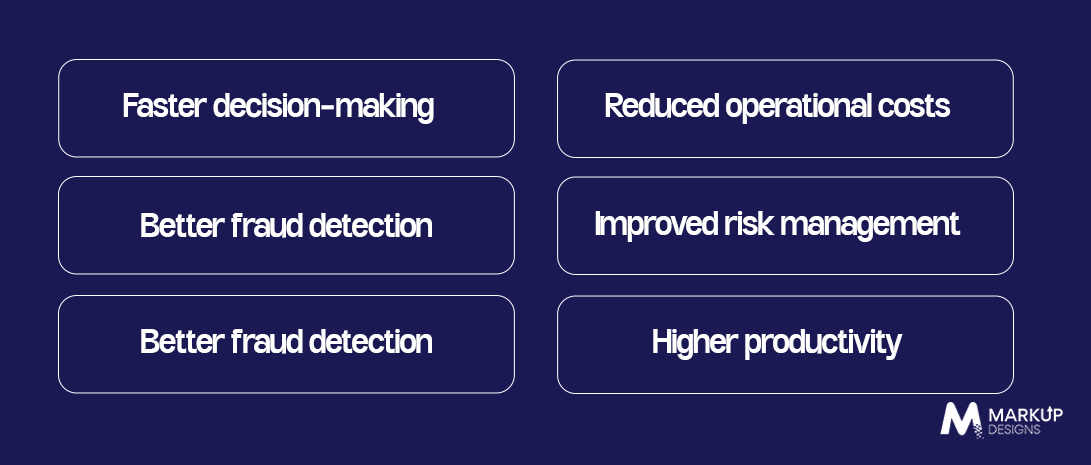
The practical application of artificial intelligence (AI) technology can have great benefits for FinTech businesses through enhanced management of their financial operations and serving their customers in the best way possible. When used with appropriate data, security, and AI governance, it can enable businesses to perform better and make informed decisions.
Faster decision-making
Artificial intelligence technology can analyze big data sets in a short time and offer valuable insights on financial decisions.
Better fraud detection
Through real-time analytics, the identification of suspicious transactions will be easier.
Reduced operational costs
Automation will minimize manual effort in repetitive financial operations.
Personalised customer experiences
With the help of AI technology, businesses will provide more relevant products and services.
Improved risk management
Predictive models will help in identifying credit, financial, and operational risks early enough.
Higher productivity
AI tools will perform routine tasks, enabling staff to engage in complex tasks.
Top AI Use Cases in FinTech Australia
AI technology is no longer constrained to experiments in the finance industry. In Australia, FinTech companies are implementing it in their operations for customer-related services, risk management, compliance, and even operations management. The most useful applications of AI include:
- AI-driven Fraud Prevention
AI is capable of monitoring transactions in real-time, spotting unusual patterns, and alerting about the possibility of fraud occurring.
- Credit Scoring and Lending
Machine Learning can assess the financial background, transactions, and any other data to make a decision on lending.
- Regulatory Compliance
AI is capable of automating the process of compliance assessment, financial activities tracking, documentation organisation, and assisting teams in identifying compliance issues.
- Personalisation of Financial Services
FinTech platforms may leverage AI to learn about customer behavior and provide recommendations on financial products or services.
- AI-driven Customer Support
AI-powered chatbots can answer customers’ frequently asked questions, work round-the-clock, and resolve financial inquiries.
- Automated Accounting and Reconciliation
AI has the ability to match transactions, detect discrepancies, categorize finances, and automate the process of reconciliation.
- Wealth Management and Superannuation
AI can analyze financial data and conditions in the market to provide investment insights and wealth management services.
- KYC and Digital Identity Verification
AI-driven verification through the use of documents and biometrics can enable FinTech companies to enhance the customer onboarding process and perform better identity checks.
- Insurance Claims Processing
AI can analyze claim data provided through various documents, find discrepancies, and help insurance companies improve claims processing.
- Predictive Cash Flow Management
AI can analyze historical and real-time data to predict cash flow and manage treasury decisions.
Build Smarter FinTech Solutions with AI
AI can help your FinTech business improve efficiency, reduce risk, and create better customer experiences. Ready to turn your AI idea into a secure, scalable solution?

Challenges of Implementing AI in Australian FinTech
While AI offers significant opportunities, implementing it in FinTech requires careful planning. Financial businesses work with sensitive data and strict regulatory requirements, so AI solutions need to be secure, reliable, and transparent.
- Data Quality: Bad, incomplete, or fragmented data can impact the accuracy and results of the use of AI.
- Legacy Systems: Old financial systems could make AI implementation difficult.
- Data Privacy: The firm should ensure that all sensitive data is well protected from the start to the end of the process.
- Regulatory Compliance: AI services and solutions should comply with the existing financial and privacy laws in Australia.
- AI Bias and Explainability: It is essential that the business understands how AI makes important decisions regarding money.
- Cybersecurity Risks: New cybersecurity threats may arise from using AI solutions; thus, good access control, monitoring, and testing are vital.
Read Also: FinTech Cybersecurity Guide: Essential Controls for Building Secure Financial Applications
How to Implement AI in a FinTech Business
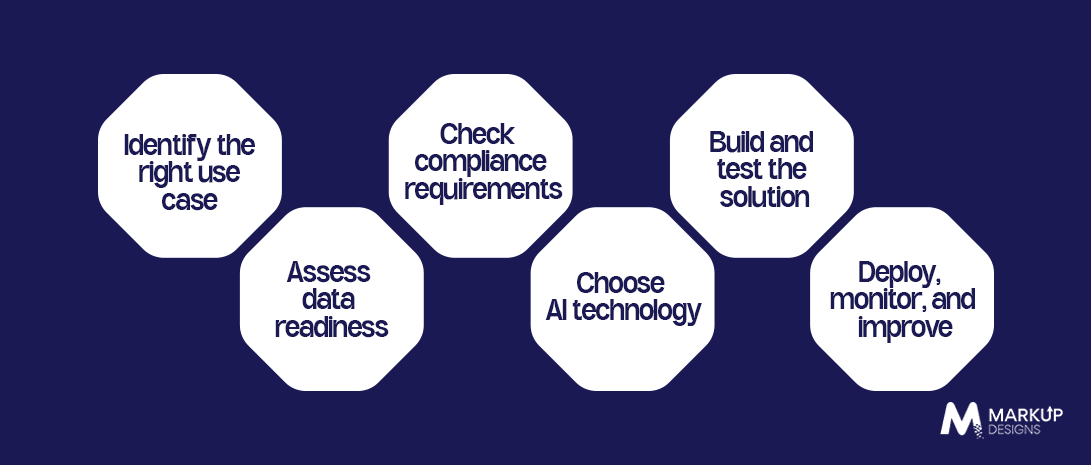
However, successful implementation of AI involves much more than simply selecting an appropriate AI model. It also includes having a good use case, access to quality data, proper security architecture, and governance from the start. The following process may help in the practical implementation of AI:
Identify the right use case
Consider a business case where AI can provide measurable value through fraud detection, customer service, financial forecasts, and so forth.
Assess data readiness
Evaluate the quality, availability, structure, and security of data necessary for training or operation of the AI model.
Check compliance requirements
Understand the privacy, financial, security, and regulatory requirements in advance.
Choose AI technology
Choose the type of artificial intelligence you will be using: machine learning, generative AI, predictive analytics, computer vision, AI agents, and so forth.
Build and test the solution
Build and test a prototype of the solution to evaluate its performance, security, accuracy, and business value.
Deploy, monitor, and improve
Integrate the solution with existing systems, monitor AI performance, and continuously improve the models as data and business needs change.
How Much Does It Cost to Implement AI in FinTech in Australia?
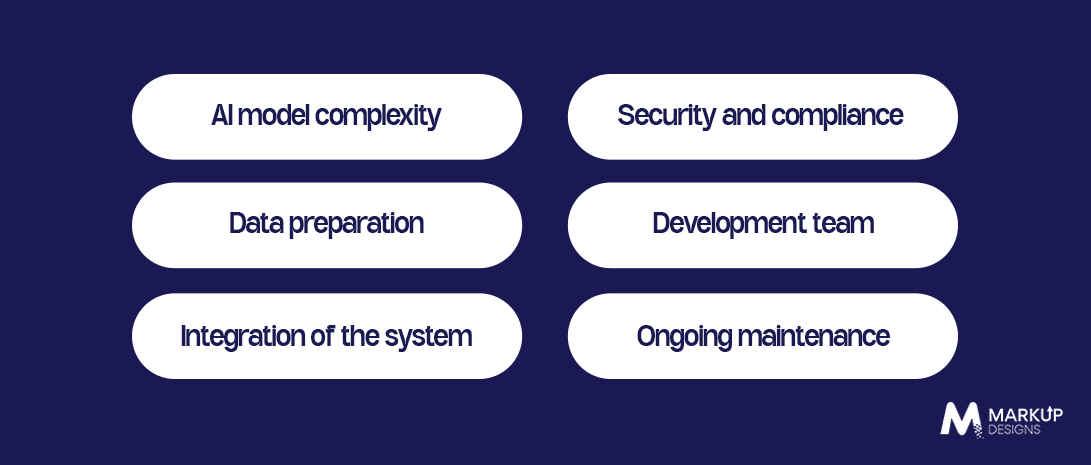
The cost of AI deployment in FinTech Australia is dependent on how complicated the solution is, the amount of data required, integrations, security requirements, and the extent of customization. A basic AI prototype will be much cheaper to implement compared to an enterprise-ready solution that connects to several financial systems.
As a general estimate:
| AI FinTech Solution | Estimated Cost in Australia |
| Basic AI Proof of Concept | AUD 70,000–200,000 |
| Mid-Level AI Application | AUD 200,000–400,000 |
| Enterprise AI Solution | AUD 400,000–700,000+ |
Several factors can influence the final development cost:
- AI model complexity: Predictive or generative AI demands greater effort for its development and testing.
- Data preparation: Cleansing, structuring, and integration of financial data can be costly.
- Integration of the system: The connection of the AI system with banking, payments, CRM, or accounting systems is costly, too.
- Security and compliance: Financial products demand robust security controls and testing.
- Development team: The price depends on the level of expertise and geolocation of the development team.
- Ongoing maintenance: AI models require monitoring, updates, infrastructure, and performance optimisation.
For an accurate estimate, businesses should first define the use case, data requirements, integrations, and expected outcomes.
Read Also: AI in FinTech: Key Use Cases, Adoption Trends, and Growth Strategies
Why Choose Markup Designs for AI FinTech Solutions?
Building an AI-powered FinTech solution necessitates an excellent blend of AI know-how, financial technology knowledge, secure software development, and scalable architecture. Markup Designs assists enterprises in transforming AI-driven ideas into working solutions tailored specifically to their needs.
- AI development expertise: Develop AI solutions utilizing machine learning, generative AI, predictive analytics, and AI agents.
- Custom FinTech solutions: Create AI solutions tailored to your objectives, processes, and customers’ needs.
- Secure architecture: Concentrate on securing data, controlling access, integrating securely, and scalable infrastructure.
- Data and systems integration: Integrate your AI solutions with current financial platforms, APIs, databases, and systems.
- End-to-end development: Provide end-to-end services throughout the AI development process from AI strategy to deployment and optimization.
- Scalable solutions: Design scalable AI systems ready for growth as your number of customers, data volume, and needs evolve.
Turn Your FinTech Idea into an AI Solution
Have a FinTech idea that could benefit from AI? Let’s discuss your requirements and build a secure, scalable solution that delivers measurable value.

Conclusion
AI is slowly emerging as one of the key players in the ever-developing FinTech space in Australia. The application of AI could potentially benefit organizations in areas such as fraud detection, credit assessment, customer service, compliance, financial forecasting, etc., while increasing efficiency and enhancing the experience.
Nevertheless, to apply AI successfully, one has to consider certain aspects other than implementing innovative solutions. Namely, there needs to be appropriate data, security architecture, awareness of regulations, and regular monitoring.
With new technologies like generative AI, predictive analytics, and agentic AI maturing, Australian FinTech companies have more options for automation and smarter decisions when it comes to finances.
Those who are able to find practical applications and proper outcomes of using AI will be able to leverage AI as an opportunity for growth rather than mere technological improvement.
FAQs
1. How is AI being used in FinTech in Australia?
AI is being used for fraud detection, credit scoring, customer support, compliance, financial forecasting, wealth management, KYC, reconciliation, and other financial processes.
2. What are the main benefits of AI in FinTech?
The key benefits include faster decision-making, lower operational costs, improved fraud detection, personalised customer experiences, better risk management, and higher productivity.
3. How much does it cost to implement AI in FinTech in Australia?
AI FinTech development can range from around AUD 70,000 for a basic proof of concept to AUD 700,000+ for an enterprise-grade solution, depending on complexity, integrations, data, security, and compliance requirements.
4. What are the biggest challenges of AI adoption in FinTech?
Common challenges include data quality, legacy system integration, privacy, cybersecurity, regulatory compliance, AI bias, and explainability.
5. How long does it take to implement an AI FinTech solution?
The timeline depends on the project scope. A proof of concept may take several weeks, while a complex enterprise AI solution can require several months for development, integration, testing, and deployment.
Author's Perspective
AI is moving from an emerging technology to a practical tool for solving real challenges across the FinTech industry. For Australian businesses, the biggest opportunity lies in identifying where AI can create measurable value rather than adopting it simply because it is a growing technology.
A clear use case, reliable data, strong security, and responsible implementation can help FinTech companies build AI solutions that support long-term efficiency, innovation, and customer value.
Discuss Your Project NowAjit Kumar Jha
VP - Business Operations
Related Posts

How Much Does It Cost to Develop a...

How Much Does It Cost to Develop a...

How to Build a FinTech App in the...
Insights Are Valuable & Execution is Priceless
You’ve read about the digital future. Now, let’s build the infrastructure to take you there. Move your strategy from the page to the product.
Design Your Solution Now
Contact Us
Schedule The Appointment At Your Convenience Date And Time.
30 Min
Web Conference
Time Zone
Indian standard time (08:30pm)

Thanks For Getting In Touch!
You’ve Taken The First Step Toward Transforming Your Digital Presence. Our Experts Will Reach Out Shortly To Take It Forward.
Launch Your Dream Project
Provide a brief overview of your project, and our specialists will evaluate your requirements. We will connect with you to explore how the right digital solutions can help you launch faster.